
Table of Contents
Humans did not evolve inside glass towers, plastic boxes, or sterile white rooms. We evolved outdoors. Our sensory systems, our nervous systems, and our visual processing centers were built across millions of years to understand natural textures, changing daylight, plant curves, and living spaces.
Yet when we look at modern web development, especially within digital stores, we find an endless landscape of rigid grey boxes, blinding white backgrounds, harsh rectangular buttons, and jarring popups. High-end retail cannot thrive in a digital concrete bunker. Modern shoppers who look for premium goods expect beauty, craft, comfort, and calm. This is where we must look at how nature can reshape digital architecture.
In this article, we will examine how living design concepts fit into high-end retail platforms. When you run an online storefront, every detail changes how a shopper feels. By using the natural patterns found in plants, landscapes, and daylight, luxury e-commerce platforms can create deeply memorable, calm, and profitable spaces.
Translating E.O. Wilson’s Biophilia to Digital Architecture
In 1984, the biologist Edward O. Wilson popularized the term biophilia. He described it as the innate human tendency to seek connections with nature and other forms of life. Wilson showed that humans have an inherited biological need to be around natural environments. When we are separated from nature, our bodies show higher levels of stress. Our hearts beat faster, our blood pressure rises, and our minds tire quickly.
When you study environmental psychology and the patterns defined by researchers like Stephen Kellert, you see that nature is not just a visual decoration. Nature is an entire operating system. It provides visual order, soft sounds, changing light, and spatial variety. In the physical world, architects have used these rules for decades. They add indoor courtyards, living green walls, natural cross-ventilation, and curved timber beams to luxury retail boutiques.
In web development, we can bring these exact biological principles into code. When someone enters a store online, they use their eyes and ears to explore an environment. If an online shop uses harsh contrasts and rigid layouts, the visitor feels mental fatigue within minutes. By bringing natural design into a site, luxury e-commerce storefronts become restorative places. A shopper feels relaxed instead of overwhelmed, which directly elevates the digital identity of luxury e-commerce.
The Business and Conversion Case for Living Systems Online
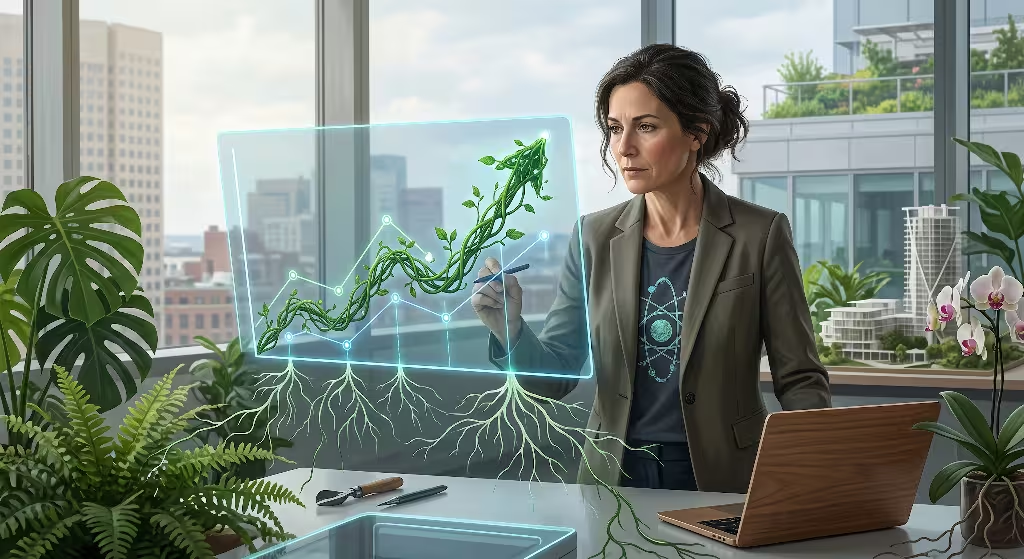
Many developers and retail managers think natural design is purely an artistic choice. From a technical and analytical standpoint, this is incorrect. The human brain consumes a massive amount of metabolic energy when processing visual information. When a shopper browses an unorganized catalog filled with flat, high-contrast boxes, their cognitive load spikes.
Cognitive load is the total mental effort used by your working memory. When cognitive load gets too high, people experience decision fatigue. In retail, decision fatigue shows up as high bounce rates, short browsing times, and abandoned shopping carts. When visitors feel exhausted, they simply close the browser tab.
Natural patterns work because the human brain processes them fluently and effortlessly. Neuroscientists call this visual fluency. When a layout mirrors the visual structure of nature, the brain uses less energy to parse information. For any luxury e-commerce brand, lower cognitive strain means shoppers remain relaxed and engaged.
When visitors feel calm, their dwell time increases. In digital commerce, dwell time is closely linked to brand trust and emotional connection. High-value purchases are rarely impulse decisions made in seconds. A client looking for bespoke jewelry, fine timepieces, or couture fashion needs time to admire the craft. By lowering visual stress, luxury e-commerce websites invite customers to linger, explore product stories, and complete transactions with confidence.
Fractal Geometries and Visual Fluency
Look at a fern frond, a Romanesco broccoli, or the branching patterns of an oak tree. You will notice that a small leaf has the same basic shape as the entire branch, which in turn shares the form of the whole tree. In mathematics and geometry, this property is known as statistical self-similarity, or a fractal.
Physicists and psychologists have discovered that the human eye is tuned to find comfort in mid-range fractals. When people look at patterns with a fractal dimension between 1.3 and 1.5, their brains produce alpha waves. Alpha waves are electrical brain frequencies associated with a relaxed, alert mental state. Looking at these patterns reduces physiological stress by as much as sixty percent.
Modern web design often ignores this science, using rigid grids where every box has identical pixel dimensions. We can break away from this artificial stiffness by building responsive layouts based on natural mathematical ratios, such as the Golden Ratio or Fibonacci progressions.
In luxury e-commerce layouts, content blocks, product images, and typography scales can expand using these organic proportions. When a product grid flows according to natural scaling rather than hard mechanical divisions, the page feels balanced and organic. The customer does not consciously think about mathematics, but their eye moves across the catalog with ease. This visual rhythm makes browsing luxury e-commerce catalogs feel as effortless as a walk through an open meadow.
Curvilinear Contours and Biomorphic Forms
In the wild, sharp ninety-degree angles are extremely rare. You see them in crystalline structures like salt minerals, but almost never in living organisms. Living tissue, water droplets, sand dunes, and river stones are shaped by wind, gravity, and growth, creating gentle curves and soft parabolas.
Human evolutionary biology has trained our brains to treat sharp, pointed corners as potential hazards. Brain scans reveal that when people look at sharp angles, an area of the brain called the amygdala activates. The amygdala handles threat processing and triggers mild alertness. In contrast, viewing rounded, sweeping curves keeps the amygdala calm and activates the visual cortex smoothly.
Standard website components often use sharp boxes for layout cards, image holders, and action buttons. For a luxury e-commerce site, replacing rigid rectangles with biomorphic curves transforms the entire user experience.
Using organic border radii, teardrop shapes, and pebble-like buttons allows interface elements to invite interaction rather than cause subconscious tension. A checkout button shaped with gentle curves feels inviting to touch on a mobile screen. When modal overlays, dropdown menus, and image carousels adopt the natural geometry of river stones, luxury e-commerce designs project a quiet, confident elegance.
Bio-Chromatic Palettes Beyond Harsh Stark Contrast
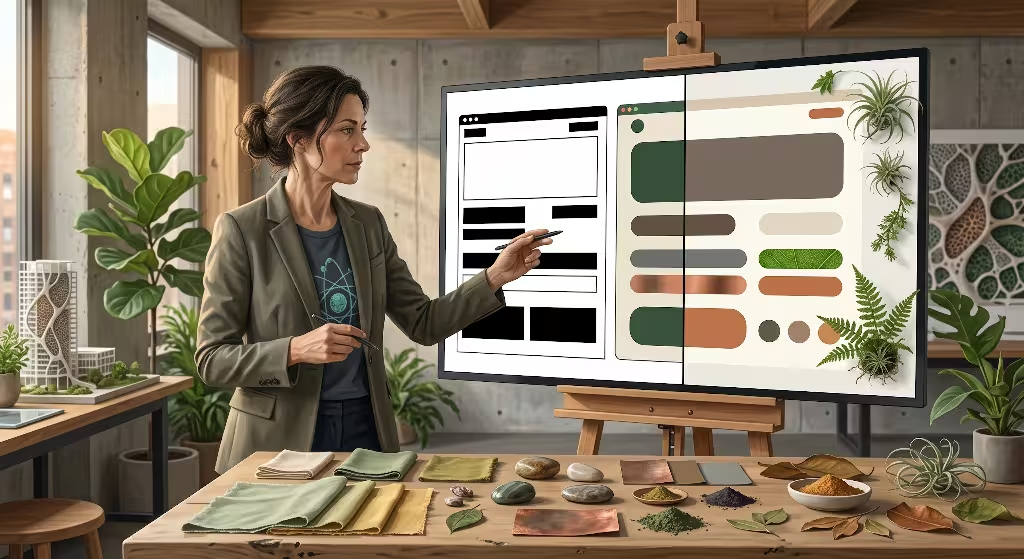
For years, digital storefronts have relied on pure white backgrounds (#FFFFFF) with pure black text (#000000) and intense neon accent buttons. While this combination offers high contrast, it is harsh on human eyes. In the natural world, pure white and pure black rarely exist in vast, flat expanses. Natural sunlight filters through atmosphere, leaves, and dust, creating rich, complex tones.
When building color schemes for luxury e-commerce, we should turn to natural palettes. Instead of harsh black and stark white, we can use warm travertine, weathered linen, slate grey, clay, and deep charcoal. These shades provide excellent readability while softening the brightness that shines from backlit OLED and LCD screens.
Accents should also reflect living pigments. Rather than using synthetic primary colors, interfaces can incorporate deep forest greens, mineral ochres, terracotta, river-stone blues, and raw umber. These earthy undertones ground the visual presentation.
When high-end products are framed against organic colors, their craftsmanship stands out naturally. Natural shades do not compete with product imagery; they support it. For luxury e-commerce, using nature-inspired color palettes turns a cold screen into a warm, welcoming gallery.
Circadian-Aware UI/UX Design
The human body operates on a circadian rhythm, an internal twenty-four-hour clock synchronized with the cycle of natural sunlight. Morning light contains higher amounts of blue wavelengths, which suppresses melatonin and signals our bodies to wake up. As the sun sets, light shifts toward warmer amber and red tones, allowing melatonin production to rise so we can sleep.
Most modern websites look identical at nine in the morning and eleven at night. When an online shopper browses a bright, cool-toned store late in the evening, the screen bombards their retinas with high-energy blue light. This disrupts their internal rhythm, causes eye fatigue, and can lead to frustration and quick exits.
By using simple frontend scripts and modern CSS custom properties, luxury e-commerce platforms can adjust to the user’s local time. When a shopper visits during midday, the interface can display crisp daylight tones with clear contrast. If that same shopper visits late at night, the platform can subtly shift its background toward warmer tones, lowering screen glare and softening ambient contrast.
This circadian adaptation protects the customer from visual strain. It creates an intuitive, comfortable browsing experience that respects human biology. In the competitive world of luxury e-commerce, designing software that cares for a user’s physical well-being is the ultimate expression of attentive service.
Non-Rhythmic Sensory Stimuli and Organic Micro-Interactions
Step into a quiet forest. The air is never completely still. You might see a dry leaf drift down, catch a sudden light breeze rustling branches, or watch light ripple across a creek. In biophilic design, these gentle events are called non-rhythmic sensory stimuli. They are brief, unpredictable, and gentle. They capture your attention for a moment without causing alarm, helping refresh your mental focus.
On the internet, movement is often mechanical, rigid, and repetitive. Banners slide on fixed timers, and elements snap abruptly between states. To make luxury e-commerce feel alive, we can add subtle, nature-inspired interactions.
Think about the physics of movement. When a user hovers over an image in a luxury e-commerce catalog, the transition should not follow a harsh, linear line. Instead, it can use smooth acceleration and gentle deceleration curves, mirroring how a water drop moves or how a branch settles after being touched.
Small particle movements that react softly to cursor coordinates, or subtle parallax shifts that feel like looking through clear water, bring tactile life to the screen. These micro-interactions must always be light and purposeful. When applied with restraint, they make luxury e-commerce feel responsive, fluid, and refined.
Digital Materiality and Tactile Substitution
One of the biggest hurdles in online retail is the loss of touch. In a physical luxury boutique, customers run their hands over buttery soft leather, feel the weight of solid gold, tap polished marble counters, and feel the grain of untreated oak. In a web browser, that tactile richness is reduced to smooth glass.
To close this sensory gap, a luxury e-commerce platform must use visual cues that suggest physical touch. We call this tactile substitution. By rendering authentic textures, an interface helps the customer imagine what a physical product feels like in their hands.
Modern frontend techniques allow us to render subtle material surfaces directly in the browser. High-resolution product images can be paired with fine CSS blend modes and SVG filters that suggest stone, paper, fabric, or brushed metal. Crisp lighting effects can simulate surface grain, making materials look tangible.
When a customer zooms in on a handbag or a mechanical watch in a luxury e-commerce boutique, the lighting should reveal every thread, pore, and bevel. High-fidelity visuals allow the brain to simulate the feeling of touch, giving shoppers the confidence they need when purchasing premium goods online.
Non-Invasive Auditory Feedback and Soundscapes
Our ears collect information about our surroundings every second of the day. In nature, sound is organic, textured, and contextual. A footstep on gravel sounds different from a footstep on moss. The chime of wind through trees or the trickle of a creek provides a rich backdrop without overwhelming our senses.
In contrast, web audio is often jarring. Loud promo videos play automatically, and harsh notification beeps interrupt shoppers, breaking their concentration and causing them to close the tab. Because of this, many designers avoid audio altogether.
However, when applied with restraint, subtle sound design can elevate luxury e-commerce to new heights. Instead of mechanical electronic clicks, button presses can produce soft, organic sounds, like a smooth wooden toggle, the gentle click of a latch, or the quiet rustle of heavy cardstock.
These audio cues should be quiet, optional, and used sparingly at key moments, such as placing an item into a shopping bag or completing a purchase. Thoughtful acoustic design brings a pleasant sense of weight and tactile reality to the digital interface, reinforcing the premium identity of the brand.
Appleton’s Prospect-Refuge Theory Online
In 1975, geographer Jay Appleton developed Prospect-Refuge Theory to explain why certain landscapes make humans feel safe and content. He noted that our ancestors survived by seeking environments that offered two things: prospect and refuge. Prospect means having an open, unobstructed view to scan the horizon for resources or danger. Refuge means having a safe, sheltered spot to hide and rest without being seen.
When an environment provides both prospect and refuge, people feel secure and at ease. We can apply this exact spatial balance to web interfaces.
+-------------------------------------------------------------------+
|                        GLOBAL NAVIGATION                         |
+-------------------------------------------------------------------+
|                                                                   |
|                       THE PROSPECT ZONE                           |
|       - Expansive negative space (clean whitespace)               |
|       - Unobstructed visual horizon                               |
|       - Sweeping imagery showcasing craftsmanship                 |
|       - Wide, open catalog vistas                                 |
|                                                                   |
+------------------------------------+------------------------------+
|         PRODUCT DISCOVERY          |       THE REFUGE ZONE        |
|                                    |                              |
|   Browse curated goods with        |   [ Slide-Out Drawer / Cart ]|
|   relaxed, open pacing.            |   - Enclosed, quiet boundary |
|                                    |   - High-contrast clarity    |
|   Items display with natural       |   - Distraction-free space   |
|   margins and breathing room.      |   - Safe checkout sanctuary  |
|                                    |                              |
+------------------------------------+------------------------------+
In luxury e-commerce, the prospect zone is created through wide, uncluttered layouts, generous margins, and broad views of the collection. Customers can scan the offerings clearly without visual clutter blocking their path.
The refuge zone appears during focused, personal moments. When a customer opens a product customizer, reviews their private measurements, or enters the checkout workflow, the interface should feel sheltered and secure. Using clean side drawers, quiet backgrounds, and simplified layouts creates a calm sanctuary. By balancing expansive browsing areas with private transaction spaces, luxury e-commerce creates an environment where shoppers feel both inspired and protected.
Mystery and Progressive Disclosure in Browsing
In environmental psychology, mystery does not mean confusion or dark secrets. It means designing an environment where walking forward promises new, interesting information. Think of a curving gravel garden path that bends behind an arbor of flowering vines. You cannot see everything at once, but the curve invites you to step forward and see what lies around the corner.
Modern discount retail platforms often dump everything on the screen at once, showing star ratings, urgency timers, stock alerts, and related items on a single page. This approach overwhelms shoppers and cheapens the experience.
Luxury e-commerce benefits greatly from measured discovery, often called progressive disclosure. Instead of displaying every product specification and badge upfront, the interface shares details gradually as the customer explores.
A customer might see an elegant photo of an item, and as they scroll or move their cursor, details about the artisan, materials, and origins unfold naturally. This measured pacing turns browsing into an enjoyable, rewarding journey. By treating the catalog like a curated path, luxury e-commerce allows customers to explore at their own speed.
Digital Ecology: Sustainability and Performance
Biophilic design is deeply connected to environmental stewardship. A digital shop cannot celebrate the beauty of nature while wasting energy and running inefficient software. The global internet emits roughly the same amount of carbon dioxide as the commercial airline industry, driven by massive data centers, networks, and power-hungry consumer devices.
Every heavy script, uncompressed video, and poorly written database query consumes electricity. If a luxury storefront looks green on the surface but takes ten seconds to load and drains a customer’s battery, it fails both ecological and user experience standards. High-performance engineering is an essential part of responsible luxury e-commerce.
+-------------------------------------------------------------------------+
|                  SUSTAINABLE PERFORMANCE ARCHITECTURE                   |
+-------------------------------------------------------------------------+
|  ASSET OPTIMIZATION                                                     |
|  - AVIF / WebP image pipelines (reducing payload size by up to 70%)     |
|  - Efficient SVG vectors for iconography and organic silhouettes         |
|  - Native browser lazy-loading for off-screen media assets              |
+-------------------------------------------------------------------------+
|  CODE HYGIENE                                                           |
|  - Elimination of heavy, unused JavaScript libraries                    |
|  - Native CSS transitions over heavy rendering engines                  |
|  - Lean DOM tree architecture to minimize CPU and battery cycles        |
+-------------------------------------------------------------------------+
|  GREEN INFRASTRUCTURE                                                   |
|  - Edge server networks powered by verified renewable energy sources    |
|  - Aggressive caching strategies to avoid unnecessary server compute    |
+-------------------------------------------------------------------------+
High performance directly benefits the customer experience. Slow loading times increase bounce rates and frustrate shoppers. By adopting modern image formats like AVIF and WebP, streamlining CSS, and using renewable-powered cloud hosts, a brand cuts its carbon footprint while delivering lightning-fast pages. True luxury e-commerce pairs aesthetic beauty with lean, responsible engineering.
Optimizing Core Web Vitals for Rich Natural Experiences
When designers add rich media, fluid shaders, and interactive models to a site, web performance can suffer if not managed carefully. Search engines like Google look closely at Core Web Vitals to measure the real-world user experience. These metrics measure how fast content loads, how smoothly pages respond to taps and clicks, and whether layout elements shift unexpectedly.
If a luxury e-commerce shop stutters when scrolling or jumps around while images load, shoppers will leave, and search engine rankings will drop. Technical execution must be clean and deliberate.
- Largest Contentful Paint (LCP): To keep your main hero images loading quickly, pre-render your key visual elements on the server. Always compress hero images and use responsive image tags to serve the correct resolution for each screen.
- Interaction to Next Paint (INP): Dynamic effects like water ripples or smooth hover states should run on the device’s graphics processor (GPU) rather than the main thread. Using CSS properties like
transformandopacityprevents input delay, keeping interactions snappy and smooth. - Cumulative Layout Shift (CLS): Reserve exact dimensions for all product cards, hero sections, and images using aspect ratio containers. When elements load, they slip into pre-allocated spaces without pushing text or navigation buttons around.
By keeping these technical metrics strong, a luxury e-commerce storefront stays fast and responsive. Premium customers expect effortless elegance, and modern technical optimization makes sure that beauty never comes at the expense of speed.
What are the 3 Main Principles of Biophilic Design in Digital Environments?
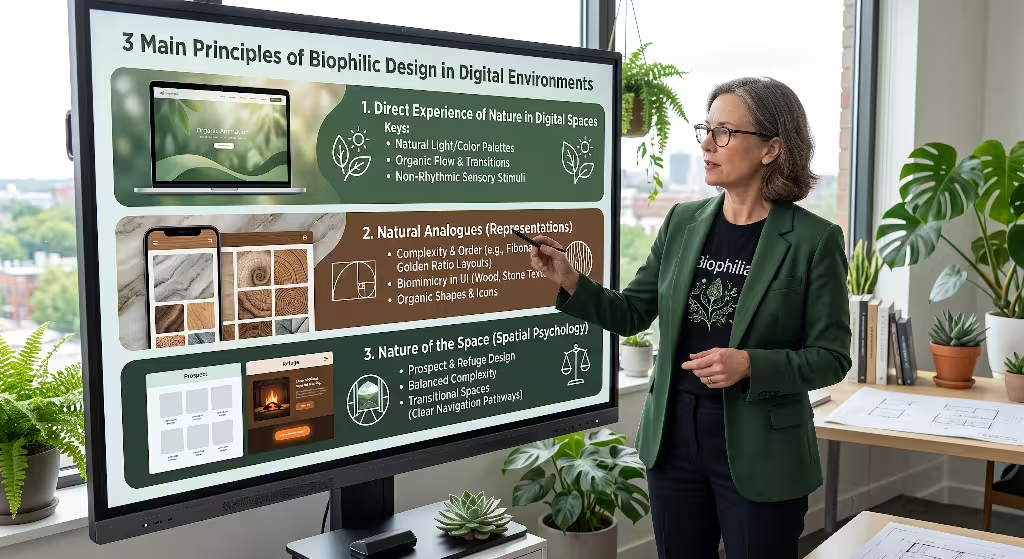
To bring the physical science of biophilic design into digital code, we organize our work around three main principles. These concepts originate from environmental design and adapt naturally to web interfaces:
+-----------------------------------------------------------------------+
|              THE THREE PILLARS OF DIGITAL BIOPHILIA                   |
+-----------------------------------------------------------------------+
| 1. NATURE IN THE SPACE (Direct Experiences)                           |
|    - Circadian lighting shifts that track the solar day               |
|    - Dynamic ambient sounds that respond to interactions              |
|    - Micro-animations mimicking wind, water, and living flow          |
+-----------------------------------------------------------------------+
| 2. NATURAL ANALOGUES (Indirect Experiences)                           |
|    - Biomorphic curves that eliminate harsh ninety-degree edges        |
|    - Earthy, mineral color palettes inspired by nature                |
|    - Mathematical fractal grids using Golden Ratio proportions        |
+-----------------------------------------------------------------------+
| 3. NATURE OF THE SPACE (Spatial Layout Strategies)                    |
|    - Prospect: Wide, open navigation and clear product horizons       |
|    - Refuge: Enclosed, peaceful checkout and configuration drawers    |
|    - Mystery: Progressive disclosure that rewards curiosity           |
+-----------------------------------------------------------------------+
By using these three pillars together, we build a cohesive online experience. When a luxury e-commerce brand implements all three, the interface feels less like a database frontend and more like a welcoming, living gallery.
Can Biophilic Design Increase E-Commerce Conversion Rates?
Design choices in digital retail should always support real business performance. Some stakeholders worry that focusing on beauty and nature might distract from sales. The data shows the exact opposite.
Natural design principles work with human biology to remove friction and support sales:
| Mechanism | Physiological Impact | Commercial Outcome |
| Fractal Layouts | Induces alpha brain waves; lowers visual stress | Extended session dwell time and deeper catalog exploration |
| Biomorphic Shapes | Down-regulates amygdala activation; removes perceived hazard | Lower cart abandonment and higher checkout completion |
| Circadian Color Calibration | Reduces evening eye strain and suppresses blue glare | Higher conversion rates for late-night mobile shopping |
| Tactile Materiality | Activates mental simulation of touch | Increased perceived product value and higher average order values |
When a customer visits a luxury e-commerce website, they are not just looking for a low price; they are looking for quality and care. A stressful, cluttered interface signals rushed, low-quality production.
Conversely, an interface designed around calm natural patterns signals patience, precision, and luxury. Customers feel comfortable spending more time on the platform. They can view each item thoroughly and complete transactions with confidence, leading to fewer returns, stronger customer loyalty, and consistent revenue growth for luxury e-commerce businesses.
How Luxury Brands Use Biophilia Online
High-end brands across different industries are beginning to bring natural elements into their digital flagships. Let us look at how distinct sectors apply these ideas:
Bespoke Horology and Fine Jewelry
Fine watchmakers create timepieces inspired by natural rhythms like celestial orbits, lunar phases, and the flow of water. When showcasing these pieces, their web pages reflect that same inspiration.
They use warm, dark backgrounds that resemble polished slate or volcanic stone, allowing gold and platinum watchcases to shine without harsh screen glare. Navigation menus often rotate smoothly along circular paths, mimicking mechanical gears or planetary orbits. This gives the online shop a rhythm that matches the artistry of fine timepieces.
High Fashion and Haute Couture
Haute couture fashion houses celebrate natural fibers like silk, wool, and linen. Their platforms showcase these materials with extreme visual fidelity.
Instead of flat, cropped cutouts, garments are presented in fluid, full-screen video, showing how fabric ripples in the breeze. Subtle wind effects and soft, linen-like textures bring warmth to the interface, echoing the craftsmanship of every garment.
Architectural Home Goods and Furnishings
Bespoke furniture makers use natural materials like walnut, oak, brass, and travertine. Their websites use open layouts with generous margins to echo the expansive feel of modern homes.
Customers can adjust digital lighting to see how a leather armchair looks at sunrise, midday, or dusk. This interactive lighting mirrors physical daylight, helping customers visualize how pieces will live in their spaces. In each of these examples, luxury e-commerce relies on natural cues to communicate exceptional quality.
The Difference Between Green Design and Biophilic Web Design
People often confuse green web design with biophilic web design. While both care for the natural world, they focus on different parts of the user experience.
+-----------------------------------+-----------------------------------+
|         GREEN WEB DESIGN          |       BIOPHILIC WEB DESIGN        |
+-----------------------------------+-----------------------------------+
| - Focused on operational metrics  | - Focused on human biology        |
| - Cuts carbon footprint           | - Lowers visual and mental stress |
| - Optimizes server performance    | - Shapes layout and typography    |
| - Reduces data transfer           | - Mirrors natural patterns        |
| - Machine-centric efficiency      | - Human-centric sensory wellness  |
+-----------------------------------+-----------------------------------+
Green web design focuses on sustainability and energy efficiency. It works behind the scenes to optimize code, minify scripts, compress files, and run sites on renewable energy. Its primary goal is to lower the digital carbon footprint.
Biophilic web design focuses on human perception and well-being. It is visible on the screen, using organic shapes, balanced colors, dynamic lighting, and natural sound to make people feel calm. It helps users think clearly and process visual information without getting tired.
The best luxury e-commerce websites bring both together. An efficient green architecture provides the foundation for a responsive, living design. When engineering and biology align, the platform delivers a fast, responsible, and beautiful digital storefront.
The Future of Luxury Digital Storefronts
The early era of the internet was built around simple efficiency. Websites were designed like digital filing cabinets, with rigid tables, bright blue hyperlinks, and sharp, boxy buttons. As web technology matured, luxury brands often took that basic structure and simply made it black and white, assuming that stark minimalism was enough to convey prestige.
Today, that sterile approach feels cold and out of touch. Discerning customers spend hours on digital screens every day and are tired of chaotic, demanding interfaces. They look for spaces that offer beauty, peace, and restorative calm.
Biophilic design gives us the tools to transform digital storefronts. By using fractal proportions, soft curves, earthy palettes, circadian-aware lighting, and balanced layouts, we can build online destinations that honor our biological roots.
For luxury e-commerce, this design philosophy creates spaces where craft is celebrated, visitors feel at home, and browsing becomes a pleasure. When we look to the living patterns of the natural world, we can create digital retail environments that are sustainable, beautiful, and enduring.