
The Geometry of Chaos
Have you ever looked closely at a piece of broccoli and realized it looks like a tiny green forest? Or have you noticed how the branching of a tree looks just like the veins on a single leaf? If you have, you are already seeing the magic of fractals in nature. These are not just pretty designs. They are the secret code that the world uses to grow and stay healthy. In the world of design, we call this biophilia. It is the idea that humans have a deep, built in love for the natural world.
When we talk about fractals in nature, we are talking about patterns that repeat themselves. If you zoom in on a small part of the pattern, it looks exactly like the big picture. Scientists and artists call this “self similarity.” It is like a set of Russian nesting dolls, where each smaller doll is a perfect copy of the one before it. In this article, we are going to dive deep into the world of fractals in nature. We will look at how they work, where you can find them, and why they are so important for everything from your health to how we build websites at Silphium Design LLC.
Table of Contents
Defining the Fractal: Beyond Simple Shapes
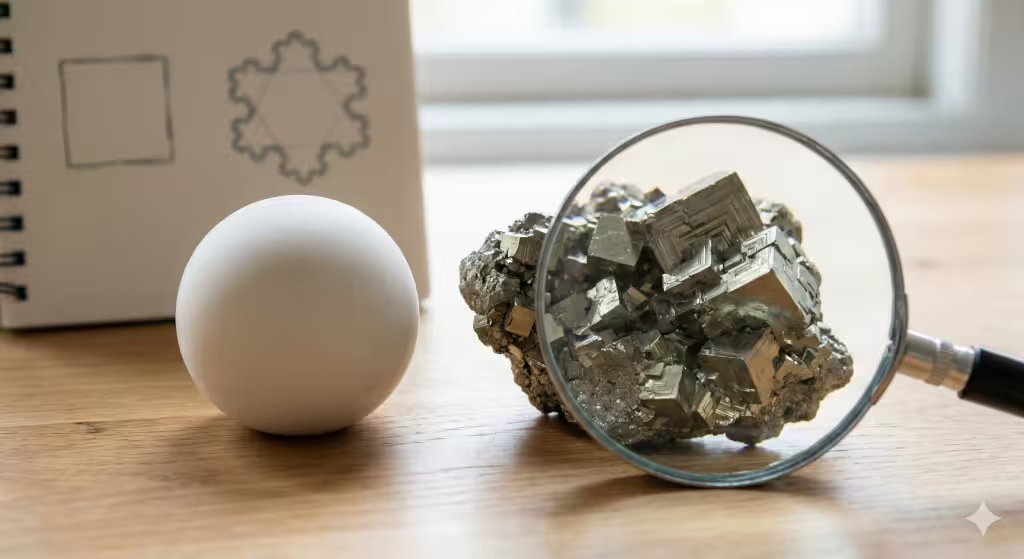
When we are kids, we learn about simple shapes like circles, squares, and triangles. These are called Euclidean shapes. They have smooth edges and are very easy to draw. But if you look at a real mountain or a cloud, you will see that they are not smooth at all. They are “rough.” They have bumps, jagged edges, and complex turns.
A fractal is a way to describe this roughness. Instead of being a flat shape, a fractal is a never ending pattern. It is created by repeating a simple process over and over again. This process is called a feedback loop. Because the pattern repeats at every level, a fractal can be infinitely complex. When we study fractals in nature, we are looking at how the world uses these “rough” geometries to solve problems, like how to get the most sunlight for a plant or how to move water across a giant continent.
The Mandelbrot Legacy: Finding Order in the Wild
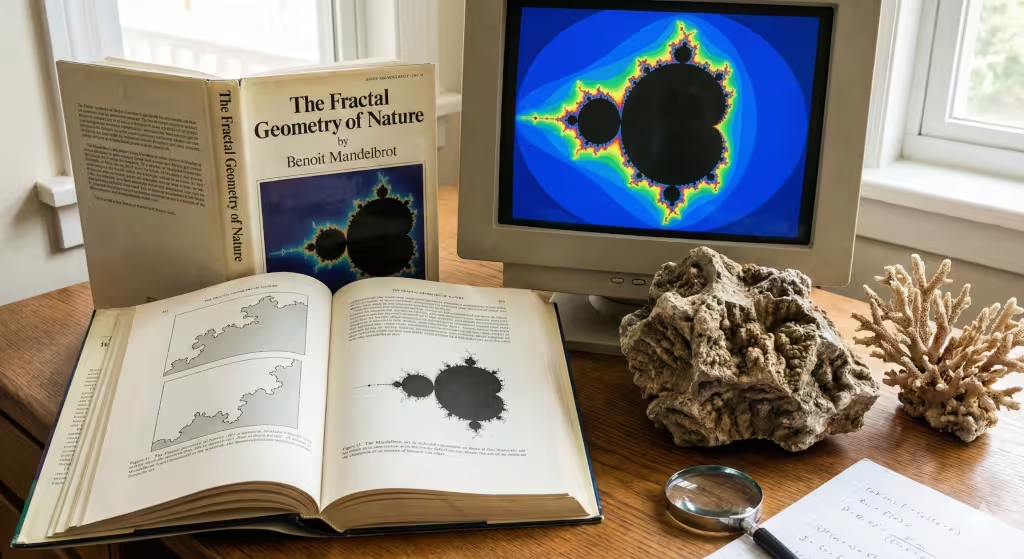
For a long time, mathematicians thought that nature was too messy to understand with numbers. They called it “chaos.” But in the 1970s, a man named Benoit Mandelbrot changed everything. He was a mathematician who worked for IBM, and he used computers to look at these messy shapes in a new way.
Mandelbrot realized that there was an order hidden inside the chaos. He wrote a famous book called “The Fractal Geometry of Nature.” In this book, he showed that the wiggly lines of a coastline or the branching of a lung follow mathematical rules. He coined the word “fractal” from the Latin word “fractus,” which means broken or shattered. By looking at fractals in nature, Mandelbrot gave us a new set of tools to describe the world around us. He showed us that nature isn’t just a collection of random accidents. It is a highly organized system built on simple, repeating rules.
The Concept of Scale: The Art of Zooming In
One of the coolest things about fractals in nature is that they look the same no matter how close you get. This is the concept of scale. Think about a huge oak tree. It has a thick trunk that splits into big branches. Those big branches split into smaller branches, and those smaller branches split into tiny twigs.
If you took a photo of just one small branch and showed it to someone, they might think they were looking at a whole tree. This is because the “rule” for how the tree grows is the same at every level. This scale symmetry is a hallmark of fractals in nature. Whether you are looking at something through a telescope or a microscope, the fractal patterns stay consistent. This is very different from a circle. If you zoom in on the edge of a circle, eventually it just looks like a straight line. But if you zoom in on fractals in nature, you just find more and more beautiful detail.
Mathematical Foundations: The Code of the Universe
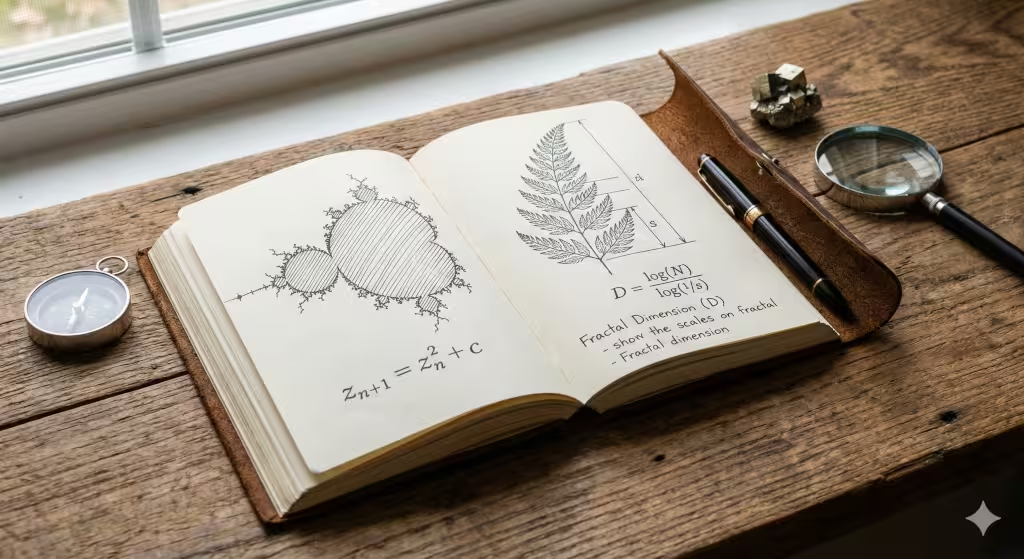
You don’t need to be a math genius to understand fractals in nature, but it helps to know the basic ideas. The most famous fractal formula is the Mandelbrot Set equation. It looks like this:
zn+1 = z2 n + C
This equation is a feedback loop. You take a number, square it, add another number, and then plug the result back into the start. When you do this millions of times using a computer, you get a beautiful, infinite shape.
Another important math concept is the Fractal Dimension, or D value. While a flat piece of paper has 2 dimensions and a box has 3, fractals in nature usually sit somewhere in between. For example, a very crinkly coastline might have a dimension of 1.2 or 1.3. This number tells us how much “space” the pattern fills up. Most fractals in nature have a D value between 1.3 and 1.5. Scientists have found that humans find this specific level of complexity very relaxing to look at.
Botanical Fractals: Nature’s Green Geometry
Plants are some of the best examples of fractals in nature. They use these patterns to survive. For a plant, life is a race to get as much sun and water as possible. Fractals allow them to grow very large surfaces without needing a huge amount of energy.
Romanesco Broccoli
If you go to the grocery store, look for Romanesco broccoli. It looks like a neon green cauliflower from outer space. It is perhaps the most perfect of all fractals in nature. Each big cone on the head is made of smaller cones. Each of those smaller cones is made of even tinier cones. They all grow in a spiral pattern. This is not just for looks. This shape allows the plant to pack as many buds as possible into a small space.
Fern Fronds
Ferns are another classic example of fractals in nature. Look at a large fern leaf. You will see that it is made of smaller leaflets. Each of those leaflets looks like a miniature version of the whole leaf. This is called a “self similar” branching pattern. Even when a fern is just a baby “fiddlehead” curled up, it is already following this fractal rule.
Sunflowers and Pinecones
While a pinecone itself isn’t a perfect fractal, the way its scales are arranged follows a fractal spiral. Sunflowers do the same with their seeds. They use the Fibonacci sequence to create spirals that never overlap. This is an efficient way for the plant to store seeds, and it creates the beautiful fractals in nature that we love to photograph.
Geological and Geographic Fractals: Shaping the Earth
The earth itself is a giant canvas for fractals in nature. When you look at the planet from a satellite, you can see patterns that cover thousands of miles.
The Coastline Paradox
If you try to measure the length of a coastline, you will find something strange. If you use a long ruler, you get one number. If you use a shorter ruler, you get a bigger number because you can measure all the little bays and wiggles. If you used a microscopic ruler, the coastline would seem almost infinitely long! This is because coastlines are fractals in nature. They have infinite detail. No matter how much you zoom in, there is always more “wiggle” to find.
River Deltas
When a river flows into the ocean, it often breaks apart into many smaller channels. This is called a delta. From above, a river delta looks like a tree or a nervous system. This branching allows the water to spread out and drop the sand and dirt it is carrying. These river systems are beautiful fractals in nature that show how water finds the most efficient path to the sea.
Mountain Ranges
Have you ever noticed that a small rock can look like a giant mountain in a photo? That is because mountains are fractals in nature. The jagged peaks are shaped by erosion and the movement of the earth’s crust. These forces work at every scale, creating the same “rough” look whether you are looking at a pebble or Mount Everest.
Atmospheric and Physical Fractals: Energy in Motion
Not all fractals in nature are made of solid stuff like plants or rocks. Some are made of energy, gas, or ice.
Lightning Bolts
When a storm happens, electricity tries to find the easiest way to the ground. It doesn’t travel in a straight line. Instead, it branches out. Each branch of a lightning bolt looks like a smaller version of the main bolt. Lightning is one of the most powerful fractals in nature. It shows how energy flows through the air in a recursive way.
Snowflakes
Every snowflake is unique, but they all follow fractal rules. As a snowflake grows, it branches out into six directions. Each of those branches grows its own smaller branches. This creates a complex, starry shape. The Koch Snowflake is a famous math model that mimics these fractals in nature, showing how you can have a very long edge in a very small space.
Clouds
Clouds might look like fluffy piles of cotton, but they are actually very complex. If you look at the edge of a cloud, you will see smaller puffs. If you look at those puffs, you will see even smaller wisps. Clouds are “stochastic” fractals in nature, meaning they have a random but repeating pattern caused by the way air moves and swirls.
Biological Fractals: The Geometry Inside You
The most amazing place to find fractals in nature is inside your own body. You are built out of repeating patterns that help you stay alive.
The Circulatory System
Your heart has to pump blood to every single cell in your body. To do this, your blood vessels branch out like a tree. Big arteries turn into smaller veins, which turn into tiny capillaries. This fractal branching allows your body to reach every corner without taking up too much space. If you laid out all your blood vessels in a straight line, they would wrap around the earth twice! That is the power of fractals in nature.
The Lungs
Your lungs are another great example. When you breathe in, air goes down your windpipe and then into smaller and smaller tubes called bronchi. These tubes end in tiny sacs where your body gets oxygen. This fractal design gives your lungs a huge surface area. In fact, if you unfolded your lungs, they would cover a whole tennis court. This allows you to get the oxygen you need very quickly.
The Brain
Your brain is the most complex thing in the known universe, and it is full of fractals in nature. The neurons (brain cells) have long branches called dendrites. These branches allow cells to connect with thousands of other cells. This “web” is a fractal pattern that helps you think, learn, and remember.
Common Questions About Fractals
Many people have questions when they first learn about this topic. Here are some of the most common things people ask about fractals in nature.
What is a fractal in simple terms?
The simplest way to think of a fractal is as a “pattern within a pattern.” It is a shape where the small parts look like the whole thing. If you take a picture of a fractal and zoom in, you just see the same pattern over and over again. It is nature’s way of being consistent and efficient.
Why are fractals important in nature?
Fractals in nature are important because they are efficient. They allow things to grow, move energy, and store information using very little “instruction.” For example, a tree doesn’t need a map for every single leaf. It just needs one simple rule: “Grow a branch, then grow two more from that one.” By repeating this rule, the tree can create a massive, complex canopy.
Are humans fractals?
We are not one giant fractal, but we are made of many fractal parts! Our lungs, our blood vessels, our brains, and even our heartbeats follow fractal patterns. Scientists believe that having these fractals in nature inside us helps our bodies be more resilient. If one small part breaks, the rest of the system can often keep working because it is so well organized.
Biophilic Design and Web Design: Why it Matters
At Silphium Design LLC, we don’t just study fractals in nature for fun. We use them to build better websites. This is part of biophilic design. Biophilia means “love of life.” When we put natural patterns into a website, people feel better when they use it.
Fractal Fluency
Scientists have discovered something called “fractal fluency.” This is the idea that our eyes and brains are “tuned” to see fractals in nature. Because we evolved in the woods and on the plains, our brains find these patterns very easy to process. In fact, looking at fractals can lower your stress levels by up to 60 percent!
When we design a website, we try to use these patterns. We might use a “branching” layout for a menu or use textures that look like wood grain or stone. This reduces what we call “cognitive load.” This means the user’s brain doesn’t have to work as hard to understand the site. When a site is easy on the brain, people stay longer and feel happier.
SEO and Fractals
Using fractals in nature is also good for Search Engine Optimization, or SEO. Google likes websites that provide a good “user experience.” If people spend more time on your site because it is beautiful and relaxing, Google sees that as a good sign. We use LSI keywords (latent semantic indexing) like “recursive design,” “natural symmetry,” and “biophilic patterns” to help search engines understand that our content is deep and valuable.
By focusing on fractals in nature, we create a bridge between the digital world and the physical world. We use the same rules that grow a forest to build a digital space that feels like home.
Designing for the Human Response
Fractals in nature are everywhere. They are in the food we eat, the air we breathe, and the very cells in our bodies. They are the universal language of growth and efficiency. By understanding these patterns, we can learn so much about how the world works.
Whether you are a student learning about math, a gardener looking at your ferns, or a designer building the next great website, fractals in nature offer endless inspiration. They remind us that even the most complex things start with a simple rule. At Silphium Design LLC, we believe that the best designs are the ones that honor these natural laws. When we bring the beauty of fractals in nature into our work, we aren’t just making things look good. We are making them feel right.
The next time you are outside, take a look around. See if you can spot the branching of a tree or the spiral of a shell. You will realize that you are surrounded by the infinite beauty of fractals in nature.