
Table of Contents
The Thermodynamics of the Web
Every time a web browser opens a page, electricity flows. That electricity powers giant buildings full of computers, spins fiber optic lines under the ocean, lights up phone screens, and runs local processors. When we look at nature, living organisms survive because they use energy with extreme care. A plant does not waste a single drop of water or a single ray of sunlight. It grows leaves shaped to catch maximum light while losing the least amount of moisture. It builds systems that last, balances its internal chemistry, and works in harmony with its surroundings.
The modern internet often works in the exact opposite way. Many modern websites carry massive digital baggage. They load scripts that nobody needs, run bulky trackers that watch every mouse move, and ping distant database systems every time a visitor clicks a button. Because electricity still comes mostly from burning coal, oil, and gas, this digital waste adds up to huge carbon emissions worldwide. In fact, data centers, networks, and consumer electronics produce as much carbon pollution as the global airline industry.
A low carbon website approaches digital systems from a completely different mindset. Instead of assuming digital power is free and limitless, we treat every single byte of data as real physical energy. When you design a low carbon website, you are not stripping away beauty or making the experience worse. You are applying natural efficiency to computer engineering. You are building clean, robust systems that load faster, work better on older devices, rank higher in search results, and leave a smaller environmental footprint behind.
To build a low carbon website, you need to understand the path that data travels. A digital request moves through three main physical stages: the data center where files live, the telecommunication lines that carry the data across towns and oceans, and the visitor device where software renders the layout. If you want to cut emissions, you have to clean up all three areas. By following natural principles of balance and efficiency, any organization can build an online presence that uses tiny amounts of power while delivering world class performance.
Selecting Truly Sustainable Server Infrastructure
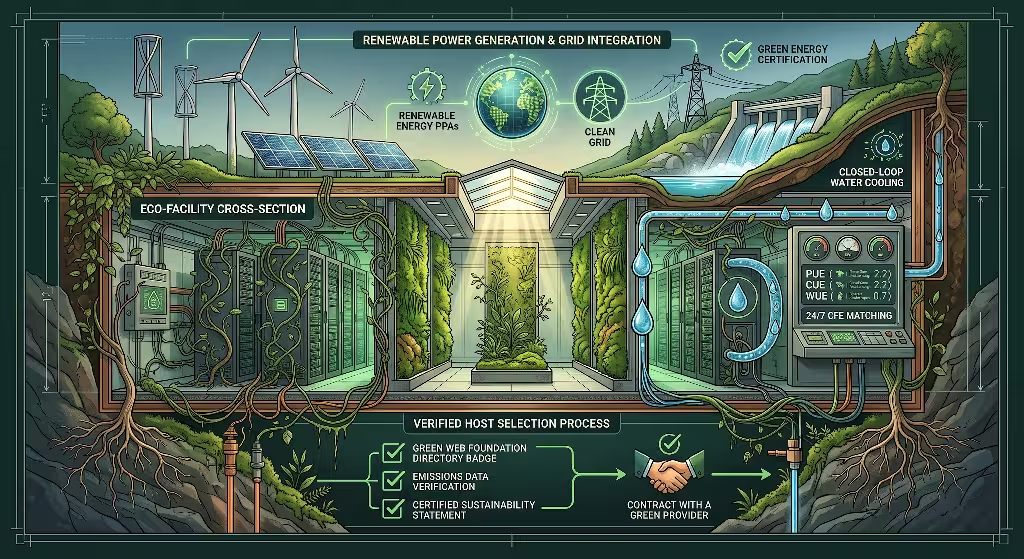
The foundation of any low carbon website is the physical server where its files and databases live. Servers are computers running twenty four hours a day, every day of the year. They need steady electrical power to calculate operations, and they generate massive heat that requires continuous air cooling or water chilling.
Many web hosting companies claim to run green operations, but you have to look closely at what they actually do. A common trick is buying unbundled Renewable Energy Certificates, often called RECs. A company might run its machines in a region that burns coal all day long, and then buy cheap paper credits from a wind turbine operating hundreds of miles away. On paper, their annual accounting balances out. In the real world, their servers still burn coal whenever the wind drops or demand spikes.
A true low carbon website relies on real-time clean power matching. This is often called twenty four seven carbon-free energy. Under this model, the data center matches its exact hourly electricity use with clean power produced on the exact same regional electrical grid. If the sun goes down and wind slows, the facility uses stored battery power or geothermal energy rather than switching to coal.
You must also check how efficiently the facility uses power. The metric used worldwide is Power Usage Effectiveness, or PUE. PUE measures the ratio of total energy used by the whole facility compared to the energy used purely by the computing equipment.
- If a data center has a PUE score of 2.0, it means that for every watt of power used to run a server, another full watt goes toward cooling, lighting, and power conversion.
- A modern, well-engineered green data center will have a PUE of 1.15 or lower. That means only fifteen percent of extra power goes to cooling and infrastructure overhead.
Water use matters just as much. Traditional data centers evaporate millions of gallons of drinking water each week to cool hot server racks. Low carbon website infrastructure uses closed loop dry cooling or outside air cooling, preventing unnecessary strain on local water systems.
Where you place your servers also changes their footprint. A low carbon website selects server regions powered by clean hydro power or geothermal grids, such as parts of northern Europe, the Pacific Northwest, or Quebec. Running identical computer code on a server grid powered by dirty energy can produce ten times more carbon than running it on a clean grid. Choosing the right physical home for your files is the first major step toward building a low carbon website.
Decoupled and Serverless Edge Architecture
For the past twenty years, traditional websites have relied on dynamic software stacks like WordPress, PHP, and relational databases. While these systems make publishing easy, they waste enormous amounts of compute cycles.
When a visitor visits a traditional website, the server has to wake up. It runs code to parse the URL, queries the database several times to assemble the text, gathers comments, loads sidebar widgets, stitches together a template, and outputs an HTML document. If one thousand people visit that article at the same time, the server does that exact same calculation one thousand times in a row. It burns electrical power repeatedly to create identical results.
A low carbon website removes this wasted compute power by using decoupled and static architectures. Often called Jamstack or Static Site Generation, this method pre-builds every page of your site ahead of time. When you write a new article or update an image, your build system compiles the page once into simple HTML, CSS, and lightweight scripts.
When visitors arrive at a low carbon website, the server does not run any database queries or complex PHP scripts. It simply hands over the ready-made file. This drops the CPU workload of the server close to zero. A simple server that previously struggled to handle a few hundred visitors can now effortlessly serve tens of thousands of visitors without breaking a sweat or consuming extra electricity.
To take efficiency even further, a low carbon website uses serverless edge functions. Instead of maintaining giant virtual servers that stay powered on all night waiting for visitors, serverless computing only wakes up for a few milliseconds when an interactive feature is triggered, such as a contact form submission or a search lookup. Once the job finishes, the computer execution stops immediately. By running lightweight code on demand and serving pre-rendered files everywhere else, your low carbon website eliminates thousands of kilowatt-hours of idle server waste.
Network Topology and Data Transmission Minimization
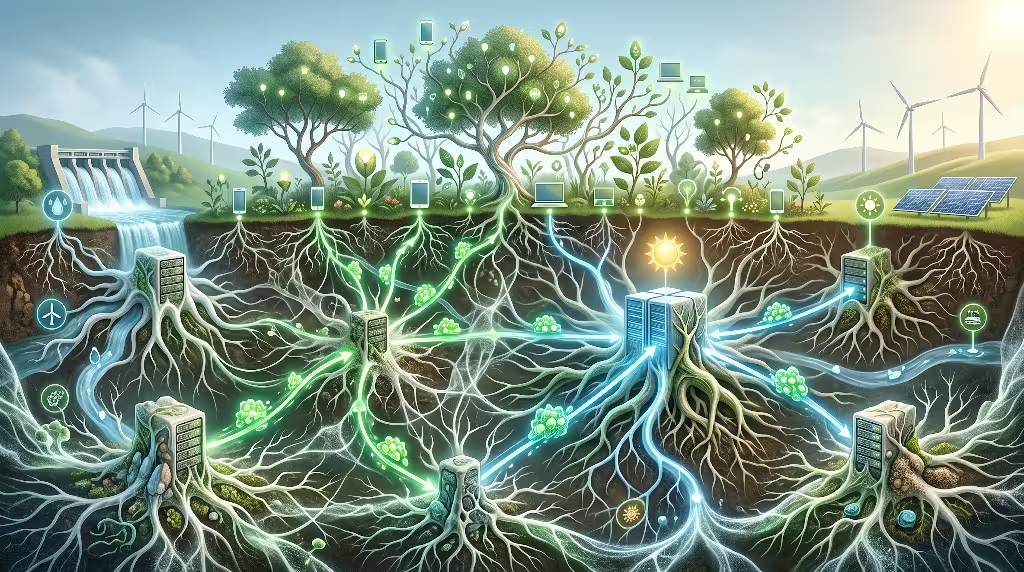
Data is not weightless. Every kilobyte of information sent across the web travels through copper cables, fiber optic glass lines, cellular towers, and routing hardware. Each piece of hardware along that path contains processors, switches, and cooling units that consume electricity. The farther your data has to travel, and the more network routers it passes through, the more energy it burns.
A low carbon website minimizes network transit by placing content closer to visitors through an Anycast Content Delivery Network, or CDN. A CDN is a global network of simple edge servers stationed in dozens of cities worldwide. When you update your low carbon website, copies of your pre-built static files spread across these edge locations.
When someone in Tokyo views your site, they do not pull files from a server in Virginia. They connect to a data center right in Tokyo, just a few miles away. This shortens the physical path across undersea cables, cuts network packet loss, reduces the need for data retransmission, and saves power across the entire global telecommunication network.
Network efficiency also depends on the communication rules used to send data packets. Older web protocols required back and forth handshakes before files could start flowing. Each handshake took precious milliseconds and burned radio power on mobile phones. Modern low carbon website design implements modern network protocols like HTTP/3 and QUIC.
HTTP/3 runs over UDP rather than older TCP protocols. It combines connection handshakes with encryption handshakes, cutting out redundant back and forth trips. It also handles dropped packets much better on weak Wi-Fi or mobile connections, preventing unnecessary repeated data streams.
Finally, a low carbon website uses modern compression algorithms like Brotli or Zstandard. Brotli compresses text, CSS, and JavaScript files up to twenty or thirty percent better than older tools like Gzip. Better compression means fewer packets sent across the wire, lower electricity demand at every routing switch, and faster load times for every visitor.
Algorithmic and Database Efficiency
Software code behaves like an engine. Clean code runs smoothly with little friction, while messy code forces computers to grind through millions of unnecessary calculations. When you write code for a low carbon website, you examine how long your algorithms take to run.
In computer science, we often talk about algorithmic complexity. If an algorithm takes twice as long to process twice as much data, it runs with linear scaling. But if poorly designed code takes four times or eight times as long, the CPU must run at maximum frequency for extended periods. When a computer processor runs at full speed, its temperature shoots up, its internal fans spin loudly, and it draws far more watts from the wall. A low carbon website ensures that all code running on servers and client devices finishes its work in the fewest possible clock cycles.
Database queries also demand careful attention. In many standard web setups, unoptimized databases perform full table scans whenever a user searches for an article or filters a product list. This means the computer reads through every single row stored on its hard drives, loading millions of values into active memory just to return five items. A low carbon website uses clean database indexes, precise queries, and strict data limits.
Caching database results inside temporary high-speed memory systems, like Redis or Memcached, helps avoid spinning up disks repeatedly. If twenty visitors request the same category list, the system reads it from low power memory instead of performing twenty separate heavy database calculations.
API design plays an identical role in maintaining a low carbon website. Traditional REST APIs often return huge blocks of data containing dozens of fields that the front page never displays. By using selective endpoints or GraphQL queries, a low carbon website requests only the exact fields needed to render the view. By trimming away extra fields, you avoid wasted memory allocation, cut down serialization overhead, and reduce the total energy spent moving data through the software stack.
Asset Optimization and Biomimetic Payload Budgets
The heaviest part of the modern web is media. Images, custom fonts, video clips, and audio tracks make up the vast majority of all data transferred online. If you look at nature, animals develop lightweight skeletons and birds have hollow bones so they can move freely without wasting metabolic energy. A low carbon website applies this exact biomimetic principle by setting strict payload budgets.
Ten years ago, the average webpage size was under one megabyte. Today, the average webpage weighs over two and a half megabytes, and many commercial sites balloon past five or ten megabytes. A true low carbon website aims for a hard budget, usually under five hundred kilobytes for an entire page, and often under one hundred kilobytes for simple articles.
To achieve this lightweight structure without losing visual appeal, you must choose modern image formats. Older formats like JPEG and PNG are heavy and inefficient compared to modern alternatives.
- WebP provides excellent compression with broad browser compatibility, often cutting file weights in half compared to JPEG.
- AVIF goes even further, offering dramatic compression while preserving crisp edges, smooth color gradients, and tiny file footprints.
- SVG (Scalable Vector Graphics) should always replace raster images for icons, logos, and simple diagrams. Because SVG files are written in simple text coordinates, an intricate icon can weigh less than one single kilobyte while remaining sharp at any screen size.
Typography represents another hidden source of energy waste. Many sites load four or five different font files, with separate weights for regular, bold, semi-bold, and italics. Each custom font file can easily weigh one hundred kilobytes or more, forcing the visitor’s device to pause, download the data, and compile the letter shapes into memory.
A low carbon website often embraces system fonts, using the high-quality typefaces already built into Apple, Android, and Windows operating systems, such as San Francisco, Roboto, or Segoe UI. Because these fonts already live on the user’s hard drive, zero network packets are needed to display beautiful typography. If a custom font is necessary for branding, a low carbon website uses a single variable font file, which provides infinite weights and styles within one tiny, optimized package.
Furthermore, media must only load when it is actually needed. A low carbon website applies native lazy loading to all images and embedded media located below the fold. If a visitor only reads the first two paragraphs of an article and navigates away, their phone never downloads the five images sitting farther down the page. This simple optimization prevents massive amounts of wasted data transfer every single day.
Client-Side Rendering and Energy-Conscious DOM Design
Many web developers assume that once files leave the server, their job is done. But research shows that more than half of the energy used during a web browsing session is burned directly by the visitor’s own device. A mobile phone or laptop must run its own processor to parse code, lay out elements, render pixels, and power its display screen. A low carbon website is designed to be gentle on end-user hardware, extending battery life and reducing electrical demand at the wall outlet.
Modern JavaScript frameworks have popularized heavy client-side rendering. Websites frequently ship megabytes of JavaScript libraries that force the mobile phone to parse complex code, calculate virtual DOM trees, and assemble the page locally. On older or budget smartphones, this heavy processing causes the device to heat up, drains the battery quickly, and makes scrolling feel sluggish.
A low carbon website relies on server-rendered or static HTML, keeping JavaScript to an absolute minimum. When interactive scripts are required, they should be written in clean, vanilla JavaScript or lightweight libraries that do not demand heavy processing power.
The structure of the Document Object Model, or DOM, also directly impacts energy consumption. Every HTML element on a page—every paragraph, box, list item, and container—must be tracked by the browser engine. When a page contains thousands of nested elements, the browser must recalculate positions and redraw the screen every time the user scrolls or clicks. A low carbon website keeps the DOM tree shallow, clean, and simple. By avoiding deeply nested containers, the browser can calculate the layout in milliseconds using minimal CPU effort.
Screen lighting is another physical area where design choices directly affect energy use. Most modern smartphones and high-end laptops use OLED or AMOLED display screens. Unlike older LCD screens that use a permanent backlight behind the entire display, OLED screens light up each pixel individually.
- When displaying a pure white pixel (
#FFFFFF), the sub-pixels draw full power. - When displaying a true black pixel (
#000000), the sub-pixels turn off completely, drawing zero electric current.
A low carbon website takes advantage of this physical reality by supporting dark mode through the prefers-color-scheme CSS media query. By offering a clean, dark interface with deep blacks and soothing muted tones, a low carbon website can reduce screen power draw by thirty to sixty percent on OLED devices. This saves real electrical power and creates a more comfortable reading experience that mirrors the gentle, low glare patterns found in natural environments.
CI/CD Pipeline and Development Lifecycle Carbon Auditing
Building a low carbon website is not a one-time project; it is an ongoing engineering habit. Every time a software engineering team updates a site, they run automated testing, build scripts, compile code, and push updates. These build processes, known as Continuous Integration and Continuous Delivery (CI/CD) pipelines, run in the cloud hundreds or thousands of times every month. If your build systems are inefficient, your development workflow burns significant power before a single visitor ever views your updates.
A low carbon website team optimizes its build pipelines to run fast and lean. This means caching dependencies so the system does not download identical libraries on every build, using lightweight container images, and running tests only on the code that actually changed. By cutting build times from fifteen minutes down to two minutes, you directly cut the electrical consumption of your development infrastructure.
Development teams should also integrate automated carbon testing directly into their workflow. Just as teams test their code for security flaws or syntax bugs, a low carbon website pipeline tests every code commit against a digital carbon budget. Tools like the Green Web Foundation’s CO2.js library or Eco-CI can run during every build, estimating the carbon emissions of the updated site. If a developer accidentally adds an uncompressed five megabyte image or a heavy tracking script, the automated build can flag the issue and stop the deployment before the heavy asset reaches production.
Software dependency management is equally critical. Modern web projects often rely on third-party packages installed through package managers. Over time, these dependencies grow into giant software trees, pulling in hundreds of extra files that the project does not actually need. A low carbon website undergoes regular code audits to prune unused dependencies, update outdated packages to more efficient versions, and replace bulky multi-purpose libraries with focused, lightweight alternatives. Keeping your software codebase lean protects the long-term efficiency of your low carbon website.
Measurement, Auditing, and Verification Standards
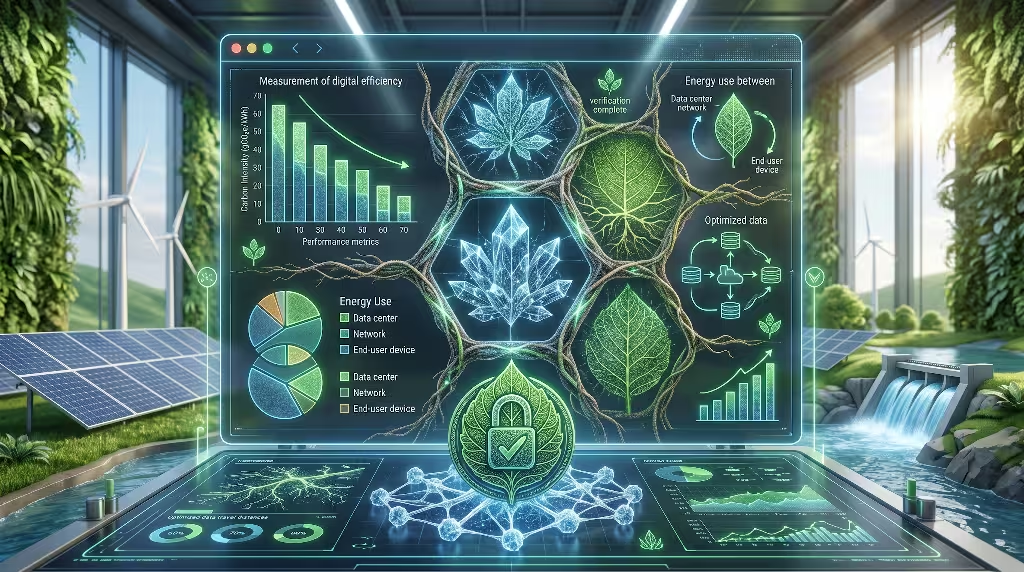
You cannot reduce what you do not measure. To build and maintain a genuine low carbon website, you need clear scientific methods to calculate digital energy and track progress over time.
The most widely adopted framework for measuring website emissions is the Sustainable Web Design Model, often abbreviated as SWDM. This open standard uses empirical data to estimate the kilowatt-hours of electricity used per gigabyte of web traffic. The model splits digital energy across four major areas:
- Data Centers (15%): The servers and infrastructure handling storage and computations.
- Telecommunications Networks (14%): The transmission lines, cellular towers, and routing gear moving the data.
- End-User Devices (52%): The phones, laptops, and screens processing the code and displaying pixels.
- Hardware Manufacturing and Embodied Carbon (19%): The energy required to extract minerals, build chips, and manufacture all the physical devices involved.
The model combines this energy use with global or regional carbon intensity figures, measured in grams of carbon dioxide equivalent per kilowatt-hour of electricity (gCO2e/kWh). It also accounts for caching: a first-time visitor downloads all assets, while a returning visitor loads cached files from local memory, using significantly less energy.
By using these standard calculations, a low carbon website can monitor its estimated carbon score per page view. Tools like Website Carbon, Ecograder, and Lighthouse allow teams to benchmark their performance against industry averages. A typical web page produces around 0.8 to 1.0 grams of carbon dioxide per page view. A well-optimized low carbon website aims for less than 0.2 grams, and the most efficient sites easily achieve scores below 0.05 grams per page view.
Verification provides credibility and prevents greenwashing. Organizations can verify their infrastructure through the Green Web Foundation database, which checks whether hosting providers run on independently confirmed renewable energy. A low carbon website should openly share its sustainability policies, publishing a clear carbon statement that explains its hosting choices, page budgets, and ongoing optimization goals. Being open about your numbers builds trust with visitors and sets a positive standard for the entire digital industry.
Digital Pruning, Archival Policy, and Longevity
In natural ecosystems, dead leaves fall to the forest floor, decompose, and return their nutrients to the soil. Natural systems do not accumulate endless mountains of useless material; everything cycles, clears out, and stays balanced. In the digital world, however, we tend to keep everything forever. Old marketing campaign pages, draft articles from ten years ago, duplicate product images, and unused tracking tags sit on cloud drives year after year.
This accumulation of digital clutter consumes real physical energy. Storage drives in data centers must remain powered on to keep old data accessible. Cloud backups run repeatedly, copying dead files from one server cluster to another. Search engine web crawlers spend compute cycles indexing outdated pages that nobody reads. A low carbon website fights this digital clutter through active digital pruning and strict archival policies.
Regularly auditing your content allows you to identify zombie pages—pages that receive zero traffic and offer no current value. If an old page is no longer useful, a low carbon website deletes it or archives it into cold, unpowered offline storage rather than leaving it on active server disks. When pages must be redirected, make sure redirects go straight to the final destination. Chained redirects, where URL A points to URL B which points to URL C, force browsers and search bots to make multiple network round trips, wasting energy on every single visit.
Setting smart caching headers is another powerful way to reduce recurring digital waste. When a low carbon website serves images, stylesheets, and fonts, it marks those files with long cache lifespans, such as one full year (max-age=31536000, immutable). This instructs the visitor’s browser to store the files locally on their hard drive. When they return to read another page next week, their browser loads the files from local storage instead of downloading them across the telecommunications network again.
Finally, designing for longevity means avoiding short-lived digital trends. Many websites undergo complete rebuilds every two years simply because their designs relied on flashy visual trends, complex animations, or fragile frameworks that broke with the next browser update. A low carbon website embraces timeless, biophilic principles: clear visual hierarchy, simple responsive layouts, accessible typography, and resilient code. When you build a website that lasts for seven or eight years without needing a total rebuild, you save immense amounts of human energy, computing power, and manufacturing overhead.
Summary of Core Principles for Low Carbon Website Infrastructure
Building a low carbon website is not about compromise. It is about applying intentional engineering and natural design logic to build a cleaner, faster digital ecosystem. When you remove unnecessary code, compress your media, choose genuinely green hosting, and respect the hardware of your visitors, everyone wins:
- Your visitors enjoy lightning-fast load times, lower mobile data use, and longer battery life.
- Your business sees higher search engine rankings, lower cloud hosting bills, and better conversion rates.
- The planet benefits from reduced electricity consumption and lower greenhouse gas emissions.
By following the ten criteria outlined above, any organization can build an enduring low carbon website. In an increasingly crowded digital landscape, simplicity, speed, and ecological responsibility are the ultimate marks of great engineering.
Frequently Asked Questions about Low Carbon Website Infrastructure
How does a website produce carbon emissions?
A website produces carbon emissions because computing requires electricity. Data centers use power to run servers and cool equipment. Telecommunications networks burn electricity to transmit data packets across cables and cell towers. Finally, visitor devices consume battery power and electricity to process code, render layouts, and light up displays.
What is green web hosting?
Green web hosting refers to server infrastructure powered by genuine renewable energy sources like wind, solar, or hydro power. The best green hosts match their hourly energy use to local clean grids, maintain a low Power Usage Effectiveness rating (PUE under 1.15), and avoid relying purely on unbundled paper carbon credits.
How do you calculate a website’s carbon footprint?
You calculate a website’s carbon footprint by measuring the total data transferred per page view in gigabytes, multiplying that by the energy intensity of global networks and data centers (kilowatt-hours per gigabyte), and applying the carbon intensity of the relevant electrical grid. The Sustainable Web Design Model is the industry standard tool for these calculations.
Does a low carbon website improve SEO?
Yes, a low carbon website directly improves search engine optimization. Google rewards pages that load quickly and deliver clean user experiences, measured through Core Web Vitals such as Largest Contentful Paint and Interaction to Next Paint. Because a low carbon website removes bloated scripts and heavy assets, it naturally achieves high performance scores and ranks higher in search results.