
Table of Contents
The Convergence of Digital Ecology and Corporate Responsibility
The traditional web development paradigm treats digital spaces as sterile, hyper-industrial environments. For years, companies built software without considering the physical resources those digital tools consume. We designed grids that were rigid, mechanical, and entirely divorced from the natural world. This historical separation has created a massive blind spot in corporate sustainability.
As B Lab tightens its B Impact Assessment metrics, forward-thinking enterprises must extend environmental stewardship to their digital infrastructure. The B Impact Assessment is the tool used to measure a company’s total social and environmental impact. True corporate responsibility can no longer stop at physical supply chains. Every byte of data transferred, every server query executed, and every pixel illuminated on a user’s screen requires physical electricity. Most of this electricity still comes from burning fossil fuels. This means your website has a direct physical impact on our planet.
To address this impact, we must look at the biophilia hypothesis in cyberspace. Biophilia is a term popularized by biologist Edward O. Wilson. It states that human beings have an innate, evolutionary need to connect with nature and other living systems. When we spend hours looking at rigid, bright, and flashing digital boxes, our nervous systems experience subtle but continuous stress. Integrating Edward O. Wilson’s foundational theory into User Interface design changes how we build digital products.
User Interface design, or UI design, is the process of building the visual elements of a website or application. We must understand how the human nervous system responds to organic structures versus rigid digital grids. Natural shapes, calm colors, and predictable patterns soothe the human brain. Rigid grids and flashing elements trigger a fight-or-flight response that drains human energy.
The core thesis of this new design paradigm is straightforward. Implementing biophilic UI frameworks for B Corp compliance is an empirical methodology to satisfy both the Environment and Customers pillars of the B Impact Assessment. This process works by minimizing data-processing energy and mitigating user digital stress. When a business optimizes its software using these natural frameworks, it directly improves its scores for B Corp compliance. It transforms a standard corporate website from a digital carbon source into a restorative ecosystem.
At Silphium Design LLC, we study these relationships closely to bridge the gap between hard computer science and natural biology. We can design interfaces that respect planetary boundaries while respecting the biology of the human user. Achieving B Corp compliance requires this exact type of holistic thinking. We must look at our screens not as isolated pieces of glass, but as extensions of the natural world.
The Pillars of Organic Web Architecture

De-industrializing the interface requires a major shift in how frontend engineers view web layouts. For decades, the internet has been built on box-heavy, industrial design patterns. We use square blocks, sharp corners, and harsh lines that mimic factory layouts. Organic web architecture offers an entirely different approach. Instead of forcing content into rigid geometric components, we transition toward fluid, asymmetrical, and biomorphic forms. Biomorphic forms are shapes that take inspiration from living things, such as the gentle curve of a river, the structure of a leaf, or the soft profile of a pebble.
By using CSS technologies like clip-paths and border-radii, developers can build layouts that feel alive and natural. This design philosophy directly aids in achieving B Corp compliance because it matches the broader corporate goal of environmental harmony.
Biomimicry in frontend logic takes this idea even deeper. Biomimicry means copying the shapes, patterns, and processes found in nature to solve complex human engineering problems. When applied to code, this means designing state management and data flows that mirror natural systems. State management is how a website keeps track of user data and changes as the user clicks around. Instead of using heavy, centralized databases that constantly push and pull massive chunks of data, we can build decentralized, event-driven data flows.
These flows act much like neural networks in a human brain or cellular distribution models in a plant. Data travels only where it is needed, exactly when it is needed. This reduces the mechanical processing power required by the computer or phone running the website. By lowering processing needs, you lower carbon emissions, which is a key requirement for companies pursuing B Corp compliance.
To talk about these concepts accurately, we use several related terms. Digital biophilia refers to the practice of bringing natural elements into software environments. Organic web architecture focuses on the underlying structural systems that make a website light and natural. Ecological UI design combines these ideas to build interfaces that are good for both human health and planetary health. When these three concepts work together, a company can easily document its digital sustainability efforts for B Corp compliance. The digital footprint becomes a key part of the enterprise’s ecological balance sheet.
What is organic web architecture? To answer this from a technical perspective, we must look at how code runs on a screen. Organic web architecture is a structural philosophy where web systems minimize energy consumption and cognitive drag through code patterns modeled after efficient natural processes. In nature, systems do not waste energy. A tree does not transport more water than it needs to survive. Organic web architecture applies this efficiency rule directly to web development. It avoids bloated code libraries, minimizes network requests, and treats server energy as a precious natural resource. Building a site this way is an excellent method to prove a company’s commitment to B Corp compliance under the environmental assessment guidelines.
Algorithmic Efficiency and Carbon Control (The Environmental Pillar)
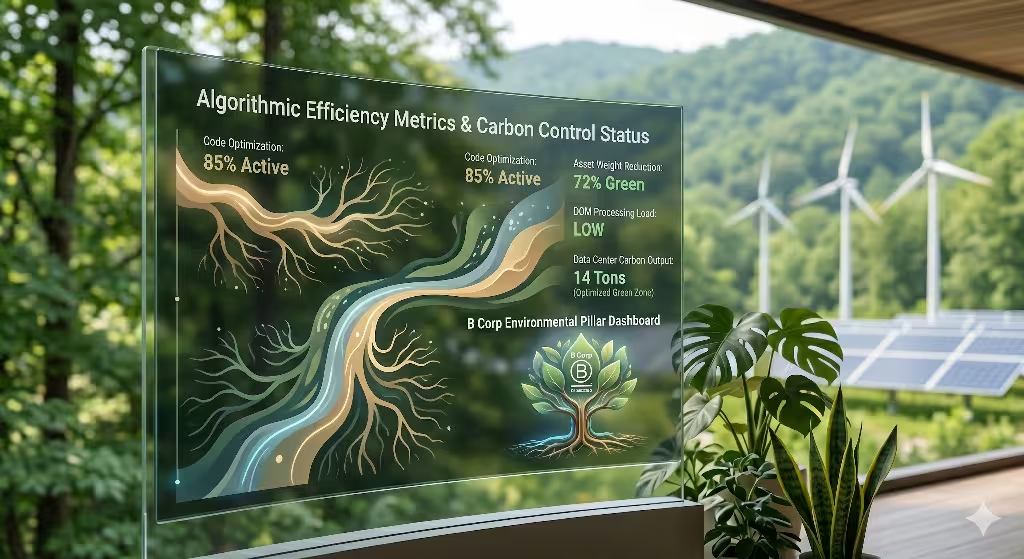
Green coding audits are the first line of defense against the growing problem of digital pollution. Many modern websites are built using heavy, complex JavaScript frameworks that load megabytes of unneeded code. This is known as legacy framework bloating. Every time a user loads a page, their device has to burn energy just to read through thousands of lines of unused scripts.
To clean up this waste and assist with B Corp compliance, engineers must transition to lightweight native Web Components. Web Components are built directly into modern web browsers. They do not require downloading massive external files to run. Eliminating framework bloat reduces the computational work required by the user’s browser, which directly lowers the electrical power pulled from the wall.
Efficient asset strategies are another critical piece of carbon control. Traditional websites often use massive, high-resolution photographs that require megabytes of data storage. Loading these images across millions of user visits creates an immense carbon footprint. A biophilic framework swaps these heavy images for vector graphics, half-tone illustrations, and optimized SVGs. SVG stands for Scalable Vector Graphics. These are images built out of mathematical math equations rather than pixels.
Because they are just code, their file sizes are tiny, often less than ten kilobytes. They can be scaled to any size without losing sharpness. Furthermore, half-tone illustrations use small dots to create complex visual depth. This technique reduces the total number of colored pixels on a screen. Using these lightweight visual assets reduces DOM processing power. The DOM, or Document Object Model, is the internal map that a browser creates to display a web page. A smaller DOM means faster rendering, less heat generated by the device, and clearer documentation for B Corp compliance.
Circadian screen protocols bring the natural cycles of daylight into our software systems. The human body evolved to respond to the natural shift of light throughout the day. High-intensity blue light from screens mimics the midday sun, which can disrupt human sleep cycles and cause eye fatigue. To combat this, biophilic UI frameworks use system-level dark mode configurations that trigger automatically based on the user’s local time. These dark modes do not use harsh, artificial black colors. Instead, they rely on earth-inspired color palettes, including deep forest greens, low-intensity ochres, and muted charcoal tones. These colors feel familiar to the human eye and reduce physical strain.
The environmental benefit of this strategy is backed by hard numbers. Empirical data shows that dark mode configurations on OLED displays reduce active display power consumption by up to 63%. OLED stands for Organic Light Emitting Diode. These screens are unique because they light up each pixel individually. When a pixel displays a dark color or an earth tone, it draws significantly less electrical current. When it displays true black, the pixel turns off completely and uses zero power. By adopting these circadian colors, a web platform directly cuts the energy used by its entire user base. This measurable drop in electricity use provides clear data for B Corp compliance audits.
To maintain these savings over time, developers must focus on server load minimization. Every time a user interacts with a website, a request is sent to a server located in a data center. These servers run constantly, requiring immense cooling systems to keep from overheating. By optimizing code and using carbon control methods, we decrease the total number of server trips. We can also use green hosting providers that run their data centers on clean energy. Tracking these metrics through a green coding audit gives a company the precise data points needed to verify B Corp compliance. Digital sustainability changes from a vague concept into a provable metric.
Cognitive Sustainability and Human Biology (The Community/Customer Pillar)

Stephen Kellert’s 14 patterns of biophilic design are widely used by architects to build physical spaces like offices and hospitals. These patterns help lower heart rates, reduce blood pressure, and improve human focus. We can apply these exact same 14 patterns to digital user interfaces to improve human biology online. The first pattern is a visual connection with nature. In a digital interface, this does not mean plastering generic photos of trees across the background. Instead, we use subtle, non-intrusive algorithmic generative natural patterns.
For example, a background can feature a mathematically generated pattern that mimics the natural flow of waves or the branching structure of tree limbs. These lines can shift very gently as the user scrolls, creating a sense of calm movement that reduces mental fatigue. This focus on human well-being helps fulfill the customer protection requirements needed for B Corp compliance.
Another powerful pattern is dynamic and diffuse light. In physical buildings, this is achieved through skylights and windows that let changing daylight filter into a room. In digital design, we can use CSS-driven transitions that mimic natural circadian lighting shifts based on the user’s local time. When a user opens an app at eight in the morning, the interface can display soft, warm morning tones. By noon, the colors transition gently to a bright, clear sky-blue. In the evening, the system shifts into deep, relaxing earth tones.
These changes happen automatically in the background without disturbing the user’s work. This approach aligns digital products with human biological clocks, which is a major victory for companies that view user health as a core part of B Corp compliance.
Mitigating digital stress is an urgent task for modern software designers. The modern internet is filled with dark patterns. Dark patterns are design elements intended to trick users into clicking things or spending money they did not intend to. They include flashing pop-ups, hidden exit buttons, and bright red notification badges that trigger anxiety. Biophilic UI frameworks intentionally ban these aggressive tactics. They focus on cognitive sustainability, which means designing interfaces that protect and restore human mental energy.
By using spacious layouts, soft colors, and clear typography, we eliminate eye strain and mental overwhelm. The website becomes a calm oasis rather than a chaotic digital marketplace. Providing such a supportive environment allows an enterprise to earn high scores in the customer governance section of their B Corp compliance review.
People often ask: How does biophilic design improve website performance? To answer this, we must look at the direct link between human-centered design and technical clean code. Biophilic optimization inherently demands programmatic minimalism. Programmatic minimalism means writing the smallest, cleanest amount of code possible to achieve a design goal. When you eliminate heavy tracking scripts, flashing animations, and bloated media files, you automatically make the website much faster. Cleaner scripts and fewer pixels mean the web browser can read and build the page in milliseconds.
This drop in page load times greatly improves search engine optimization metrics, making the site easier to find on Google. At the same time, this clean design fosters psychological ease for the visitor. Performance and biology improve together, creating a perfect data point to present during an evaluation for B Corp compliance.
Infrastructure Realignment: Green Hosting & VPS Systems
The substrate of the site is the physical foundation where all your digital files live. Many business owners believe that because a website is virtual, it has no physical home. In reality, every line of code, every image, and every user database sits on a hard drive inside a physical building called a data center. These data centers are packed with thousands of computers that run twenty-four hours a day, seven days a week. They consume massive amounts of electricity and water for cooling.
Because of this, a beautiful biophilic UI framework will completely fail to support B Corp compliance if it is hosted on standard coal-powered server farms. It does no good to design a natural, low-carbon user interface if the underlying infrastructure relies on dirty fossil fuels.
To solve this problem, enterprises must focus on Virtual Private Servers optimization. A Virtual Private Server, or VPS, is a method of partitioning a large physical server into multiple smaller virtual servers. This allows businesses to share hardware resources efficiently without wasting energy. For true B Corp compliance, these VPS networks must be mapped specifically to nodes running exclusively on renewable energy sources, such as wind or solar power.
Many green hosting providers now buy renewable energy credits or build their own green power grids to run their data centers. When your biophilic frontend code runs on a green VPS, your entire digital pipeline approaches a net-zero carbon impact. This clear alignment makes the process of documenting environmental metrics for B Corp compliance incredibly straightforward.
+-------------------------------------------------------------+
|               Biophilic Frontend UI Framework               |
|  (Minimal JS, Native Web Components, SVG Assets, Dark Mode)  |
+-------------------------------------------------------------+
                              |
                              v  (Optimized Low-Data Transfer)
+-------------------------------------------------------------+
|             Green VPS / Cloud Infrastructure Node           |
|      (Powered by 100% Wind & Solar Renewable Energy)        |
+-------------------------------------------------------------+
                              |
                              v  (Hardware Recycling Policy)
+-------------------------------------------------------------+
|                Circular E-Waste Management                  |
|     (Strict Electronic Component Lifecycle Protection)      |
+-------------------------------------------------------------+
This structural realignment is a major part of the circular digital economy. The circular economy is an economic model that focuses on eliminating waste and continually reusing resources. In the tech world, this means sourcing technical infrastructure from partners who execute strict e-waste lifecycle management. Computer hardware degrades quickly, and millions of old servers are thrown into landfills every year, leaking heavy metals into the soil and water.
Companies that care about B Corp compliance must ensure their hosting partners recycle old server components safely. They should look for certifications from organizations like the Living Future Institute or check for alignment with the W3C Web Sustainability Guidelines. These groups provide clear rules for building digital systems that respect the earth.
By choosing a green host and optimizing your VPS, you create a complete chain of custody for your digital assets. You can trace your website’s path from the natural colors on the user’s screen down to the clean wind turbine powering the server drive. This complete transparency is exactly what B Lab auditors look for when they grade an enterprise for B Corp compliance. It proves that your company understands that digital actions have physical reactions in the biosphere.
Technical Implementation Blueprint for B Corp Alignment
Achieving digital sustainability requires a clear, repeatable process. Businesses cannot simply guess at their digital carbon footprint. They must follow a structured plan to measure, build, and document their systems. This technical blueprint breaks the implementation process down into three distinct phases. Each phase is designed to provide the hard data needed to confirm B Corp compliance under the environmental and customer protection pillars.
Step 1: The Carbon Audit Baseline
The first step is to establish a clear starting point by quantifying your current Kilobytes-per-page transfer. You can use free page weight analysis tools to see exactly how much data your website sends to a user’s device during a single visit. These tools read your page and break down the weight by asset type, showing you exactly how many kilobytes come from JavaScript, CSS, images, and fonts.
You must calculate the average carbon emissions per page load using industry-standard formulas, such as those provided by the Sustainable Web Design group. This baseline gives you a clear number to improve against. Documenting this initial high-emissions baseline is essential for proving a true reduction in environmental impact when you apply for B Corp compliance.
Step 2: Framework Selection
Once you know your baseline numbers, you must replace your heavy software tools. This step requires selecting or building low-overhead CSS and JS frameworks designed around biophilic design tokens. Design tokens are the foundational building blocks of a design system, such as specific color variables, spacing rules, and font choices. Your chosen framework should completely avoid large external theme files. It must rely on native browser features to build animations and structural grids.
During this phase, engineers should replace all pixel-heavy image formats with optimized vector SVGs. They must also install automated circadian theme switchers that transition the site into energy-saving dark modes during evening hours. This keeps the codebase incredibly light and clean, ensuring that your digital assets support your goals for B Corp compliance.
Step 3: BIA Documentation
The final step is to turn your technical success into official credit during your assessment. You must compile your before-and-after data into a clear report for the B Lab auditors. This process involves mapping website energy reductions and accessibility enhancements directly to specific subsections of the B Corp Environment assessment. For instance, you can list the total kilowatt-hours of electricity saved across one million user visits due to your new codebase. You can also show how your circadian color choices and simplified layouts improve access for users with visual or mental sensitivities. By presenting this clean data, you demonstrate that your digital systems are actively working to maintain B Corp compliance.
Frequently Asked Questions about B Corp Compliance
People frequently search Google for answers about sustainable web design and how technology connects with nature. This section provides direct, straightforward answers to the most common queries, using clear metrics and data.
Can digital design truly be sustainable?
Yes, digital design can absolutely be sustainable. By executing clean code architectures, migrating to 100% green hosting, and employing biophilic principles that minimize computational overhead, digital assets can approach net-zero operational impact. Software sustainability is achieved by focusing on both the frontend code and the backend servers.
When you minimize the size of the files sent over the network, you directly cut the electrical power needed by telecommunication lines and user devices. When you pair this light code with data centers that run entirely on solar or wind power, the website’s ongoing carbon footprint drops to near zero. Documenting this entire lifecycle is an excellent way for a modern company to satisfy the environmental standards required for B Corp compliance.
How to use technology in biophilic design?
Technology serves as the primary delivery mechanism for biophilic principles in digital environments. We do not use technology to replace nature. Instead, we use smart programming to mimic natural systems, automated dark mode scripts to respect human circadian rhythms, and highly efficient code architectures to preserve physical planetary resources.
For example, a developer can use lightweight CSS animations to create gentle, organic movements on a page that lower a user’s stress levels. They can also use geolocation scripts to subtly adjust screen brightness and contrast based on the time of day in the user’s specific location. By using technology as a bridge to the natural world, software engineers can build digital spaces that protect human biology while reducing data waste, making it much easier for an organization to secure B Corp compliance.
Comprehensive Metrics & Framework Reference
To assist development teams in evaluating their digital architecture for B Corp compliance, the following reference table maps traditional digital design liabilities against their sustainable, biophilic alternatives.
| Interface Component | Traditional Industrial Practice | Biophilic Sustainable Alternative | Impact on B Corp Compliance |
| Grid Layout | Rigid, box-heavy geometric containers. | Fluid, asymmetrical, biomorphic forms using CSS clip-paths. | Reduces user cognitive load and digital stress metrics. |
| Asset Strategy | High-resolution pixel photographs (JPEG/PNG). | Lightweight vector graphics, half-tone illustrations, and optimized SVGs. | Drastically lowers DOM processing power and data transfer sizes. |
| Color Protocol | High-intensity blue light displays with static white themes. | Circadian screen protocols using earth-inspired OLED-optimized palettes. | Reduces active display power consumption by up to 63% on OLED screens. |
| Code Foundation | Bloated third-party JavaScript frameworks and tracking libraries. | Low-overhead native Web Components and programmatic minimalism. | Lowers client-side computational energy and device heat generation. |
| Hosting Substrate | Standard fossil-fuel powered commercial data centers. | Virtual Private Servers optimized and mapped to 100% renewable energy nodes. | Directly mitigates data-processing carbon emissions to near-zero levels. |
Strategic Regulatory Note: When assembling your corporate verification portfolio for B Lab review, treat your digital ecosystem as a physical facility. The operational efficiency of your code frameworks, the reduction in data transfer volume, and the carbon mitigation achieved through green hosting infrastructure represent verifiable environmental progress. Documenting these digital changes provides clear, auditable evidence that strengthens your organization’s position for B Corp compliance.