
At Silphium Design we are glad you are here to look at how we can make the web a cleaner place. At Silphium Design we like to find ways to keep the internet fast while also protecting our planet, in order to produce a win-win. It is now 2026, and we have more tools than ever to do this. One of the biggest ways we can help is by picking the right image formats for our websites. Every time a person visits a website, data moves across the world through cables and servers. This uses electricity. If our images are too big, we use more electricity than we need to. This creates a bigger digital carbon footprint.
Today, we are going to look at a very important topic: Low-carbon image formats: WebP vs. AVIF. We will learn how these image formats work and why they matter for the earth and for your business.
Table of Contents
The Weight of a Pixel: Why Website Weight Matters in 2026
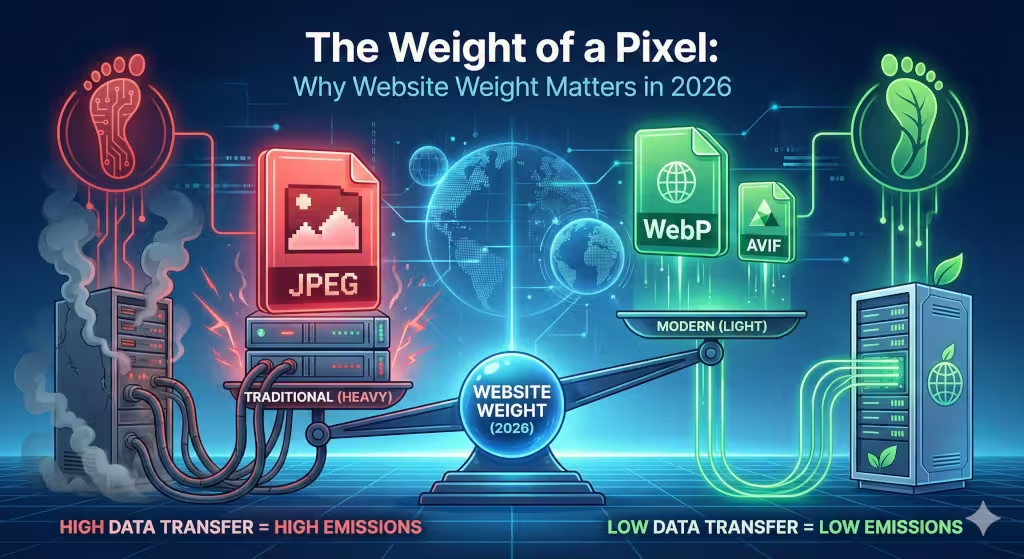
When we talk about website weight, we are talking about the total size of all the files that make up a web page. This includes text, code, videos, and, most importantly, the various image formats you choose to use. In the early days of the internet, pages were mostly text. They were light and fast. But as the years went by, we started adding more and more things to our sites. Today, a typical web page is thousands of times heavier than it was twenty years ago.
You might ask, “Why does the weight of a pixel matter if I can’t feel it?” The answer lies in how the internet actually works. Data does not just float through the air like magic. It travels through a massive network of physical things. Every time you click a link, a request goes to a data center. These data centers are giant buildings filled with thousands of computers called servers. These servers need a lot of electricity to stay running and even more electricity to stay cool.
Once the server finds the data you want, it sends it through cables, under oceans, and through routers until it reaches your device. All of this moving data requires power. In 2026, the internet is responsible for a huge amount of global greenhouse gas emissions. Some experts say it is between 1.5 percent and 4 percent of all the world’s carbon emissions. To put that in perspective, if the internet were a country, it would be one of the biggest polluters on the planet, right up there with the airline industry.
Images are the heaviest part of most websites. They often make up half of the total weight of a page. This is why the specific image formats you pick are so vital. If you use heavy, old-fashioned image formats, you are forcing the internet to work harder. You are using more electricity and creating more carbon than necessary. By switching to more modern image formats, we can “trim the fat” off our websites.
In 2026, we also have to think about our devices. Many people around the world use older phones or have limited data plans. A heavy website takes longer to load on a mobile phone and uses up more of the user’s data. If your page is full of unoptimized image formats, it can make a phone get hot and drain the battery quickly. This is not a good experience for the user. As a professional, my goal is always to provide the best experience with the lowest cost to the environment.
Sustainable web design is not just about being “green.” It is also about being efficient. A light website is a fast website. A fast website makes users happy and keeps them coming back. It also makes search engines happy. In the next sections, we will look at how choosing between different image formats (WebP and AVIF) can help you reach these goals while protecting the world we live in.
Technical Breakdown: WebP (The Versatile Veteran)
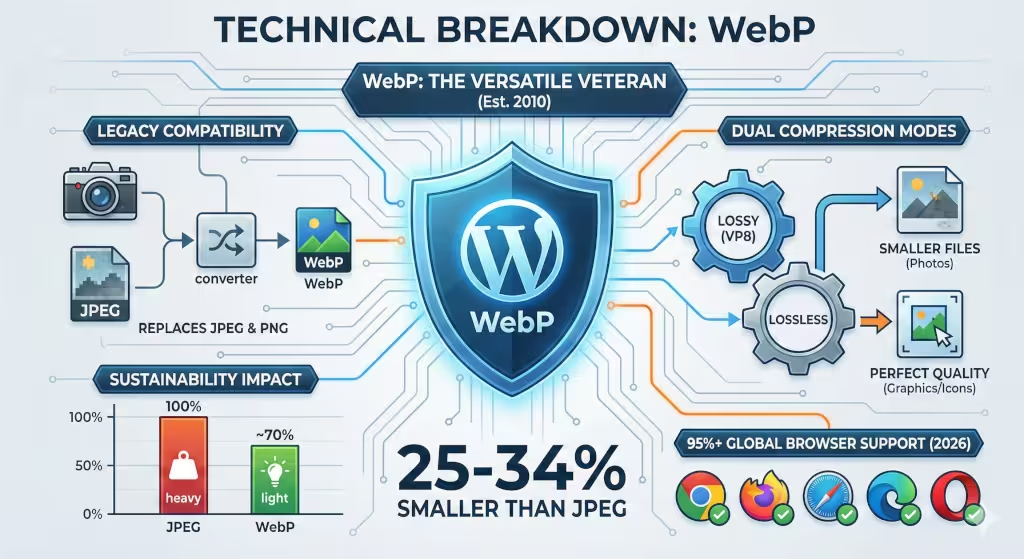
Let us start with WebP. This is one of the most famous image formats in the world today. Google made it many years ago to replace older types like JPEG and PNG. WebP is very smart. It uses a special kind of math to make files smaller without making them look bad. It has two main modes. One is called lossy. This means it removes some tiny details you cannot see to save a lot of space. The other is called lossless. This keeps every single pixel perfect but still makes the file smaller than a PNG.
In terms of sustainability, WebP is a great choice. It is usually 25 percent to 34 percent smaller than a regular JPEG. If you have a website with a lot of photos, switching to these image formats can save a huge amount of data. By the time we reached 2026, almost every web browser started supporting WebP. This makes it a very safe choice for any business. You do not have to worry that someone will see a broken image. It is like a reliable old car that gets great gas mileage. It works for almost everyone and it saves you money and energy.
Technical Breakdown: AVIF (The Efficiency Elite)
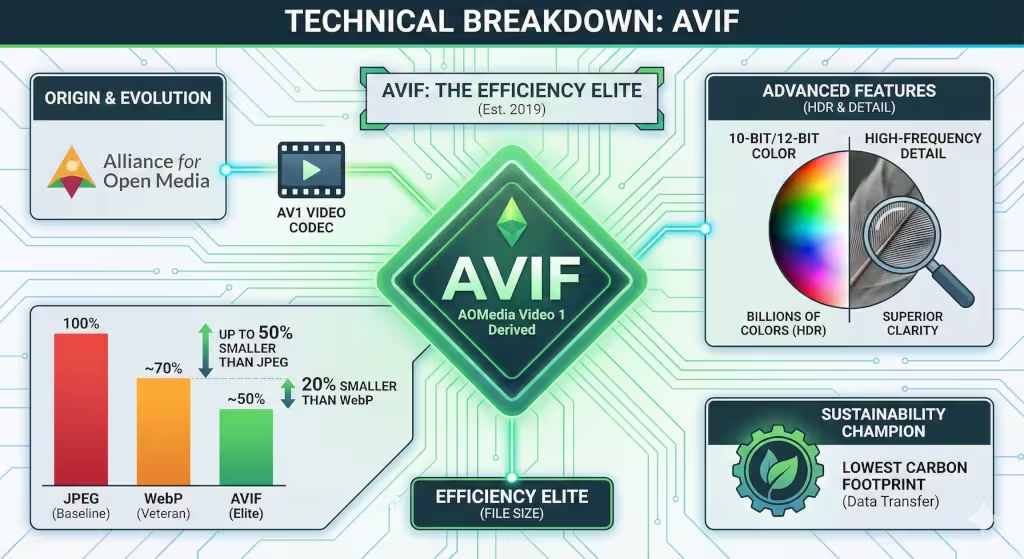
Now let us talk about the relative newcomer that everyone is excited about. This is AVIF. When we compare image formats, AVIF is like the high-tech electric sports car. It was created by a group called the Alliance for Open Media. They used the same technology that makes high-quality videos look good even when the internet is slow. This technology is called the AV1 codec.
AVIF is much more efficient than almost any other option. It can make files that are 50 percent smaller than a JPEG. It is even 20 percent smaller than WebP in many cases. This is a huge win for the planet. Less data means less carbon. But AVIF does more than just save space. It also makes pictures look better. It can handle more colors and better brightness. This is called HDR. It also handles very fine details better than older image formats.
If you want the best quality with the lowest weight, AVIF is the elite choice. It is the gold standard for anyone who cares about being green and being fast. All of our websites produced at Silphium Design use this format, if possible.
The Sustainability Duel: Data Transfer vs. Decoding Energy
There is a debate about which of these image formats is actually better for the earth. Some people say that AVIF is so complex that it takes more battery power for a phone to open the picture. This is called decoding energy.
It is true that a phone has to work a little harder to open an AVIF file compared to a WebP file. However, the energy used to send the data across the internet is much higher. Sending a large file across thousands of miles of cables and through huge data centers uses a lot of power. Because AVIF files are so much smaller, the energy you save by sending less data is much bigger than the extra energy used to open the file.
Therefore, if we look at the total carbon footprint, AVIF is the winner. It is better to have a small file that is a little hard to open than a giant file that is easy to open. When you pick your image formats, always look at the total energy used from start to finish.
Browser Support and Compatibility in 2026
In the past, people were afraid to use new image formats. They were worried that if someone used an old computer, the pictures would not show up. In 2026, this is much less of a problem. Most modern browsers like Chrome, Firefox, Safari, and Edge all work with both WebP and AVIF. However, as a professional, I always recommend having a backup plan.
We use a special bit of code called the picture tag. This allows the website to ask the browser a question. The website says, “Can you show an AVIF picture?” If the browser says yes, it gets the smallest, greenest file. If the browser says no, the website asks, “Can you show a WebP?” If that also fails, it gives them a regular JPEG. This way, no one ever sees a blank space, but most people get the most sustainable image formats possible. This is how we balance being high-tech with being reliable.
SEO, GEO, and AEO: Why the Format Matters
You might wonder why a sustainability expert is talking about search engines. It is because they are all connected. Search Engine Optimization, or SEO, is all about making your site easy for Google to find. Google loves speed. If your site is fast, Google ranks it higher. Since these image formats make your site load faster, they directly help your SEO.
But in 2026, we also have GEO and AEO. GEO stands for Generative Engine Optimization. This is for AI search engines that summarize the web. These AI tools look for websites that are healthy and well-built. A site that uses modern image formats tells the AI that the site is high quality. AEO stands for Answer Engine Optimization. This is for voice assistants like Alexa or Siri. They want to give answers from sites that load instantly. If your pictures are too heavy, those engines might skip your site. By using low-carbon image formats, you are making your site ready for the future of the entire internet.
Common Questions About Image Formats on Websites
We see many people searching for the same answers online. Let us answer some of those now to help you understand better.
Is AVIF better than WebP for SEO?
The short answer is yes, but indirectly. Search engines do not rank you higher just because you use AVIF. They rank you higher because your site is faster. Since AVIF makes files smaller than other image formats, your site will load more quickly. This leads to better scores in things like Core Web Vitals, which Google cares about a lot.
Which image format has the lowest carbon footprint?
Currently, AVIF usually has the lowest carbon footprint. This is because it offers the most compression. When you use less data, you use less electricity. Even though it takes a tiny bit more energy to decode, the savings in data transfer are much larger. It is the best choice for a green website.
Can Google Images index AVIF files?
Yes. By 2026, search engines have become very good at reading these modern image formats. They can see the pictures, read the details, and show them in search results just like they do with JPEGs. You do not have to worry about losing your spot in image search.
Do I need to convert all my old photos?
It is a good idea. If you have an old site with thousands of JPEGs, you are wasting a lot of energy. Many tools can help you change your image formats all at once. This will make your site faster and much more sustainable immediately.
Implementation Guide for 2026
Making your website green does not have to be hard. I like things to be organized and direct. Here is how you can start using better image formats today.
First, you should look at your current website. You can use a tool like Lighthouse or a website carbon calculator. This will show you how much energy your images are using right now. It is often a big surprise to see how much we can save.
Second, use automation. You do not have to change every photo by hand. There are services called Content Delivery Networks, or CDNs. Examples include Cloudinary or Imgix. These services look at who is visiting your site. If they have a new phone, the CDN automatically sends them the AVIF version. If they have an older computer, it sends them WebP. This happens in the blink of an eye. It ensures you always use the best image formats for every visitor without you doing any extra work.
Third, check your settings. If you use WordPress or another system to run your site, make sure you have a plugin that handles image compression. In 2026, many of these systems have built-in support for AVIF. Just turning this on can cut your website’s weight in half. It is one of the easiest ways to meet your sustainability goals.
Strategic Recommendations: When to Use Which Format
At Silphium Design, we believe in using the right tool for the right job. Even though AVIF is great, WebP still has a place in our toolkit. Here is how I recommend using these image formats at Silphium Design LLC.
Use WebP for things like small icons, logos, or simple graphics. WebP is very good at handling transparency. This means it can have a clear background. For very small files, the difference between WebP and AVIF is tiny. WebP is very fast and works everywhere, so it is perfect for the small stuff.
Use AVIF for your big hero images. These are the large photos at the top of your homepage. These are usually the heaviest parts of a website. Because AVIF is so good at squishing large photos without losing quality, it saves the most energy here. Also, use AVIF for any high-quality photography. If you are showing off products or beautiful landscapes, AVIF will make them look amazing while keeping the file size small. By using both of these image formats strategically, you get the best performance and the lowest carbon footprint.
Designing for a Cooler Planet
It is easy to think that one small picture does not matter. But when millions of people look at that picture, the energy adds up. In 2026, being sustainable is not just a nice thing to do. It is a sign of a professional and competent business. Choosing low-carbon image formats: WebP vs. AVIF is a choice to be better. It makes your site faster, it helps your SEO, and it protects our environment.
We should always aim for innovation and data integrity. By moving away from old, heavy image formats, we are building a leaner and greener internet. Whether you choose WebP for its reliability or AVIF for its incredible efficiency, you are making a move in the right direction. Every kilobyte you save is a gift to the planet.
Being interested in improving the energy use of your images shows that you care about the details, and in sustainability, the details are everything.