
Table of Contents
The Operational Bottleneck of the Modern Native Nursery
Running a native plant nursery is very different from running any other kind of retail business. When someone walks into a standard garden center, they usually look for bright annual flowers that bloom for a few weeks in a plastic hanging basket. Those customers want quick color, and they do not ask many questions about ecology, soil organisms, or evolutionary biology.
Running an indigenous or native plant nursery is another story altogether. You are not simply selling potted green goods. You are teaching your community how to restore living ecosystems, clean local water, feed native pollinators, and rebuild regional biodiversity.
Because your plants belong to complex biological systems, your customers arrive with dozens of detailed questions. They want to know which caterpillars feed on your milkweeds, whether your wild bergamot will rot in heavy clay, and how deep the roots of big bluestem will dig into their soil.
When your digital home fails to answer those questions, your nursery faces serious operational friction. A generic digital storefront creates endless confusion for retail customers, overwhelms your greenhouse team with phone calls, and buries your unique plant catalog in static lists that search engines cannot read. Building a specialized native plant website solves these problems from the ground up.
When you build a dedicated native plant website, you turn your digital presence into an automated botanical educator. A thoughtfully designed native plant website relieves the pressure on your staff, teaches your buyers how to plant successfully, and positions your nursery as a trusted ecological authority.
In this comprehensive guide, we will explore the exact technical systems, user experience principles, and educational tools you need to create an exceptional native plant website that drives regional impact and business growth.
The Educational Paradox of Native Retail
Independent nursery owners operate at the intersection of horticulture, ecological science, and regional land stewardship. This position brings deep personal meaning, but it also creates a significant commercial challenge known as the educational paradox of native retail.
In a conventional nursery, plant sales require very little background instruction. An ornamental petunia or a non-native hybrid tea rose does not support specialized local insects. It does not demand a specific native soil fungal community, and it does not need to fit into an established local plant community. Conventional plants are marketed like disposable home decor.
Native species are living members of local wild communities. When a property owner buys a swamp milkweed (Asclepias incarnata) or an eastern columbine (Aquilegia canadensis), that plant carries biological relationships formed over thousands of years. The buyer needs to know the exact moisture tolerances of the plant, its sun exposure requirements, its value to specialist native bees, and whether it will spread by underground rhizomes across a small backyard.
Because customers understand that native plants have specific habitat needs, they hesitate to buy when information is missing. If your digital storefront treats these species like ordinary retail products, your visitors feel unsure of themselves. They abandon their online shopping carts, or they flood your staff with questions before they feel comfortable placing an order. An educational native plant website solves this paradox by placing clear ecological context at the center of every single page.
The Operational Cost of Generic Web Design
Most web designers build online stores using standard templates designed for clothing, consumer electronics, or basic retail goods. When a native plant nursery adopts one of these generic templates, the mismatch creates immediate operational bottlenecks.
The first bottleneck appears in your office and greenhouse. Nursery managers frequently spend fifteen to twenty hours every single week answering basic phone calls and emails from retail buyers. Customers ask if a certain aster will thrive in shade, whether a sedge can handle road salt, or if a particular goldenrod is too aggressive for a neat border garden. Your team ends up typing the same answers over and over again because the nursery site does not explain these details clearly.
The second bottleneck involves inventory tracking. Many growers still publish their seasonal availability as static, downloadable PDF documents. While a PDF may seem easy to upload once a month, it creates serious digital hurdles. Search engines like Google cannot easily extract individual plant attributes from a flat PDF file. Mobile visitors struggle to pinch, zoom, and read multi-column documents on tiny smartphone screens while standing outside in their gardens. Furthermore, a PDF cannot show live inventory updates. A customer might drive forty miles to your nursery to buy an inventory item listed on an outdated PDF, only to discover that the flat was sold out two days prior.
The third bottleneck is the widespread confusion caused by common plant names. Common names vary wildly from county to county and state to state. Three completely different species might all be called “coneflower” or “ironweed” by local gardeners. When a generic storefront relies on common names without scientific accuracy, customers frequently purchase the wrong plant for their site conditions. When the plant struggles or dies, the customer blames their own gardening skills or assumes native plants are difficult to grow. A well-built native plant website eliminates this confusion by using clear botanical naming conventions throughout its catalog.
The Digital Ecosystem: An Automated Botanical Consultant
The central premise of modern ecological web development is straightforward: your digital presence must function as an automated botanical consultant. A modern native plant website does not simply display prices and container sizes. It actively guides, diagnoses, and teaches your visitors throughout their entire shopping journey.
Imagine a digital customer who visits your native plant website on a Tuesday evening. They type in that their property has wet, poorly draining clay soil and receives only three hours of morning sunlight. Instead of forcing them to browse through four hundred plant profiles or download a spreadsheet, your native plant website instantly filters your collection. It presents eight shade-tolerant, wetland-loving native shrubs and sedges that naturally thrive in those exact conditions.
Within minutes, the visitor understands why those plants belong together in nature. They see photos of how the plants look in spring, summer, and winter. They view the exact bird and butterfly species supported by each selection. They place an order for nursery pickup with complete confidence.
Your staff spent zero minutes answering basic phone questions, yet the customer received an accurate, expert consultation. That is the true power of a custom native plant website. By structuring your plant knowledge into an accessible digital format, your nursery saves valuable staff time while helping customers build resilient, beautiful habitats.
Structural Taxonomy Over Generic Catalogs
The Failure of Off-the-Shelf E-Commerce Platforms
When setting up an online store, many business owners turn to standard platforms like basic Shopify, generic Squarespace, or off-the-shelf WooCommerce themes. These systems are engineered around consumer goods. They organize products by straightforward commercial properties such as clothing size, fabric color, brand name, and retail price.
In the world of botany, those standard categories are almost entirely useless. A customer visiting a native plant website does not care what color the plastic nursery pot is. They do not search for plants based on arbitrary commercial SKU codes. They need to find plants based on complex ecological traits that match their specific parcel of land.
When you attempt to force botanical species into an off-the-shelf retail template, your information architecture breaks down. You might try to squeeze soil moisture ratings, sun tolerances, bloom periods, mature heights, and wildlife values into a simple product description text box. While that information is technically on the page, the website cannot sort or filter by those factors. A visitor cannot click a button to isolate plants that tolerate dry shade, because the system treats your detailed biological notes as plain, unorganized text.
To create a truly functional native plant website, your underlying database must treat ecological properties as distinct, searchable data points.
Custom Relational Database Architecture
A high-performing native plant website requires a custom relational database structure. In platforms like WordPress, this is achieved by building custom post types and custom taxonomic relationships that mirror genuine botanical science.
Instead of treating every plant as a simple standalone product, a custom native plant website establishes a clean taxonomic hierarchy:
- Botanical Family: Grouping species by their broader family relationships (such as Asteraceae, Fabaceae, or Poaceae) helps advanced ecological buyers and native plant enthusiasts locate related species.
- Genus: Organizing your catalog by botanical genera establishes scientific credibility and prevents layout errors.
- Specific Epithet: Combining genus and specific epithet creates the precise botanical binomial, such as Symphyotrichum novae-angliae for New England Aster. A custom native plant website makes this scientific name the central database anchor.
- Local Provenance and Ecotype: Native plants possess regional genetic adaptations. A native plant website built for serious restoration work should track the seed collection zone or ecoregion of your stock. Letting buyers see whether your seed originated in their specific river basin or mountain range builds immense trust with conservation buyers.
In addition to this taxonomic tree, a well-engineered native plant website links botanical names to regional common names using alias mapping. If a beginner searches for “butterfly weed”, the site immediately serves Asclepias tuberosa. If another user searches for “orange milkweed” or “chigger flower”, the same native plant website recognizes those regional colloquialisms and directs the user to the exact same plant record without missing a beat.
The Essential Multi-Faceted Filter Matrix
The greatest operational pain point for nursery staff is dealing with customers who do not know what will grow on their land. An advanced native plant website solves this problem through a multi-faceted filter matrix. This tool allows users to select multiple site conditions simultaneously and watch the plant catalog update in real time.
+-----------------------------------------------------------------------------------+
|                        NATIVE PLANT WEBSITE FILTER MATRIX                         |
+-----------------------------------------------------------------------------------+
| 1. Hydrology (Soil Moisture) |  [ ] Hydric (Wet)  [x] Mesic (Medium)  [ ] Xeric (Dry) |
| 2. Solar Exposure            |  [x] Full Sun      [ ] Partial Sun     [ ] Full Shade  |
| 3. Soil Texture & pH         |  [ ] Acidic Sand   [x] Neutral Loam    [ ] Heavy Clay  |
| 4. Ecological Value          |  [x] Host Plant    [x] Specialist Bees [ ] Songbirds   |
| 5. Phenology & Bloom Season  |  [ ] Spring        [ ] Early Summer    [x] Late Autumn |
+-----------------------------------------------------------------------------------+
| Matching Botanical Results: 6 Species Found (Displaying Real-Time Availability)   |
+-----------------------------------------------------------------------------------+
To deliver real value, your native plant website should include these primary environmental filter categories:
- Hydrology and Soil Moisture: Avoid vague terms like “water moderately.” Instead, categorize your species by hydric (wet, saturated, or seasonal standing water), mesic (average garden moisture that drains normally), and xeric (very dry, sandy, or rocky conditions where drought is common).
- Solar Exposure: Provide precise daylight categories. Define full sun as six or more hours of direct light, partial shade as two to six hours of dappled or gentle morning light, and full shade as less than two hours of direct sunlight under a forest canopy.
- Soil Texture and Chemistry: Categorize plants by their ability to thrive in heavy clay, sandy loam, or rocky soils, as well as distinct soil chemistries like acidic pine barrens or alkaline limestone glades.
- Ecological Trophic Value: Many modern buyers plant specifically to support wildlife. Your native plant website should allow visitors to filter for larval host plants, specialized pollen sources for solitary bees, nectar plants for migrating hummingbirds, and high-fat seed sources for overwintering songbirds.
- Phenology and Seasonal Bloom: A balanced wildlife garden needs continuous blooms from early spring through late autumn. Incorporating a bloom-month filter allows gardeners to fill seasonal gaps in their landscapes easily.
Fast Client-Side Search and Dynamic Filtering
Nothing frustrates a digital shopper more than clicking a search filter and waiting five seconds for the entire web page to reload. When customers face slow, clunky page reloads after every single click, they quickly give up and leave your native plant website.
Modern web engineering solves this using asynchronous data querying, often referred to as client-side AJAX or REST API filtering. When a user checks a box for “mesic soil” and “partial shade” on your native plant website, the browser communicates quietly with the database in the background. The catalog updates instantly on the screen without refreshing the header, navigation, or footer.
Providing this smooth, instantaneous filtering makes exploring a native plant website feel like using a fast, responsive software application. It invites users to experiment with different site conditions, discover new species, and build larger plant orders without technical friction.
The Product Detail Page as a Modular Field Guide
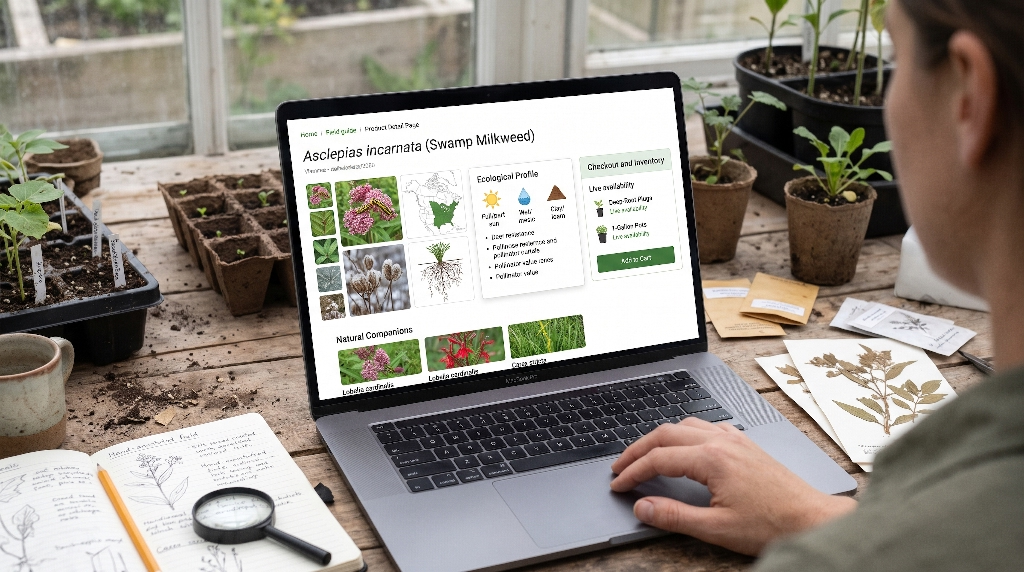
Header and Identification Anchor
When a visitor clicks on an individual species, the product detail page should feel like an interactive, modern field guide. Most retail websites place a large price tag and an “Add to Cart” button at the very top of the page. While an educational native plant website must make buying easy, it must first establish clear, unambiguous botanical identity.
Every plant page on your native plant website should open with a clean identification anchor:
- Primary Botanical Binomial: Display the Latin genus and species in clear, elegant italics with the standard botanical authority citation where appropriate. This anchors the scientific accuracy of your nursery. Note, that the afficinados of native plants will notice if you have it wrong or if it is outdated.
- Recognized Common Names: Display primary common names clearly beneath the Latin title, followed by alternative regional names in smaller type.
- Native Range and Ecoregion Indicators: Use clean badges or small vector maps to show where the plant occurs naturally. Showing that a plant is native to the local Level III or Level IV ecoregion gives restoration professionals immediate confirmation that the plant matches their project criteria.
- Plant Family Association: Listing the botanical family helps customers understand the plant’s broader evolutionary lineage and disease resistances.
By organizing the top of the page in this way, your native plant website immediately reassures botanists, landscape designers, and backyard gardeners that they have arrived at a professional, trustworthy nursery.
Visual Identification Gallery and Descriptive Alt-Text
One of the greatest hurdles in selling native plants online is that many species look unassuming or plain when young in a nursery container. A native perennial plug might appear to be nothing more than three small green leaves in a deep plastic tube. If your native plant website only shows a picture of that green plug, typical retail customers will struggle to imagine its ultimate beauty.
An effective native plant website solves this problem with a comprehensive visual identification gallery:
+-----------------------------------------------------------------------------------+
|               PRODUCT DETAIL PAGE: VISUAL IDENTIFICATION MATRIX                   |
+-------------------------+---------------------------------------------------------+
| [ Primary Photo:        | [ Detail 1: Floral Anatomy & Pollinators ]              |
|   Mature Perennial      | Close-up of nectar tubes, petals, and feeding insects.  |
|   in Full Summer Bloom  +---------------------------------------------------------+
|   Showing Clumping      | [ Detail 2: Foliage & Stem Venation ]                   |
|   Landscape Habit ]     | Clear shot of leaf margins, leaf texture, and stem.     |
|                         +---------------------------------------------------------+
|                         | [ Detail 3: Dormant Winter Seed Structure ]             |
|                         | Architectural seed heads providing bird food in snow.   |
+-------------------------+---------------------------------------------------------+
| Accessible Alt-Text: "Golden-yellow flower heads of Solidago speciosa buzzing with|
| native bumblebees in a late-autumn meadow garden setting."                        |
+-----------------------------------------------------------------------------------+
Each plant profile on your native plant website should show the species across multiple seasons and growth stages:
- Mature Landscape Habit: Show the full-grown plant in a healthy garden or meadow setting so the buyer understands its overall shape and mature size.
- Floral Structure and Pollinator Interaction: Include high-detail closeups of the flowers, especially when visited by butterflies, moths, or bees.
- Foliage Venation and Leaf Form: Provide clear pictures of the leaves, stems, and branching patterns to aid in field identification.
- Winter Structure and Seed Heads: Native plants provide essential winter habitat. Show how the dried seed heads, decorative stems, and seed pods look covered in frost or snow.
- Root System Architecture: When selling restoration species like deep-rooted prairie grasses, diagramming or photographing the root depth helps customers understand why native plants prevent soil erosion and resist severe drought.
Every image uploaded to your native plant website must include descriptive, accessible alternative text (alt-text). Instead of lazy alt-text like “plant-photo.jpg”, write descriptive descriptions such as: “Golden-yellow flower heads of Solidago speciosa buzzing with native bumblebees in a late-autumn meadow garden setting.”
This practice makes your native plant website accessible to vision-impaired gardeners using screen readers. It also gives search engines deep contextual clues, boosting your visibility for specialized botanical image searches.
Micro-Site Compatibility Widget and Companion Planting
To eliminate purchase anxiety, an educational native plant website should feature a micro-site compatibility widget on every plant page. This widget acts as a simple self-diagnostic tool for the customer.
The widget presents a short, scannable table listing the exact tolerances of the plant:
| Environmental Factor | Species Tolerance / Requirement | Diagnostic Check |
| Sunlight | Full Sun (6+ hours direct) | Excellent for open yards, poor for dense woods |
| Moisture | Mesic to Xeric (Dry-leaning) | Avoid low spots with standing water |
| Soil Drainage | Well-drained sand, loam, or rocky soil | Will suffer root rot in compacted, soggy clay |
| Spread Rate | Clump-forming; slow seed distribution | Non-aggressive; safe for small tidy borders |
| Deer Resistance | High (Aromatic volatile oils in foliage) | Rarely browsed by white-tailed deer |
Directly below this diagnostic check, your native plant website should showcase naturally occurring plant companions. In wild ecosystems, plants do not grow as isolated specimens; they thrive in complex phytosociological communities.
When your native plant website displays purple coneflower (Echinacea purpurea), it should automatically query your database and suggest companion species that share the exact same soil and light requirements, such as little bluestem (Schizachyrium scoparium) and butterfly milkweed (Asclepias tuberosa). This educational feature teaches buyers how to design layered, resilient plantings. At the same time, it naturally increases average order value by encouraging customers to buy complete ecological communities rather than single plants.
Live Biological Inventory States
Managing nursery stock is fundamentally different from managing manufactured goods stored on dry warehouse shelves. A sweater or a tool stays the same all year, but a native plant moves through dynamic biological cycles. It emerges from dormancy in spring, flowers in summer, drops seed in autumn, and goes dormant underground in winter.
A specialized native plant website must communicate these biological inventory states with crystal clarity:
- Container and Propagation Types: Clearly distinguish between deep restoration plugs, standard quart containers, one-gallon landscaping pots, bare-root dormant crowns, and cold-stratified seed packets.
- Seasonal Dormancy Notices: When a customer orders a perennial in late autumn or early spring, your native plant website should include an educational note explaining that the top growth may be brown or absent because the plant is resting safely in its winter dormant state.
- Pre-Orders and Release Schedules: Native species often need cold, moist winter stratification before germinating. An advanced native plant website allows customers to pre-order specialty species during winter for pickup or shipment once the root systems are fully established in spring.
Communicating these natural stages directly on your native plant website prevents customer panic, eliminates angry emails, and teaches buyers to work with the seasonal rhythms of native plants.
Solving the E-Commerce and Seasonality Bottleneck
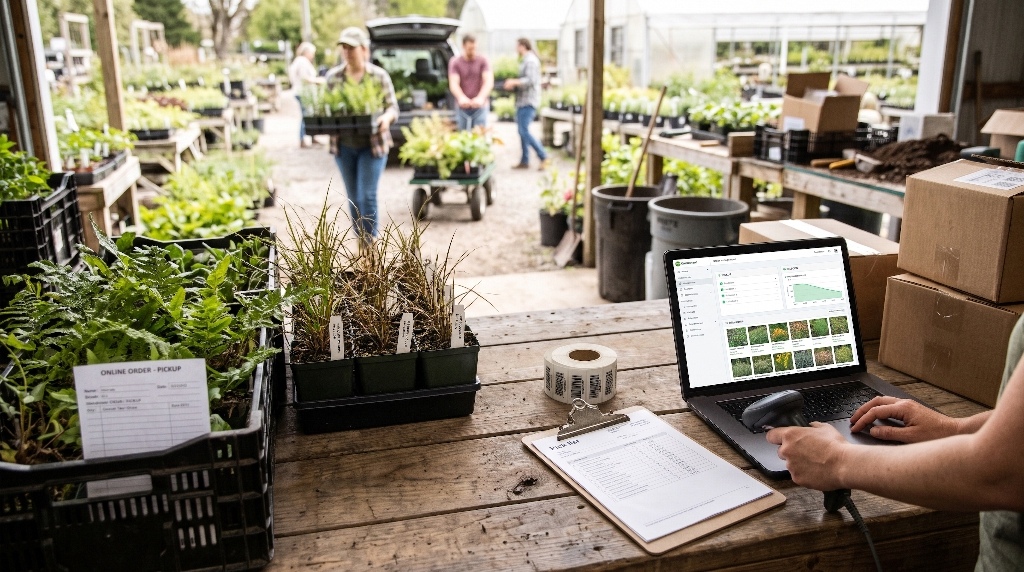
The Nursery Inventory Paradox
One of the greatest headaches for native plant nursery owners is balancing rapid seasonal surges with living, perishable inventory. In many parts of the country, nurseries generate sixty to seventy percent of their retail revenue in a brief eight-week window between April and June.
During this intense spring rush, hundreds of retail customers visit the nursery in person while online orders pour in simultaneously. If your digital inventory is disconnected from your physical sales floor, your nursery faces chaos. You risk selling the exact same flat of maidenhair ferns twice: once to a customer standing at your cash register, and once to an online customer checking out from their home computer.
A professionally engineered native plant website resolves this inventory paradox. It connects your digital sales system directly to your physical nursery workflow, ensuring that your available quantities update automatically across every channel.
+-----------------------------------------------------------------------------------+
|               SYNCHRONIZED BOTANICAL INVENTORY ARCHITECTURE                       |
+-----------------------------------------------------------------------------------+
|                           PHYSICAL NURSERY SYSTEM                                 |
|               Point of Sale (POS) Register / Greenhouse Scanners                  |
+-----------------------------------------+-----------------------------------------+
                                          |
                                [ Two-Way Live Sync ]
                                          |
+-----------------------------------------v-----------------------------------------+
|                          ONLINE NATIVE PLANT WEBSITE                              |
|           E-Commerce Catalog / Wholesale Portals / Retail Customers               |
+-----------------------------------------+-----------------------------------------+
                                          |
                   [ Automated Biological Business Rules ]
                                          |
+-----------------------------------------v-----------------------------------------+
|  - Real-Time Depletion of Retail & Wholesale Stock                                |
|  - Weather-Gated Shipping Windows (Prevents Transit Shock)                        |
|  - Scheduled Curbside Pickup & Delivery Time Slots                                |
+-----------------------------------------------------------------------------------+
Point of Sale and Digital Synchronization
To run a stress-free operation, your native plant website should integrate smoothly with modern point-of-sale (POS) systems like Square, Clover, or specialized nursery inventory software.
When a barcode is scanned at your physical retail register, the underlying database should immediately update your native plant website. When an online customer places an order for five flats of wild geranium, those units should be deducted from your physical sales inventory immediately.
Furthermore, your native plant website should support intelligent shipping rules:
- Regional Climate Gating: Shipping live plants during extreme summer heat waves or severe winter freezes can kill the stock in transit. A native plant website built for plant health can automatically delay live shipments until regional temperatures stabilize, keeping customers informed via automated status updates.
- Scheduled Farm Gate Pickup: Many native nurseries prefer on-farm pickup over postal shipping. Your native plant website should feature integrated scheduling modules that allow customers to select specific pickup time slots. This smooths out weekend customer traffic and allows your greenhouse crew to stage plant orders well in advance.
Segmented Wholesale versus Retail Portals
Many native plant growers operate a dual business model. They sell individual potted plants to local homeowners while selling high-volume flats and contract-grown stock to commercial landscape architects, restoration contractors, and municipal park departments.
Treating wholesale buyers and retail consumers identically on the same native plant website creates operational friction:
- Retail Shoppers: Need rich educational narratives, lifestyle photography, beginner-friendly garden advice, and simple checkout paths.
- Wholesale Contractors: Want rapid order entry, immediate access to container volume discounts, bulk availability sheets, and tax-exempt verification.
A sophisticated native plant website provides a dual-portal architecture. Retail visitors browse the public-facing educational catalog. Meanwhile, registered wholesale partners log into a dedicated wholesale dashboard.
Inside this private portal, commercial contractors can view real-time wholesale pricing, review minimum order quantity thresholds, and submit project-scale plant lists. The native plant website can even allow wholesale clients to download automatically generated botanical cut-sheets containing species specifications, ecotypes, and nursery licensing details for municipal bidding packets.
Biophilic UI/UX and Sustainable Digital Infrastructure

Visual Connection with Nature on Screens
Biophilic design is the practice of incorporating natural patterns, textures, and biological rhythms into human environments. While this concept originated in architecture and interior design, it is equally vital when building digital experiences.
Too many e-commerce sites rely on harsh, sterile user interfaces. They feature stark, clinical white backgrounds, blinding neon accent colors, and frantic, flashing pop-up banners that push aggressive discounts. This commercial approach feels unnatural and unpleasant. It clashes directly with the peaceful, earth-centered values of native plant gardening.
+-----------------------------------------------------------------------------------+
|               BIOPHILIC DIGITAL DESIGN TOKENS (CSS SPECIFICATIONS)                |
+-----------------------------------------------------------------------------------+
| Background Foundations : Soft Mineral Oatmeal (#F9F8F5) / Deep Forest Leaf (#1B2A22)
| Typography Hierarchy   : Humanist Proportional Serifs & Clean Legible Sans-Serifs  |
| Layout Grid Scale      : Modular Ratios Derived from Natural Growth Spirals       |
| Micro-Interactions     : Smooth Easing Curves Mimicking Wind & Water Movement      |
| Visual Resting Zones   : Generous Organic White Space to Prevent Screen Fatigue    |
+-----------------------------------------------------------------------------------+
A biophilic native plant website brings natural harmony to the screen:
- Earthy, Natural Color Palettes: Use digital colors derived directly from real ecological communities. Build your site foundations with warm, mineral-rich tones like soft river-stone greys, warm sandstone, deep leaf-mold browns, and rich forest greens.
- Visual Resting Zones: Nature is never crowded into a frantic, claustrophobic grid. A biophilic native plant website incorporates generous amounts of whitespace, giving the user room to breathe, read, and reflect as they browse through your plant offerings.
- Micro-Interactions that Mimic Nature: Instead of abrupt, jarring page jumps, employ gentle easing animations for dropdown menus and image galleries that reflect the gentle movement of wind or water.
By creating an organic visual environment, your native plant website puts visitors in a calm, receptive frame of mind, making the educational journey pleasant and memorable.
Biomorphic Forms and Cognitive Ease
In addition to color, the physical shapes used across your native plant website influence how visitors feel. Traditional software design relies heavily on sharp right angles, boxy buttons, and rigid grids.
A well-crafted native plant website uses biomorphic forms:
- Softened Geometry: Use gently rounded corners on plant cards, image containers, and search filters that mirror the curves of river stones or rounded leaf margins.
- Proportional Typographic Scaling: Structure your font sizes using mathematical proportions found in natural forms, such as the Fibonacci sequence or the golden ratio. This creates an intuitive visual rhythm that makes long botanical texts easy to read without causing eyestrain.
- Clear Content Hierarchy: Group complex ecological information into clean, accordion-style drawers or tabbed panels. This prevents information overload by allowing curious beginners to read basic planting tips while allowing professional botanists to click deeper for advanced taxonomic data.
Low-Carbon Engineering and Performance
There is a deep irony when an environmental organization hosts a native plant website on heavy, energy-inefficient web servers. The global internet generates billions of tons of greenhouse gases every year, powered by massive data centers running continuously on fossil fuel power grids.
An environmentally conscious nursery should ensure that its native plant website reflects its conservation ethics through sustainable digital engineering:
- Lightweight Code Architecture: Clean up redundant JavaScript libraries, eliminate unnecessary third-party tracking scripts, and streamline CSS stylesheets. A lean native plant website requires far less server processing power, significantly cutting down digital carbon emissions per page view.
- Modern Image Formats: Convert large botanical photographs into cutting-edge WebP or AVIF formats. These file types provide crystal-clear visual detail at a fraction of the file size of older JPEG or PNG images.
- Green Cloud Hosting: Host your native plant website on infrastructure powered by verified renewable energy sources such as wind, solar, or hydroelectric power.
- Superior Core Web Vitals: A lightweight native plant website loads almost instantly, even when a customer is browsing on a weak mobile phone connection in the middle of a remote nursery field or backyard garden. Fast loading speeds directly improve user satisfaction and boost your organic rankings on Google.
Custom Block Systems versus Page Builders
To maintain speed, accessibility, and clean code over time, a modern native plant website should avoid bulky commercial page builders like Elementor or Divi. While these drag-and-drop tools promise convenience, they add thousands of lines of unnecessary code to every page, slowing down your site and causing technical bugs down the road.
Instead, build your native plant website using custom, lightweight WordPress blocks (often called block themes or Full Site Editing blocks). For example, this website uses the Neve theme, which is lightweight and is optimized for the Gutenberg Block Editor.
Custom blocks allow you to create modular, reusable components tailored specifically to nursery operations. You can build a standardized “Plant Profile Block”, an “Ecological Tolerance Block”, or a “Seasonal Bloom Calendar Block” that nursery staff can easily insert into any new page. The user interface remains simple and foolproof for your team, while the front-end code delivered to your visitors remains clean, secure, and lightning-fast.
Educational Content Engines that Pre-Qualify Inbound Leads
Interactive Meadow and Garden Sizing Calculators
One of the most intimidating challenges for homeowners is figuring out how many plants they actually need. When starting a native wildflower meadow or planting a suburban border, customers struggle to calculate plant spacing. If they buy too few plants, aggressive weeds invade the open bare soil. If they buy too many, they waste money and overcrowd their new garden.
Your native plant website can eliminate this guesswork by offering interactive landscape calculators:
+-----------------------------------------------------------------------------------+
|               INTERACTIVE NATIVE MEADOW SIZING CALCULATOR                         |
+-----------------------------------------------------------------------------------+
| Garden Dimensions    : [ Length: 30 ft ]  x  [ Width: 15 ft ]  =  450 sq ft       |
| Planting Style       : ( ) Formal Spacing (18" on-center)                         |
|                        (x) Dense Resilient Community Matrix (12" on-center)       |
+-----------------------------------------------------------------------------------+
| CALCULATED PLANTING FORMULA:                                                      |
| Total Native Plugs Required : 450 Plugs                                           |
| Recommended Community Breakdown:                                                  |
|   - Structural Sedges / Grasses (50%) : 225 Plugs (Carex & Schizachyrium)         |
|   - Seasonal Color Forbs        (40%) : 180 Plugs (Echinacea, Rudbeckia, Aster)   |
|   - Emergent / Groundcover Layer(10%) :  45 Plugs (Fragaria virginiana)           |
+-----------------------------------------------------------------------------------+
| [ Add Entire Native Garden Community Matrix to Cart with One Click ]              |
+-----------------------------------------------------------------------------------+
This interactive tool on your native plant website guides users through a simple process:
- Input Square Footage: The user enters the length and width of their planting bed or meadow project.
- Select Planting Density: The tool lets them choose between formal garden spacing (plants placed eighteen inches apart on center) or a dense, weed-suppressing ecological matrix (plants placed twelve inches apart on center).
- Automated Planting Recipe: The calculator computes the exact number of plants required. Better yet, it automatically divides the total into functional ecological layers: fifty percent matrix grasses and sedges to cover the ground, forty percent seasonal flowering perennials for pollinator support, and ten percent emergent accent species.
- Single-Click Ordering: With one click, the customer adds the balanced plant collection directly to their digital cart on your native plant website.
By offering this interactive tool, your native plant website stops being just a simple product catalog. It becomes an indispensable digital garden designer that pre-qualifies orders and turns hesitant beginners into confident buyers.
Invasive Species Replacement Guides
Every year, millions of property owners decide to remove invasive plants like Japanese barberry (Berberis thunbergii), burning bush (Euonymus alatus), or callery pear (Pyrus calleryana). Once those invasive plants are cleared, homeowners look for beautiful native alternatives to take their place.
Creating dedicated invasive replacement guides on your native plant website generates exceptional organic search engine traffic while performing a vital public service:
- Direct Horticultural Equivalents: Pair every notorious invasive plant with two or three superior native alternatives. For instance, recommend highbush blueberry (Vaccinium corymbosum) or fragrant sumac (Rhus aromatica) to replace burning bush, showing how native shrubs deliver brilliant scarlet autumn foliage while feeding local songbirds.
- Comparison Tables: Show side-by-side comparisons highlighting the wildlife benefits, drought hardiness, and non-destructive root habits of native species over their invasive counterparts.
- Targeted Regional Search Keywords: Many homeowners search Google for phrases like “what to plant instead of burning bush in Pennsylvania.” Having these educational landing pages on your native plant website captures those motivated buyers at the exact moment they are looking for replacements.
Site Preparation Playbooks
The number one reason newly planted native gardens struggle is improper site preparation. If a homeowner plants delicate native seeds or plugs directly into an established lawn full of aggressive turf grass and buried weed seeds, the turf grass quickly chokes out the young perennials. When plants fail, disappointed customers often contact the nursery asking for refunds.
An educational native plant website protects your customers and your reputation by publishing detailed site preparation playbooks:
- Smothering and Sheet Mulching: Provide clear, step-by-step guides on how to use unprinted cardboard, leaf compost, and wood chips to kill existing lawns naturally without resorting to chemical herbicides.
- Solarization and Occultation: Explain how to use clear greenhouse plastic or heavy black silage tarps over several summer months to heat the soil, kill weed seed banks, and prepare smooth, clean seedbeds.
- Managing Soil Biology: Teach buyers why synthetic chemical fertilizers often harm native plants by encouraging invasive weeds and disrupting natural mycorrhizal fungi networks in the soil.
When your native plant website teaches customers how to prepare their soil properly, their plantings thrive. Satisfied customers become passionate native plant advocates who return to your nursery year after year to expand their gardens.
Local Search Engine Optimization (SEO) for Regional Growers
Native plant nurseries are regional by nature. A nursery in the Ridge and Valley province of East Tennessee or Western Pennsylvania grows plants specifically adapted to those regional climates, soils, and elevations. Therefore, your native plant website must dominate local and regional search results.
+-----------------------------------------------------------------------------------+
|               REGIONAL LOCAL SEO & SCHEMA ARCHITECTURE                            |
+-----------------------------------------------------------------------------------+
| Google Search Engine Query: "Native wetland shrubs for rain gardens near me"      |
+-----------------------------------------------------------------------------------+
                                          |
                                    [ Matches ]
                                          |
+-----------------------------------------v-----------------------------------------+
| Structured Schema.org Microdata on Native Plant Website:                          |
|   - LocalBusiness: Physical Nursery Coordinates, Growing Hours, Regional Delivery |
|   - Product Data : Botanical Binomials, Live Pot Availability, Regional Hardiness |
|   - Ecoregion Data: Level III / IV Ecoregion Provenance Metadata                  |
+-----------------------------------------------------------------------------------+
| Result: Premium Local Pack Placement & Rich Botanical Search Snippets             |
+-----------------------------------------------------------------------------------+
To maximize your visibility, optimize your native plant website for local ecological searches:
- Structured Schema.org Microdata: Embed structured digital markup into your plant pages. Use detailed
LocalBusiness,Product, andItemAvailabilitymicrodata tags. This structured code tells search engines your exact physical location, store hours, retail prices, and live inventory levels, allowing your nursery to appear in rich search snippets and Google Maps local packs. - Targeting Regional Watersheds and Ecoregions: Optimize your content not just for basic city names, but for regional geographic landmarks. Create pages targeting regional watershed basins, local county conservation districts, and municipal rain garden incentive programs.
- Botanical Keyword Distribution: Ensure that your target search terms, including the phrase native plant website, appear naturally throughout your site content. By integrating natural search language into informative articles, species profiles, and planting guides, your native plant website naturally climbs to the top of search rankings.
Why You Should Use Silphium Design
The Native Nursery Website Audit Checklist
Throughout your educational blog post, you should provide practical tools that help nursery owners assess their current digital strengths and weaknesses. A proven method for capturing interest is the Native Nursery Website Audit Checklist.
This diagnostic tool allows growers to evaluate their own digital operations quickly:
- Taxonomic Searchability: Does your catalog allow users to search instantly by scientific Latin binomials as well as regional common names?
- Ecological Filtering: Can a visitor filter your plants simultaneously by soil moisture, solar exposure, and wildlife value without page reloads?
- Mobile Greenhouse Usability: Can a customer standing outside in your nursery yard easily view inventory and read plant profiles on a smartphone?
- Live Inventory Integration: Is your digital catalog tied directly to your physical checkout register to prevent double-selling stock?
- Educational Field Guides: Does every plant profile explain mature size, companion plants, and seasonal dormancy states clearly?
- Accessible Visuals: Are your plant images supported by descriptive alt-text highlighting botanical identification features?
- Wholesale Accessibility: Do commercial contractors have a dedicated, password-protected portal to review wholesale volume pricing and bulk availability?
- Digital Carbon Footprint: Is your site engineered with lightweight code and hosted on renewable-powered servers that reflect your environmental values?
When nursery owners review this checklist, they quickly realize how many operational bottlenecks stem from an outdated or generic online setup. This realization opens the door for meaningful professional collaboration.
Bridging the Technical Resource Gap for Growers
Native plant nursery owners and professional propagators possess incredible botanical expertise. They know how to collect wild seeds ethically, break seed dormancy using complex stratification protocols, manage delicate greenhouse microclimates, and identify rare sedges in the field.
However, running a production nursery leaves very little time to master relational database design, write custom CSS stylesheets, configure REST API endpoints, or optimize Core Web Vitals. Nursery owners should not have to spend their evenings troubleshooting broken website plugins or wrestling with generic e-commerce templates that fail to understand basic botany.
Building an exceptional native plant website requires a design partner who speaks both fluent code and fluent botany. This is where Silphium Design stands in a class of its own.
The Silphium Design Partnership and Custom Audit Invitation
Silphium Design was founded specifically to bridge the divide between ecological science and cutting-edge web architecture. We do not build cookie-cutter storefronts using generic commercial templates. We build bespoke digital ecosystems designed around the real-world operational needs of native plant nurseries, environmental non-profits, and ecological restoration professionals, leaning on our experience in the botany and ecological fields.
When your nursery partners with Silphium Design, you work directly with experts who understand the difference between an ecotype and a cultivar, who appreciate why soil hydrology matters, and who know how to translate complex botanical data into intuitive, biophilic digital tools.
We design websites that automate your customer education, eliminate repetitive phone inquiries, streamline your physical and digital inventory, and present your nursery as the premier ecological authority in your region.
If your nursery is ready to eliminate administrative bottlenecks, expand its regional reach, and provide an unforgettable educational experience for your community, we invite you to take the next step.
Visit Silphium Design today to request a comprehensive Digital Systems and Biophilic UX Audit. Our team will evaluate your current digital setup, identify your operational bottlenecks, and provide a clear, actionable architectural plan to build the ultimate native plant website for your business. Let us handle the digital engineering so you can focus on what you do best: growing the plants that heal our living world.