
Table of Contents
The Intersection of Computational Intensity and Ecology
The internet feels weightless. When you browse a webpage, click a link, or ask a question in a chat box, nothing feels heavy. You do not hear an engine humming or see exhaust rising into the air. Yet, every single interaction on a screen pulls electricity from a real power station. Every image loaded, font downloaded, script executed, and database checked burns energy. When we add artificial intelligence into web development, that energy use grows very fast.
Web designers, who are cognizant of their impact on the environment, face an interesting challenge. On one hand, automated machine learning tools help us build websites faster. They write lines of code, edit layout variations, generate graphics, and summarize articles in seconds. On the other hand, the physical computers running these models consume massive amounts of power and clean water for cooling. This reality is why ethical ai practices have become a central topic in modern web creation.
True green web design is not just picking a palette of soft forest greens or putting a photograph of a fern in your hero banner. Green web design is the deliberate engineering discipline of reducing data transfer, minimizing server workloads, and lowering the carbon emissions of digital products. When we merge this work with artificial intelligence, we must ask hard questions. Where does the power come from? How much electricity does this feature consume every time a visitor visits the page? Does this algorithm actually help the visitor, or is it just digital clutter?
Following ethical ai practices means looking at your entire digital system as part of the living natural world. In biology, living organisms survive by being efficient with energy. A plant does not grow leaves it cannot support, and an animal does not sprint when a slow walk will do. Digital systems should follow that exact same balance. By embracing ethical ai practices, web teams can harness smart automation without causing environmental harm.
Throughout this guide, we will look and examine the practical steps you can take to unite artificial intelligence and sustainable web development. We will explore how computer hardware impacts the natural world, how to choose the right size algorithm, and how to build websites that run cleanly, quickly, and fairly for every person who visits.
The Invisible Footprint: Auditing AI Compute in Digital Environments
To understand how ethical ai practices fit into digital design, you must understand where digital pollution starts. Many people assume software lives in a floating cloud. In reality, the cloud is made of massive concrete buildings packed with steel racks of computer processors, storage drives, power supplies, and cooling systems.
When you use artificial intelligence on a website, energy is burned in two main phases: training and inference.
Training is the first phase. This is when an algorithm studies millions of text documents or billions of images to learn patterns. Training a huge machine learning model can consume hundreds of megawatt hours of power. That equals the total electrical consumption of dozens of average homes over an entire year. In addition, training requires thousands of gallons of fresh water to keep computer chips from overheating. Teams dedicated to ethical ai practices pay close attention to this upfront cost before they choose to build or adopt an artificial intelligence system.
Inference is the second phase. Inference happens every time someone uses the model after it is built. For example, if you place an automated assistant on your website homepage, inference occurs every time a visitor types a question and the software generates an answer. While a single inference request uses less electricity than training, inference happens over and over, thousands or millions of times every day.
If ten thousand people visit your website every morning and an artificial intelligence tool runs dynamic calculations for each one of them, your inference energy costs skyrocket. This continuous computation consumes power from local electrical grids. Depending on where the data center sits, that power often comes from burning natural gas or coal.
Understanding the difference between training and inference is critical for ethical ai practices. Web designers need to audit every automated feature they place on a page. You should ask yourself:
- Does this feature require real-time computation every time the page loads?
- Can the result be calculated once, saved, and served as a simple static file?
- Does this feature justify the continuous electrical load it places on global infrastructure?
By conducting regular technical audits of your digital footprint, you turn abstract concepts into measurable data. Measuring these factors is the bedrock of ethical ai practices in any serious digital project.
Pillar 1: Algorithmic Efficiency and Model Right-Sizing

In traditional software design, developers often grab the largest, most famous tool available. If someone wants an automated text assistant, they connect their website directly to a massive commercial large language model. However, using a massive multi-billion parameter model to handle simple website navigation is like driving a heavy industrial bulldozer to the grocery store to buy a carton of milk. It works, but it wastes an enormous amount of fuel.
One of the most effective ethical ai practices is model right-sizing. Right-sizing means selecting the smallest, simplest algorithm capable of solving the specific user problem. If a visitor simply needs to search your blog archive or filter products by price, you do not need an enormous generative engine running in the background. A lean search index or a compact algorithm with fewer parameters will complete the task faster, cheaper, and with a fraction of the electricity.
Techniques such as model pruning and quantization play a huge role in ethical ai practices. Model pruning cuts away unnecessary pathways in a neural network that do not contribute meaningfully to the output. It is very similar to pruning dead branches from a fruit tree to help the plant direct its sap toward healthy growth. Quantization reduces the numerical precision of the weights inside the model. Instead of using complex numbers that take up lots of memory space, it uses simpler numbers that modern computer processors can calculate using far less electrical energy.
Another major question is where the computation physically occurs. Designers committed to ethical ai practices regularly compare edge computing with centralized cloud servers. In some cases, running a small, distilled model directly inside the user’s web browser using modern web technologies avoids long round-trip network requests to distant server farms. However, you must also be careful not to drain the visitor’s phone or laptop battery. Draining a visitor’s mobile device battery forces them to plug their device into a wall outlet sooner, shifting the carbon footprint directly to the consumer.
Balancing these trade-offs requires discipline. When you commit to ethical ai practices, you do not choose technology because it is trendy. You choose technology because its mathematical architecture matches the exact size of the task at hand.
Pillar 2: Green Infrastructure and Carbon-Aware Workflows

Choosing a smart algorithm is only half the battle. You must also consider where that code runs and what energy source feeds the electrical outlet. The physical location of a web server determines whether your website runs on solar and wind energy or fossil fuels. Therefore, selecting verified green web hosting is a central requirement of ethical ai practices.
A green host operates data centers powered by dedicated on-site renewable energy or holds verified contracts for local clean power. Look for data centers with a low Power Usage Effectiveness rating. Power Usage Effectiveness measures how efficiently a facility delivers power directly to the computer equipment rather than wasting it on giant air conditioning fans or power transformers. A perfect score is 1.0, and modern green facilities strive to stay close to 1.1 or 1.2.
Beyond selecting a green host, ethical ai practices include using carbon-aware computing workflows. The carbon intensity of an electrical grid changes hour by hour. On a windy afternoon or a bright sunny morning, local power grids often produce an excess of clean electricity. In the evening, when the wind dies down and solar panels stop producing power, utilities turn on natural gas plants to meet energy demands.
Carbon-aware web systems use software scripts to check regional grid data in real time. If your website needs to run heavy artificial intelligence tasks, such as generating batches of image thumbnails, indexing thousands of articles, or re-training an internal search engine, you can schedule those background tasks to run automatically when the local grid is full of clean energy. Postponing non-urgent computations until clean energy is abundant is one of the smartest ethical ai practices a developer can use.
Caching is another vital green web development strategy. Caching means saving a completed calculation so you do not have to perform it again. When an artificial intelligence model generates an optimized asset, layout, or summary, an efficient web system saves that result as a plain text or image file. When the next visitor requests that page, the server delivers the saved file instantly without waking up the heavy processor chips. Avoiding unnecessary repetitive calculations is an easy, highly effective way to honor ethical ai practices.
Pillar 3: Data Minimization and Privacy as Ecological Restraint
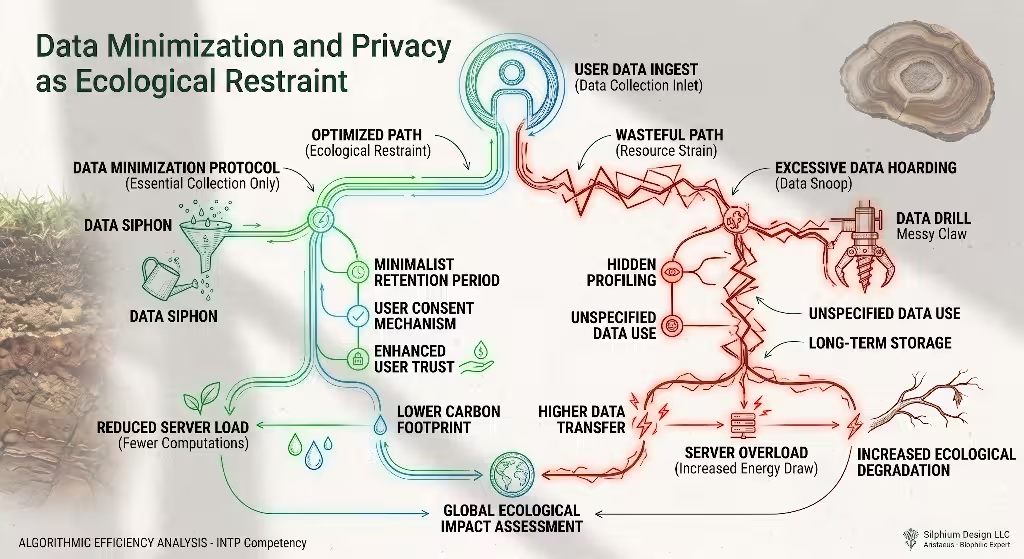
There is an unbreakable link between human privacy and environmental sustainability. For the past twenty years, the internet has operated on an extractive business model. Companies track every mouse movement, record every click, store endless personal details, and hoard massive piles of data. Then, they feed this data into automated models to predict what users will buy next.
Every byte of data collected must be transferred across miles of fiber-optic cables, processed by network routers, and stored permanently on banks of hard drives that run twenty-four hours a day. Massive databases require constant electrical power to keep running and continuous cooling to stay stable. From an environmental view, excessive data collection is pure digital waste.
Embracing ethical ai practices means adopting the principle of data minimization. Data minimization means you only collect and keep the exact information needed to deliver a specific service to the visitor right now. If a user visits your website to read an article, you do not need to track their physical location, their device battery level, or their browsing history across other tabs. By refusing to harvest useless behavioral telemetry, you cut down your database size, reduce server requests, and lower electrical consumption.
Data minimization also protects fundamental human rights. Websites that follow ethical ai practices do not sell user behavioral trails to third-party data brokers or feed private personal conversations into shared commercial models. When web teams integrate artificial intelligence interfaces, they should implement strict zero-retention policies. This means that once a visitor finishes their session, their private prompts and personal information are discarded rather than saved to train future iterations of the software.
Choosing data sufficiency over data hoarding reflects the core philosophy of ethical ai practices. You build trust with your readers while simultaneously trimming away the heavy computational weight that harms our shared climate.
Pillar 4: Biophilic Design Principles and Digital Biomimicry
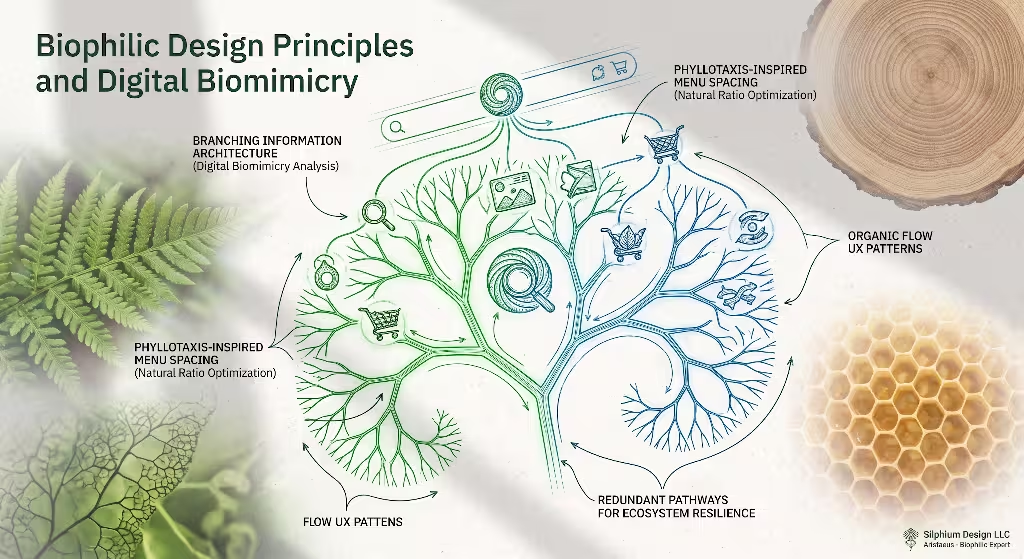
Biophilic design is the practice of connecting people with the natural world within human-made environments. In physical architecture, this means adding sunlight, natural wood, living plants, and fresh air to buildings. In digital design, biophilic principles guide us to create web environments that feel calming, natural, and restorative rather than noisy, chaotic, and exhausting.
Nature operates through elegant, balanced systems. An ecosystem does not waste resources, nor does it bombard organisms with frantic, unnatural stimulation. When we apply these observations to websites, we see how ethical ai practices align naturally with biophilic web design.
Many websites today use artificial intelligence algorithms to maximize screen time. These systems track user habits to generate addictive feeds, intrusive pop-up messages, and endless notifications. These features consume heavy computational energy while causing mental fatigue and stress for the user. Ethical ai practices reject these manipulative design tricks. Instead, we use intelligent automation to streamline user tasks so people can find the information they need quickly and get back to their real lives outdoors.
Visually, biophilic web design takes inspiration from organic forms, balanced geometries, and natural light patterns. For example, implementing an ambient or phenological dark mode is an excellent way to connect biophilic aesthetics with energy reduction. A phenological theme automatically adjusts its contrast, colors, and brightness based on the natural day and night cycles of the local environment.
On modern screens, especially OLED displays, darker pixels consume substantially less electrical power than bright white pixels. In an OLED panel, each individual pixel creates its own light. When a pixel is black, it is turned off completely, drawing zero electricity. By using calming, earth-toned dark modes that reflect evening light, you protect the reader’s eyes from harsh glare, support healthy circadian sleep cycles, and save device battery life. Combining visual tranquility with technical efficiency demonstrates the true creative power of ethical ai practices.
Pillar 5: Inclusive Accessibility Without Automated Band-Aids

A sustainable website must be accessible to everyone, including people who are blind, deaf, neurodivergent, or navigating with motor challenges. In recent years, many companies have attempted to take shortcuts by installing third-party automated accessibility overlay plugins. These tools claim that a single line of automated JavaScript can instantly make any website compliant with accessibility laws.
In reality, these automated overlays often fail completely. They frequently conflict with the screen readers and assistive keyboards used by disabled individuals, creating major barriers instead of removing them. Furthermore, these overlay scripts add heavy JavaScript files to every single page load, slowing down the website and consuming extra processor energy. Relying on superficial automated widgets is the exact opposite of ethical ai practices.
Real digital accessibility requires building a solid foundation using clean, semantic HTML code. However, artificial intelligence can still serve as a valuable assistant when guided by human hands. This cooperative approach is called human-in-the-loop design.
For example, machine learning vision tools can scan an image and draft descriptive alternative text (alt text) for visually impaired visitors. But automated software often makes mistakes or misses critical cultural nuances. A responsible web author uses the tool to generate a starting draft, checks it carefully, edits it for clarity, and confirms that it accurately describes the image in context.
Ethical ai practices ensure that automated tools assist humans rather than replace human judgment. When you combine lean code, thoughtful human editing, and high-contrast typography that meets accessibility guidelines, you build an inclusive digital platform that respects both human diversity and environmental boundaries.
Practical Implementation: The Sustainable AI Web Stack Checklist
Transforming ideas into action requires clear, structured engineering standards. If you want your web projects to demonstrate ethical ai practices, use this technical checklist during your planning, building, and launch phases:
+--------------------------------------------------------------------------+
|                 SUSTAINABLE AI WEB STACK AUDIT CHECKLIST                 |
+--------------------------------------------------------------------------+
| 1. ARCHITECTURAL SIZING                                                  |
|   [ ] Chosen the smallest viable model architecture for the specific job |
|   [ ] Evaluated rule-based scripts before adding machine learning tools  |
|   [ ] Pruned and quantized models to minimize memory and compute load    |
|                                                                          |
| 2. ENERGY & HOSTING PROVENANCE                                           |
|   [ ] Verified host uses renewable energy contracts (PUE under 1.2)      |
|   [ ] Configured carbon-aware schedulers for non-critical computing      |
|   [ ] Enabled aggressive edge caching for all generated dynamic outputs  |
|                                                                          |
| 3. DATA RESTRAINT & PRIVACY                                              |
|   [ ] Enforced strict data minimization (zero useless behavioral tags)   |
|   [ ] Established zero-data-retention agreements with all API vendors    |
|   [ ] Removed heavy third-party surveillance scripts and user tracking   |
|                                                                          |
| 4. BIOPHILIC & USER-FIRST UX                                             |
|   [ ] Built an organic, uncluttered visual hierarchy without dark tricks |
|   [ ] Implemented battery-saving, circadian-aligned dark modes           |
|   [ ] Set a strict total page weight budget (aiming under 500 Kilobytes) |
|                                                                          |
| 5. ACCESSIBILITY & GOVERNANCE                                            |
|   [ ] Rejected automated overlay widgets in favor of native semantic code|
|   [ ] Applied human-in-the-loop review for all computer-generated text   |
|   [ ] Audited the site against Web Sustainability Guidelines (WSG)       |
+--------------------------------------------------------------------------+
To run this checklist effectively, web designers rely on dedicated auditing tools. Platforms like Ecograder, the Web Carbon Calculator, and Google Lighthouse allow you to measure your page weight, script execution times, and estimated emissions per view.
If your website payload is several megabytes, your site is too heavy. Ethical ai practices encourage designers to set a strict page weight budget, ideally keeping the entire page under 500 Kilobytes. When you limit your file sizes, pages load instantly, older mobile devices run smoothly without overheating, and total data transfer across global networks drops significantly.
Frequently Asked Questions about Ethical AI Practices
How does artificial intelligence impact the carbon footprint of a website?
Artificial intelligence increases a website’s carbon footprint by demanding significant computing power during training and inference. When an automated model generates dynamic text, optimizes images, or runs user-facing chat tools, it activates specialized server processors that consume substantial amounts of electricity. If that electricity comes from power plants burning fossil fuels, each query contributes directly to atmospheric carbon emissions. Applying ethical ai practices helps teams audit, reduce, and neutralize this energy drain.
Can AI be used to make web design more sustainable?
Yes, when used with clear intention, artificial intelligence can help make web design more sustainable. Developers can use specialized algorithms to discover unused CSS styles, compress large image files into lightweight modern formats, and balance server traffic efficiently. Using automation to eliminate digital waste is an excellent demonstration of ethical ai practices, provided the energy saved by the optimization is greater than the energy burned to run the algorithm itself.
What is the difference between ethical AI and green web design?
Ethical AI focuses primarily on fairness, user privacy, intellectual property rights, and transparency in automated software systems. Green web design focuses on reducing the physical energy use, carbon emissions, and material waste of internet infrastructure. Ethical ai practices in web development unite both disciplines, ensuring that digital systems treat human beings with respect while protecting the living ecosystems of our planet.
How do you measure digital carbon emissions from machine learning models?
Measuring carbon emissions requires tracking the total electrical power consumed by hardware during a computing task and multiplying it by the carbon intensity of the local power grid. Developers utilize measurement frameworks such as CodeCarbon, the Sustainable Web Design model, and telemetry tools from cloud providers. Tracking these numbers allows web creators to prove the real-world value of their ethical ai practices over time.
The Forward Outlook
The future of web development will be decided by how responsibly we manage our shared resources. For years, the digital industry operated under the false belief that virtual tools have no physical consequences. Today, the rapid expansion of automated computing has revealed the limits of that mindset. Every digital decision is an environmental decision.
Green web design does not mean walking away from modern technological progress. It means approaching technology with mature craftsmanship, ecological restraint, and deep professional care. By placing ethical ai practices at the core of our development habits, we build websites that load rapidly, respect user privacy, and conserve planetary energy.
As digital creators, we must look to the wisdom of natural ecosystems. Nature thrives through cooperation, elegant efficiency, and purposeful balance. When we design websites that reflect these natural truths, we build a digital world that serves humanity while honoring the living Earth. Embracing ethical ai practices is our opportunity to build an internet that lasts.