
Table of Contents
When you work with decentralized networks like Mastodon, you quickly realize that standard marketing playbooks do not work here. That is especially true when it comes to social listening tools.
If your team is trying to figure out what people are saying across the Fediverse, you have probably noticed that standard web monitoring software leaves massive blind spots. In this guide, we are going to explore how modern social listening tools function in a federated world, how to choose the right social listening tools for your brand, and how to monitor conversations respectfully without breaking community trust.
The Decentralized Shift: Why Traditional Social Listening Fails on the Fediverse
For over fifteen years, digital marketers relied on a very simple setup for brand tracking. Corporate platforms like Twitter, Facebook, and Reddit kept all their user data inside giant private data warehouses. When companies built social listening tools, they only had to buy access to an enterprise application programming interface, often called a firehose. This firehose delivered every public post, reply, and like directly into a single database.
On the Fediverse, that model does not exist. The Fediverse is not a single website run by one corporation. Instead, it is a vast, interconnected network made up of thousands of independent servers. These independent servers talk to each other using an open web standard called ActivityPub. Because there is no central owner, there is no single master database to tap into. This fundamental structural difference is why legacy social listening tools fail when they try to monitor decentralized networks.
+-----------------------------------------------------------------------+
|                     TRADITIONAL VS. FEDIVERSE DATA                    |
+-----------------------------------------------------------------------+
| TRADITIONAL (Centralized Firehose):                                   |
|   [ All Users ] ---> [ Single Corporate Server ] ---> [ Single API ]  |
|                                                                       |
| FEDIVERSE (Decentralized Mesh):                                       |
|   [ Server A (Tech) ] <====== Federated ======> [ Server B (Art) ]    |
|            ||                  Relays                  ||             |
|            ||                                          ||             |
|   [ Server C (News) ] <=======================> [ Server D (Local) ]  |
+-----------------------------------------------------------------------+
The Death of the Centralized Firehose
The central firehose made data collection easy for old marketing platforms, but it also created severe limitations for user privacy. In a centralized system, one company sets the rules, sells user data to advertisers, and controls the search index.
When you look at social listening tools designed for decentralized media, the architecture looks completely different. There is no single master switch or single API endpoint that collects every post across the globe. A post published on a Mastodon server in Germany might only travel to servers that have users following that specific author. If no user on a server in Canada follows that author, the Canadian server might never receive a copy of that post.
This means that social listening tools cannot simply query one corporate server and expect to see the whole world. Modern social listening tools must actively participate in the federation network. They must connect to multiple server streams, subscribe to public relay hubs, and aggregate data across independent communities in real time. For social media teams, this requires a big mindset shift. You are no longer just pulling records from a giant data silo. You are listening to a living, distributed conversation across thousands of neighborhood servers.
The Instance Topology Challenge
To understand why standard monitoring fails, you have to look at instance topology. An instance is just an independent server running software like Mastodon, Pixelfed, Lemmy, or PeerTube.Each instance has its own administrator, its own moderation rules, its own database, and its own local community culture.
Instances connect with each other through peer-to-peer relationships known as federation. When two instances federate, they pass public messages back and forth. However, server administrators can also decide to block or restrict other servers. This process is called defederation.
If Server A decides to defederate from Server B because of spam or policy violations, the two servers stop talking entirely. A user on Server A will never see posts from Server B, and Server B will never receive updates from Server A.
For developers building social listening tools, instance topology creates a complex puzzle:
- Fragmented Data Feeds: Because servers hold their own local records, social listening tools must connect to many distinct entry points to gather a wide view of public chatter.
- Varying Server Policies: Some instances allow public search indexing, while other instances explicitly forbid automated data collection in their terms of service. Effective social listening tools must respect these server-level rules.
- Dynamic Network Boundaries: As servers join the network, leave the network, or defederate from one another, the flow of public information changes constantly. Robust social listening tools must adjust to these shifting boundaries automatically.
When you use social listening tools built for the Fediverse, you are not getting a static snapshot. You are navigating an active network topology that changes every single day.
Why Brands Need Fediverse Listening Now
You might wonder why your business should invest in social listening tools for decentralized networks in the first place. The answer comes down to audience quality, industry influence, and platform resilience.
The Fediverse is home to millions of active professionals, software developers, academics, journalists, artists, and privacy advocates. When key technical communities, open-source projects, and industry leaders talk about software bugs, brand reputations, or emerging market trends, they increasingly hold those conversations on Mastodon and federated platforms.
Furthermore, major technology platforms are adopting the ActivityPub protocol. With Meta federating Threads into the ActivityPub ecosystem and cross-network bridges like Bridgy Fed linking different networks, the total reach of the Fediverse is expanding rapidly.
If your organization only monitors legacy social networks, you are missing crucial conversations:
- High-Intent Feedback: Software developers and technical buyers often post detailed product reviews, integration issues, and tool recommendations on Mastodon long before writing a blog post.
- Early Crisis Detection: Journalists and industry analysts frequently discuss developing news and corporate announcements within decentralized communities first.
- Authentic Community Sentiment: Because there are no corporate algorithms boosting outrage for ad clicks, conversations on the Fediverse reflect genuine user sentiment.
Deploying dedicated social listening tools allows your team to keep an ear to the ground, protect your brand reputation, and discover product feedback that standard platforms miss entirely.
Top Social Listening Tools That Support Fediverse Monitoring

Choosing the right software depends heavily on your team goals. Some marketing teams need high-level demographic reports, while customer support teams need immediate alerts whenever a user mentions a product bug. Below, we break down the leading social listening tools that support Fediverse tracking, comparing their data collection methods, core strengths, and limitations.
| Tool Name | Core Purpose | Data Ingestion Method | Best Suited For |
| Fedica | Audience intelligence and multi-platform analytics | Direct Mastodon API and scheduled sync | Marketing teams and content strategists |
| Syften | Real-time keyword alerts and buying intent tracking | Public instance monitoring and filtered webhooks | DevRel teams, customer support, and founders |
| Enterprise Suites (Brandwatch, Meltwater) | Global brand monitoring and PR crisis management | Multi-instance connectors and partner data feeds | Enterprise PR departments and global agencies |
| Custom Relay Ingestion | Full data control and internal compliance | Direct WebSockets and ActivityPub JSON-LD feeds | Engineering teams and security analysts |
+-----------------------------------------------------------------------+
|                    TOOL ECOSYSTEM BY SPECIALIZATION                   |
+-----------------------------------------------------------------------+
|  Real-Time Alerts & Buying Intent   --->  [ Syften ]                  |
|  Audience & Demographic Analytics   --->  [ Fedica ]                  |
|  Broad PR & Enterprise Sentiment    --->  [ Brandwatch / Meltwater ]  |
|  Private & Custom Data Pipelines    --->  [ Custom Relay Ingestion ]  |
+-----------------------------------------------------------------------+
Fedica: Deep Audience Intelligence and Multi-Platform Analytics
Fedica is one of the most comprehensive social listening tools available for businesses that manage both decentralized and traditional accounts. While many legacy platforms treat Mastodon as an afterthought, Fedica has built deep, native analytics tailored specifically to federated accounts.
+-----------------------------------------------------------------------+
|                           FEDICA DATA FLOW                            |
+-----------------------------------------------------------------------+
|  [ Mastodon Account ] ---> [ Fedica Engine ] ---> [ Audience Map ]    |
|                                              ---> [ Topic Clusters ]  |
|                                              ---> [ Unified Inbox ]   |
+-----------------------------------------------------------------------+
Core Capabilities and Features
Fedica allows organizations to schedule content, analyze follower growth, and evaluate community interactions from a single dashboard. What sets Fedica apart from basic scheduling utilities is its advanced audience segmentation engine. It analyzes the public metadata of accounts that interact with your brand, helping you map out audience professions, geographic distribution, language preferences, and shared interests.
Fedica also features an interactive unified inbox. This allows your community managers to track incoming mentions, reply threads, and direct inquiries across multiple social accounts without needing to jump between different web tabs.
Strengths for Fediverse Marketers
- True Demographic Mapping: Fedica translates raw Fediverse interactions into clear demographic charts, showing where your audience lives and what topics they care about most.
- Follower Quality Tracking:The tool helps you identify influential community members, active contributors, and accounts that consistently boost your posts.
- Ethical Protocol Compliance: Fedica operates strictly within standard API permissions, ensuring your data gathering does not violate community standards.
Limitations to Consider
Fedica primarily focuses on accounts and communities directly connected to your owned handles. While it excels at audience analysis and interaction tracking, it is not designed to serve as an open-web crawler that scans millions of unlinked conversations across thousands of remote instances.
Syften: Real-Time Keyword Alerts and High-Intent Discovery
When your goal is to find untagged mentions, customer support questions, and discussions about competitors, Syften stands out among specialized social listening tools. Syften was designed specifically for developers, community managers, and product marketers who need instant alerts whenever relevant keywords appear online.
+-----------------------------------------------------------------------+
|                           SYFTEN ALERT PIPELINE                       |
+-----------------------------------------------------------------------+
|  [ Public Mastodon Streams ]                                          |
|  [ Reddit & Hacker News    ] ---> [ Filter Engine ] ---> [ Slack ]    |
|  [ Web Forums & Blogs      ]      (Exact Match /         [ Discord ]  |
|                                    Exclusions)           [ Email ]    |
+-----------------------------------------------------------------------+
Core Capabilities and Features
Unlike tools that only check your direct notifications, Syften actively monitors public timeline streams across a wide collection of major Fediverse servers. You can set up precise monitoring rules for your brand name, website domain, product category keywords, or competitor names.
Whenever a user writes a public post matching your filter criteria, Syften captures the post text, author handle, and original URL, and routes that alert directly to your team communication channels. You can receive alerts inside Slack channels, Discord servers, email inboxes, or custom webhook endpoints.
+-----------------------------------------------------------------------+
|                        SAMPLE SYFTEN QUERY SETUPS                     |
+-----------------------------------------------------------------------+
|  Domain Tracking:      "silphiumdesign.com"                           |
|  Competitor Research:  "alternative to" AND "CompetitorName"          |
|  Bug Reports:          "YourApp" AND ("error" OR "broken" OR "bug")   |
+-----------------------------------------------------------------------+
Strengths for Fediverse Marketers
- Untagged Mention Discovery:Syften catches conversations where users discuss your product or service without using your official handle or adding a hashtag.
- High-Intent Lead Generation: By tracking phrases like “looking for an alternative to” or “recommend a tool for,” your team can discover active buying discussions right as they happen.
- Cross-Community Coverage:Syften monitors Mastodon alongside platforms like Reddit, Hacker News, and technical forums, placing all your developer chatter into one feed.
Limitations to Consider
Syften is an alert routing engine rather than a visual analytics dashboard. It does not generate complex historical sentiment charts or multi-year trend graphs. It is built for real-time awareness and rapid community response.
Enterprise Suites: Brandwatch, Meltwater, and Sprinklr
For large corporations and global public relations agencies, enterprise suites like Brandwatch, Meltwater, and Sprinklr represent the heavy-duty tier of social listening tools. These platforms are designed to ingest billions of data points across traditional news media, broadcast transcripts, legacy social networks, and decentralized platforms.
Core Capabilities and Features
Enterprise social listening tools connect to major public Mastodon instances and broad data aggregators to include federated posts alongside legacy media data. They apply natural language processing to categorize conversations by tone, emotional sentiment, geography, and brand reach.
These suites allow large teams to build complex Boolean search strings, track share of voice against major competitors, and generate executive reports for leadership teams.
Strengths for Fediverse Marketers
- Unified Media Reporting: You can compare Fediverse sentiment directly against news coverage, print media, and traditional social channels in a single dashboard.
- Automated Crisis Alerts: Advanced anomaly detection models send instant warnings if conversation volume spikes unexpectedly around sensitive corporate topics.
- Large-Scale Sentiment Analysis: Automated natural language tools help categorize thousands of posts into positive, neutral, or negative categories.
Limitations to Consider
Enterprise social listening tools carry significant annual subscription costs that place them out of reach for small and mid-sized businesses. Furthermore, because these enterprise platforms were originally built for centralized networks, their coverage of smaller or niche Mastodon servers can be uneven. They often focus their ingestion on high-volume public nodes like mastodon.social while missing conversations happening on specialized, local community servers.
Custom Open-Source Relay Stacks and Native Streaming Scripts
For engineering teams, security researchers, and organizations with strict compliance requirements, commercial software is not the only option. Many organizations choose to build their own custom social listening tools using open-source libraries, Mastodon streaming APIs, and private ActivityPub relays.
+-----------------------------------------------------------------------+
|                     CUSTOM INGESTION ARCHITECTURE                     |
+-----------------------------------------------------------------------+
|  [ Public Fediverse Relays ]                                          |
|             ||                                                        |
|             \/                                                        |
|  [ Private Ingestion Node ] ---> [ Streaming WebSocket API ]          |
|                                              ||                       |
|                                              \/                       |
|                                   [ Internal Database / ]             |
|                                   [ Compliance Storage  ]             |
+-----------------------------------------------------------------------+
Core Capabilities and Features
By hosting a dedicated, lightweight Mastodon server or a specialized ActivityPub listener node, your engineering team can subscribe directly to public server relays. Using Python or Node.js scripts connected to WebSocket endpoints (/api/v1/streaming/public), your internal system can ingest, parse, and filter public post payloads in real time.
This data can be piped directly into internal databases, customer relationship management tools, or compliance archives.
Strengths for Fediverse Marketers
- Complete Data Ownership: Your company owns the entire pipeline. No third-party vendor gets access to your query lists, monitoring parameters, or internal alerts.
- Zero Licensing Fees: Aside from basic cloud server hosting costs, open-source ingestion tools eliminate expensive monthly software subscriptions.
- Custom Filter Logic: Your developers can build proprietary classification models tailored specifically to your industry terminology and internal product codes.
Limitations to Consider
Building custom social listening tools requires continuous engineering maintenance. Your developers must handle server uptime, manage database scaling, maintain connection health across WebSocket streams, and ensure full compliance with instance terms of service.
Technical Anatomy: How Social Listening Actually Works Across ActivityPub
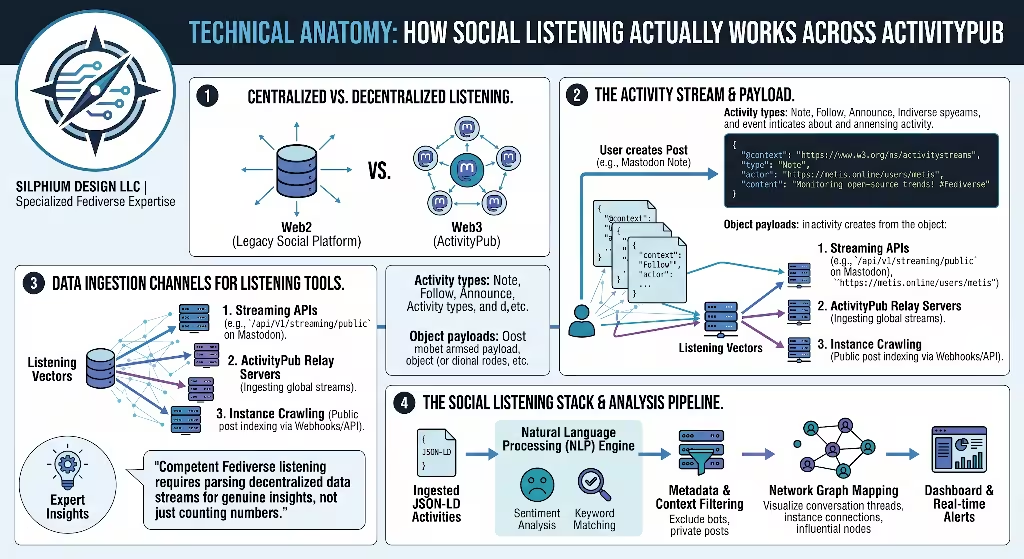
To get the most out of your monitoring stack, it helps to understand the technical plumbing behind decentralized networks. When social listening tools gather data from the Fediverse, they rely on open protocols rather than closed corporate databases. Let us look under the hood at how data flows from a user keyboard into your monitoring dashboard.
+-----------------------------------------------------------------------+
|                    ACTIVITYPUB MESSAGE INGESTION                      |
+-----------------------------------------------------------------------+
|  User creates post on Instance A                                      |
|         ||                                                            |
|         \/                                                            |
|  Instance A wraps post in ActivityPub JSON-LD object                  |
|         ||                                                            |
|         \/                                                            |
|  Instance A delivers object to Inboxes of connected servers           |
|         ||                                                            |
|         \/                                                            |
|  Social listening tools consume payload via Streaming WebSocket API   |
+-----------------------------------------------------------------------+
WebSockets and Streaming APIs
Traditional web crawlers gather information by scraping static HTML web pages on a scheduled timer. On modern social networks, scraping web pages is slow, inefficient, and easily blocked. Modern social listening tools rely on real-time streaming connections.
Most Fediverse platforms provide WebSocket streaming endpoints. For example, the Mastodon API offers a public streaming route (/api/v1/streaming/public) that broadcasts public posts as soon as the server processes them.
When social listening tools connect to a streaming WebSocket, the process works in clear stages:
- Persistent Connection: The monitoring tool opens an active WebSocket connection to an instance or relay hub.
- Event Streaming: As users publish public posts, the server pushes JSON data packets across the open connection immediately.
- Payload Parsing: The listening software inspects the JSON payload, extracting important fields such as
content,created_at,account,tags, andvisibility. - Keyword Filtering: The software checks the post text against your active keyword lists. If a match is found, it triggers an alert or stores the post in an analytics database.
By using streaming connections, social listening tools achieve near-zero latency, delivering brand alerts within seconds of publication.
Hashtag Tracking vs. Full-Text Search
One of the biggest differences between Mastodon and legacy social networks is how search indexing is handled. For many years, Mastodon deliberately avoided building global full-text search engines to protect users from automated harassment and mass scraping.
Instead, Mastodon was built around hashtags. When users want their posts to be discovered by the wider community, they add relevant hashtags (such as #OpenSource, #WebDev, or #TechNews). For social listening tools, hashtag tracking represents the most reliable, server-friendly method of capturing thematic discussions.
+-----------------------------------------------------------------------+
|                  SEARCH MECHANISM COMPARISON                          |
+-----------------------------------------------------------------------+
|  HASHTAG STREAMING:                                                   |
|  * Universal across all instances                                     |
|  * Fast and lightweight to index                                      |
|  * Guaranteed discovery for tagged posts                              |
|                                                                       |
|  FULL-TEXT SEARCH INDEXING:                                           |
|  * Requires Mastodon 4.2+ search features                             |
|  * Requires explicit user opt-in ("Include public posts in search")   |
|  * Respects user privacy flags automatically                          |
+-----------------------------------------------------------------------+
With the release of Mastodon 4.2 and newer versions, full-text search capabilities were expanded. However, this expansion includes a vital privacy safeguard: users must explicitly opt in to have their public posts included in public search indexes.
Modern social listening tools must handle both formats. They track public hashtag streams across all servers, while also utilizing opt-in full-text search indexes to catch untagged brand discussions in a way that respects user choices.
The Network Horizon Problem and Relay Networks
In a centralized system, the platform knows about every post published anywhere on the network. In a decentralized network, an individual server only knows about posts that cross its local network horizon.
A server learns about external posts in three primary ways:
- A local user on the server follows an account on a remote server.
- A remote post is boosted by an account that a local user follows.
- The server subscribes to a public relay network.
+-----------------------------------------------------------------------+
|                        THE NETWORK HORIZON                            |
+-----------------------------------------------------------------------+
|  [ Isolated Server X ]                                                |
|         |                                                             |
|         | (No mutual followers, no relay subscription)                |
|         v                                                             |
|  [ Your Listening Instance ] <--- BLIND SPOT (Post never arrives)     |
|                                                                       |
|  [ Connected Server Y ]                                               |
|         |                                                             |
|         | (Connected via Public Relay Hub)                            |
|         v                                                             |
|  [ Your Listening Instance ] <--- SUCCESS (Post visible to tools)     |
+-----------------------------------------------------------------------+
If a user on a small, isolated server in New Zealand writes a post about your brand, and no one on your monitored servers follows that user, that post will not naturally appear on your server timeline. This is known as the network horizon problem.
To solve this challenge, professional social listening tools connect to public relay hubs. A relay is a central distribution node that federates public posts across participating servers. By subscribing to major relays, social listening tools dramatically expand their network horizon, ensuring they capture public conversations from small, independent instances that would otherwise remain hidden.
Cross-Protocol Ingestion: Bridging ActivityPub, AT Protocol, and Threads
The modern decentralized web is no longer limited to a single software application. Today, the social landscape includes multiple protocols and federated platforms working side by side.
- ActivityPub: The open W3C standard that powers Mastodon, Pixelfed, Lemmy, PeerTube, and Meta Threads.
- AT Protocol:The distributed protocol created for the Bluesky network.
- Bridging Services: Open bridges, such as Bridgy Fed, allow users on Bluesky to follow and interact seamlessly with users on Mastodon and vice versa.
Because these networks increasingly exchange messages, modern social listening tools must support cross-protocol ingestion. When your social listening tools can parse both ActivityPub JSON-LD feeds and AT Protocol firehose streams, your marketing team gains a complete picture of the decentralized social sphere without needing separate software packages for each protocol.
The Fediverse Social Contract: Ethics, Privacy, and Avoiding Brand Backlash

Monitoring decentralized platforms requires more than just technical setup. It requires a deep understanding of community culture. Unlike commercial networks where users accept that their personal data will be indexed and monetized, Fediverse communities place a high value on autonomy, consent, and user privacy.
If a brand approaches the Fediverse with aggressive scraping tactics or intrusive automated sales pitches, the community will push back quickly. Understanding the ethical standards of decentralized networks is essential for any team deploying social listening tools.
+-----------------------------------------------------------------------+
|                  THE ETHICAL FEDIVERSE LISTENING MATRIX               |
+-----------------------------------------------------------------------+
|  ALLOWED & ENCOURAGED:                                                |
|  * Monitoring public brand keywords for support issues                |
|  * Tracking open industry hashtags for community research             |
|  * Respecting `noindex` and search opt-out flags                      |
|                                                                       |
|  STRICTLY DISCOURAGED:                                                |
|  * Scraping private, followers-only, or direct messages               |
|  * Unsolicited sales pitches in reply to personal posts               |
|  * Ignoring server-level robots.txt and automated access rules        |
+-----------------------------------------------------------------------+
Consent Culture, noindex, and the #nobot Standard
Fediverse culture is rooted in user consent. When setting up social listening tools, your organization must ensure that your data collection methods respect user preferences and technical boundaries.
Many users indicate their privacy preferences directly through account settings or post tags:
- Search Privacy Settings: In Mastodon 4.2+, users can explicitly toggle whether their posts are searchable by third parties. Ethical social listening tools automatically honor this flag and exclude non-indexed posts from public search databases.
- The
#nobotTag: Many community members add#nobotor#noindexto their bios or posts. This indicates that they do not want their content ingested by automated scrapers, search engines, or AI training datasets. - Instance Rules: Many server terms of service explicitly define what automated tools are allowed to do. Always check server guidelines before adding an instance to your monitoring pipeline.
When your social listening tools follow these community standards, you protect your brand from public callouts and preserve community trust.
Handling Content Warnings and Unlisted Posts
Mastodon features built-in privacy and formatting controls that differ from traditional social networks. Two of the most important features are Content Warnings (CW) and Unlisted post visibility.
+-----------------------------------------------------------------------+
|                     POST VISIBILITY LEVELS IN MASTODON                |
+-----------------------------------------------------------------------+
|  Public:           Visible on public timelines and relays             |
|  Unlisted:         Public, but excluded from discovery timelines      |
|  Followers-Only:   Delivered strictly to approved followers           |
|  Direct Message:   Private message delivered only to mentioned users  |
+-----------------------------------------------------------------------+
When users write a post with a Content Warning, they place a descriptive summary above the main body text. The reader must click the summary to reveal the full content.
Content Warnings are used for many reasons, including sensitive news topics, political commentary, movie spoilers, and long technical discussions. High-quality social listening tools must parse both the warning header and the hidden text to accurately evaluate the context and sentiment of the conversation.
Similarly, users often select the Unlisted post option. Unlisted posts are public, but they are deliberately kept off the main public timelines so they do not clutter community feeds. Responsible social listening tools treat unlisted posts with care, ensuring they do not treat quiet conversations as loud public announcements.
The Risk of Defederation and Server-Level Blocks
On centralized platforms, if users dislike an automated brand bot, they can mute or block that single account. On the Fediverse, server administrators hold significant power. If a brand runs aggressive, noisy, or non-compliant social listening tools that hammer server APIs with excessive requests, the server administrator can block the entire brand domain.
This server-level block is known as defederation or domain silencing. When an instance administrator blocks your brand domain:
- No user on that instance can see your official posts or profile.
- Your brand account cannot follow, reply to, or interact with anyone on that server.
- Your data gathering tools will be completely cut off from that server data stream.
To avoid defederation, configure your social listening tools to use reasonable rate limits, respect server API guidelines, and maintain a quiet, respectful infrastructure footprint.
Brand Rules of Engagement in Decentralized Communities
Discovering a brand mention with your social listening tools is only the first step. Knowing how to respond is where many organizations struggle.
On commercial networks, brands frequently jump into conversations with cheerful marketing slogans or unsolicited discount codes. On Mastodon, that behavior is viewed as spam and is often met with immediate blocks.
When using social listening tools to discover brand discussions, follow these practical rules of engagement:
+-----------------------------------------------------------------------+
|                  FEDIVERSE ENGAGEMENT BEST PRACTICES                  |
+-----------------------------------------------------------------------+
|  DO:                                                                  |
|  * Help users resolve technical problems and software bugs            |
|  * Provide honest, factual answers to direct questions               |
|  * Write like a helpful human peer rather than a corporate script     |
|                                                                       |
|  DON'T:                                                               |
|  * Jump into casual, personal conversations uninvited                 |
|  * Paste generic marketing copy or promotional landing page links     |
|  * Argue with community members about server rules or etiquette       |
+-----------------------------------------------------------------------+
When your team approaches the Fediverse as a helpful community member rather than an aggressive advertiser, your presence is welcomed and respected.
Common Questions Answered About Fediverse Monitoring with Social Listening Tools
When marketing leaders and technical teams evaluate social listening tools for decentralized networks, they often ask the same practical questions. Here are clear, detailed answers to the most common questions surrounding Fediverse brand monitoring.
Can social listening tools track the entire Fediverse?
No single tool or platform tracks 100 percent of the Fediverse. Because the network is made up of thousands of independently operated servers, there is no master database in existence. Some private servers choose not to federate with outside networks, and many instances maintain private blocklists that restrict data sharing.
However, high-quality social listening tools provide comprehensive coverage of the open, public Fediverse by connecting to major relay networks, tracking public timeline streams on high-population servers, and following opt-in search indexes. This approach captures the overwhelming majority of public brand discussions, developer feedback, and industry trends while respecting server-level privacy boundaries.
How is social listening on Mastodon different from X?
The primary differences come down to architecture, search mechanics, and data access policies.
On X, all user activity flows into a centralized database owned by a single corporation. Developers access this data through a commercial API firehose that charges steep access fees. Every public post is indexed for full-text search by default.
On Mastodon, data is distributed across independent servers running open-source code. There is no single owner selling access. Social listening tools gather data by participating in the open federation network.
Additionally, Mastodon places user consent at the core of search discoverability, requiring users to opt in before their post text appears in public search results. This means that social listening tools on Mastodon rely heavily on hashtag streams, open relays, and real-time WebSocket feeds rather than simple static search queries.
Do social listening tools respect user privacy on decentralized networks?
Reputable social listening tools are built specifically to respect decentralized privacy standards. These tools limit their data collection strictly to public timelines, honor the #nobot and noindex metadata directives, and ignore followers-only posts and private messages.
Unethical tools that attempt to scrape private accounts or bypass server access rules quickly face technical blocks, rate-limiting, and server-level domain bans from instance administrators. By selecting established, privacy-respecting social listening tools, your brand ensures that its monitoring practices remain fully compliant with community standards and international data privacy regulations.
What metrics should brands track when listening on the Fediverse?
Because the Fediverse has no algorithmic feed designed to maximize outrage or artificial engagement, vanity metrics like raw impression counts are less meaningful here. Instead, successful marketing teams focus on conversation depth and organic community signals.
+-----------------------------------------------------------------------+
|                    KEY FEDIVERSE MONITORING METRICS                   |
+-----------------------------------------------------------------------+
|  1. Untagged Brand Mentions:                                          |
|     * Unfiltered customer feedback and product discussions           |
|                                                                       |
|  2. Boost-to-Favorite Ratio:                                          |
|     * Boosts indicate community amplification and endorsement        |
|     * Favorites represent private appreciation                        |
|                                                                       |
|  3. Reply Depth and Discussion Length:                                |
|     * Multi-post threads indicate meaningful topic engagement         |
|                                                                       |
|  4. Instance Distribution:                                            |
|     * Identifying which specific server communities talk about you    |
+-----------------------------------------------------------------------+
Tracking these metrics gives your team a clear, actionable picture of how your brand is perceived across technical and professional communities.
Blueprint: Building an Effective Fediverse Monitoring Workflow
Setting up your monitoring operations does not have to be overwhelming. By following a structured implementation plan, your team can deploy social listening tools quickly, gather valuable product intelligence, and protect your brand reputation across decentralized channels.
+-----------------------------------------------------------------------+
|                    FEDIVERSE LISTENING ROADMAP                        |
+-----------------------------------------------------------------------+
|  [ Step 1: Map Core Hubs ]                                            |
|        || Identify high-population and niche industry servers         |
|        \/                                                             |
|  [ Step 2: Deploy Multi-Tiered Tools ]                                |
|        || Combine real-time alerts with audience analytics          |
|        \/                                                             |
|  [ Step 3: Configure Query Matrices ]                                 |
|        || Set up brand, product, competitor, and domain terms         |
|        \/                                                             |
|  [ Step 4: Establish Engagement Protocol ]                            |
|        || Train team on Fediverse culture and human communication     |
+-----------------------------------------------------------------------+
Defining Your Core Instance Hubs
Rather than attempting to monitor thousands of tiny servers simultaneously, start by mapping out the primary instance hubs that matter to your industry.
- General Hubs: Large public servers like
mastodon.socialhost diverse global user bases. - Technology & Open Source: Servers like
fosstodon.organdhachyderm.ioare central hubs for software developers, sysadmins, and technology leaders. - Creative & Design Communities: Servers dedicated to digital art, design, and writing host vibrant discussions among creative professionals.
- Regional Instances: Local community servers provide geographic focus for regional events, municipal services, and local retail brands.
Identify the top five to ten servers where your target audience congregates and configure your social listening tools to prioritize feeds from those communities.
Deploying a Multi-Tiered Tooling Architecture
No single software package solves every monitoring need. The most effective organizations deploy a multi-tiered stack of social listening tools that pairs instant alerting with deep demographic reporting.
- The Alert Layer (Syften):Use an alert router like Syften to monitor public keyword streams and deliver instant notifications into your team Slack or Discord channels whenever someone asks for product recommendations or reports a bug.
- The Analytics Layer (Fedica):Use an audience analytics platform like Fedica to track follower demographics, analyze engagement trends, and manage scheduled publishing from a central hub.
- The Executive Layer (Enterprise Suites): If you operate a large global enterprise, integrate Fediverse data feeds into your broad PR monitoring suite to keep executive leadership informed of brand sentiment.
This tiered approach ensures that your customer support, marketing, and leadership teams all have access to the exact data they need without paying for duplicate features.
Establishing Proactive Alert Triggers
To capture high-value conversations without getting flooded by irrelevant noise, configure your social listening tools with a structured query matrix.
+-----------------------------------------------------------------------+
|                    MONITORING QUERY STRUCTURE                         |
+-----------------------------------------------------------------------+
|  Primary Brand Terms:    "YourCompany", "YourProduct", "yourdomain.com"
|  Leadership Handles:     "author:[email protected]"                |
|  Competitor Tracking:    "CompetitorApp" AND ("alternative" OR "switch")
|  Pain-Point Discovery:   "category keyword" AND ("recommend" OR "issue")
|  Negative Keyword Filters: Exclude common homonyms, job posts (-hiring)
+-----------------------------------------------------------------------+
Setting up clean exclusions and focused queries ensures that your team only receives alerts that require real action.
Creating Fediverse-Native Response Guidelines
Finally, establish clear internal guidelines for how your team interacts with the community once social listening tools identify a relevant discussion.
- Assign Dedicated Responders: Ensure that customer support and community responses come from real, knowledgeable team members rather than automated bot accounts.
- Use Transparent Signatures: When replying to a user from a brand profile, have team members sign off with their name or initials to maintain a personal, human touch.
- Provide Direct Answers: If a user reports a bug, provide the direct answer or documentation link immediately rather than forcing them to fill out a lengthy third-party contact form.
- Respect the Vibe: If a user is having a private discussion with friends and casually mentions your product name, observe the feedback quietly without interrupting their personal conversation.
By pairing modern social listening tools with authentic, respectful community communication, your organization can build lasting relationships, protect its brand reputation, and thrive across the decentralized web.
Key Takeaways for Marketing and PR Teams
- The Fediverse relies on decentralized ActivityPub protocols rather than a single corporate firehose, requiring social listening tools that can ingest distributed server feeds.
- Dedicated social listening tools like Fedica and Syften offer specialized capabilities, from deep demographic analysis to real-time Slack keyword alerts.
- Ethical monitoring requires respecting user privacy settings,
#nobotdirectives, and instance-level terms of service. - Success on decentralized networks is measured through genuine conversation depth, authentic community support, and transparent communication rather than vanity reach metrics.