
The Evolution of Digital Biophilia
At Silphium Design, we have figured out that humans are not built for a life spent entirely in sterile, digital boxes. We are biological beings. Our brains evolved over millions of years in forests, plains, and near water. When we stare at a flat, glowing screen for ten hours a day, we feel a specific type of strain. This is often called technostress. It is the feeling of being tired, irritable, and unfocused because our digital world does not match our biological needs.
Virtual nature interactions are one the solution to this mismatch. These are digital experiences that use the sights, sounds, and patterns of the natural world to make users feel better. It is not just about putting a picture of a tree on a homepage. It involves a deep understanding of how our eyes and brains process information. When we design virtual nature interactions correctly, we create digital spaces that feel like a breath of fresh air.
The value of this approach is huge. For a business, it means people stay on your website longer. Their heart rates slow down. They feel more trust toward your brand. High-performance web design is no longer just about fast loading times. It is about how the human on the other side of the screen feels while they wait. By using virtual nature interactions, we can turn a stressful task into a restorative moment. This is the new standard for digital user experience.
Table of Contents
The Core Framework: 14 Patterns of Biophilic Design in Virtual Nature Interactions
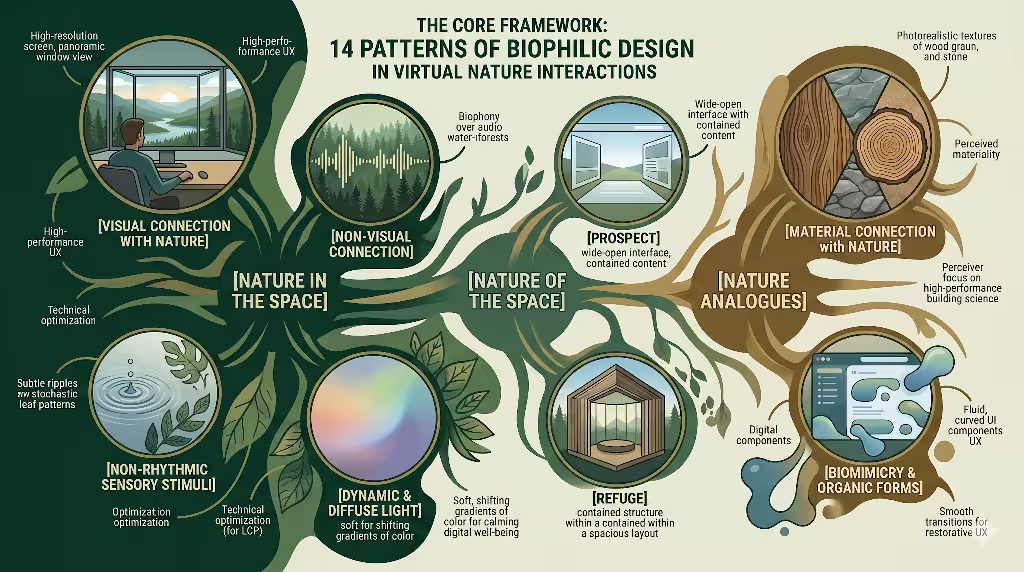
To build a website that truly helps people, we look at 14 patterns of biophilic design from Terrapin Bright Green. These patterns were first made for buildings, but they work perfectly for the web. We focus on how virtual nature interactions can bring these patterns to life on a screen.
Fractal Geometry and Visual Patterns
One of the most powerful tools in our kit is fractal geometry. Fractals are patterns that repeat at different scales. Think of a tree branch. The big branch looks like the trunk. The smaller twigs look like the big branch. This is a pattern found everywhere in nature. Our brains find these patterns very easy to process. In fact, looking at fractals can reduce stress by up to sixty percent.
When we use virtual nature interactions to show these patterns, we help the user relax. This might mean using a background pattern that follows the Golden Ratio. This ratio, often written as the number 1.618, is a math formula found in shells and flowers. By building our website layouts around this number, we create a sense of natural balance. It feels “right” to the eye, even if the user does not know why.
Non-Rhythmic Sensory Stimuli
In the real world, nature is never perfectly still. Leaves rustle. Grass sways. Clouds move across the sky. These are called non-rhythmic sensory stimuli. They are subtle movements that grab our attention without demanding it. In web design, virtual nature interactions can include these soft movements.
Imagine a video header where the water ripples very slowly. If the movement is too fast, it is a distraction. If it is too slow, it feels like a frozen image. The goal is to find that middle ground. This keeps the user engaged and prevents the site from feeling dead or static. It makes the digital space feel alive.
Biophony and Soundscapes
We often think of the web as a visual place, but sound is just as important. Biophony is the sound made by living organisms in a specific area. Virtual nature interactions can include high-quality recordings of birds, wind, or rain. These sounds trigger the parasympathetic nervous system. That is the part of your body that tells you it is time to rest and digest.
Using sound requires a soft touch. You never want to blast a user with noise the second they land on a page. However, providing a button to “turn on nature sounds” can change the whole experience. It helps the user block out the noise of their office and focus on your content.
Prospect and Refuge
Humans have a biological need for two things: to see what is coming (prospect) and to feel safe from behind (refuge). In virtual nature interactions, we can design layouts that meet these needs. A wide, open header gives a sense of prospect. It feels like looking out over a valley. Then, we use contained content blocks with soft borders to create refuge. This makes the user feel like they are sitting in a safe spot while they look at the view. It is a classic way to make a digital environment feel comfortable and welcoming.
Technical Implementation and Best Practices
Building these experiences takes more than just a good eye. It takes technical skill. We have to balance beauty with speed. A slow website is a stressful website, no matter how many trees are on it.
Visual Fidelity vs. Performance
The biggest challenge is making sure the site stays fast. High-quality images and videos are heavy. They can slow down your Largest Contentful Paint. This is a metric that tells us how long it takes for the main content to show up on the screen. To keep virtual nature interactions smooth, we use modern file formats like WebP or AVIF. These formats keep the images looking sharp while making the file size much smaller.
We also use lazy loading. This means the browser only loads the images the user is actually looking at. If a beautiful forest photo is at the bottom of the page, the computer does not waste energy loading it until the user scrolls down. This keeps the initial load time very fast.
CSS and Organic Shapes
Most of the internet is made of squares and rectangles. Nature, however, rarely uses straight lines. To make virtual nature interactions feel real, we use CSS to create organic shapes. We can use code to create soft, curving borders instead of sharp corners. We can also use “blob” shapes for background elements. This mimics the look of water or smooth stones. These shapes feel much more natural to the human eye and help the user stay in a calm state of mind.
Color Theory and Blue Space
When most people think of nature, they think of the color green. While green is great, it is not the only choice. Virtual nature interactions should also include blue spaces. Research shows that looking at water can be even more relaxing than looking at trees. We call this “Blue Mind.” By using shades of blue that mimic the ocean or a clear sky, we can lower a user’s heart rate.
We also look at earth tones like browns, tans, and soft grays. These colors provide a solid foundation for the site. They make the digital space feel grounded. The key is to use colors that are found in the local environment of the user. This makes the experience feel more personal and real.
Motion UX and Slow Tech
The way things move on a screen matters. Most digital animations are very fast and robotic. In virtual nature interactions, we use what I call “Slow Tech.” This means transitions that mimic the speed of nature. When a menu opens, it should feel like a flower blooming or a leaf falling. It should be smooth and graceful. Fast, jerky movements can trigger a “fight or flight” response. Slow, organic movement triggers a “stay and explore” response.
Common Questions Answered about Virtual Nature Interactions
Below are some answers to questions that are often asked about virtual nature interactions.
What are virtual nature interactions?
In simple terms, these are any digital experiences that simulate being in nature. It can be as simple as a photo of a mountain on a blog. It can be as complex as a virtual reality forest where you can hear the wind and see the shadows move. The goal is always the same: to use technology to give us the benefits of nature. These virtual nature interactions help us bridge the gap between our high-tech lives and our biological roots.
How does biophilic design improve digital well-being?
This is tied to something called Attention Restoration Theory. Our brains have two types of attention. The first is directed attention. This is what you use when you are working, reading, or solving a problem. It is very tiring. The second is soft fascination. This is what happens when you look at a sunset or a garden. It does not require effort.
Virtual nature interactions provide moments of soft fascination. They give the “directed attention” part of your brain a break. By looking at a natural pattern on a screen for just forty seconds, your focus can improve. This makes people more productive and less stressed.
Can virtual nature replace real nature?
The short answer is no. Nothing can replace the feeling of real sun on your skin or the smell of a pine forest. However, virtual nature interactions are a powerful supplement. Most of us spend ninety percent of our time indoors. We cannot always go for a hike in the middle of a workday. In those moments, a digital nature break is much better than no nature at all. It is a way to get a “micro-restorative” boost when we need it most.
Accessibility and Inclusive Biophilic Design
A website is only good if everyone can use it. We must make sure our virtual nature interactions work for people with disabilities.
WCAG Compliance
We always follow the Web Content Accessibility Guidelines. This means we make sure there is enough contrast between our text and our natural backgrounds. If we use a soft green background, we make sure the text is dark enough to read easily. We also make sure the site can be navigated using only a keyboard. Nature is for everyone, and digital nature should be too.
Alt-Text for Mood
Most people use alt-text to describe what is in a picture for someone who is blind. For virtual nature interactions, we go a step further. Instead of just saying “a photo of a forest,” we describe the feeling. We might say, “A peaceful forest in the morning light with soft shadows and tall green trees.” This helps a screen reader user understand the “mood” of the page. It ensures they get the same restorative benefits as everyone else.
Measuring Success: The Analytics of Biophilia
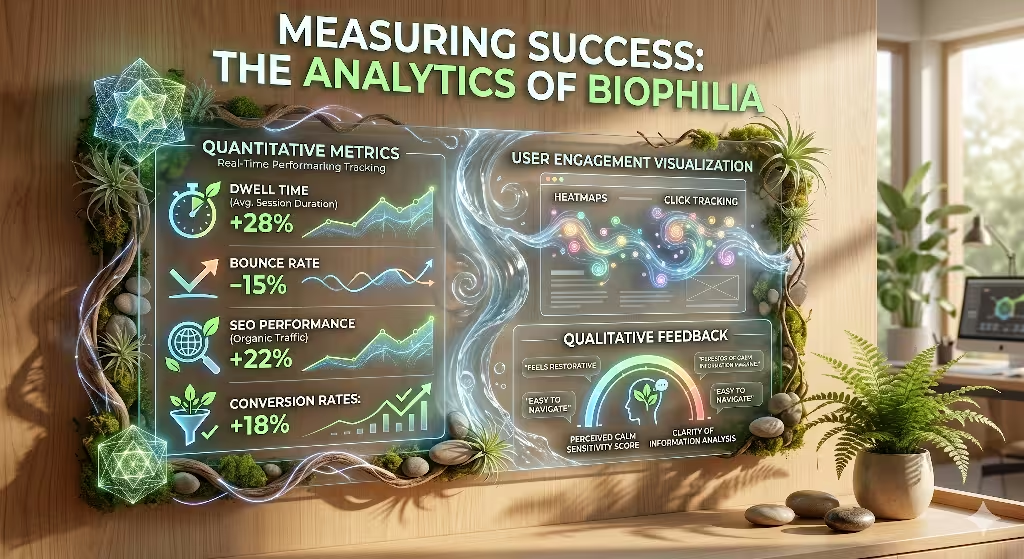
How do we know if our virtual nature interactions are working? We look at the data. We use numbers to prove that nature-based design is good for business.
Quantitative Metrics
We track how long people stay on a page. This is called Average Session Duration. If people are staying longer, it usually means they find the site comfortable. We also look at the bounce rate. If the bounce rate is low, it means people are exploring more than one page. In our experience, sites with virtual nature interactions have much better numbers than sites with standard, flat designs.
Qualitative Feedback
Numbers don’t tell the whole story. We also ask users how they feel. We use surveys to ask about “Perceived Calm.” We want to know if the site felt easy to use or if it felt stressful. When users say they feel “relaxed” or “focused” while using a site, we know our virtual nature interactions are doing their job.
The Future of Synthetic Nature
As we look ahead, the world of virtual nature interactions is only going to grow. We are moving toward a future where our digital devices are not separate from the natural world. They will become windows into it.
Ethical Responsibility
As designers, we have a big responsibility. We are the architects of the digital world. If we build spaces that are cold and stressful, we hurt the people who use them. If we build spaces filled with virtual nature interactions, we help them. It is our job to create “healthy” digital habitats. We must use our skills in biology, computer science, and design to make the internet a better place for humans.
The Competitive Advantage
In a world where everyone is fighting for attention, the sites that win will be the ones that respect human biology. People will naturally move toward places that make them feel good. By mastering virtual nature interactions, we give our clients a huge advantage. We are not just building websites. We are building digital sanctuaries.
The blend of nature and technology is the next great frontier in design. Whether it is a small blog or a massive corporate portal, the principles remain the same. We must look to the forest to learn how to build the web. The patterns are already there. We just have to use them.
By following these best practices for virtual nature interactions, we can create a web that is fast, beautiful, and restorative. We can reduce technostress and improve the lives of millions of people. This is the goal of Silphium Design LLC, and it is the future of the internet.
Examination into Biophilic Patterns
To really understand how virtual nature interactions work, we need to look closer at the specific ways they affect the human brain. This is not magic. It is science. When we see certain shapes or hear certain sounds, our bodies react in predictable ways.
The Science of Fractal Viewing
As mentioned before, fractals are a key part of virtual nature interactions. But why do they work? It comes down to how our eyes scan a scene. When we look at a complex natural scene, our eyes move in a fractal pattern. When the image we are looking at also has a fractal pattern, the eye and the image “match.” This makes the work of seeing very easy for the brain.
In computer science, we talk about the fractal dimension, often called D. Most natural scenes have a D value between 1.3 and 1.5. When we design virtual nature interactions, we try to keep our patterns in this range. This is the “sweet spot” for relaxation. If a pattern is too simple (D=1.1), it is boring. If it is too complex (D=1.9), it is stressful. By hitting that middle range, we create a feeling of effortless looking.
The Role of Water in Digital Spaces
Water is a special element in virtual nature interactions. In many cultures, water is a symbol of life and purity. Biologically, we are drawn to water because we need it to survive. In a digital space, water can take many forms. It could be a video of a waterfall, a photo of a lake, or even just the sound of a bubbling brook.
The key to using water in virtual nature interactions is clarity. Murky or dark water can actually cause stress because it looks unsafe. We want to show clear, moving water. This signals to the brain that the environment is healthy and rich in resources. This subtle signal creates a deep sense of peace in the user.
Materiality and Texture
Even though a screen is flat, we can use virtual nature interactions to create a sense of texture. We call this “perceived materiality.” By using high-resolution images of wood grain, stone, or leaf veins, we can trick the brain into “feeling” those textures.
This is important because humans have a tactile need for natural materials. In an office full of plastic and metal, seeing the texture of a rough oak board on a screen can be very grounding. It adds a layer of richness to the digital experience that you don’t get with flat colors.
Advanced Motion Principles for Restoration
We have talked about “Slow Tech,” but let’s go deeper into how motion works within virtual nature interactions. The goal is to avoid “digital jitter.” This is when things jump around or snap into place too quickly.
Gravity and Physics
In nature, everything follows the laws of physics. Things have weight. They have momentum. When we design animations for virtual nature interactions, we should use “physics-based” motion. This means an object should speed up and slow down naturally. It should not just start and stop at a constant speed. When a digital element moves like a real object, it feels much more natural to the user.
Stochastic Movement
In nature, nothing repeats perfectly. If you watch a tree, the leaves don’t move in a perfect loop. They move randomly but within a certain range. This is called stochastic movement. In virtual nature interactions, we can use code to create these random movements. Instead of a simple looping video, we can use a particle system to create “wind” that moves elements on the screen in a way that never repeats exactly. This keeps the brain from getting bored and makes the scene feel much more “real.”
Biophilia and the Search Engine of the Future
Search engines are changing. They are moving away from just looking at keywords and toward looking at “user satisfaction.” This is why virtual nature interactions are so important for the future of SEO.
Helpful Content and User Experience
Google’s latest updates focus on “helpful content.” They want to reward sites that provide a great experience for the user. Virtual nature interactions are a direct way to make your content more helpful. When a user feels relaxed and focused, they are more likely to read your whole article. They are more likely to find the information they need. This signals to the search engine that your site is high-quality.
E-E-A-T and Design
E-E-A-T stands for Experience, Expertise, Authoritativeness, and Trustworthiness. While this is usually about the writing, it also applies to the design. A site that looks professional and uses biophilic principles builds trust. It shows that the creators care about the user. Virtual nature interactions help create an environment where the user feels safe and respected. This leads to higher trust scores and better rankings over time.
Practical Steps for Designers and Site Owners
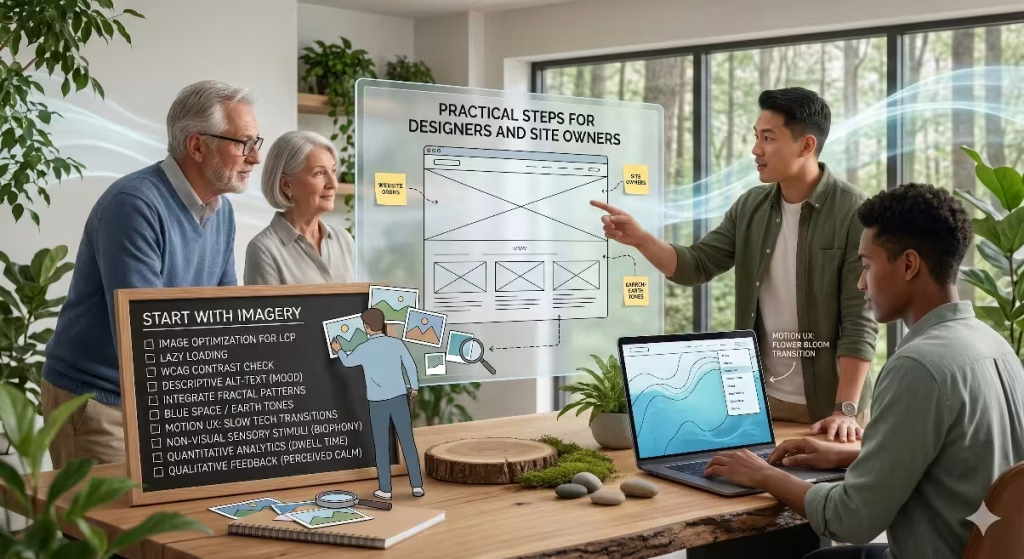
If you want to start using virtual nature interactions on your site today, where do you begin? You don’t need a Ph.D. to make a difference.
Start with Imagery
The easiest way to begin is with high-quality, natural images. Look for photos that have “prospect and refuge.” Find images that show a clear path or a wide view. Avoid “stocky” photos of people shaking hands in front of a green screen. Use real photos of the natural world. This is the foundation of good virtual nature interactions.
Soften Your Layout
Look at your current website. Does it have a lot of sharp corners and hard lines? Try softening those edges. Use CSS to add a small border-radius to your boxes. Replace some of your solid white backgrounds with very light earth tones. These small changes can make your virtual nature interactions much more effective.
Add Subtle Motion
If you have a hero image, consider turning it into a cinemagraph. This is a still photo where only one small part moves, like a flickering candle or a waving blade of grass. This is a perfect example of a non-rhythmic sensory stimulus. It adds life to the page without being a distraction.
The Path Forward
We are at a turning point in history. Our lives are becoming more digital every day, but our bodies are staying the same. We have a choice. We can build a digital world that is cold, fast, and stressful. Or we can build a world filled with virtual nature interactions that nurture and heal us.
At Silphium Design LLC, we choose the second path. We believe that the best websites are the ones that remember we are human. By using fractal patterns, biophony, and organic motion, we can create digital spaces that feel like home. These virtual nature interactions are not just a trend. They are a new way of thinking about how we live and work in the modern world.
As you build your own digital spaces, I encourage you to look out the window. Look at the trees, the sky, and the water. The best design advice in the world is right there, waiting for you. Use it to create something beautiful, something helpful, and something natural. The future of the web depends on it.
By integrating virtual nature interactions into every level of our design, we can ensure that technology serves us, rather than the other way around. We can create a world where we are more connected to nature, even when we are online. This is the true power of biophilic design. It is the power to make the digital world human again.
Through the careful application of virtual nature interactions, we can improve well-being, boost performance, and create a more sustainable digital ecosystem. Let’s work together to make it happen. The tools are in our hands, and the patterns are in our hearts. It is time to bring the forest to the screen.