
Table of Contents
The Convergence of Code, Living Systems, and Human Well-Being
The modern web is built like a concrete parking garage. Most websites rely on rigid gray boxes, harsh blue light, flashing alerts, and sterile layouts that drain our energy. When people spend eight to ten hours a day staring at these unnatural screens, they experience mental fatigue, headaches, and rising stress levels. This problem is known as directed attention fatigue. Our minds were never built to stare at static plastic squares all day. We evolved over millions of years inside complex, living ecosystems filled with sunlight, branching branches, moving water, and soft textures.
This is where AI biophilic imagery enters modern web design. By combining deep learning algorithms with the principles of natural design, AI biophilic imagery allows us to introduce organic patterns, restorative colors, and living geometry into digital interfaces. Rather than pasting flat stock photos onto a page, AI biophilic imagery creates procedural, mathematically sound visual elements that soothe the human nervous system. When built correctly, AI biophilic imagery transforms a website from an exhausting screen into a digital meadow. In this article, I will explain the science, the mathematical foundations, the code pipelines, and the UX design strategies behind AI biophilic imagery.
Definitional Architecture and Core Taxonomy
To understand AI biophilic imagery, we must first break down the two concepts that form its name: biophilia and generative artificial intelligence. The biophilia hypothesis, popularized by biologist Edward O. Wilson, states that human beings possess an innate, genetically wired affinity for the natural world. We feel better, think more clearly, and heal faster when we are in the presence of living systems.
Generative artificial intelligence refers to algorithms, specifically deep neural networks, that can analyze massive collections of visual data and synthesize brand new images based on mathematical rules. Therefore, AI biophilic imagery refers to synthetic visual assets produced by machine learning models that intentionally replicate the structural rules, visual rhythms, and cognitive benefits of the natural world.
There is a profound difference between a traditional stock photo of a forest and procedural AI biophilic imagery. A stock photograph is a frozen slice of time. It has fixed lighting, rigid boundaries, and zero awareness of the user who is viewing it. In contrast, AI biophilic imagery can be created procedurally to match the exact mathematical frequencies found in real ecosystems. It can adapt to the layout of a web page, match the screen size of a user, and even change its color palette based on whether it is morning or evening.
To organize how we build and deploy AI biophilic imagery, we divide it into three primary tiers:
- Direct Natural Analogues: These are visual elements that depict recognizable natural structures, such as synthesized tree bark, moving water surfaces, stone grain, and living leaves. Through prompt engineering and diffusion models, AI biophilic imagery creates realistic botanical structures without the generic feel of stock photography.
- Indirect Biomorphic Forms: These assets do not depict a specific plant or animal. Instead, this form of AI biophilic imagery uses the visual language of biology. It includes flowing organic curves, cellular membranes, contour lines, and soft gradients that remind our visual system of natural growth.
- Spatial and Ecological Analogues: This tier uses AI biophilic imagery to establish spatial balance within a web layout. It uses visual concepts like prospect (a clear, open view across a layout) and refuge (a protected, quiet space for reading text) to make a visitor feel safe, oriented, and calm.
When we create modern digital experiences, AI biophilic imagery serves as the visual mortar between functional user interface elements. It softens hard layout borders, frames long articles with gentle textures, and reduces the sterile feeling of software applications.
The Neuroscience of Digital Biophilia: Attention and Brain Waves
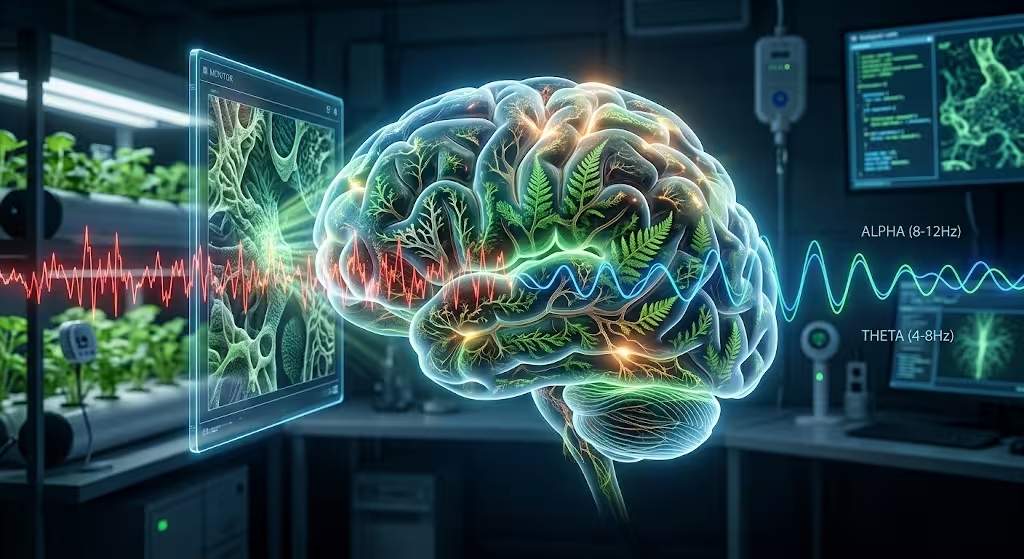
Why does looking at AI biophilic imagery change how we feel? The answer lies in the human brain and our evolutionary biology. For hundreds of thousands of years, survival depended on our ability to read natural environments. Our eyes and visual processing cortex evolved specifically to parse the subtle textures of grass, the motion of rivers, and the dappled sunlight filtering through tree canopies.
In cognitive psychology, the primary model for explaining this reaction is Attention Restoration Theory, developed by Rachel and Stephen Kaplan. The Kaplans showed that human attention is split into two distinct modes:
- Directed Attention: This is the conscious, focused effort we use to read text, write software code, calculate numbers, or ignore distractions. Directed attention takes a massive amount of mental energy and burns through glucose in the prefrontal cortex. When overused, it leads to brain fog, irritability, and mistakes.
- Involuntary Attention (Soft Fascination): This occurs when our attention is captured gently by non-threatening, aesthetically pleasing natural stimuli. Watching waves roll onto a beach or looking at light dance through leaves requires zero conscious effort. It allows our directed attention mechanism to rest, recharge, and restore itself.
High quality AI biophilic imagery acts as a digital trigger for soft fascination. When a visitor scrolls through an article framed by AI biophilic imagery, their eyes process the organic curves and gentle gradients without strain. The visual system registers the presence of natural forms, allowing the prefrontal cortex to take micro-breaks while reading.
Another crucial framework is Stress Recovery Theory, established by Dr. Roger Ulrich. Ulrich demonstrated that exposure to natural scenes triggers an immediate response from the parasympathetic nervous system. This is the branch of our autonomic nervous system responsible for resting, digesting, and calming the body down. When test subjects look at natural patterns, their blood pressure drops, muscle tension decreases, and levels of salivary cortisol fall.
Neurological studies show that viewing AI biophilic imagery can stimulate alpha brain waves. Alpha waves, which cycle at frequencies between 8 and 12 Hertz, are associated with a state of relaxed alertness. They are the brain waves you produce during meditation or when taking a calm walk in a park.
Many people ask an obvious question: can synthetic images generated by a computer really produce the same calming effects as standing in a real forest? While touching real soil and breathing real pine needles is always superior, research confirms that our visual cortex responds to geometric properties rather than the biological reality of the object. If AI biophilic imagery accurately mirrors the spatial distributions, soft contrasts, and fractal dimensions of nature, our brain produces the exact same parasympathetic calming response. The brain does not need the tree to be made of real wood to experience cognitive relief. It only needs the visual geometry to follow nature’s laws.
Algorithmic Foundations: How Machine Learning Generates Living Nature
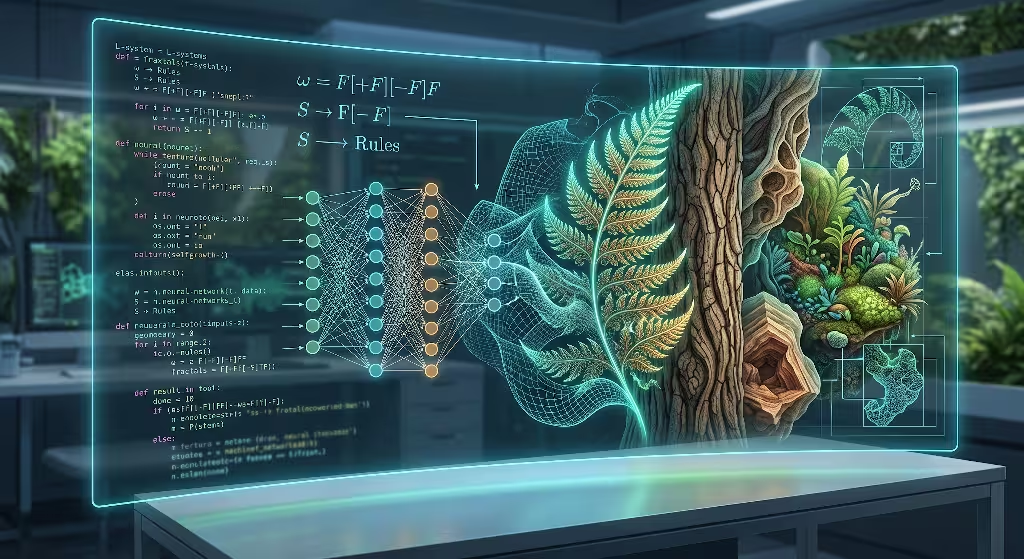
To understand how AI biophilic imagery is generated, we must look at the software pipelines that power modern artificial intelligence. We do not paint digital nature pixel by pixel anymore. Instead, we train neural networks to understand the statistical rules of the natural universe.
The primary engine behind modern AI biophilic imagery is the latent diffusion model. A diffusion model works through a two-step process called forward diffusion and reverse diffusion:
- Forward Diffusion: The algorithm takes an image of a real botanical or geological subject, like the venation pattern of a leaf, and slowly adds random Gaussian noise over hundreds of steps until the image becomes pure, chaotic static.
- Reverse Diffusion: The neural network is trained to remove that noise step by step. By learning how to clean up the noise, the model learns the underlying structure of the leaf. When we ask the system to create AI biophilic imagery, it starts with a completely blank canvas of random static and gently sculpts it into a coherent biological visual asset.
Latent diffusion models are extraordinarily capable because they operate inside a compressed mathematical space called latent space. Inside this latent space, concepts like “oak bark texture”, “dappled morning sunlight”, and “fluid stream currents” exist as mathematical vectors. By shifting these vectors, a designer can guide AI biophilic imagery to produce custom visual assets that never repeat yet always feel authentic.
Beyond standard diffusion models, advanced AI biophilic imagery draws inspiration from classical biological algorithms. One famous method is the reaction-diffusion model proposed by the mathematician Alan Turing in 1952. Turing wanted to understand how identical biological cells organize themselves to create the spots on a leopard, the stripes on a zebrafish, or the whorls on a seashell. He discovered that two interacting chemical substances, an activator and an inhibitor, diffusing across a space at different speeds, naturally create complex biological patterns. Modern generative systems can combine Turing equations with neural networks to produce dynamic AI biophilic imagery that mimics living growth patterns directly inside web browsers.
Another essential algorithmic foundation is the Lindenmayer System, commonly known as an L-system. Developed in 1968 by the Hungarian theoretical biologist Aristid Lindenmayer, an L-system is a formal mathematical grammar used to model the growth processes of plant development. An L-system starts with a simple axiom, like a single line representing a plant stem, and applies recursive replacement rules to generate complex branching structures, roots, and leaves.
When we feed these mathematical L-systems into neural network renderers, the resulting AI biophilic imagery possesses genuine botanical logic. The branches do not intersect unnaturally, the leaves attach at realistic biological angles, and the visual weight distribution mirrors physical reality. This prevents the strange visual mistakes that often ruin generic computer graphics.
The Mathematics of Visual Comfort: Fractals and the Golden Ratio

Nature looks effortless, but it is built on strict mathematical foundations. If you want AI biophilic imagery to soothe the human eye, you must understand the mathematics of visual comfort. The most important mathematical concept in all of biophilic design is fractal geometry.
Traditional Euclidean geometry deals with clean shapes like squares, circles, and straight triangles. However, as the mathematician Benoit Mandelbrot famously pointed out, clouds are not spheres, mountains are not cones, and tree bark is not smooth. Natural forms are made of fractals: irregular shapes that display statistical self-similarity across multiple scales of magnification.
Think of a common fern leaf. If you pluck a single small frond off the fern, it looks like a miniature version of the entire branch. If you look closely at one tiny section of that frond, it repeats the exact same branching pattern again. This self-similarity is everywhere in nature: river deltas, pulmonary blood vessels, lightning strikes, coastlines, and Romanesco broccoli.
Physicist Dr. Richard Taylor has spent decades studying how the human visual system responds to fractal patterns. Taylor discovered that humans exhibit a universal, biological preference for fractals with a specific fractal dimension, known as the D value. The fractal dimension measures how completely a fractal pattern fills the space it occupies:
- A low D value (around 1.1) produces sparse, simple patterns that look too empty to our eyes.
- A very high D value (around 1.8) produces dense, chaotic visuals that our brain perceives as cluttered, stressful noise.
- The visual sweet spot occurs when the D value falls between 1.3 and 1.5.
When human beings look at patterns with a D value between 1.3 and 1.5, their brains produce a 60 percent reduction in physiological stress indicators. Why? Because the visual systems of our ancestors evolved by looking at savanna grasses, tree canopies, and cloud formations, which naturally exhibit a fractal dimension in this exact range.
When configuring prompts and conditioning layers for AI biophilic imagery, we train our models to generate textures that strictly observe this mathematical boundary. If our AI biophilic imagery is too simple, it looks boring and artificial. If it is too dense, it increases mental fatigue. By targeting a fractal dimension of 1.4, AI biophilic imagery induces immediate cognitive ease.
Alongside fractals, we utilize the Golden Ratio, represented by the Greek letter Phi (φ, approximately 1.618). Found throughout nature in the spiral arrangements of sunflower seeds, pinecones, and snail shells, the Golden Ratio governs how biological systems pack maximum surface area into minimal physical space. By using the Golden Ratio to divide page space, establish typography scales, and position AI biophilic imagery, we create layouts that feel balanced and harmonious to the human eye.
Finally, we rely on procedural noise algorithms, such as Perlin noise and Simplex noise. Invented by Ken Perlin for computer graphics, these algorithms generate smooth, continuous gradients of pseudo-random values. By blending Perlin noise into AI biophilic imagery, we eliminate the harsh, repetitive grids typical of digital design, replacing them with the gentle, rolling contours of sand dunes, riverbeds, and weathered stone.
Dynamic and Circadian Web Implementation: Interfaces That Live
A major mistake that many web designers make is treating natural imagery as static wallpaper. They generate a single image of a forest, export it as a heavy JPEG file, set it as the background of a hero section, and walk away. That is not true biophilic design. In nature, environments are never static. Light shifts throughout the day, shadows lengthen, leaves flutter in the wind, and colors warm as the sun dips below the horizon.
To realize the full potential of AI biophilic imagery, we must build living digital canvases that adapt to the physical context of the user. The most effective way to accomplish this is through circadian rhythm integration.
Human biology is governed by an internal 24-hour clock known as the circadian rhythm. Specialized cells in our eyes, called intrinsically photosensitive retinal ganglion cells, track the color temperature of ambient light to regulate melatonin production, alertness, and sleep cycles. High color temperature blue light (around 6500 Kelvin) signals midday sun, making us alert. Low color temperature warm light (around 2700 Kelvin) signals sunset, telling our body to wind down and prepare for restorative sleep.
We can program our websites to read the local time of the user and modify our AI biophilic imagery dynamically:
- Morning: The AI biophilic imagery presents soft, horizontal morning light with warm amber and soft rose tones, easing the eye into the workday.
- Solar Noon: The visual textures transition to clean, diffuse, balanced illumination with high clarity to support focused directed attention.
- Dusk and Evening: The interface automatically shifts to deep twilight tones, warm ochres, and muted forest greens, stripping out harsh blue frequencies to protect the user’s natural melatonin production.
We achieve this without loading heavy image files for every hour of the day. By using client-side JavaScript to calculate the sun’s position and CSS custom properties defined in modern color spaces like OKLCH, we apply real-time mathematical color filters over base AI biophilic imagery assets.
Furthermore, we can incorporate phototropism into user interface interactions. Phototropism is the biological process by which plants bend and grow toward light. On a web page, we can use lightweight WebGL fragment shaders to let AI biophilic imagery react gently to user interaction. When a user moves their mouse cursor across the screen, background foliage textures can lean subtly toward the cursor, or dappled lighting can shift as if leaves were rustling overhead.
These movements must be extraordinarily subtle. If animations are too fast or aggressive, they become annoying distractions that pull user attention away from their task. When calibrated to slow, organic rhythms (similar to the breathing rate of three to five seconds per cycle), AI biophilic imagery transforms a rigid digital application into an ambient, living environment that respects human cognitive pacing.
Common Questions Answered about Generative AI Biophilic Imagery
Below are some of the primary questions people ask when exploring algorithmic biophilia.
Can AI-generated nature visuals reduce stress like real nature?
Yes. Peer-reviewed research in environmental psychology confirms that human visual systems respond directly to the geometric and structural properties of an image, rather than its biological origin. When AI biophilic imagery incorporates statistical fractals with a dimension (D) between 1.3 and 1.5, it engages involuntary attention and triggers the parasympathetic nervous system. This reduces heart rate, lowers blood pressure, and stimulates alpha brain wave activity in a manner nearly identical to viewing physical natural environments. While it cannot replace the multisensory benefits of breathing fresh outdoor air, digital nature visuals provide meaningful physiological restoration during screen time.
How does generative AI support biophilic design?
Generative AI allows designers to create custom, responsive biological patterns that scale across modern software applications. Before generative AI, incorporating nature into websites was limited to repetitive stock photography, static vector illustrations, or expensive custom 3D renders. With modern tools, designers use AI biophilic imagery to synthesize non-repeating organic textures, context-aware biological backgrounds, and ambient user interfaces that shift in real time based on user location, local time, and device requirements.
What are the 14 Patterns of Biophilic Design in web UI?
Originally established for architecture by the research firm Terrapin Bright Green, the 14 Patterns of Biophilic Design can be translated directly into web user interfaces using AI biophilic imagery:
- Visual Connection with Nature: Using AI biophilic imagery to display organic landscapes and plant forms.
- Non-Visual Connection with Nature: Incorporating subtle, procedural natural audio like flowing water or wind rustling through leaves.
- Non-Rhythmic Sensory Stimuli: Fleeting, momentary background movements, such as a falling leaf or shifting sunlight.
- Thermal and Airflow Variability: Subtle, continuous shifts in digital color temperature across hours of use.
- Presence of Water: Dynamic, fluid AI biophilic imagery simulating flowing ripples or mist.
- Dynamic and Diffuse Light: Dappled light patterns filtering through digital elements.
- Connection with Natural Systems: Interfaces that reflect seasonal changes and day-night cycles.
- Biomorphic Forms and Patterns: Buttons, cards, and dividers styled with organic contours rather than rigid boxes.
- Material Connection with Nature: Textures reflecting natural wood, stone, moss, or linen surfaces.
- Complexity and Order: Visual layouts organized around mathematical fractals and Fibonacci proportions.
- Prospect: Wide, open visual spaces providing clear orientation across a web layout.
- Refuge: Enclosed, quiet visual modules that allow users to read long text without distraction.
- Mystery: Layers of translucent, overlapping imagery that encourage gentle exploration.
- Risk/Peril: In web design, this is softened into high-contrast focal points that draw safe, focused attention to vital actions.
What is the difference between biomimicry and biophilic design?
Biomimicry focuses on copying nature’s functional engineering to solve human technical challenges. For example, studying how burrs stick to animal fur led to the invention of Velcro, and modeling high-speed trains on the beak of the kingfisher bird reduced noise and air resistance. In contrast, biophilic design focuses on human psychological and physiological health. It does not try to engineer a mechanical tool; instead, it uses nature’s aesthetic forms, spatial patterns, and lighting conditions to create spaces that reduce human stress, improve mood, and restore mental focus.
Semantic Structure and Information Architecture for Organic Sites
A beautiful website that search engines cannot read is a wasted opportunity. To ensure our work reaches the people who need it, we must combine natural design principles with rigorous search engine optimization (SEO) and information architecture.
Search engines like Google rely on crawlers that read the underlying code of a web page. These crawlers look for clear structure, semantic clarity, and logical organization. Interestingly, the best practices for semantic HTML closely mirror the organizational hierarchies found in natural ecosystems. A forest is organized into clear vertical layers: the soil layer, the forest floor, the understory, the canopy, and the emergent tree layer. A well-designed website should follow the exact same layered logic.
When structuring a page that features AI biophilic imagery, we use clear semantic HTML5 elements:
- The
<header>defines the canopy of the page, holding orientation links and high-level navigational context. - The
<main>container holds the primary ecological content, divided into clean<section>and<article>tags. - The
<aside>tags act as the understory, providing complementary resources, related readings, and contextual notes without cluttering the main reading trail. - The
<footer>acts as the root system, anchoring the page with legal details, administrative information, and deeper navigational paths.
To ensure that search engines understand our visual assets, every instance of AI biophilic imagery must be paired with precise alternative text (alt tags). Never write generic descriptions like “leaf background” or “pretty AI pattern.” Instead, write descriptive, entity-rich explanations:
- Poor Alt Text: “AI green design”
- Good Alt Text: “Procedurally generated AI biophilic imagery displaying the micro-venation structure of a compass plant leaf with soft morning light.”
Furthermore, we anchor our content using Schema.org structured data. By embedding JSON-LD microdata into the head of the document, we explicitly inform search engines about the entities discussed on the page:
JSON
{
  "@context": "https://schema.org",
  "@type": "TechArticle",
  "headline": "What is Generative AI Biophilic Imagery?",
  "author": {
    "@type": "Person",
    "name": "Aristaeus",
    "jobTitle": "Design Expert",
    "worksFor": {
      "@type": "Organization",
      "name": "Silphium Design LLC"
    }
  },
  "about": [
    {"@type": "Thing", "name": "Biophilic Design"},
    {"@type": "Thing", "name": "Generative Artificial Intelligence"},
    {"@type": "Thing", "name": "User Experience Design"},
    {"@type": "Thing", "name": "Attention Restoration Theory"}
  ]
}
By linking our technical discussions to verified knowledge graph entities, we allow search engine algorithms to understand that AI biophilic imagery is not merely an artistic aesthetic, but a formal technical discipline bridging computer science, human biology, and environmental psychology.
The Production Pipeline: Prompt Engineering and ControlNet Workflows
How does a designer actually produce production-ready AI biophilic imagery? You cannot simply type “make a nature background” into a standard AI generator and expect an asset suitable for professional web development. That approach produces messy, chaotic visuals filled with visual distractions that make text unreadable.
Professional production of AI biophilic imagery requires a controlled, multi-stage engineering workflow.
Step 1: Layout Framing and Negative Space Architecture
Before generating an image, you must determine where user interface elements will live. Text requires clean, low-contrast negative space to remain legible. If your background image is filled with high-contrast twigs and bright sunlight highlights, your user will squint, experience eye fatigue, and quickly bounce from the page.
In our prompt engineering, we explicitly enforce negative space by incorporating spatial parameters. We direct the generative engine to position intricate botanical details along specific screen margins while keeping the central reading canvas open, diffuse, and softly textured.
Step 2: Structural Guidance with ControlNet
Standard diffusion models are prone to hallucinating unpredictable compositions. To solve this, we use ControlNet. ControlNet is a neural network structure that allows designers to add spatial conditions to text-to-image diffusion models.
Instead of relying solely on text prompts, we feed structural maps into ControlNet:
- Depth Maps: We use depth maps of real natural objects, like dry limestone cliffs or dried hydrangea flower heads, to dictate the exact spatial depth of our AI biophilic imagery.
- Edge Detection (Canny and LineArt): We extract the clean boundary lines of architectural wireframes and force the AI biophilic imagery to grow naturally around our layout grid, wrapping organic curves cleanly around text containers and call-to-action buttons.
Step 3: Botanical Fine-Tuning with LoRA Models
Generic commercial models tend to produce stereotypical, hyper-saturated tropical leaves like monsteras and palm fronds. While these look fine on postcards, authentic biophilic design emphasizes regional fidelity. People feel the greatest psychological connection to landscapes that reflect their local bioregion.
We train Low-Rank Adaptation (LoRA) models on regional botanical specimens. A LoRA is a small, efficient mathematical adapter that fine-tunes a large foundation model on a specific set of visual data without retraining the entire neural network. We train our LoRAs on detailed botanical illustrations of native North American flora, like the tallgrass prairie species Silphium laciniatum (the compass plant), native oak bark textures, and Appalachian mosses.
When applied to our generation pipeline, the LoRA ensures that our AI biophilic imagery displays anatomically accurate leaf attachments, realistic bark lenticels, and authentic botanical textures.
Example Prompt Architecture for Web UI Assets
To see how these concepts translate into production, consider this structural prompt template for generating a responsive background asset:
- Positive Prompt: “Macro architectural texture of native river birch bark, statistical fractal self-similarity, D-value 1.4, wide negative space in central horizontal band, soft morning lighting through early mist, 3800K color temperature, muted earthy palette, diffuse shadows, botanical accuracy, 8k resolution, photorealistic.”
- Negative Prompt: “High contrast, neon colors, plastic surfaces, unnatural geometric grids, crowded composition, sharp spikes, over-saturated greens, text, watermarks, chaotic clutter.”
By combining precise prompt constraints with ControlNet depth guidance, the resulting AI biophilic imagery provides a calm, beautiful visual foundation that enhances readability rather than fighting it.
Web Performance Optimization: Preserving Core Web Vitals
A fundamental rule of sustainable web development is that aesthetics must never break performance. If a website is loaded with heavy, unoptimized visual files, the browser will stall, page rendering will lag, and users will leave before reading a single sentence. Search engines also penalize slow sites through their Core Web Vitals performance benchmarks.
Core Web Vitals measure three specific aspects of user experience:
- Largest Contentful Paint (LCP): The time it takes for the largest visual element on the screen (often a hero image or banner) to finish rendering. A good score is 2.5 seconds or faster.
- Interaction to Next Paint (INP): The responsiveness of a page when a user clicks a button, taps a link, or interacts with a menu. A good score is under 200 milliseconds.
- Cumulative Layout Shift (CLS): The visual stability of a page. If elements jump around as images load in late, your CLS score suffers. A good score is 0.1 or lower.
Because AI biophilic imagery contains complex visual textures, it can quickly inflate file sizes if you are not careful. We follow a strict performance protocol to keep our assets lightweight and lightning fast.
Advanced Modern Formats: AVIF and WebP
Never serve raw PNG or legacy JPEG files for your AI biophilic imagery. Instead, convert all assets into modern next-generation image formats:
- AVIF (AV1 Image File Format): AVIF provides superior compression efficiency compared to older formats. It preserves subtle gradients, soft shadows, and high-frequency textures with zero visible artifacting at file sizes 50 percent smaller than JPEG.
- WebP: For broad browser support across older devices, WebP serves as an excellent fallback format, offering clean compression with built-in alpha-transparency support.
By combining the HTML5 <picture> element with modern file formats, we allow browsers to pick the most efficient format supported:
HTML
<picture>
  <source srcset="biophilic-texture.avif" type="image/avif">
  <source srcset="biophilic-texture.webp" type="image/webp">
  <img src="biophilic-texture.jpg"
       alt="Soft organic stone texture created with AI biophilic imagery"
       loading="lazy"
       width="1920"
       height="1080"
       decoding="async">
</picture>
Eliminating Layout Shifts and Optimizing the Critical Rendering Path
Notice the explicit width and height attributes on the image tag above. By setting those dimensions in the HTML, the browser reserves the exact space needed for the image before it even downloads, driving your Cumulative Layout Shift (CLS) score to zero.
Furthermore, any AI biophilic imagery that appears below the fold (the area of the screen the user must scroll down to see) should always use native loading="lazy". This prevents the browser from wasting bandwidth on images the user might never scroll to look at. For the hero image that lives at the top of the page, we do the exact opposite: we remove lazy loading and use <link rel="preload"> in the document head so that the Largest Contentful Paint (LCP) triggers almost instantly.
Sustainable Computing and Digital Carbon Footprints
There is an ethical dimension to digital performance. Large data centers and cloud servers consume massive amounts of electricity. Generating AI biophilic imagery client-side using heavy, unoptimized JavaScript loops burns local battery life, makes the user’s laptop fan spin up, and generates needless carbon emissions.
True biophilic design must respect the health of our planet as well as the health of our users. We optimize our AI biophilic imagery on our local development workstations, compress the files to their leanest possible size, and host them on edge networks powered by renewable energy. A website cannot claim to celebrate nature if its underlying code burns excessive energy.
The Silphium Standard: Authentic Resonance Versus Algorithmic Greenwashing
As artificial intelligence tools become more accessible, we are witnessing a wave of shallow, decorative design that I call algorithmic greenwashing. Designers download an AI tool, generate generic pictures of rainforests or mossy rocks, paste them across a landing page, and claim they have created a biophilic website.
This superficial approach does not work. Sticking a leaf on a stressful, poorly organized website does not make it biophilic. In fact, doing so can make the user experience worse.
When artificial intelligence models are prompted carelessly, they often generate biological hallucinations: leaves that branch out in physically impossible directions, trees with multiple trunks that blur together unnaturally, or flowers with misshapen petals. While the user may not consciously analyze these anatomical errors, their subconscious visual system detects the visual discordance. Instead of inducing calm, biologically corrupted AI biophilic imagery creates an uncanny valley effect that triggers subtle anxiety and visual confusion.
At Silphium Design LLC, we hold our work to what we call the Silphium Standard. This framework is built on three core commitments:
- Botanical Integrity: Every asset generated as AI biophilic imagery must honor the anatomical and ecological rules of the species it depicts. If we are rendering a native oak leaf, its veins, margins, and stem attachments must be botanically true. We use AI to elevate nature’s beauty, not to distort it into surreal caricatures.
- Functional Purpose: Visuals must never be decorative filler. Every piece of AI biophilic imagery must serve a clear cognitive purpose: framing long articles to prevent eye strain, organizing complex data sets with soft natural boundaries, or easing the user’s transition through a complex task.
- The Ecological Bridge: The ultimate goal of digital biophilia is not to trap people inside a digital terrarium. Technology should never try to replace the physical outdoors. Instead, thoughtfully crafted AI biophilic imagery acts as a gentle reminder of the real world that exists outside our office windows. By creating digital interfaces that feel calm, respectful, and balanced, we reduce mental exhaustion and leave users with the energy to step away from their desks, close their laptops, and spend time walking among real trees, real rivers, and real soil.
Crafting the Future of Mindful Web Design
The digital landscape is changing rapidly. As software applications and artificial intelligence tools continue to absorb more hours of our daily lives, we cannot afford to continue designing digital environments that treat humans like emotionless machines. We cannot thrive inside sterile white grids and jarring notification banners that exhaust our mental resources.
AI biophilic imagery provides a practical path forward. By uniting the ancient evolutionary wisdom of biophilia with the modern computational power of generative deep learning, we have the ability to redesign our screens from the ground up. We can build interfaces that respect human biology, restore exhausted attention, and promote deep mental clarity.
Through careful prompt engineering, disciplined mathematical pacing, strict performance optimization, and an uncompromising commitment to biological accuracy, designers can transform the internet into a healthier space for everyone. As we continue to refine the tools and techniques behind AI biophilic imagery, our focus must remain clear: using the power of modern technology to honor, celebrate, and reconnect with the living natural systems that sustain us all.