
Table of Contents
Science, Nature, and Federated Discovery
Biophilic web design, the main subject of this blog, brings natural organizing principles into digital user experiences. In centralized search, algorithms force content into narrow channels to maximize clicks. But in decentralized social networks, content discovery behaves much like natural ecosystems.
Understanding fediverse niche visibility requires a complete shift in how we think about search engine optimization and social discovery. The Fediverse does not rely on corporate algorithms to decide who sees your content. Instead, it relies on federated protocol mechanics, server relays, and user-driven search queries. To achieve consistent fediverse niche visibility, creators and webmasters must adopt a structured long-tail hashtag strategy for fediverse niche visibility.
In this comprehensive guide, we will explore how to build topic taxonomies that work with ActivityPub servers. We will examine how small instances index content, how to format tags for accessibility, and how to build lasting fediverse niche visibility without relying on corporate surveillance algorithms.
+-------------------------------------------------------------------+
|                  TRADITIONAL CENTRALIZED FEED                     |
|  Content -> Central Server -> Engagement Algorithm -> User Feed   |
+-------------------------------------------------------------------+
                                  VS
+-------------------------------------------------------------------+
|                    FEDERATED PULL DISCOVERY                       |
|  Content -> Local Instance -> Relay/Peers -> Explicit Tag Index   |
+-------------------------------------------------------------------+
Architectural Differences: Centralized Feeds vs. Federated Indexing

A. The Mechanics of Decentralized Search
Centralized social networks use push-based algorithms. When you publish a post on a traditional network, a central server evaluates your content. It looks at your past engagement, your follower count, and your user history. Then, the algorithm decides whether to push your content into other users’ feeds. This system rewards emotional reactions, rapid clicks, and high post volume.
The Fediverse works on a completely different model. Networks built on the ActivityPub protocol, such as Mastodon, Firefish, and Pixelfed, use pull-based indexing. There is no central server sitting in the middle to score your post. There is no master algorithm scanning your text to figure out what you are talking about.
When you publish a post on an independent server, your content stays on your home server. It spreads to other servers only when specific connections exist. Other servers discover your content because a user on that server follows you, or because your post contains an indexed hashtag.
This design makes hashtags the core search mechanism of the federated web. In an ActivityPub environment, hashtags act like digital DNA. They tell foreign servers exactly where your post belongs in the broader ecosystem. If you publish content without explicit tags, users on other servers cannot find your work through text search. Achieving strong fediverse niche visibility depends directly on how accurately you categorize your content using structured tags.
Without central tracking, content discovery becomes a pull operation. Users actively query their server for specific topics. The server checks its local database for posts matching that tag. If your post includes that tag and has federated to that server, it appears in the search results. Therefore, building fediverse niche visibility requires an intentional approach to taxonomy. You are not trying to fool an algorithm. You are filing your content into a distributed, global library.
B. How Do Hashtags Work in the Fediverse Compared to Traditional Social Platforms?
To understand fediverse niche visibility, you must examine how federated hashtag indexing differs from traditional social search. On traditional platforms, search engines automatically index every word in every public post. You can search for a obscure phrase, and the platform will scan millions of database rows to find matching text. Hashtags on those platforms are often treated as mere trend markers or decorative jokes.
In the Fediverse, full-text search is deliberately restricted on many servers to protect user privacy and prevent harassment. While some servers enable opt-in full-text search, the universal bridge across all ActivityPub servers remains the hashtag.
+--------------------------------------------------------------------+
|                CENTRALIZED VS. FEDIVERSE SEARCH                    |
+--------------------------+-----------------------------------------+
| Centralized Networks     | Federated Networks (ActivityPub)        |
+--------------------------+-----------------------------------------+
| Push-based algorithms    | Pull-based user queries                 |
| Full-text automatic scan | Hashtag-driven database indexing        |
| Global centralized index | Server-to-server cached index           |
| Engagement-driven reach  | Explicit tag-driven discovery           |
+--------------------------+-----------------------------------------+
When you add a hashtag to a public post on an ActivityPub server, the server creates a direct index entry for that specific term. When another server federates with your server, it receives a copy of your post. It extracts the tag payload and adds your post to its local hashtag timeline.
If you post about sustainable architectural design without using tags, your post remains invisible to anyone who does not follow your account directly. But when you apply a dedicated long-tail hashtag strategy for fediverse niche visibility, your post instantly joins curated topic feeds across thousands of interconnected servers.
This mechanism protects users from unwanted exposure while offering a clear path for content discovery. It puts control back into the hands of creators and readers. You do not need to buy ads or chase viral trends to reach an audience. You simply need to use the right functional labels. This is why fediverse niche visibility relies on clear, structured keyword choices rather than clickbait headlines.
Anatomy of the Long-Tail Hashtag Framework
A. Constructing the Three-Tier Tag Architecture
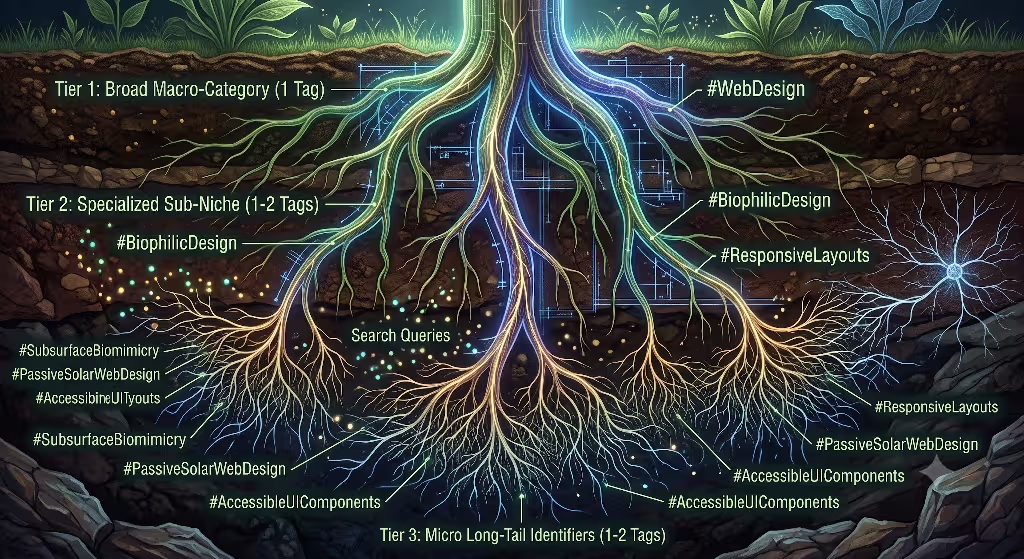
In biology, living organisms are classified using a clear hierarchy: kingdom, phylum, class, order, family, genus, and species. This hierarchy makes it easy to organize millions of distinct life forms.
We can apply this exact natural hierarchy to digital content categorization. To achieve reliable fediverse niche visibility, your posts should use a structured Three-Tier Tag Architecture. This approach balances broad reach with hyper-focused niche targeting.
       / \         Tier 1: Macro Category (#WebDesign)
      /   \        -------------------------------------------
     /     \       Tier 2: Specialized Sub-Niche (#BiophilicDesign)
    /       \      -------------------------------------------
   /_________\     Tier 3: Micro Long-Tail (#SubsurfaceBiomimicry)
Tier 1: Broad Macro Category (1 Tag)
The top layer of your taxonomy uses a broad category tag. These are high-volume terms used across the entire network.
- Examples:
#WebDesign,#Botany,#Architecture,#ComputerScience. - Function: Establishes the general domain of your content. While broad tags move quickly on federated timelines, they give your post baseline exposure on high-volume discovery pages.
- Role in fediverse niche visibility: Broad tags anchor your post inside large topic streams, ensuring basic categorization across broad server indices.
Tier 2: Specialized Sub-Niche (1 to 2 Tags)
The middle layer narrows your focus to a specific domain discipline. These tags attract active practitioners, specialized communities, and dedicated hobbyists.
- Examples:
#BiophilicDesign,#ResponsiveLayouts,#NativePlants,#FederatedNetworks. - Function: Filters out general traffic and connects your post with users who hold a serious interest in your domain.
- Role in fediverse niche visibility: Specialized tags build consistent interactions with peers, professionals, and active community nodes.
Tier 3: Micro Long-Tail Identifier (1 to 2 Tags)
The foundation of your strategy relies on hyper-specific long-tail terms. These are long-tail phrases that target exact sub-topics, tools, or design frameworks.
- Examples:
#SubsurfaceBiomimicry,#PassiveSolarWebDesign,#AccessibleUIComponents. - Function: Connects directly with high-intent searchers looking for precise information. These tags experience lower post volume, meaning your content remains at the top of these feeds for days or weeks.
- Role in fediverse niche visibility: Micro long-tail tags deliver the highest conversion and engagement rates because they match exact user queries.
By combining all three tiers in a single post, you build a complete discovery bridge. You capture high-intent readers through Tier 3, engage domain peers through Tier 2, and maintain baseline network presence through Tier 1. This balanced structure is the heart of a long-tail hashtag strategy for fediverse niche visibility.
B. The 3 to 5 Tag Rule and Community Etiquette
On traditional social platforms like Instagram or LinkedIn, creators often paste blocks of 20 to 30 hashtags at the bottom of every post. On the Fediverse, this practice is considered spammy and counterproductive.
To maintain strong fediverse niche visibility, you should follow the 3 to 5 Tag Rule. Using 3 to 5 well-chosen tags per post provides optimal search indexing without cluttering your content or annoying your readers.
Here is why excessive tagging hurts your fediverse niche visibility:
- Server Muting: Many fediverse users set up automated filters to mute posts containing more than five hashtags. If you publish a wall of tags, your post will be hidden from experienced community members.
- Instance Blocklists: Server administrators actively monitor for tag-spamming behavior. Accounts that repeatedly dump irrelevant tags risk being silenced at the server level.
- Screen Reader Clutter: Visually impaired users relying on screen readers must listen to every hashtag read aloud. Long blocks of tags create a terrible user experience.
Focus on quality over quantity. Choose one broad tag, two niche tags, and two micro long-tail tags. This disciplined approach respects community norms, protects your server reputation, and maximizes long-term fediverse niche visibility.
Federation Technicalities and Instance-Level Visibility Rules
A. Node Peering, Relays, and Local Caching
To master fediverse niche visibility, you must understand how data moves between independent ActivityPub servers. The Fediverse is not a single giant database. It is a network of thousands of individual servers, or nodes, talking to each other.
When you publish a post on Server A, how does it reach Server B?
- Follower Connections: If a user on Server B follows your account on Server A, Server A sends a copy of your post directly to Server B.
- Federated Relays: Server administrators often connect their instances to federated relays. A relay is a hub that broadcasts public posts between all connected servers.
- Local Caching: When Server B receives your post, it processes the text, extracts any hashtags, and stores the post in its local database cache.
+---------------+           +-----------------+           +---------------+
|  Server A     |           | Federated Relay |           |  Server B     |
| (Your Home)   | ──Post──> |  (Broadcaster)  | ──Post──> | (Remote Node) |
+---------------+           +-----------------+           +---------------+
        │                                                         │
        └──────────────── Direct Follower Sync ───────────────────┘
This architecture has a direct impact on fediverse niche visibility. A post containing your long-tail tags only appears in search results on servers that have received a copy of that post. If a small, isolated server has no users following you and is not connected to a relay, its local database will not know your post exists.
To expand your fediverse niche visibility across more servers, your content needs to travel through active federation channels. Using recognized niche tags helps your content get picked up by relays and indexed across remote nodes.
B. How Do Small Fediverse Instances Index and Federate Hashtag Feeds?
Small, self-hosted servers are a core part of the Fediverse. However, small instances face unique technical limits when indexing global content. Understanding these limits is critical for managing your fediverse niche visibility.
A small server with only five active users has a limited view of the overall network. It only indexes public posts from accounts its five users follow, plus posts delivered through its connected relays. If a user on a small server searches for a niche tag, the server scans its own local database. It cannot perform a real-time scan of every server across the entire internet.
+--------------------------------------------------------------------+
|               HOW SMALL INSTANCES INDEX HASHTAG FEEDS              |
+--------------------------------------------------------------------+
| 1. User on Instance C searches for #BiophilicDesign                |
| 2. Instance C queries its local database cache                     |
| 3. Database returns posts received via followers and relays        |
| 4. If your post federated to Instance C, it appears in search      |
+--------------------------------------------------------------------+
So, how can you ensure your content reaches users on small instances?
- Engage with Diverse Nodes: When you interact with users across different servers, those servers start caching your public posts.
- Encourage Boosts: When someone on a remote server boosts (reblogs) your post, your post is pushed to every user on that server, instantly expanding your local index presence.
- Use Consistent Tagging: Using a consistent long-tail hashtag strategy for fediverse niche visibility allows small instance databases to store your content under reliable search keys over time.
By understanding how small nodes cache data, you can build a stable web of fediverse niche visibility that grows naturally as your network expands.
C. Post Visibility States and Indexing Rules
Every post you publish on an ActivityPub platform includes a visibility setting. Choosing the wrong visibility state will completely ruin your fediverse niche visibility, regardless of how well you research your hashtags.
ActivityPub supports four standard visibility levels:
+-------------------------------------------------------------------+
|                     POST VISIBILITY LEVELS                        |
+-------------------+--------------------+--------------------------+
| Setting           | Federated?         | Indexed in Hashtags?     |
+-------------------+--------------------+--------------------------+
| Public (Globe)    | Yes                | YES                      |
| Unlisted (Lock)   | Yes                | NO                       |
| Followers-Only    | Restricted         | NO                       |
| Direct Message    | Private            | NO                       |
+-------------------+--------------------+--------------------------+
- Public (Globe Icon): Your post is federated across all connected servers and indexed in global, local, and user hashtag feeds. This is the only setting that supports fediverse niche visibility.
- Unlisted (Open Lock Icon): Your post is public and visible on your profile, but it is explicitly excluded from public timelines and hashtag search indices.
- Followers-Only (People Icon): Your post is delivered only to your confirmed followers. It is never indexed in hashtag searches.
- Direct (Mentioned Users Only): Private communication sent directly to specified accounts. No indexing occurs.
Do Hashtags Work on Unlisted or Friends-Only Fediverse Posts?
The answer is a simple and firm no. Hashtags added to Unlisted, Followers-Only, or Direct posts do not appear in public hashtag search results.
Unlisted posts act as a strict “do not index” instruction to federated servers. When a server processes an Unlisted post, it strips the post from its public tag indices. You can still type hashtags in an Unlisted post, and those tags will render as clickable links, but they will not add your post to search results.
If your goal is achieving high fediverse niche visibility, you must ensure your post visibility is set to Public before publishing.
Accessibility and Syntax Standards
A. CamelCase Standardization
In computer science and biological taxonomy, precise formatting is essential for avoiding system errors. On the Fediverse, formatting your hashtags correctly is both a technical requirement and a fundamental accessibility standard.
To maintain professional fediverse niche visibility, every multi-word hashtag must use CamelCase formatting. CamelCase means capitalizing the first letter of each individual word within the hashtag string.
- Correct CamelCase:
#BiophilicDesign,#SubsurfaceBiomimicry,#FediverseNicheVisibility - Incorrect Formatting:
#biophilicdesign,#subsurfacebiomimicry,#fediversenichevisibility
+--------------------------------------------------------------------+
|                      CAMELCASE FORMATTING                          |
+--------------------------------------------------------------------+
| Accessibility: Screen readers pronounce each word separately       |
| Readability:   Human readers scan multi-word phrases faster        |
| Standard:      #BiophilicDesign vs #biophilicdesign                |
+--------------------------------------------------------------------+
Why Is CamelCase Formatting Mandatory for Multi-Word Hashtags?
There are two critical reasons why CamelCase formatting is mandatory for multi-word hashtags across federated networks:
- Screen Reader Accessibility: Visually impaired users rely on screen reader software to navigate web content. When a screen reader encounters
#biophilicdesign, it attempts to pronounce the entire string as a single, unpronounceable word. But when it encounters#BiophilicDesign, the capital letters signal the software to pause and pronounce “Biophilic” and “Design” as separate words. - Cognitive Readability: For human readers scanning fast-moving federated timelines, CamelCase makes long-tail phrases instantly readable. Lowercase strings require extra mental effort to parse, increasing the chance that users will scroll past your post.
Building sustainable fediverse niche visibility requires making your content accessible to every user. Using CamelCase shows respect for your audience and protects your reputation across inclusive federated communities.
B. Tag Placement Options: Inline vs. Footer Syntax
Where should you place hashtags inside your post? There are two common approaches: Inline Syntax and Footer Syntax. Both methods have distinct structural trade-offs for fediverse niche visibility.
INLINE SYNTAX EXAMPLE:
"Exploring how #BiophilicDesign improves web accessibility today."

FOOTER SYNTAX EXAMPLE:
"Exploring how biophilic principles improve web accessibility today.

#BiophilicDesign #WebAccessibility #UIUX"
Inline Syntax
Inline placement integrates hashtags directly into the flow of your sentences.
- Pros: Saves valuable character space on servers with strict post limits.
- Cons: Interrupts text readability. Screen readers must read the word “hashtag” before every tagged term, creating a jarring experience during sentence playback.
Footer Syntax
Footer placement groups all hashtags into a clean block at the bottom of your post.
- Pros: Keeps the primary text clean, natural, and easy to read. Screen readers can read your main message continuously before processing the tag metadata at the end.
- Cons: Consumes character space at the end of your post.
Best Practice Recommendation
For maximum fediverse niche visibility and screen reader comfort, use Footer Syntax for your complex long-tail tags. If you want to tag a broad primary term within a sentence, you may do so, but relegate your detailed long-tail identifiers to a clean footer block.
Strategic Execution: Building a Long-Tail Hashtag Taxonomy
A. Researching Fediverse Niche Keywords
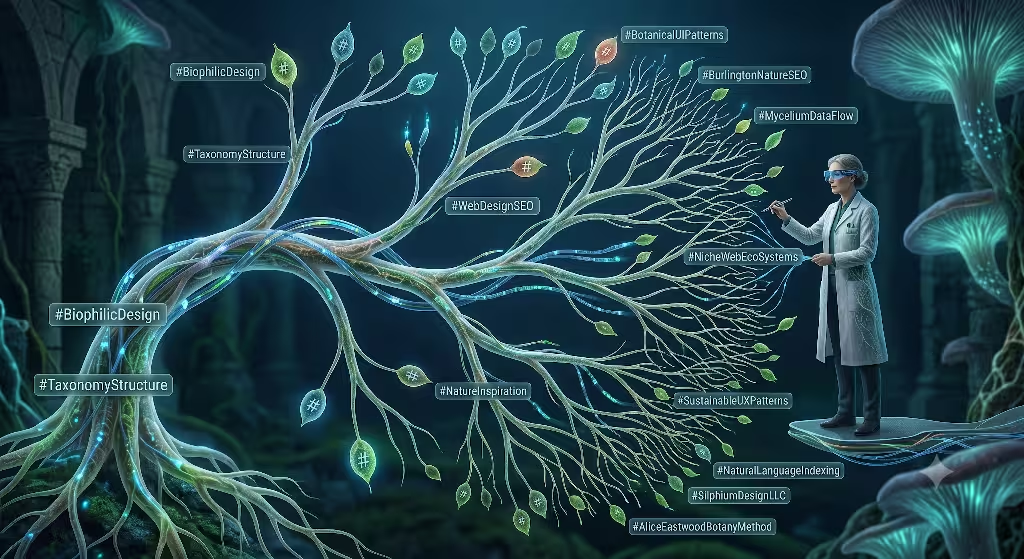
Building a high-performing long-tail hashtag strategy for fediverse niche visibility requires systematic keyword research. Because there is no centralized Google Keyword Planner for ActivityPub, you must use decentralized research techniques.
+--------------------------------------------------------------------+
|                  FEDIVERSE KEYWORD RESEARCH STEPS                  |
+--------------------------------------------------------------------+
| Step 1: Audit Niche Server Directories                             |
| Step 2: Track Established Weekly Theme Tags                        |
| Step 3: Cross-Reference Web SEO and Search Terms                   |
| Step 4: Map Terms to the Three-Tier Tag Architecture               |
+--------------------------------------------------------------------+
Step 1: Audit Niche Server Directories
Identify servers dedicated to your specific field. If you work in web design, architecture, or environmental science, explore instances hosting creators in those disciplines. Browse their public timelines to observe which specific hashtags generate active discussions.
Step 2: Track Established Weekly Theme Tags
The Fediverse relies heavily on recurring daily and weekly community hashtags. Combining your micro tags with established weekly themes expands your fediverse niche visibility significantly.
#FediFriday: Weekly network networking and account introductions.#Mosstodon: Community photos and discussions around moss, plants, and nature.#ThickTrunkTuesday: Photography and structural posts focused on trees and forest ecosystems.#WebDevWednesday: Technical discussions on web development and frontend architecture.
Step 3: Cross-Reference Web Search Data
Take high-performing long-tail search terms from traditional SEO tools and convert them into CamelCase hashtags. For instance, if web search data shows strong interest in “passive solar web design,” convert that phrase into #PassiveSolarWebDesign. This bridges the gap between traditional search behavior and federated discovery.
B. Measuring Niche Reach Without Centralized Analytics
Traditional web marketers rely on invasive analytics scripts, tracking cookies, and conversion pixels. The Fediverse rejects user surveillance. There are no tracking pixels or third-party cookies embedded in ActivityPub posts.
How do you measure fediverse niche visibility without privacy-invading tools? You evaluate functional interaction signals:
+--------------------------------------------------------------------+
|                   PRIVACY-RESPECTING METRICS                       |
+--------------------------------------------------------------------+
| Direct Engagement  | Boosts, replies, and favorites                |
| Inbound Federation | New server followers and remote interactions   |
| Referral Traffic   | Self-hosted analytics (Plausible, Matomo)       |
+--------------------------------------------------------------------+
- Direct Engagement Velocity: Measure the number of boosts, replies, and favorites your post receives within 48 hours. Boosts are especially valuable because they push your content directly onto foreign server timelines.
- Inbound Server Diversity: Monitor the server addresses (domains) of the users interacting with your post. If interactions come from ten different servers, your fediverse niche visibility is successfully reaching across federated boundaries.
- Self-Hosted Web Analytics: If your social posts include links back to your website, monitor your referral logs using privacy-focused analytics like Plausible or Matomo. Look for incoming traffic originating from fediverse domains without tracking individual user identities.
By tracking these clean signals, you can refine your long-tail hashtag strategy for fediverse niche visibility while fully respecting user privacy.
Checklist for Launch
Before publishing content to maximize fediverse niche visibility, review this pre-flight technical checklist:
+--------------------------------------------------------------------+
|                     LAUNCH TECHNICAL CHECKLIST                     |
+--------------------------------------------------------------------+
| [ ] Primary Keyword Strategy Defined                               |
|     Targeting: long-tail hashtag strategy for fediverse niche      |
|     visibility.                                                    |
|                                                                    |
| [ ] Post Visibility Set to Public                                  |
|     Verified globe icon selected to enable server indexing.        |
|                                                                    |
| [ ] CamelCase Formatting Enforced                                  |
|     Every multi-word tag uses proper capital letters.              |
|                                                                    |
| [ ] 3-5 Tag Balance Maintained                                     |
|     Post contains 1 Broad tag, 1-2 Niche tags, and 1-2 Micro tags.  |
|                                                                    |
| [ ] Accessibility Syntax Applied                                   |
|     Complex long-tail tags placed cleanly in a footer block.       |
|                                                                    |
| [ ] Privacy-Respecting Tracking Ready                              |
|     Monitoring boosts, server diversity, and clean web referrals.  |
+--------------------------------------------------------------------+
By applying these structured principles, you build a sustainable foundation for long-term fediverse niche visibility. Decentralized networks reward technical clarity, structural organization, and genuine community respect. When you align your digital publishing strategy with the natural architecture of the federated web, your ideas will find their ideal ecosystem.