
Table of Contents
When we build a digital world, whether it is a video game, an interactive website, or a virtual reality space, we are never just creating empty geometry. Every tree model, river shader, and mountain heightmap carries a hidden set of values. The way a 3D artist codes a forest or the way a web designer renders a flowing water animation is shaped by their background, their local ecology, and their heritage. This is the heart of cultural representation in modern technology.
In biophilic design, we know that human beings have an innate need to connect with living nature. Edward O. Wilson and Stephen Kellert showed us that our minds and bodies respond directly to natural shapes, sunlight, and living patterns. When we move these natural patterns onto digital screens, that biophilic connection does not vanish. Instead, it gets filtered through cultural representation. A person who grew up near the misty pine valleys of Japan will build a digital forest with different emotional goals than someone who grew up on the dry plains of the American Midwest.
Digital landscapes are active communication systems. When an interactive environment shows a mountain, it asks the user to feel something specific. Is that mountain a sacred ancestor to revere? Is it a difficult obstacle to conquer for points? Or is it a quiet sanctuary for personal reflection? The answer depends entirely on the cultural representation built into the software. In this comprehensive guide, we will analyze how digital media from different regions of the world constructs forests, rivers, and mountains. We will explore how these patterns influence user experience, search behavior, web design, and the algorithms that generate virtual worlds.
The Semiotics of Simulated Geography
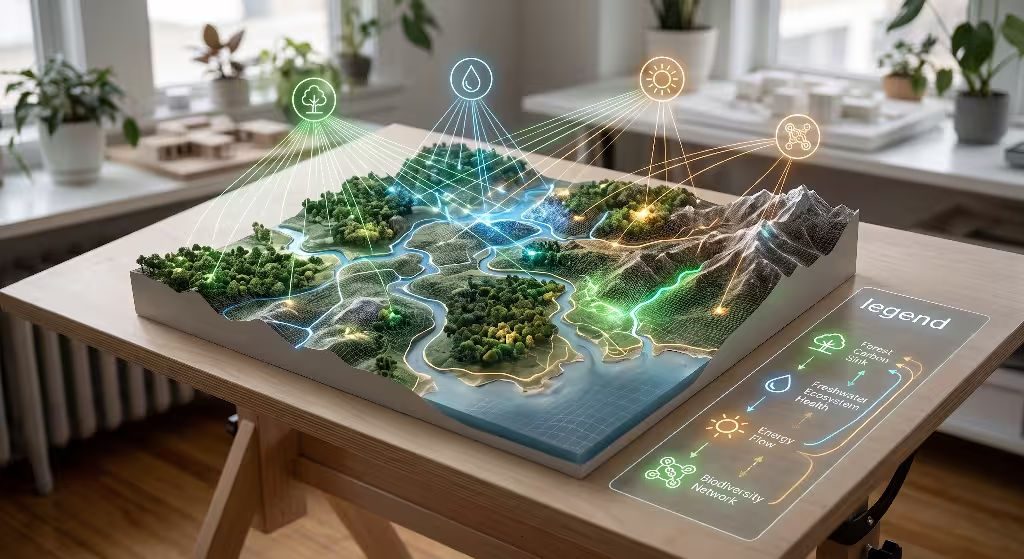
To understand digital landscapes, we must look at how digital signs and symbols create meaning. In semiotics, an object on a screen represents both itself and a larger idea. When you see a digital polygon tree, your brain recognizes it as vegetation. At the exact same time, your cultural background assigns a social meaning to that tree.
+--------------------------------------------------------------------------------+
|                   THE DIGITAL LANDSCAPE SEMIOTIC PIPELINE                      |
|                                                                                |
|  [ Biological Reality ]  -->  [ Cultural Filter ]  -->  [ Digital Shader / Code] |
|   (Trees, Water, Rock)        (Values, Myth, Lore)      (Geometry, Mechanics)  |
|                                        |                                       |
|                                        v                                       |
|                           [ User Meaning & Biophilia ]                         |
+--------------------------------------------------------------------------------+
Translating the Biophilia Hypothesis into Digital Spaces
The biophilia hypothesis states that humans possess a biological urge to seek connections with nature. In physical architecture, we use natural light, indoor plants, and natural wood grain to lower human stress and improve focus. On the web and in digital games, we use simulated biophilia. We use soft lighting, curved lines, dynamic water surfaces, and lush canopy textures to create calming digital spaces.
However, the biophilia response is not identical for every person on Earth. While all humans share a basic love for living things, our regional upbringings change how we interpret specific natural signs. For example, dense foliage might signal safety and abundant shelter in one society, while in another, it represents danger and hidden predators. Effective cultural representation in digital media respects these differences. When a software team designs a digital environment without understanding regional nature symbols, the resulting space feels flat, confusing, or emotionally disconnected.
The Spatial Paradigm: Why Digital Terrain is Never Neutral
No digital mountain or procedural river is created in a vacuum. Every line of code written into a physics engine or graphic shader comes from human assumptions. When a developer creates a river in a game engine like Unreal Engine or Unity, they must decide how the player interacts with that water.
- Can the player drink from it?
- Does the river wash away pollution?
- Is the river an enemy boundary that causes instant drowning?
- Is the river a sacred character with dialogue?
These mechanical choices form the foundation of cultural representation in interactive media. When an interface treats nature solely as a flat boundary wall, it teaches the user to see the natural world as a barrier. When an interface treats nature as a responsive, living partner, it reinforces an ecological worldview.
Basic Thesis: Digital Topographies as Reflections of Ecological Philosophy
Our central finding is straightforward: virtual topographies directly mirror the ecological philosophy, resource history, and spiritual traditions of their creators. Digital landscapes are computational philosophy. By analyzing how different societies code rocks, water, and timber, we can uncover deep patterns of human thought. The future of global digital design depends on expanding our cultural representation so that virtual spaces celebrate the rich diversity of Earth’s physical and spiritual ecosystems.
Common Questions about Cultural Representation
Search engines reflect what global audiences want to understand about digital landscapes, games, and web design. By looking at search trends and common questions, we can see that users and creators alike are hungry for a deeper understanding of cultural representation in interactive software.
How Do Different Cultures Depict Nature in Digital Media?
Different societies depict nature across a wide spectrum between two main poles: anthropocentric design and ecocentric design.
In anthropocentric design, nature exists purely to serve human needs. Forests are sources of wood, rivers are trade routes or power sources, and mountains are mineral deposits or challenges to overcome. This approach is common in Western commercial media, survival video games, and industrial digital simulations.
In ecocentric design, nature is treated as an equal, living partner. Forests are complex communities of spirits and plants, rivers are ancient ancestors, and mountains are sacred guardians. This perspective is prominent in East Asian media, Latin American indigenous projects, and traditional African storytelling. High-quality cultural representation in digital spaces helps audiences move fluidly between these worldviews, broadening their appreciation for different ways of living on Earth.
What is the Role of Landscape Design in Video Games and Virtual Worlds?
Landscape design in digital worlds serves three main functional purposes:
- Spatial Navigation: Mountains and tall trees act as visual anchors, known as landmarks, helping users understand where they are without looking at a map.
- Emotional Atmosphere: Lighting through tree leaves or the sound of rushing rapids creates specific emotional states, ranging from tranquil peace to intense suspense.
- Non-Verbal Storytelling: A broken ancient bridge over a river or a mountain scarred by mining tells a story without words. The cultural representation embedded in these ruins reveals the history of that virtual society.
In digital design, we often apply Jay Appleton’s Prospect-Refuge theory. This theory states that humans feel most comfortable in environments where they have an open view of their surroundings (prospect) while having a secure, protected space behind them (refuge). How different cultures balance prospect and refuge in their digital layouts reveals their unique relationship with outdoor safety and wilderness exploration.
How Does Biophilic Design Influence Digital Interfaces Across Global Regions?
Biophilic design shapes user interface (UI) and user experience (UX) design across the internet. Designers use natural geometries, such as the Golden Ratio, Fibonacci spirals, and organic branching patterns, to organize navigation menus and screen layouts.
However, regional preferences change how these patterns are applied:
- East Asian Web Design: Frequently features soft atmospheric gradients, dynamic seasonal changes, and balanced whitespace that mimics traditional ink paintings.
- Scandinavian Web Design: Emphasizes clean natural light, muted earth tones, moss greens, and honest, functional textures.
- Tropical and Indigenous Web Design: Employs vibrant biological color schemes, flowing river-like scroll paths, and dynamic patterns inspired by local flora.
Incorporating deliberate cultural representation into these biophilic interfaces ensures that digital tools feel welcoming and intuitive to their intended regional audiences.
Regional Deconstructions of Digital Landscapes
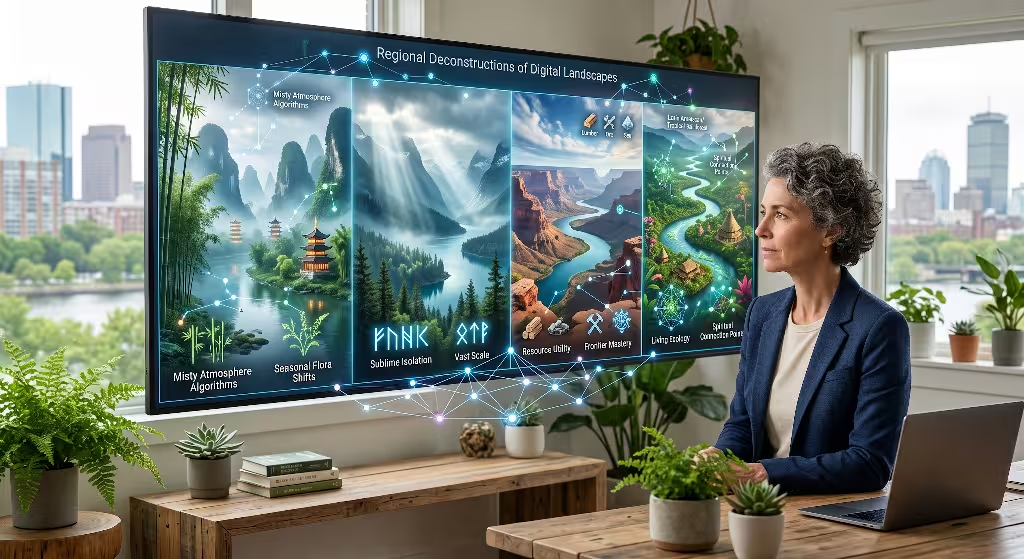
To fully appreciate how natural features are translated into digital worlds, we must examine specific regions. We will look at how forests, rivers, and mountains are built in East Asia, Northern Europe, North America, Latin America, and Africa.
| Region | Primary Forest Concept | Primary River Concept | Primary Mountain Concept |
| East Asia | Spirit-dwelling sanctuary (Kami, Shinrin-yoku) | Cosmological balance and flow (Wu Wei, Yin-Yang) | Sacred mist-wrapped peaks (Shan Shui) |
| Nordic / Europe | Primordial forest of trials (Urwald) | Mythic boundary of seasons and transit | Monolithic stone, home of ancient giants |
| North America | Untamed wilderness and resource cache | Route of expansion and industrial power | Frontier peak to be climbed and conquered |
| Latin America | Living, sentient ecological web (Selva) | Sacred ancestral serpent and lifeline | Protective ancestral spirit deity (Apu) |
| Africa | Sacred communal grove and ancestral altar | Spiritual lifeblood and water spirit home | Pillar of cosmic balance and origin |
1. East Asia: Harmonic Fluidity, Shan Shui, and Animistic Ecology
Digital media produced in China, Japan, and Korea often presents nature not as a chaotic force to be conquered, but as an interconnected whole governed by spiritual and philosophical balance.
+--------------------------------------------------------------------------------+
|                   SHAN SHUI HARMONIC BALANCE IN DIGITAL ART                    |
|                                                                                |
|          [ SHAN: Mountains ]                       [ SHUI: Water / Rivers ]    |
|          - Yang Principle                          - Yin Principle             |
|          - Vertical, Solid, Fixed                  - Horizontal, Fluid, Soft   |
|          - Bone structure of Earth                 - Blood and Breath of Earth |
|                                       \         /                              |
|                                        v       v                               |
|                          [ MA: Intentional Void / Mist ]                       |
|                          - Dynamic Negative Space                              |
|                          - Balances UI and Scenery                             |
+--------------------------------------------------------------------------------+
Mountains and Rivers (Shan Shui and Sansui)
The traditional Chinese term for landscape, Shan Shui, literally translates to “Mountain-Water.” In this artistic tradition, mountains represent the solid, vertical, unchanging Yang energy of the universe, while rivers represent the fluid, horizontal, changing Yin energy. A landscape is not complete without both elements working together in harmony.
When East Asian developers create 3D worlds, this balance is built directly into the scenery:
- Verticality and Mist: Games like Genshin Impact (specifically the Liyue region) and Black Myth: Wukong render mountains that rise sharply from tranquil river basins, wrapped in soft, dynamic fog shaders.
- Negative Space (Ma): In Japanese aesthetic tradition, empty space is just as important as solid matter. In digital interfaces, this translates to generous whitespace, quiet moments between quests, and uncluttered camera angles that allow the user to absorb the scale of the landscape.
- Flow and Non-Action (Wu Wei): Rivers in East Asian digital media are rarely presented as hostile obstacles. Instead, they guide the user along natural navigation paths, mirroring the Daoist philosophy of flowing effortlessly around obstacles. This is a masterclass in regional cultural representation.
Forests as Living Ensembles
In Japanese Shinto tradition, nature is filled with kami, which are spirits that reside in old trees, clear streams, unusual rocks, and dense groves. This animistic worldview completely changes how forests are rendered in digital media:
- Forests as Characters: In titles inspired by Studio Ghibli, such as Ni no Kuni, or games like Ghost of Tsushima and Okami, the forest is not mere background scenery. It is a living, breathing community. Trees are rendered with glowing moss, ancient rope shrines (shimenawa), and floating pollen particles.
- The Practice of Shinrin-yoku: Forest bathing, or immersing oneself in the sensory atmosphere of the woods, is translated into games through gentle ambient audio, dynamic wind moving through bamboo stalks, and dappled sunlight filtering through leaves. This style of cultural representation prioritizes peace, mindfulness, and deep respect for botanical life over resource harvesting.
2. Nordic and Northern European: The Primordial Forest and Sublime Isolation
In Northern European folklore and modern Nordic digital design, nature is depicted with a deep sense of primeval power, stoicism, and quiet mystery.
The Mythic Urwald (Deep Ancient Forest)
The European fairy-tale tradition, rooted in the dense temperate forests of Germany and Scandinavia, treats the deep woods (Urwald) as a liminal space. A liminal space is a threshold where ordinary rules do not apply, and where a person must face psychological trials:
- Visual Atmosphere: Games such as Valheim, Year Walk, and The Witcher series render forests with heavy spruce, birch, and pine canopies. Light enters in sharp, dramatic shafts through cold mist.
- Folklore and Danger: The forest hides ancient creatures, trolls, and forgotten rune stones. It is an environment that commands caution. You must learn the rules of the woods to survive, reflecting an authentic cultural representation of historical European folklore where wandering off the forest path led to danger.
Mountains, Fjords, and Glacial Glades
Nordic geography is defined by deep fjords, sheer granite cliffs, and glacial valleys. Digital media from this region reflects this dramatic topography:
- The Sublime: In aesthetic theory, “the sublime” refers to a feeling of awe mixed with terror when encountering massive natural forces. Nordic digital mountains are massive, sharp, and weather-beaten. They remind the human user of their small place within deep geological time.
- Clean, Functional Digital Minimalism: Scandinavian web design takes direct inspiration from these open, quiet landscapes. Websites built in this style use stark contrast, clean structural lines, muted earthen color palettes (slate grey, ice blue, pine green), and spacious layouts that evoke the calm clarity of a snow-covered mountain valley.
3. North American Settler Frameworks: The Frontier Sublime and Resource Utility
North American digital landscapes, particularly those created by major commercial software studios in the United States, are heavily influenced by the history of the frontier and the romantic art of the nineteenth century.
+--------------------------------------------------------------------------------+
|            NORTH AMERICAN SETTLER LANDSCAPE PARADIGM IN GAMES                  |
|                                                                                |
|     [ Hudson River School Aesthetic ]       [ Frontier Survival Mechanics ]    |
|     - Golden hour volumetric skyboxes       - Trees = Board-feet of lumber     |
|     - Vast, dramatic open vistas            - Rivers = Hydro-power & fish nodes|
|     - Empty land waiting for exploration    - Mountains = Ore and mineral veins|
|                                        \     /                                 |
|                                         v   v                                  |
|                  [ Wilderness as Mastery & Resource Arena ]                    |
+--------------------------------------------------------------------------------+
The “Wilderness Myth” and Dramatic Panoramas
American landscape art, notably the Hudson River School, painted the continent as a vast, dramatic, untamed paradise glowing under golden sunlight. This visual heritage directly shapes open-world digital games:
- The Open Horizon: Games like Red Dead Redemption 2, The Last of Us Part II, and Horizon Zero Dawn showcase massive, cinematic vistas. The digital skybox is huge, filled with dynamic cloud systems and warm sunset colors.
- The Myth of Untouched Land: These games often recreate the concept of the “pristine wilderness,” portraying landscapes as open territory awaiting discovery. While visually breathtaking, this specific cultural representation can sometimes erase the deep history of indigenous management that shaped those real lands for thousands of years.
Mechanical Reduction of Landscape in Survival Crafting
The frontier mindset also appears in gameplay mechanics. In many American-designed survival-craft games, natural features are broken down into raw commodities:
- Trees are hit with axes to produce units of lumber.
- Rivers are used as mechanical routes to transport goods or generate industrial power.
- Mountains are hollowed out for iron, copper, and coal ore.
This computational model turns nature into an inventory system. While highly engaging as a game loop, it represents a specific utilitarian worldview. Recognizing this cultural representation allows designers to consciously choose whether they want to reinforce resource extraction or offer players more sustainable ways to interact with digital ecosystems.
4. Latin American and Indigenous Cosmovisions: Non-Anthropocentric Digital Ecologies
Digital media developed by Latin American and Indigenous creators often rejects the idea that humans are separate from nature. Instead, the natural world is portrayed as a living web of family, memory, and spirituality.
The Sentient Forest (La Selva)
In Amazonian and Mesoamerican traditions, the rainforest is not an empty wild space. It is a bustling metropolis of non-human persons, including plants, animals, rivers, and spirits:
- Kinship and Respect: In independent video games like Mulaka (developed by Lienzo, based on the culture of the Rarámuri people) and various indigenous digital preservation projects, the forest possesses its own voice and agency. Trees are not passive timber; they are elders who hold ancestral memory.
- Interactive Reciprocity: In these virtual spaces, players cannot simply harvest plants without giving something in return. A player may need to offer a prayer, complete a ritual, or leave an offering to pass safely through a grove. This cultural representation embeds ecological ethics directly into the code.
Rivers as Living Ancestors and Arteries
Rivers across South America are frequently understood as sacred cosmic serpents that connect the heavens, the earth, and the underworld:
- Living Waterways: In regional digital art and interactive web experiences, rivers are animated with fluid, serpent-like motion. They are not merely flat surfaces with reflection shaders; they are rendered as dynamic spiritual highways.
- Environmental Protection Themes: Many Latin American interactive projects center on defending rivers from industrial pollution and illegal mining. The river is presented as a beloved relative under threat, providing an emotionally powerful cultural representation that motivates real-world environmental action.
The Apus (Sacred Mountain Deities)
In Andean cosmology, towering mountain peaks are known as Apus. An Apu is a divine, living protector of the surrounding valley:
- Active Computational Agents: When Andean creators build mountains in digital spaces, these peaks are not static background meshes. The Apus influence game systems directly, altering weather patterns, granting protection to travelers, and dictating where agricultural communities can safely settle. This offers a magnificent alternative to the Western trope of the mountain as merely a peak to be conquered.
5. African and Afro-Centric Digital Landscapes: Communal Topographies and Sacred Groves
African digital media and Afrofuturist design bring rich, diverse ecological traditions into virtual environments, blending ancestral wisdom with advanced technology.
+--------------------------------------------------------------------------------+
|                 AFRO-CENTRIC DIGITAL LANDSCAPE DIMENSIONS                      |
|                                                                                |
|    [ Sacred Groves / Baobabs ]                  [ Spiritual Waterways ]        |
|    - Ancestral meeting places                   - Domains of Mami Wata         |
|    - Communal shrines and living altars         - Fluid links between worlds   |
|                                        \       /                               |
|                                         v     v                                |
|                        [ Topographies of Community & Memory ]                  |
+--------------------------------------------------------------------------------+
Sacred Groves and the Baobab Tree
Throughout West, Central, and Southern Africa, sacred groves and ancient Baobab trees serve as meeting grounds, historical archives, and spiritual sanctuaries:
- The Living Archive: In African digital art, 3D web spaces, and games like Aurion: Legacy of the Kori-Odan, the Baobab tree is rendered as a central hub of energy and communal knowledge. Its wide trunk and sprawling branches provide shade, shelter, and connection to past generations.
- Community-Centered Space: Rather than emphasizing individual isolation in the wilderness, Afro-centric landscapes focus on how natural features bring communities together. The forest edge is a place of shared trade, ritual, and celebration.
Water Spirits and Interactive Shaders
Water systems across the African continent are tied to powerful spirits of life, fertility, and renewal, such as Mami Wata and Oshun:
- Dynamic Shaders: Digital water surfaces in modern African game projects and interactive media are often coded with luminous, vibrant color shifts that reflect spiritual presence beneath the waves.
- Harmonious Navigation: Crossing a river in these narratives requires humility and respect for the water guardian. This cultural representation honors water as the vital foundation of all human culture and survival.
Computational Landscape Generation: The Algorithmic Bias in Nature Toolkits
As a computer scientist, I pay close attention to the math behind virtual landscape generation. Many creators assume that math is objective and free of cultural bias. However, the algorithms we use to generate mountains, scatter trees, and simulate rivers are often shaped by regional assumptions.
+--------------------------------------------------------------------------------+
|              ALGORITHMIC BIAS IN PROCEDURAL TERRAIN PIPELINES                  |
|                                                                                |
|  [ Standard Perlin / Simplex Noise ]   -->  [ Default Swiss Alpine Peaks ]     |
|  (Mathematical Fractal Octaves)             (Sharp granite ridges, scree)      |
|                                                        |                       |
|                                                        v                       |
|  [ Global Ecosystem Flattening ]       <--  [ Erasure of Regional Forms ]      |
|  (Tropical Karsts & Tepuis Missing)         (Biased Botanical Scattering)      |
+--------------------------------------------------------------------------------+
Noise Algorithms and the Alpine Assumption
Most procedural terrain tools rely on Perlin noise, Simplex noise, or fractal algorithms to create digital heightmaps. These mathematical functions stack layers of noise at different frequencies to create rough, natural-looking surfaces.
However, the default settings in software like Houdini, World Creator, and Unreal Engine’s landscape tools are almost universally tuned to produce European Alpine or North American Rocky Mountain geomorphologies:
- Sharp, jagged granite ridges.
- Symmetrical erosion channels.
- Sub-alpine conifer tree lines.
When an artist clicks “Generate Terrain,” the software automatically defaults to a European mountain. If a creator wants to generate the limestone karst towers of Guilin, China, the flat-topped Tepuis of Venezuela, or the weathered laterite plateaus of West Africa, they must manually fight against the software’s default math. Expanding our toolkits to include diverse geomorphological equations is a critical step toward authentic cultural representation in computational design.
Procedural Content Generation (PCG) and Regional Botanical Logic
Procedural Content Generation allows artists to populate massive game worlds with millions of trees, bushes, and rocks with a single click. The software uses scattering rules to decide where each plant should grow based on elevation, slope, and moisture maps.
+--------------------------------------------------------------------------------+
|               PCG BOTANICAL SCATTERING LOGIC COMPARISON                        |
|                                                                                |
|  Standard Commercial PCG Rule:                                                 |
|  - If Slope < 30 deg AND Height < 1500m --> Spawn Generic Conifer/Oak          |
|                                                                                |
|  Culturally & Ecologically Nuanced PCG Rule:                                   |
|  - If Shade = High AND Moisture = Damp --> Spawn Sacred Medicinal Understory   |
|  - Group trees in symbiotic kinship clusters (Nurse trees + Fungal networks)   |
+--------------------------------------------------------------------------------+
When PCG scattering systems are built without ecological and cultural awareness, they create generic “green salads” that look like a suburban park anywhere in the world. Authentic cultural representation requires building custom scattering rules:
- Placing medicinal herbs near riverbanks where local traditions harvest them.
- Grouping trees in symbiotic family clusters, such as mother trees surrounded by saplings, reflecting modern forestry discoveries and indigenous ecological knowledge.
- Accurately modeling understory shrubs, fungi, and mosses that belong to specific regional biomes.
Applied Biophilic Web Design: Integrating Regional Nature into Modern UX
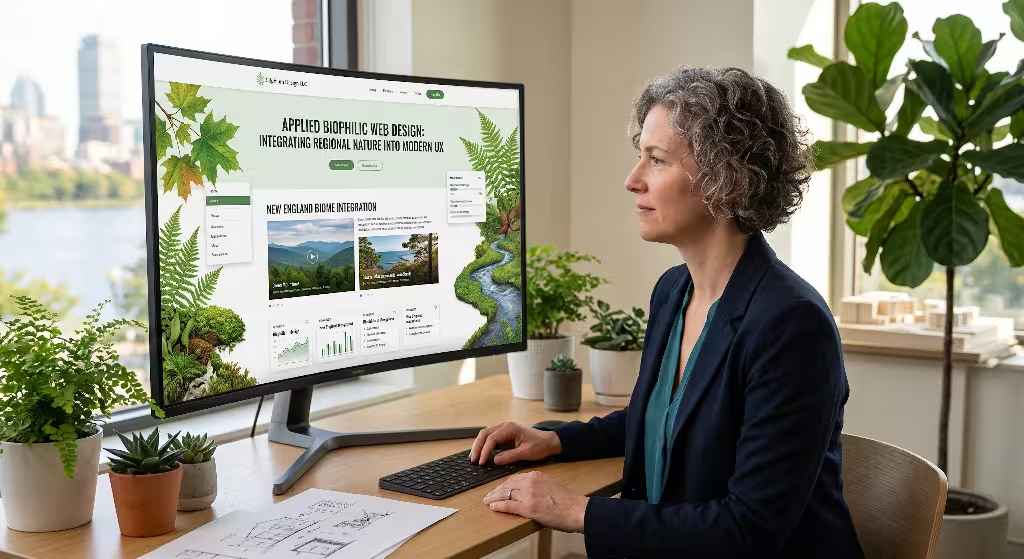
At Silphium Design, our daily mission is applying these ecological principles to website layouts, digital user interfaces, and mobile experiences. Biophilic web design improves engagement, lowers visitor bounce rates, and makes technology feel soothing. Incorporating regional cultural representation elevates these benefits even further.
+--------------------------------------------------------------------------------+
|                BIOPHILIC UX ARCHITECTURE: PROSPECT & REFUGE                    |
|                                                                                |
|  +--------------------------------------------------------------------------+  |
|  | [ HERO SECTION: PROSPECT ]                                               |  |
|  | - Expansive visual horizon, clear typography, open breathing room       |  |
|  | - Evokes high vantage point overlooking mountain valley                  |  |
|  +--------------------------------------------------------------------------+  |
|                                                                                |
|  +---------------------------------------+  +-------------------------------+  |
|  | [ MAIN CONTENT: SAVANNA NAVIGATION ]  |  | [ SIDEBAR / MODAL: REFUGE ]   |  |
|  | - Branching information paths         |  | - Cozy, high-contrast shelter |  |
|  | - Flowing water-inspired scroll paths |  | - Safe harbor for user actions|  |
|  +---------------------------------------+  +-------------------------------+  |
+--------------------------------------------------------------------------------+
Prospect, Refuge, and Peril in Website Layouts
We can structure web pages using spatial landscape archetypes:
- Prospect (The Open Vista): Hero sections at the top of a webpage should provide prospect. Large, open visual space, clear navigation headers, and uncluttered typography give the user a complete overview of what the website offers, reducing initial browsing anxiety.
- Refuge (The Safe Enclave): Slide-out menus, search modals, and checkout drawers serve as digital refuge. These spaces should feel secure, high-contrast, and contained, like a warm cabin shelter or a sheltered cave alcove overlooking a valley.
- Peril (Engaging Urgency): Peril in design should be used sparingly, such as limited-time registration notices or security warnings. Just as a sheer cliff edge commands attention in a hike, a sharp, contrasting accent color directs human focus during critical interactions.
Adapting these concepts through regional cultural representation allows web designers to adjust the balance between open space and snug enclosure based on local cultural preferences.
Biomorphic Micro-Interactions and Fluid Scroll Dynamics
Static web pages feel rigid and artificial. Living nature is constantly in gentle, harmonic motion. We bring digital spaces to life using biomorphic micro-interactions:
- River-Flow Scrolling: We can calibrate page scroll acceleration curves using fluid dynamics math, making the scrolling motion feel like a smooth, buoyant drift down a clean mountain river.
- Topographic Vector Contours: Using responsive Scalable Vector Graphics (SVG), we can render subtle topographic elevation contour lines in website backgrounds that gently shift and morph as the user moves their mouse.
- Canopy Shimmer Animations: Subtly modulating button shadows and card hover states to mimic sunlight filtering through leaves adds organic depth to clean, modern user interfaces.
Sensory Multi-Modal Loading and Environmental Soundscapes
True biophilic design engages multiple human senses. While visual design does most of the work on computer screens, auditory biophilia provides powerful subconscious grounding:
- Location-Aware Soundscapes: Ambient audio, such as the gentle rustle of birch leaves or the rhythmic splash of river water, can be integrated into web loading screens or meditation portals.
- Cultural Audio Calibration: Authentic cultural representation ensures that natural audio matches the regional imagery. A website showcasing Andean mountains should feature the winds of high-altitude grasslands (Puna) rather than generic coastal ocean waves.
Synthesis and Strategic Action Plan for Digital Creators
Creating digital media that respects both natural ecology and human heritage requires an intentional design process. Below is a structured checklist for digital worldbuilders, 3D artists, and web designers.
+--------------------------------------------------------------------------------+
|                    THE DIGITAL ECOLOGY & DESIGN CHECKLIST                      |
|                                                                                |
|  [ ] STEP 1: AUDIT TERRAIN SEMIOTICS                                           |
|      Determine if natural features are active partners or mere raw resources.  |
|                                                                                |
|  [ ] STEP 2: VERIFY BOTANICAL ACCURACY                                         |
|      Ensure plant species, bark textures, and leaf shapes match target biomes. |
|                                                                                |
|  [ ] STEP 3: ADAPT GEOMORPHOLOGY ALGORITHMS                                     |
|      Override default Alpine noise settings with regional digital elevation.  |
|                                                                                |
|  [ ] STEP 4: APPLY BIOPHILIC INTERFACE PRINCIPLES                              |
|      Balance open prospect vistas with cozy refuge modules in the layout.      |
|                                                                                |
|  [ ] STEP 5: ENGAGE WITH LOCAL COMMUNITIES & SCHOLARS                          |
|      Partner directly with regional knowledge keepers to prevent stereotypes.  |
+--------------------------------------------------------------------------------+
Strategic Checklist for Digital Worldbuilders
- Audit Terrain Semiotics: Ask yourself: How does the software treat nature? Are forests, rivers, and mountains portrayed merely as fuel, obstacles, and barriers, or do they possess cultural significance and ecological agency?
- Verify Botanical Accuracy: Avoid generic “video game greenery.” Research the specific native flora of the region you are depicting. Ensure that understory plants, canopy heights, and seasonal leaf color changes accurately reflect local biology.
- Calibrate Geomorphological Tools: Adjust procedural noise sliders and heightmap generation algorithms. If you are building an Asian karst landscape or an African rift valley, study real Digital Elevation Models (DEMs) to capture authentic rock fracture patterns and erosion slopes.
- Honor Regional Narratives: Partner with local cultural consultants, indigenous elders, and regional historians. Authentic cultural representation requires listening to the people whose ancestors lived alongside those physical mountains and rivers for centuries.
- Implement Biophilic UX Principles: When building websites and web apps, use natural geometries, fluid scroll velocities, and balanced whitespace. Create digital environments that lower user stress and foster a healthy relationship with both technology and the natural world.
The Future of Culturally Aware Virtual Ecologies
As we step into the future of digital spatial computing, virtual reality, and artificial intelligence, the natural landscapes we build will shape how humanity views the real Earth. If our virtual worlds continue to treat nature as an endless warehouse of raw materials, we risk reinforcing the ecological disconnection that threatens our planet.
By embracing thoughtful, accurate cultural representation in our forests, rivers, and mountains, we can create digital environments that inspire wonder, foster cross-cultural empathy, and deepen our shared human biophilia. At Silphium Design, we believe that every pixel is an opportunity to celebrate the living beauty of our diverse planet. When we code virtual nature with biological truth and cultural wisdom, we build a healthier digital world for everyone.