
Table of Contents
The Decentralized Paradigm Shift
The Cultural Contrast
If you walk into Mastodon with the standard social media marketing rulebook, you will run into a wall very quickly. Most mainstream networks run on algorithms designed to keep people outraged, addicted, or arguing. Growth hacking, engagement baiting, and sensational headlines are rewarded on those platforms because drama drives clicks, and clicks drive ad revenue.
Building community on Mastodon works in the exact opposite way. There is no algorithmic feed pushing emotional outrage to the top. There is no secret code deciding who gets seen based on how angry the comments are. When creators use shallow engagement tactics, such as posting “Reply with your favorite color” just to pump up numbers, the community notices immediately. On Mastodon, people do not want to be mined for data or treated as an audience to be captured. They want real conversations with real human beings. If you try to use old corporate marketing tricks, users will simply mute you, block you, or report your account to server administrators.
The Fediverse Philosophy
To understand building community on Mastodon, you have to understand the philosophy of the Fediverse. The word Fediverse comes from combining “federated” and “universe”. It is a global collection of independent servers that can talk to one another using an open web standard called ActivityPub.
No single billionaire or company owns the Fediverse. The software is open source, which means anyone can inspect the code, suggest improvements, or run their own server. This structure puts privacy and user control first. People own their data, choose their own moderation boundaries, and decide how they want to interact with the world. When you are building community on Mastodon, you are joining a network built on mutual respect and shared digital commons, not a commercial shopping mall.
Main Premise: Protocol Over Platform
On corporate platforms, your audience is merely rented. If the company changes its algorithm, introduces high fees, or bans your profile, your entire community disappears overnight. You do not own the relationship between you and your followers.
Building community on Mastodon is different because it relies on an open protocol rather than a proprietary platform. When you build relationships on an open protocol, your social graph is durable. You are not trapped inside one walled garden. If your current server shuts down or changes its management, Mastodon has built-in tools that let you move your account, along with all of your followers, to an entirely new server without losing your network. Community here is co-created with your peers. You are an active participant in an open neighborhood, which makes building community on Mastodon an investment that stays under your direct control.
Choosing the Right Soil: Instance Selection and Federation Mechanics
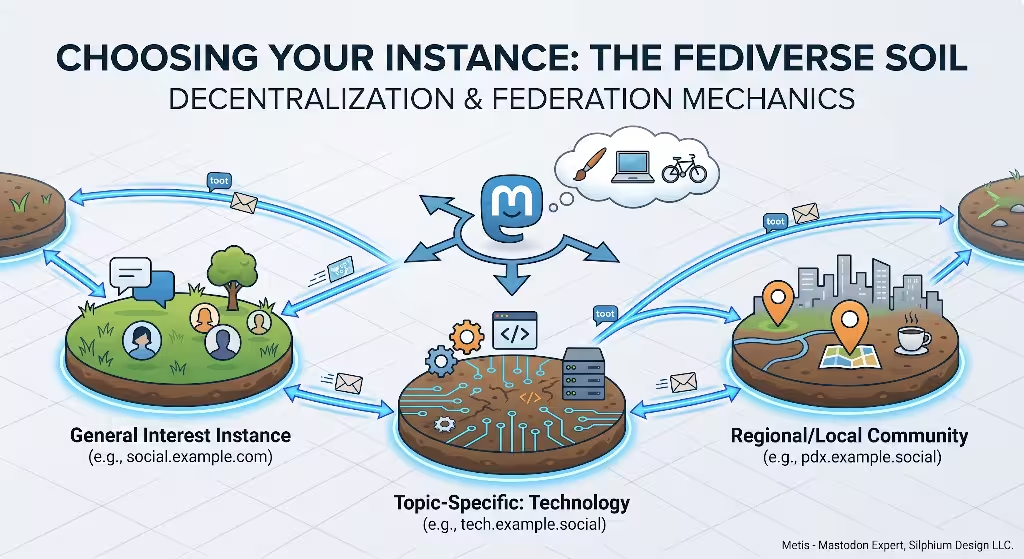
Decentralization 101
How does a decentralized network actually function? Think of Mastodon like email. If you use Gmail, you can easily send an email to a friend who uses Outlook or Yahoo. You do not need to create an account on their service, because both providers use the same shared open email standards.
Mastodon instances work the same way. Each instance is an independent server with its own members, rules, and hardware. When an instance connects to the wider network, it shares posts with other instances across the Fediverse through the ActivityPub protocol. This cooperative connection is called federation. Understanding federation is a foundational step for building community on Mastodon, because where you plant your roots determines how smoothly your content travels.
Selecting Your Base Instance
Choosing where to register your profile is an important early choice for building community on Mastodon. Your instance gives you your local timeline, which acts like a front porch where you can meet your immediate neighbors.
- Special-Interest Instances: These are servers built around a single theme, such as technology, academic research, creative writing, game development, or visual art. Joining a special-interest server gives you immediate access to peers who already share your passions. For many organizations, this is the easiest path for building community on Mastodon because the local feed is naturally relevant to your work.
- General Instances:Servers like mastodon.social welcome everyone and cover every topic under the sun. While they have millions of registered users, their local feeds move fast and can feel overwhelming. They are great starting points for exploration, but smaller topical servers often foster closer friendships.
- Self-Hosting a Branded Instance: If you run an organization or business, you can host your own server on your custom domain name (such as
@[email protected]). Running your own server gives you complete control over your data, uptime, and identity. However, it also requires regular technical maintenance, server hosting fees, database backups, and daily moderation duties. If you are just getting started with building community on Mastodon, joining an established community server is usually simpler than running server infrastructure yourself.
Server Governance and Defederation Risk
Every Mastodon server is run by administrators and volunteer moderators who enforce local community guidelines. Because servers are sovereign, administrators can choose which outside servers they want to talk to, and which ones they want to silence or block.
When one server completely cuts off communication with another server, it is called defederation. If your home server hosts bad actors, spreads spam, or fails to moderate hate speech, other reputable servers will defederate from it. If your server gets blocked by large portions of the network, nobody on those blocked servers will ever see your posts or replies. This is why building community on Mastodon requires doing your homework on server governance. Always read an instance’s code of conduct and review its list of blocked servers before signing up. A server with professional moderation and clear rules protects your visibility and keeps your community safe.
Profile Optimization and Authentic Verification
Establishing Digital Identity
Your profile is your digital business card on the decentralized web. When someone sees an interesting reply from you, they click your profile to see who you are and what you stand for. If your profile looks abandoned or robotic, they will move on.
When setting up your profile for building community on Mastodon, write a bio that sounds warm, honest, and distinctly human. State clearly what you do, what you care about, and what topics you discuss. Skip corporate buzzwords like “disruptor” or “thought leader.” Upload a crisp avatar image, such as a friendly headshot or a well-designed logo, along with a clean header image that reflects your creative projects or workplace culture. A complete, welcoming profile is an essential first impression for building community on Mastodon.
Decentralized Verification
On commercial social networks, verification checkmarks often require paying a monthly fee or submitting government paperwork to a private corporation. Mastodon handles verification through open web standards, giving you full control for free.
Mastodon uses standard HTML attributes, specifically the rel="me" link relationship. In your profile settings, you can add up to four custom metadata fields, such as your personal website, GitHub page, or employer portfolio. If you place a matching link on your external website pointing back to your Mastodon profile with the rel="me" code snippet, Mastodon verifies that you own both domains. When the system confirms this handshake, that profile link turns bright green with a verification checkmark. This allows anyone visiting your profile to confirm your identity with zero corporate gatekeepers. Authentic verification gives your account immediate credibility, which speeds up the process of building community on Mastodon.
The Sacred Introduction Post
One of the most enduring customs in the Fediverse is the introductory post, usually tagged with #Introduction. Unlike other networks where you quietly show up and start blasting links, Mastodon encourages new arrivals to introduce themselves to the room.
Write a friendly post sharing who you are, what projects you work on, what hobbies you enjoy, and what you plan to share. Include several relevant hashtags for your main interests, like #WebDev, #OpenSource, #Gardening, or #Biking. The broader community actively monitors the #Introduction tag to welcome newcomers, offer server tips, and share initial follows. Once you publish this post, use the pin feature to attach it to the very top of your profile. That way, anyone who discovers you later can read your story right away, laying a reliable foundation for building community on Mastodon.
The Engine of Discovery: Hashtags, Search, and Algorithmic Absence
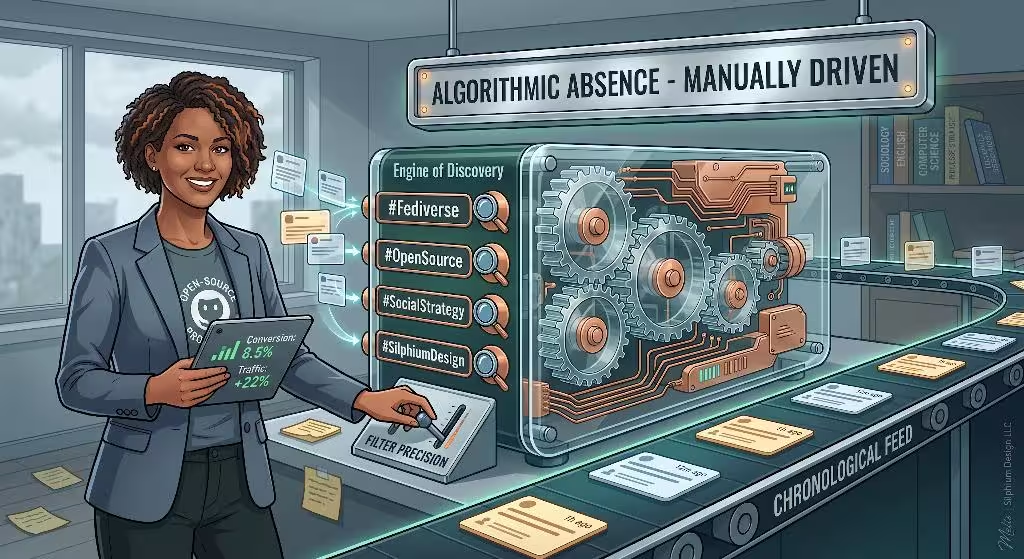
Navigating the Chronological Feed
On traditional social networks, an algorithm reshuffles your feed based on engagement scores. A post from three days ago might jump to the top of your feed simply because hundreds of people argued in the comments.
On Mastodon, public timelines are strictly chronological. Posts appear in the exact order they are published. This fundamental design choice completely changes your posting schedule. Burst-posting five updates in two minutes will clutter your followers’ feeds and annoy them. For successful results in building community on Mastodon, spread your updates throughout the day. Consistency and steady pacing work far better than sudden dumps of content.
Hashtag Optimization
Because there is no recommendation engine pushing content to users, hashtags are the single most important mechanism for discovery across the Fediverse. If you do not use hashtags in your posts, the only people who will ever see them are your existing followers.
To make hashtags work effectively when building community on Mastodon, keep these best practices in mind:
- Use CamelCase Formatting: Always capitalize the first letter of each word in a hashtag, such as
#MastodonTipsor#SocialMediaStrategy. Screen readers used by visually impaired people read CamelCase as individual words. If you write#mastodontipsin all lowercase, screen readers can stumble over the letters or produce garbled speech. - Keep It Focused: Limit yourself to two to four relevant hashtags per post. Dumping ten or fifteen hashtags at the bottom of a message looks spammy and crowds the interface.
- Follow Hashtags Directly: Mastodon lets users follow specific hashtags just like user accounts. If you follow tags related to your niche, their discussions appear directly in your main feed. This makes it simple to discover interesting conversations, reply helpfully, and make friends who share your specific focus. Following key tags is a practical everyday routine for building community on Mastodon.
Semantic Search Realities
Traditional social platforms index every single word of every public post into massive commercial search databases. Mastodon takes a more privacy-conscious stance. By default, Mastodon search engines do not automatically index the full text of every message for public querying.
Users must explicitly opt in through their account privacy settings to allow their posts to appear in full-text public searches. If someone has not opted in, you can only find their updates by searching for specific hashtags or direct links. This design respects personal boundaries and prevents coordinated pile-ons from bad actors searching for sensitive keywords. When building community on Mastodon, remember that broad discoverability relies on deliberate, accurate hashtag placement rather than hoping arbitrary keywords get caught in a search scraper.
Cultural Norms and Digital Etiquette: Earning Fediverse Trust
Content Warnings (CWs)
Content warnings, often abbreviated as CWs, are a core part of Fediverse culture. A content warning puts your text behind a clickable label that reads “Show More”. The reader chooses whether they want to expand the message or keep scrolling.
Content warnings are not just for graphic or disturbing material. People frequently use them for political debates, media spoilers, sensitive personal news, or long multi-part threads to keep the timeline easy to read. Using a CW shows consideration for your neighbors’ mental space. Taking the time to label sensitive or heavy topics demonstrates emotional maturity, which is crucial for building community on Mastodon.
Accessibility as a Requirement
Accessibility is not an optional extra on Mastodon; it is a community standard. In fact, many Fediverse users refuse to share or amplify any image that lacks descriptive alt text.
Whenever you attach an image, video, or diagram to a post, write a concise text description explaining the visual details.Describe the subjects, colors, actions, and any embedded text within the graphic. This practice ensures that blind, low-vision, or screen-reader users can fully take part in your conversations. By committing to accessibility across all of your media, you build trust and open your door to everyone, which is central to building community on Mastodon.
Engagement Over Extraction
On corporate platforms, users frequently quote-post someone else’s message to mock them, argue with them, or use them as a prop for cheap internet points. Mastodon intentionally left out quote-posts for many years to discourage public dunking and hostility. While newer versions of Mastodon have introduced controlled quote features with strict privacy boundaries, the community still strongly prefers direct, thoughtful replies.
The two main engagement buttons also function differently than you might expect:
- Favorites (The Star Icon): Marking a post as a favorite sends a quiet notification of thanks to the author. A favorite does not share the post to your followers’ feeds. It is a private gesture of appreciation.
- Boosts (The Reblog Icon): Boosting a post is the only way to share someone else’s work with the people who follow you. Because there is no discovery algorithm, boosting is the engine of distribution across the network. If you enjoy an idea, boost it! Generous boosting helps other creators and signals that you care about amplifying your peers, which accelerates your own journey of building community on Mastodon.
Avoiding Spam Traps
Many brands make the fatal mistake of setting up automated RSS feed bots that blast cross-posted links from other platforms straight into Mastodon. These posts often contain broken mentions, missing image tags, and zero interaction with replies.
The Fediverse rejects automated broadcast channels. Accounts that drop automated links without ever talking to people are quickly muted or reported as spam. If you want to share links, write custom copy for Mastodon, answer the people who reply, and engage with the wider network. Active, human participation is the secret to building community on Mastodon.
Content Frameworks That Convert Without Alienating
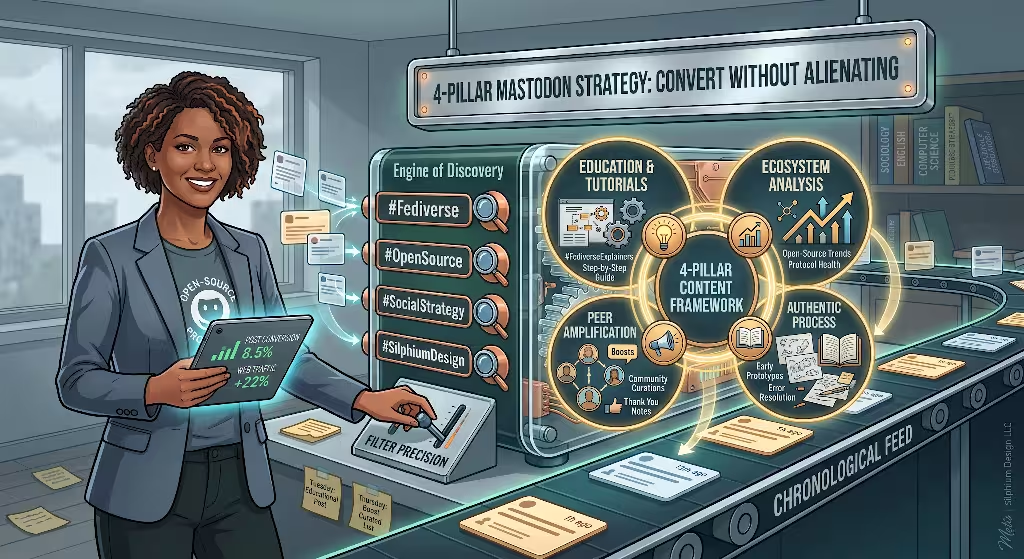
The 4-Pillar Content Strategy
To build an engaged following that supports your work, you need a balanced editorial plan. Posting only self-promotional announcements will cause people to unfollow you. By following a clear four-pillar framework, you can share useful ideas while steadily expanding your audience.
1. Technical and Educational Breakdowns
Create practical guides, step-by-step tutorials, and helpful explainers that teach a tangible skill. Share what you have learned from real-world projects, whether it is debugging a complex piece of code, organizing an open-source team, or designing accessible web pages. When you share generous educational content without demanding an email address in return, people recognize your expertise. High-value education is a reliable engine for building community on Mastodon.
2. Ecosystem Commentary
Offer thoughtful, balanced commentary on news, trends, and shifts happening across your field. You do not need hot takes or manufactured arguments. Instead, share measured analysis that helps others understand new developments. By participating thoughtfully in larger industry discussions, you establish yourself as a calm, trusted voice, which helps substantially when building community on Mastodon.
3. Community Curations
Dedicate a significant portion of your weekly activity to spotlighting other people’s work. Boost small creators, highlight interesting open-source tools, recommend great blog posts, and thank contributors who build open web resources. When you shine a light on others, they notice your generosity. True community is a two-way street, and community curation is essential for building community on Mastodon.
4. Transparent Updates
Give people an authentic look behind the curtain of your projects or company culture. Share early prototypes, discuss mistakes you made and how you resolved them, celebrate team milestones, and explain your core design decisions. Transparency builds emotional investment. People love rooting for creators who are open and honest about their process, which makes this pillar a cornerstone for building community on Mastodon.
Driving Traffic Ethically
Can you share outside links to your website, podcast, or business? Yes, absolutely. The key is how you present those links.
On traditional networks, creators post vague clickbait hooks to make users leave the platform. On Mastodon, give your readers value directly inside the post itself. Summarize your main lesson, share the core data point, or explain the central takeaway in the message. Then, offer the link as an optional resource for anyone who wants to dive deeper into the full article or documentation. When you treat readers with respect instead of manipulating their clicks, they gladly visit your site. Respectful sharing drives real conversions when building community on Mastodon.
Frequently Asked Questions about Building Community on Mastodon
How does Mastodon differ from traditional social networks?
Traditional networks operate as closed corporate ecosystems funded by behavioral surveillance advertising. They run centralized algorithms to keep users engaged and monetize their attention.
Mastodon is an open, decentralized network built on community-run servers using the ActivityPub protocol.There are no surveillance ads, no algorithmic feeds, and no central owner.You have the freedom to select your server, curate your chronological timeline, and take your followers with you if you decide to change servers. This creates an environment focused on personal autonomy, making building community on Mastodon a completely distinct experience.
Can businesses successfully market on Mastodon?
Yes, businesses can thrive on the platform, but only if they shift from traditional advertising to community participation.
Mastodon has no banner ads or paid sponsored posts. Commercial success comes from building trust through education, open-source contributions, stellar customer support, and helpful discussions. Brands that treat the network as an open town hall rather than a billboard find dedicated, loyal advocates. For brands that value authentic relationships, building community on Mastodon delivers remarkable long-term loyalty.
How do you find your target audience on the Fediverse?
Finding your audience takes active exploration rather than waiting for an algorithm to bring them to you.
Start by searching for industry-specific hashtags and following them. Look through the federated timeline of your instance to see what trending conversations are emerging. You can also browse curated public Fediverse directories and check out federated discussion groups, like Guppe groups, which automatically reblog posts to all subscribed members. Engaging in these established hubs is an effective way to accelerate building community on Mastodon.
What is the difference between a Favorite and a Boost?
A favorite (star icon) is a private compliment sent directly to the original author. It lets them know you appreciated their post, but it does not share the post to anyone else’s timeline.
A boost (reblog icon) republishes the post directly onto the home feeds of everyone who follows you. Because Mastodon has no algorithmic recommendations, boosts are the only way content spreads across the wider Fediverse. Understanding this mechanical distinction helps you appreciate why boosting others is vital for building community on Mastodon.
Measuring Success: Metrics That Matter in an Ad-Free World
Moving Beyond Vanity Metrics
On commercial platforms, success is often measured by vanity metrics: huge follower counts, millions of passive impressions, and viral view counts. These numbers look exciting on paper, but they often represent fleeting, shallow attention.
When you are building community on Mastodon, throw away those empty vanity metrics. A modest account with five hundred engaged followers who read your articles, reply thoughtfully, and buy your software is far more valuable than an account with fifty thousand passive followers who never interact. Focus on connection, not vanity.
Tracking Qualitative Engagement
Because Mastodon does not provide intrusive ad-tracking dashboards, measure your progress through qualitative signals:
- Reply Quality:Are people leaving thoughtful, interesting responses on your posts? Are your updates sparking meaningful discussions?
- Peer Amplification: Are respected peers, engineers, and creators in your space regularly boosting your content?
- Inbound Collaboration: Are people reaching out to you for podcast interviews, project collaborations, open-source work, or consulting advice?
- Community Retention: Do you see the same familiar names returning to converse with you week after week?
These qualitative signals prove that your efforts in building community on Mastodon are generating genuine trust and durable influence.
Privacy-Respecting Attribution
You can still track web traffic and business conversions from Mastodon while honoring user privacy. When you share links to your guides or product pages, you can add clean UTM tracking parameters to the end of your URLs (such as ?utm_source=mastodon&utm_medium=social).
Pair these clean links with privacy-respecting, open-source analytics platforms like Plausible, Umami, or Matomo. These modern tools let you see how many visitors come from the Fediverse, what pages they read, and whether they complete purchases or signups, all without harvesting private personal data or tracking people across the web with invasive tracking pixels. Ethical measurement aligns with Fediverse values, proving that building community on Mastodon supports your organizational goals without compromising your integrity.
The Long Game of Community Stewardship
Building community on Mastodon is not a fast sprint; it is an ongoing journey of community stewardship. If you arrive looking for an overnight viral shortcut, you will likely leave frustrated. But if you show up with curiosity, patience, and a genuine desire to contribute, the Fediverse will welcome you with open arms.
Every thoughtful reply you post, every image description you write, and every peer you boost adds to a healthier digital space. By honoring local community guidelines, sharing your best knowledge, and treating people like human beings, you create relationships that last far beyond the shifting whims of private algorithms. Step into the Fediverse, listen carefully, introduce yourself warmly, and enjoy the rewarding process of building community on Mastodon.