
Table of Contents
Discover the proven best practices for geo-targeting web content to maximize regional conversions. Master technical routing, hreflang tags, and AI search optimization.
The Evolution of Localized Web Architecture
In nature, living things survive by adapting to their specific surroundings. A tree growing on a cold mountain looks and behaves differently than the same type of tree growing in a warm valley. The web operates in much the same way. If you want your website to thrive across different regions, you must help it adapt to those specific digital environments. This process is known as geo-targeting. When you implement geo-targeting, you shape your website content to match the physical location of your target audience.
For many years, web creators thought that local search success just meant putting the name of a city into a webpage multiple times. That old method of keyword stuffing no longer works. Modern search engines are highly intelligent. They use semantic systems, which means they look at the true meaning and context of words rather than just counting how many times a word appears. Because of this shift, successful geo-targeting requires a deep, structural approach to web design. You cannot simply change a few words on a page and expect to win local traffic. You must build a web framework that understands geography at its core.
The main value of a clear geo-targeting plan is that it dramatically improves how users interact with your site. When a person lands on a page that feels like it was built specifically for their town, state, or country, they stay longer. This lowers your bounce rate, which happens when people leave your site after viewing only one page. A well-executed geo-targeting system also increases conversions, meaning more visitors will buy your products, sign up for your services, or contact your business. By matching the user’s local needs, you build immediate trust.
To succeed with geo-targeting today, you have to satisfy two different groups. First, you have to satisfy human users. Humans want to see familiar terms, local images, and correct currency formats. Second, you have to satisfy search engine bots and modern AI models. These automated tools crawl the web to find and organize information. Your geo-targeting efforts must provide clear technical clues that these bots can read instantly. When human intent and bot tracking align perfectly, your website gains massive visibility in local search results.
URL and Domain Architecture for Geographic Targeting
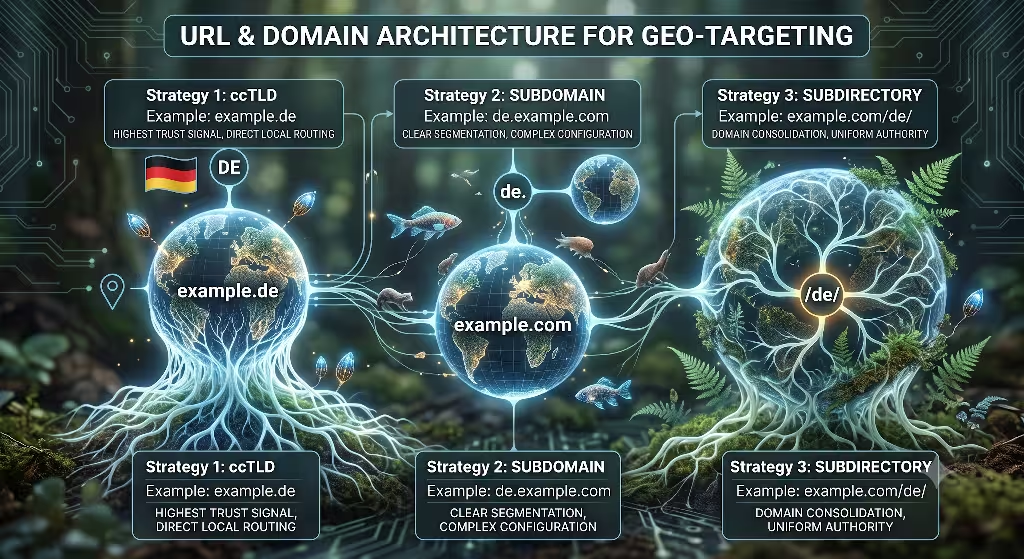
When you start planning your geo-targeting setup, your very first decision involves your website address structure. The way you arrange your URLs tells search engines exactly how your regional content is organized. If your domain structure is confusing, your geo-targeting signals will get crossed, and your traffic will suffer. There are three main ways to organize your website for different geographic areas.
The first option is using a country code top-level domain, which people call a ccTLD. Examples of this include domains that end in dot de for Germany or dot ca for Canada. Using a ccTLD is the strongest possible signal you can send for geo-targeting. Search engines know exactly which country the site belongs to right away. Local users also trust these extensions because they look familiar. However, this geo-targeting path can be very expensive. You have to buy and maintain multiple domain names. You also have to build up the search authority for each domain from scratch, which takes a massive amount of time and effort.
The second option is using a subdomain. This looks like a prefix added to your main domain name, such as uk dot example dot com. Subdomains are relatively easy to set up, and they allow you to keep your branding consistent. They also make it simple to route users to different servers based on where they live. The risk with this geo-targeting method is that search engines often treat subdomains as completely separate websites. This means the hard work you put into making your main website popular might not help your regional subdomains rank well in search results.
The third option is using a subdirectory, which is also called a subfolder. This looks like a path at the end of your main address, such as example dot com slash mx slash for Mexico. Many experts prefer this approach for geo-targeting because it keeps all of your content on one single domain. Every single backlink and piece of authority your site earns helps the entire domain grow stronger. It simplifies your overall website management. The main challenge here is that you must set up strict folder rules so that your geo-targeting content stays perfectly separated and never overlaps.
| Architectural Strategy | Implementation Method | SEO Advantage | Risk Profile |
| ccTLD | example.de | Strongest local trust signal; automated targeting. | High cost; separate domain authority building. |
| Subdomain | de.example.com | Clear segmentation; easier server routing. | Diluted root domain authority; complex configuration. |
| Subdirectory | example.com/de/ | Consolidates all backlink equity onto one domain. | Complex URL filtering; requires strict directory mapping. |
No matter which structural choice you make for geo-targeting, you must protect your site from duplicate content issues. If you have one page for the United States and a very similar page for the United Kingdom, search engines might think you are spamming them with copied text. You can solve this by using self-referential and cross-domain canonical links. A canonical link is a small piece of code that tells search engines which version of a page is the master copy. Proper canonical management ensures your geo-targeting pages work together instead of fighting each other for rankings.
Technical Signal Deployment: Hreflang, IP Detection, and Routing
Once your URL structure is ready, you need to deploy the underlying code that guides search engines and users to the right places. The most important tool for this job is the hreflang tag. This HTML attribute tells search engines the specific language and geographic region a webpage is built for. When you use hreflang tags correctly, a search engine will automatically show the French version of your site to someone searching from Paris, and the English version to someone searching from London.
Implementing these tags requires following strict syntax rules. The code must include both the language code and the region code. For example, en-us tells the system the page is for English speakers in the United States, while en-gb is for English speakers in Great Britain. If you make a tiny mistake in these codes, your entire geo-targeting system can fail. You also need to make sure these tags are reciprocal. That means if page A points to page B as the regional alternative, page B must point right back to page A. You can place these tags in the head section of your HTML pages or within your XML sitemap files.
Another major part of technical geo-targeting is how you handle visitors when they first arrive at your site. Some websites use automatic IP detection to find where a user is located, and then they immediately force a hard redirect to a regional page. This is a very dangerous mistake for geo-targeting. Search engine indexing bots often crawl the web from central locations, usually based in the United States. If you use forced redirects based on IP addresses, you might completely block search bots from ever seeing and indexing your European or Asian pages.
Instead of forcing a redirect, the best practice for geo-targeting is to use an unobtrusive user experience. You can display a polite, clear top-banner prompt that asks the user if they would like to switch to their local regional site. This method keeps your website safe and compliant with Core Web Vitals, which are the metrics Google uses to measure user experience. Specifically, it protects your Cumulative Layout Shift score and your Interaction to Next Paint score. A gentle banner ensures your layout does not jump around unexpectedly, which keeps both your human visitors and your geo-targeting efforts in perfect shape.
Semantic On-Page Content Localization & Regional Dialects

True geo-targeting goes far deeper than code strings and server settings. It lives within the actual words, phrases, and visual stories you place on your pages. When you adapt your content for a specific place, you must look at deep content adaptation rather than simple translation. Simply changing the language of your text is never enough for high-level geo-targeting. You must speak the exact dialect and utilize the unique vocabulary of the local community.
For example, a company selling clothing needs to understand that a user in London searches for jumpers, while a user in New York searches for sweaters. If your page targets the United Kingdom but uses American terminology, your geo-targeting will lose its effectiveness. Local users will instantly feel like the site is foreign, and they will likely leave. Search engines will also notice the mismatch in local search terms. Your geo-targeting strategy must include a localized dictionary for every single region you want to serve.
To make your geo-targeting even stronger, you should weave local geographic landmarks and natural environmental contexts directly into your content. This is where web design can take inspiration from biology. Mentioning nearby mountain ranges, well-known state routes, local parks, or distinct municipal neighborhoods creates an authentic digital footprint. When a search engine reads a page that mentions specific local spots alongside business offers, its algorithms immediately recognize the tight geographic connection. This elevates your geo-targeting authority far above competitors who just use generic templates.
Building dedicated geo-targeting landing pages is the ultimate way to put this into practice. Do not create hundreds of identical pages where you only swap out the city name in the headline. That creates low-quality content that search engines will ignore. Instead, craft unique location pages that feature real local case studies, authentic regional customer testimonials, and area-specific data points. If you are a builder targeting a specific valley, talk about the soil types, the local climate conditions, and the specific building codes of that valley. This makes your geo-targeting deeply valuable to the reader and highly optimized for search systems.
Schema Markup & Off-Page Entity Alignment
To ensure search engines completely understand your geographic presence, you must use structured data. Structured data is a specific code format that acts like an explicit translator for search engine bots. For geo-targeting, the most effective format is called JSON-LD schema markup. By placing this structured code in the background of your webpages, you give search engines clear, undeniable facts about your physical locations.
Within your geo-targeting schema, you should focus on three main code blocks. First, use the LocalBusiness schema to define what your company does. Second, use the PostalAddress schema to outline your exact physical location, including the street, city, state, and zip code. Third, use the GeoCoordinates schema to list your precise latitude and longitude. Providing these exact numbers removes all guesswork for search bots. It links your digital website content directly to an exact point on the surface of the earth, which supercharges your technical geo-targeting signals.
JSON
{
  "@context": "https://schema.org",
  "@type": "LocalBusiness",
  "name": "Silphium Design Regional Office",
  "address": {
    "@type": "PostalAddress",
    "streetAddress": "123 Biophilic Way",
    "addressLocality": "Titusville",
    "addressRegion": "PA",
    "postalCode": "16354",
    "addressCountry": "US"
  },
  "geo": {
    "@type": "GeoCoordinates",
    "latitude": "41.6273",
    "longitude": "-79.6748"
  },
  "url": "https://example.com/titusville/"
}
Another foundational rule of geo-targeting is maintaining perfect NAP consistency. NAP stands for Name, Address, and Phone number. The information written on your website must match your official Google Business Profile exactly, down to the last comma and abbreviation. If your website says Street but your Google profile says St., it can create minor confusion in search algorithms. By aligning your website text, your schema code, and your Google Business Profile, you build a rock-solid foundation for all of your geo-targeting goals.
The final piece of the structural puzzle is connecting your site to the local digital ecosystem around you. You need to earn geo-specific backlinks from trusted websites in your target areas. A link from a local chamber of commerce, a regional newspaper, or a neighborhood civic organization tells search engines that real communities vouch for your presence. These local links act like biological roots, anchoring your website into the local soil of that specific region. When you combine local link building with clean schema code, your geo-targeting system achieves maximum performance.
Optimizing for the 2026 Search Shift: GEO & Generative Engines
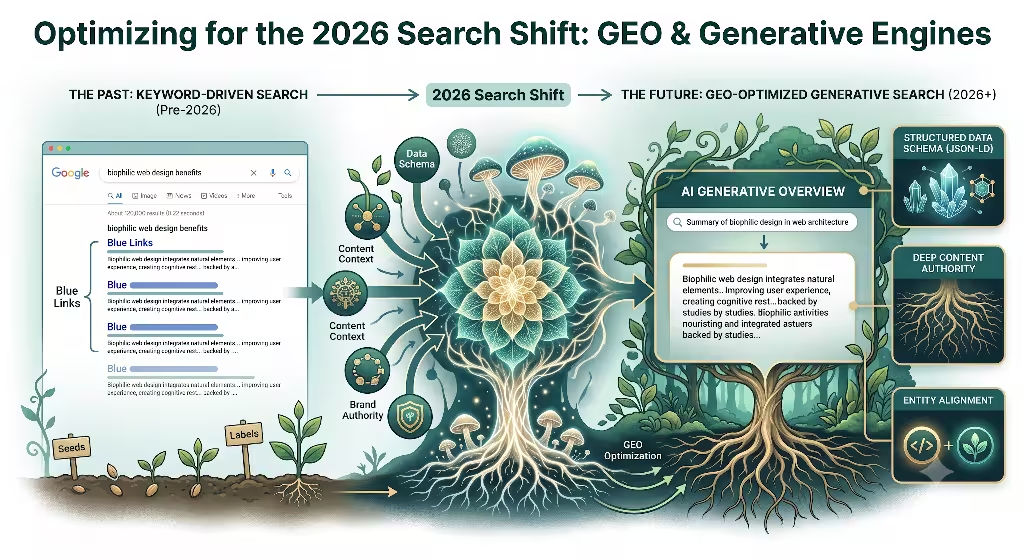
The world of web search changes rapidly, and we must look at how modern systems read sites today. Traditional search engines that only provide a list of blue links are sharing space with advanced generative AI search engines. This shift changes the way we approach geo-targeting. These new AI systems do not just match keywords; they read vast amounts of data from all over the internet to synthesize an answer for the user. This new world is called Generative Engine Optimization, or GEO.
In this new AI citation economy, geo-targeting requires you to structure your data so AI models can pull it out easily. When a user asks an AI search tool for the best service provider in a specific town, the AI searches for clear, authoritative sources to cite. If your website text is messy or buried deep inside complex layouts, the AI will bypass you. Your geo-targeting plan must adapt to how these large language models gather information.
To feed these modern AI search systems, you should use an Answer-First framework on your regional pages. This means you place a highly precise, 30 to 50 word localized summary directly below your main section headings. If your heading asks a specific local question, give a direct, clear answer immediately below it before diving into longer explanations. AI crawlers love this structure. It allows them to quickly grab your content and use it as a cited answer in AI search overviews, giving your geo-targeting massive exposure.
Finally, you must ensure your website files are configured to welcome these modern AI tools. Check your robots.txt file and your llms.txt file to verify that you are not accidentally blocking helpful AI crawlers like GPTBot or ClaudeBot. You want these automated systems to easily read your structural entity relationships and geographic content. If you block them, your site will disappear from AI-generated local recommendations. Keeping your site open and readable for AI models ensures your geo-targeting strategy remains successful now and in the future.
Technical Deployment Sequence
For an engineering team or content team implementing this strategy, order of operations dictates success. Misconfiguring infrastructure prior to launching content creates severe indexing deficits.
1.Domain & Directory Mapping:Prerequisite Phase.
Establish the chosen URL structure (Subdirectories preferred for brand consolidation) and configure server configuration files to support clean regional routing.
2.Geographic Keyword & Entity Clustering:Research Phase.
Extract location-specific keywords, cross-reference regional search volume variations via Google Trends, and catalog adjacent physical entities (landmarks, transit corridors).
3.Content Translation & Dialect Injection:Creation Phase.
Draft native, non-commodity copy utilizing specific localized terms. Avoid generic templates across multi-location landing pages.
4.Technical On-Page Tag Integration:Optimization Phase.
Inject semantic H2/H3 elements, construct cross-regional hreflang alternate tags, and ensure canonical links accurately point to the master regional version.
5.JSON-LD Schema Implementation:Structured Data Phase.
Generate and validate localized JSON-LD code blocks, nesting exact coordinate pairs and matching NAP data precisely to your Google Business Profile.
6.AI Search & Indexing Verification:Launch Phase.
Update sitemap indexes, review robots.txt to ensure AI crawlers are unhindered, and submit top-level URLs via Google Search Console for live monitoring.
Common Questions Answered about Geo-Targeting Web Content
What is geo-targeted SEO and how does it work?
Geo-targeted SEO is the process of optimizing your website content so it ranks well for specific geographic locations. It works by blending technical backend signals with real on-page local context. The technical side uses things like hreflang tags, clear subdirectory structures, and server rules to point search engines toward the right regional pages. The on-page side uses localized schema code, real neighborhood references, and consistent business profile information to prove to search algorithms that your business is truly relevant to local users in that exact area.
How do you create a geo-targeted content strategy?
Creating a strong geo-targeted content strategy starts with in-depth local keyword research to find out exactly how people in different regions search for your services. Next, you choose a clean website address setup, like using subdirectories, to keep your domain power unified. After that, you build unique landing pages for each location instead of using the same template over and over. You fill these pages with authentic regional client stories, real local terms, and precise location schemas so search systems can easily see your geographic value.
What are the best technical methods for geo-targeting web content?
The best technical methods for geo-targeting involve using clear HTML hreflang attributes to define the exact language and region for each page. You should also use a subdirectory system, like slash en-ca slash for Canada, because it keeps all your link strength on one single domain. Avoid using forced automatic redirects based on a user’s IP address because they can accidentally block search engine spiders from finding your international pages. Instead, use a helpful top-banner alert that lets users choose their preferred location naturally without hurting your search scores.
How does generative AI search impact localized content?
Generative AI search impacts localized content by looking for clear, structured entity data and real local authority instead of just checking for simple keyword density. AI search engines want to give users synthesized answers, so they pull data from highly organized websites. To win in this environment, your location pages must use clean code formatting, feature clear answer paragraphs directly under headings, and keep your business information identical across all online directories so AI systems can verify and trust your geographic location.
Detailed Implementation: Step-by-Step Execution
To make sure your geo-targeting platform functions perfectly, let us look closer at the daily execution steps. When you build out a regional page, you must think like a scientist studying a local habitat. Every single element on the page needs to feel native to the environment. If you hurry through the setup, your geo-targeting signals will become dilute and weak.
Start by looking at your imagery. A website trying to connect with users in the Pacific Northwest should feature images of local landscapes, local architecture, and regional flora like Douglas firs or mossy forest floors. If you use generic stock photos of palm trees on a page meant for Seattle, your geo-targeting will feel fake to human visitors. This visual context creates an instant, subconscious feeling of home, which keeps users on your site longer and improves your search signals.
Next, focus on your local numbers and currency formats. If you are using geo-targeting to reach users in Canada, make sure your prices are clearly marked in Canadian dollars and your measurements use the metric system. If you are targeting users in the United States, use imperial measurements like feet and miles. These small details are critical milestones for successful geo-targeting. They show that your business actually understands the practical, daily realities of the local customer.
You must also establish a regular audit schedule for your geo-targeting code. Search engines update their guidelines frequently, and website updates can sometimes break your hreflang links or erase your schema markup. Set a reminder to check your Google Search Console reports at least once a month. Look for any international targeting errors or broken localized links. Catching these technical issues early ensures your geo-targeting performance never drops.
Finally, remember that excellent geo-targeting takes time to show full results. Search engines need to crawl your new URL structures, process your schema code, and see how local users interact with your localized content. Be patient and keep focus on providing real, localized value. When you combine perfect technical infrastructure with authentic local storytelling, your website will build a deep, lasting connection with audiences around the globe.
Advanced Regional Expansion Systems
As your business grows, your geo-targeting system must scale along with it. Managing five localized pages is simple, but managing fifty or five hundred pages requires an automated, systematic approach. If you do not have a clear system for expansion, your website can quickly become a messy wilderness of broken links and outdated information.
To scale your geo-targeting successfully, you should build a master localized content database. This database should store all the specific regional variables for each location you serve. It should include the local office address, the precise latitude and longitude, the unique local vocabulary terms, and specific regional client quotes. By keeping this data in one central location, you can easily push accurate information out to your various geo-targeting landing pages without having to update each one by hand.
[Master Content Database]
       │
       ├───► /us/pa/titusville/  (Pulls Titusville NAP, Local Photos, Schema)
       ├───► /us/vt/burlington/  (Pulls Burlington NAP, Local Photos, Schema)
       └───► /us/ma/boston/      (Pulls Boston NAP, Local Photos, Schema)
You also need to think about how your site handles regions that speak multiple languages. For example, if you are using geo-targeting for Switzerland, you may need to create versions of your content in German, French, and Italian. In this scenario, your hreflang tags must contain the exact language and country combinations for each variation. This multi-layered geo-targeting ensures that every single community within a geographic border feels fully respected and understood by your brand.
It is also wise to monitor your local competitors within each target market. Local search landscapes can vary wildly from one town to the next. A competitor who dominates search results in one valley might be completely invisible in the next county over. Use local search tracking tools to see how your geo-targeting pages rank inside specific zip codes. This precise data allows you to adjust your local content, update your regional case studies, and fine-tune your schema data to stay ahead of local competition everywhere you operate.
Ultimately, successful geo-targeting is about creating digital harmony between your website and the physical world. By honoring the unique geography, culture, and technical requirements of each region, you build a sustainable digital ecosystem. This deep connection satisfies search engine bots, honors modern AI search engines, and provides a beautiful, familiar experience for every single human being who visits your site.
Maximizing Conversion Rates on Localized Landing Pages
Once your technical geo-targeting framework is driving local traffic to your website, your main goal shifts to conversion optimization. Getting a user to visit your localized page is only half the battle. You must also convince them to take action. A visitor from a specific town should immediately see that your business is deeply involved in their local community.
To lift conversion rates using geo-targeting, place your local contact information prominently at the top of the page. If a user has to search through your site to find out if you actually service their area, they will likely get frustrated and leave. Display your local phone number with its regional area code, along with the physical address of your nearest office. This immediate visual proof of proximity eliminates friction and encourages users to make contact right away.
Another highly effective geo-targeting method is highlighting regional partnerships and local community involvement. If your company sponsors a local youth sports team, participates in a regional charity event, or works with local civic groups, feature those stories on your location pages. This shows that you are not just a distant corporation using geo-targeting to extract dollars from the community. It proves you are an active, caring neighbor, which builds massive psychological trust.
┌────────────────────────────────────────────────────────┐
│  Silphium Design - Titusville Regional Office          │
│  📞 (814) 555-0199 | 📍 123 Biophilic Way, Titusville  │
├────────────────────────────────────────────────────────┤
│                                                        │
│  Our Local Community Involvement:                      │
│  🏆 Proud Sponsor of the Titusville Little League       │
│  🌳 Partners with the Local Park Dedication Project   │
│                                                        │
└────────────────────────────────────────────────────────┘
You should also customize your calls to action based on regional behavior patterns. Different areas often have different preferences for how they like to do business. Users in a fast-paced metropolitan area might prefer a quick text message option or an instant online booking form. Users in a quiet, rural valley might prefer a traditional phone call or an in-person meeting request. Aligning your conversion tools with these regional habits ensures your geo-targeting strategy delivers the highest possible return on your investment.
Long-Term Maintenance of Geo-Targeting Systems
Building a comprehensive geo-targeting framework is a major achievement, but you cannot simply set it up and forget about it. Digital landscapes change constantly. Links decay, local phone numbers change, and search engine algorithms evolve. To protect your hard-earned local rankings, you must establish a strict long-term maintenance routine for your geo-targeting platform.
Start by conducting a bi-annual review of all your regional address data and schema blocks. If your business moves to a new suite or changes its local phone number, update those details immediately across every single digital asset. Any mismatch between your website text, your JSON-LD schema code, and your Google Business Profile will weaken your overall geo-targeting signals and confuse search bots. Keep an official master document that logs every single location detail to make updates smooth and accurate.
It is also vital to regularly check the health of your cross-regional links and hreflang tag paths. As you add new pages or remove old services, it is easy to accidentally create broken redirect loops or orphaned regional pages. Use a technical website crawler once a quarter to map out your entire international and local subdirectory structure. Ensure every single regional page has a valid, functioning self-referential canonical tag and a perfectly matched counterpart tag pointing to other regions.
Finally, keep a close eye on the performance metrics of each geo-targeting page. Monitor individual traffic levels, bounce rates, and keyword rankings for every specific location directory. If you notice a particular regional page is losing ground, dive back into the content. Refresh the text with updated local landmarks, add recent regional client testimonials, and verify that modern AI search bots can still read the page without issues. By treating your geo-targeting framework as a living, breathing system that needs regular care, you ensure your website remains a dominant, trusted local authority for many years to come.