
Imagine walking through the woods in Vermont. The air is crisp, and the smell of pine fills your lungs. Now, imagine you step into a building in the middle of Boston. The air changes. The light is different. The sounds are new. In the physical world, we always know where we are because our senses tell us. In the digital world, websites often feel like they belong nowhere. They are “placeless.” Our work at Silphium Design LLC is to change that. We use biophilic design to make the internet feel as natural and localized as a forest path.
To do this, we must master the way we deliver information. The technical term for this is geo-targeted content delivery. This is the process of sending specific information to a user based on where they are in the physical world. If you are in Vermont, you might see pictures of maple trees. If you are in Florida, you might see palm trees. This is more than just a trick for sales. It is about making the digital world match the real world.
When we provide targeted content that reflects a user’s local environment, we reduce the feeling of being lost. We call this digital biophilia. It helps people feel more at home online. In this guide, I will show you how to implement these systems to help your business grow and make the internet a better place.
Table of Contents
The Basic Idea of Geo-Targeted Content Delivery
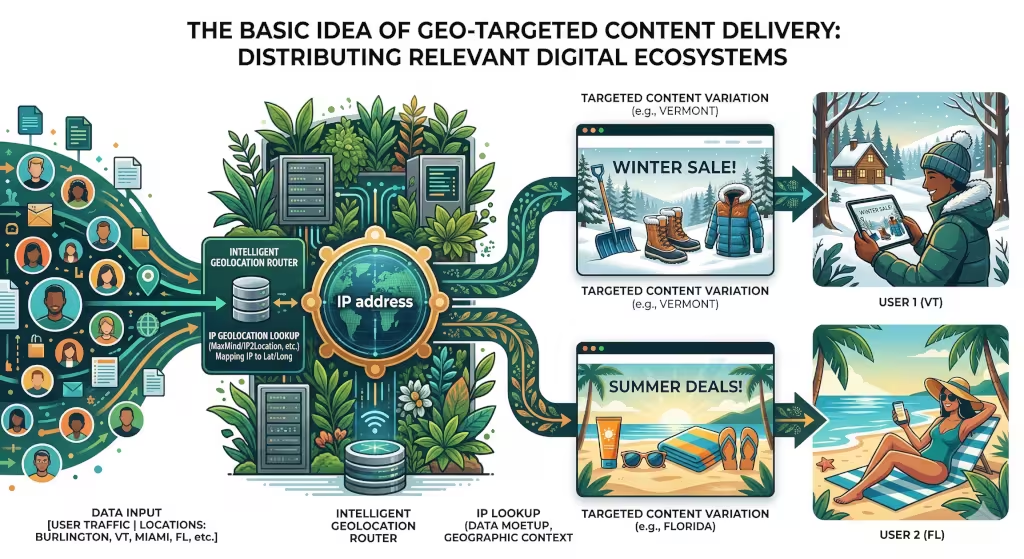
Before we dive into the math and code, we need to understand what we are trying to build. Geo-targeting is like a smart mailing system. Imagine a post office that knows exactly what you need based on your zip code. If it is snowing in your town, the post office sends you a flyer for snow shovels. If it is sunny, they send you a flyer for sunblock.
On a website, we use the user’s internet connection to find their general location. Once we know where they are, we can show them targeted content that matters to them. This might include local news, the right currency, or images of local landmarks. For a business, this means people are more likely to stay on the site. For a user, it means the site is more helpful. We are moving away from a “one size fits all” internet. Instead, we are building a web that respects the Spirit of Place.
How the Internet Finds You: IP Geolocation
The first step in sending targeted content is knowing where the user is located. Every device connected to the internet has a special number called an IP address. You can think of an IP address as a digital mailing address. It tells the network where to send data.
To turn that number into a physical location, we use a tool called an IP Geolocation Database. Companies like MaxMind or IP2Location keep huge lists of these numbers. They match the numbers to cities, states, and countries. When a person visits your site, your server looks up their IP address in the database.
Once the server finds a match, it knows the user’s city. This allows the system to pick the best targeted content for that person. It is important to remember that this is not perfect. Sometimes a user might be using a tool to hide their location. However, for most people, this method works very well. It is the foundation of any good local strategy.
Using the Edge: CDNs and Speed
In the past, websites lived on one big computer called a server. If that server was in New York and the user was in London, the data had to travel a long way. This made the site slow. To solve this, we now use something called a Content Delivery Network, or CDN.
A CDN is a group of servers spread out all over the world. When you use a CDN, your website lives on all of them at once. These small servers are called “Edge Nodes.” When a user asks for your site, the server closest to them answers the call. This is where we can really start to use targeted content effectively.
Modern CDNs allow us to run small bits of code right at the edge. Instead of waiting for the main server to decide what to show, the edge node does it. It looks at where the user is and instantly picks the right images or text. This makes the site feel very fast. Speed is a huge part of how search engines rank your site. By using edge computing, you are not just being helpful; you are also helping your SEO.
Server-Side vs. Client-Side: Behind the Scenes
There are two main ways to decide which targeted content to show. We call these “Server-Side” and “Client-Side.”
Server-side means the decision happens before the website even reaches the user’s screen. The server sees the user’s location and puts together a custom page. This is the best way for SEO. Search engines like Google can see the localized page clearly. It also prevents the “flicker” effect where a page changes right in front of your eyes.
Client-side means the decision happens inside the user’s web browser using a language called JavaScript. The browser loads the general page first, then asks, “Where am I?” Once it gets an answer, it swaps out some of the parts. While this is easier to set up, it can be slower. It can also be harder for search engines to read. For high-quality targeted content, I always recommend a server-side approach whenever possible.
Swapping the Pieces: Dynamic Content Injection
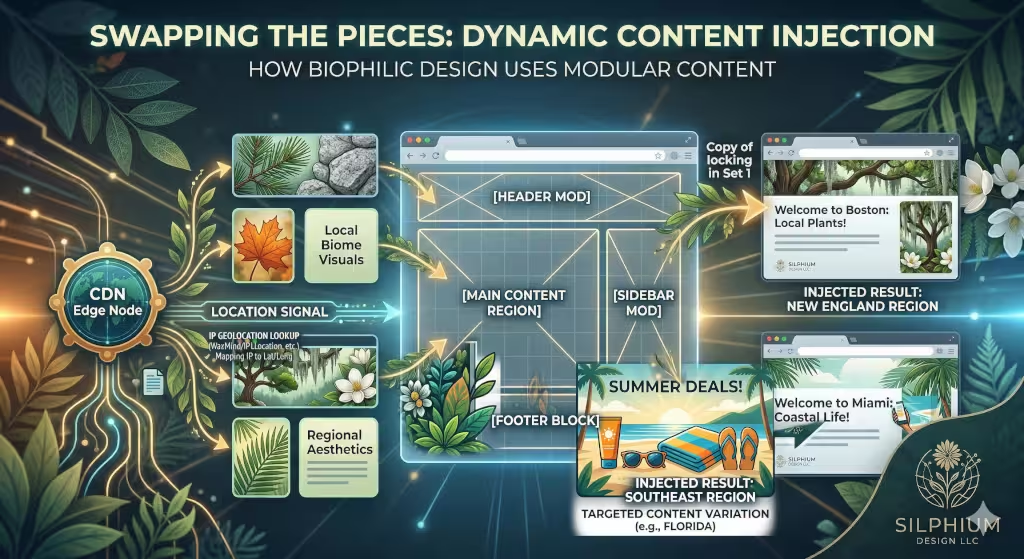
Think of your website as a Lego set. Instead of building one solid house, you build it in blocks. One block is the header, one is the main text, and one is the side bar. With geo-targeting, we can swap these blocks out easily. This is called dynamic content injection.
If a user is in a rainy city, you might swap a “sunny” header image for a “rainy” one. If they are in a country that uses the Euro, you swap the dollar signs for Euro symbols. This makes the targeted content feel like it was made just for them. At Silphium Design LLC, we take this a step further. We swap images to match the local nature. Showing a person in the desert a picture of a lush forest can feel “wrong” to their brain. By matching the local biome, we create a sense of calm and trust.
Making Machines Happy: SEO and GEO in 2026
We are now living in the year 2026. Search has changed. It is no longer just about typing words into a box. Now, we have AI agents that “read” the web for us. This is called Generative Engine Optimization, or GEO. To make sure these AI tools find your targeted content, you need to use special tags called Schema Markup.
Schema is a secret language that tells robots exactly what your content is about. If you have a local shop, you use Schema to tell the AI your address, your hours, and what you sell. When someone asks an AI, “Where is the best plant shop near me?” the AI looks for these tags. If your targeted content is properly tagged, the AI is more likely to recommend you. This builds what we call E-E-A-T, which stands for Experience, Expertise, Authoritativeness, and Trustworthiness. Showing that you know the local area builds that trust.
Talking to the Robots: AI Visibility
AI models like Gemini or ChatGPT are very smart, but they need clear paths to find information. When you create targeted content, you should organize it in small, clear sections. These are often called “modular blocks.”
When an AI crawls your site, it looks for these blocks. If it sees a block that is perfectly written for a specific city, it will use that block to answer questions for people in that city. This is why having high-quality targeted content is so important for the future of search. You are not just writing for humans anymore; you are writing for the AI that helps humans find things.
Design and the Spirit of Place
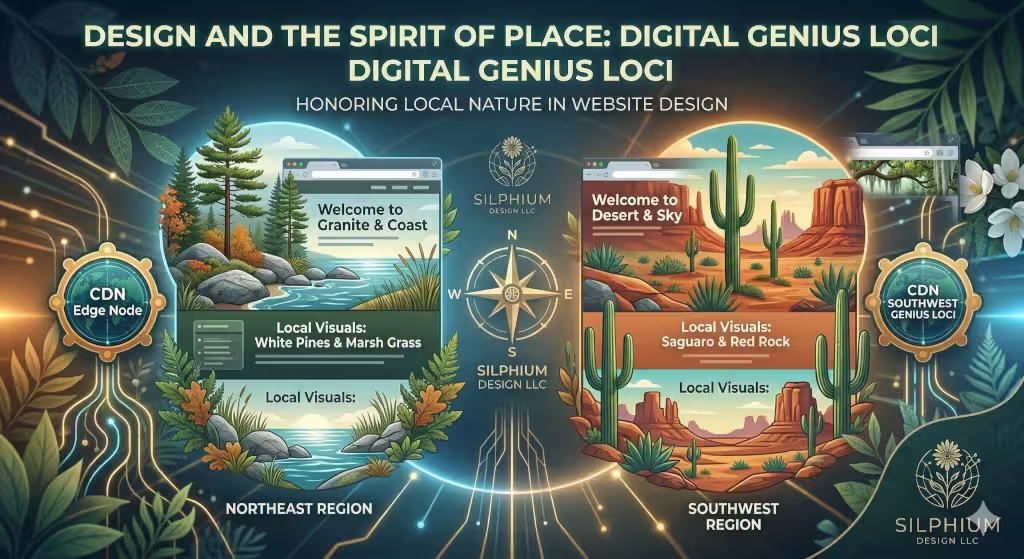
We believe that design should never be an accident. Every color and shape should have a reason. This is especially true when we use targeted content.
Visual localization is the art of changing the look of a site to match a place. For example, if I am designing for someone in Vermont, I might use colors like deep green and slate gray. These are the colors of the Vermont landscape. For someone in the Southwest, I might use terracotta and sand colors. This makes the targeted content feel grounded in reality. It is a way of honoring the “Genius Loci,” or the spirit of the place where the user lives.
The Rhythm of the Sun: Circadian Lighting
One of my favorite ways to use targeted content is through circadian lighting. Our bodies have internal clocks that follow the sun. When we look at bright blue light late at night, it messes up our sleep.
We can use a user’s location to find out when the sun sets in their city. Then, we can program the website to slowly change colors. As it gets darker outside for the user, the website becomes warmer and dimmer. This is a very powerful form of targeted content. it shows the user that the website understands their physical needs. It makes the digital experience feel like a part of the natural day.
Money and Language: Regional UX
Of course, targeted content is also about being practical. If you sell products, you must show the right currency. You should also use the local way of writing dates and phone numbers.
Language is also a big part of this. Even within the same language, there are regional differences. A “soda” in one place is a “pop” in another. Using the right local words in your targeted content shows that you are part of the community. It removes the barrier between the business and the customer. This is what we call Regional User Experience, or UX. It is about making the site as easy to use as possible by speaking the user’s “local language.”
Privacy and the Rules of the Road
When we talk about tracking where people are, we must be very careful. People care about their privacy, and so do I. There are laws like GDPR in Europe and CCPA in California that tell us how we can use location data.
To use targeted content safely, you must always be honest with your users. Tell them why you are looking at their location. Give them a choice to opt out. In 2026, we also have new tools like the Privacy Sandbox. This allows us to group people by region without knowing exactly who they are. This keeps the user safe while still allowing us to provide helpful targeted content. Ethics should always come before technology.
Common Questions about Geo-targeted Content
People often ask how SEO and GEO work together. The answer is that they are two sides of the same coin. SEO helps you show up in a list of links. GEO helps you become the “answer” that an AI gives to a user. Both require you to have excellent targeted content that is relevant to a specific place.
Another question is about the difference between geo-targeting and geofencing. Geo-targeting is broad. It looks at a whole city or state. Geofencing is very specific. It is like drawing a circle around a single building. For most websites, geo-targeting is the better tool for creating targeted content because it works for everyone, not just people with their GPS turned on.
The Value of CDNs for Local Sites
If you are a local business, you might think you don’t need a CDN. But remember, a CDN is about more than just global reach. It is about control. Even if all your customers are in one state, a CDN helps you manage your targeted content more easily. It gives you the “Edge” tools you need to swap images and text quickly. It also protects your site from crashing if too many people visit at once.
Building a Technical Checklist
If you are ready to start, here is a simple plan. First, look at where your visitors are coming from. You can use Google Search Console for this. Second, pick a CDN that allows you to run code at the edge. Third, decide what parts of your site should be targeted content. Start small, maybe with just a header or a welcome message.
Fourth, make sure you have “Hreflang” tags if you are using different languages. These tags tell search engines which version of the page belongs to which region. Finally, check your site speed. Adding targeted content should never make your site slow. If it does, you need to move more of the work to the edge servers.
The Future of the Digital Forest
As we look toward the future, the internet will only become more integrated with our physical world. We are moving away from the cold, gray screens of the past. We are building a digital forest that is full of life and local flavor. By using targeted content, we are showing respect for the diversity of our planet.
At Silphium Design LLC, we believe that a website should be as unique as the place it serves. Whether I am botanizing in the woods or coding in my office in Boston, I am always looking for ways to connect nature and technology. Implementing geo-targeted content delivery is one of the best ways to do that. It makes the web more human. It makes it more natural. And most importantly, it makes it work better for everyone.
Your Next Steps
I hope this guide has helped you understand why location matters so much in web design. Creating targeted content is a journey. It starts with a simple goal: being more helpful to the person on the other side of the screen. When you treat your users like neighbors, they will treat you like a trusted friend.
Bonus: Some Image Ideas for Specific US Regions
As a biologist and a web designer, I see the internet as a vast ecosystem. When we use targeted content, we are essentially planting seeds in the right soil. If you plant a cactus in the snow, it will not survive. In the same way, if you show a user an image that does not match their physical reality, the connection is lost. This is where biophilic design becomes a tool for better business.
By matching the natural world of the user, we lower their stress levels. We make the website feel like a safe, familiar place. Below is my curated list of biophilic image ideas for different regions in the United States. Each idea is meant to be used as targeted content to create a sense of belonging and local pride.
New England: The Spirit of the North
For users in places like Vermont, Maine, or Massachusetts, the natural world is defined by seasons and strong trees. Your targeted content should reflect the deep connection to the forest and the sea.
- White Pine and Granite: Use images of Eastern White Pine needles with their soft, blue-green color. Pair these with the gray, textured look of granite rocks. This reflects the “Appalachian” soul of the region.
- Autumn Canopy: Nothing says New England like the transition of Sugar Maples. Use high-resolution photos of orange and red leaves. This type of targeted content is very effective during the fall months to show that your site is “alive” and aware of the time.
- Coastal Salt Marshes: For users near the shore, use images of tall marsh grasses and the Atlantic tide. This creates a horizontal, calming visual that reduces eye strain.
The Southeast: Soft Textures and High Humidity
In the South, the air is thick and the growth is lush. People here respond to “soft” biophilia. Your targeted content should feel warm and inviting.
- Live Oaks and Spanish Moss: The way Spanish moss hangs from old trees is a powerful fractal pattern. Using this in your targeted content creates a sense of history and peace.
- Magnolia Blooms: Large, waxy white flowers with deep green leaves provide a strong “focal point.” This helps guide the user’s eye toward important buttons or links on the page.
- Cypress Knees and Wetlands: For a more technical or grounded look, images of cypress trees in the water show stability and resilience. This is a great choice for targeted content on service-based websites.
The Midwest: The Great Horizon
The Midwest is about the “Big Sky” and the strength of the prairie. Users in this region often value space and openness. Your targeted content should avoid feeling cluttered.
- Tallgrass Prairie: Images of Big Bluestem grass waving in the wind offer a sense of movement. This creates a “natural analogue” for the user, making the website feel less static.
- Oak Savannas: Bur Oaks are famous for their rugged, thick bark. Using close-up shots of this bark as a background for your targeted content adds a layer of “tactile” or touch-based interest to a digital screen.
- Great Lakes Dunes: If a user is near Michigan or Illinois, use images of lake grass and sandy dunes. The blue of the lake is very different from the blue of the ocean, and local users will recognize the difference in your targeted content.
The Southwest: Mineral Tones and Resilience
The Southwest is a land of light and stone. Here, biophilic design must focus on “xeriscaping” or water-saving beauty. Your targeted content should use warm, earthy colors.
- Red Rock Formations: The layered sandstone of Sedona or the Grand Canyon provides a natural color palette. Using these oranges and reds in your targeted content makes the site feel grounded in the earth.
- Saguaro Cacti and Agave: These plants have very strong geometric shapes. The “ribs” of a cactus are a perfect example of a mathematical pattern in nature. Using these in targeted content helps create a clean, modern look.
- Desert Blooms: After a rain, the desert turns purple and yellow. Using images of brittlebush or lupine can add a “burst” of energy to your targeted content during the spring.
The Pacific Northwest: The Fractal Rainforest
The Pacific Northwest is a land of moss, mist, and deep greens. It is the perfect place for “fractal” biophilia, which is the use of repeating patterns found in nature.
- Fern Grottoes: The Sword Fern is a classic PNW plant. The way the leaves repeat themselves is very pleasing to the human brain. Using ferns in your targeted content can actually help people process information faster.
- Douglas Fir Canopies: Looking up through the branches of a giant fir tree gives a sense of “prospect and refuge.” This makes the user feel protected while they browse your site. It is a powerful psychological tool for targeted content.
- Misty Coastlines: The gray fog and dark rocks of the Oregon coast are iconic. This type of targeted content creates a “mood” that is both serious and beautiful. It works well for professional or high-end brands.
The Mountain West: Peaks and Aspens
In the Rockies, the world is vertical. The air is thin and the light is sharp. Your targeted content should reflect this clarity.
- Quaking Aspens: The white bark and round, shaking leaves of the aspen are very distinct. The “eyes” on the bark create a natural pattern that captures attention. Using aspens in your targeted content suggests community, as aspen groves are often one single living organism.
- Snow-Capped Peaks: High-altitude mountains offer a sense of “awe.” Awe is a biophilic emotion that makes people feel more connected to the world around them. This is great for high-impact targeted content.
- Clear Mountain Streams: The sight of moving water over smooth river stones is one of the most relaxing images for a human. It suggests purity and flow, which are great qualities to attach to your brand through targeted content.