
Table of Contents
In todays article, we are going to explore how to build an organic presence that truly matches your corporate values on Mastodon.
The digital world is changing fast, and old ways of marketing are breaking down. For a long time, companies relied on giant social media platforms to reach customers. But those platforms are filled with annoying ads, secret tracking tools, and confusing algorithms. For businesses that care about the planet, these old platforms do not fit their core values anymore. This is why many organizations are moving to Mastodon to grow their eco-conscious branding. Mastodon is not owned by one giant company. Instead, it is made up of thousands of small, independent servers. This decentralized structure offers a fresh start for businesses that want to be honest and open.
When you use Mastodon, your online choices have real-world impacts. On traditional networks, your content is forced to compete for attention in a system designed to keep people angry or addicted. Mastodon lets you step away from that noise. For successful eco-conscious branding, this platform is an ideal match. The people who use Mastodon value honesty, community support, and sustainability. They do not want to be treated like data to be sold to advertisers. They want to talk to real people and buy from real, ethical companies.
Choosing where to set up your profile on Mastodon is your very first major brand statement. It is just like choosing where to build a physical store. If you sell organic vegetables, you probably want your store in a neighborhood that values health and nature. On Mastodon, the server you choose defines your primary neighborhood. Your server affects who sees your posts first and what rules you must follow. It also affects your carbon footprint, because different servers use different amounts of energy. If you want your eco-conscious branding to be taken seriously, you must understand how these servers work and choose the best home for your business.
What is a Mastodon Instance and How Does it Work?
To succeed with eco-conscious branding on this network, you need to understand the basic setup. A Mastodon instance is simply an independent server. You can think of the entire Mastodon network as a giant collection of separate towns. Each town is a server, or an instance, run by an individual or a small group. Even though these towns are separate, they are connected by a special communication system called the ActivityPub protocol. This protocol is just a set of rules that allows different servers to talk to each other smoothly.
This system works exactly like email. If you have an email account with one company, you can still send an email to a friend who uses a completely different email company. The two systems can talk to each other because they use the same basic rules. Mastodon works the same way. A user on a server focused on technology can easily follow and talk to a user on a server focused on farming. This open connection means your eco-conscious branding can reach people all over the network, no matter which server they call home.
When you log into Mastodon, you do not look at just one main feed. Instead, you have access to three distinct timelines. The first is your Home timeline, which shows posts only from the accounts you explicitly choose to follow. The second is the Local timeline, which shows every public post made by people who live on your specific server. This is why server selection is so important for eco-conscious branding.
If you join a green server, your posts automatically appear on the Local timeline of thousands of people who already care about the environment. The third timeline is the Federated timeline. This feed shows posts from people on your server plus any posts from other servers that people on your server happen to follow. It represents the wider world outside your immediate neighborhood.
Another massive technical benefit for your eco-conscious branding is the green link verification system. On old social networks, you have to pay a monthly fee to get a blue checkmark next to your name. On Mastodon, verification is completely free and based on open web standards. You simply add a short snippet of code to your official website that links back to your Mastodon profile. This code uses an attribute called rel="me", which tells the system that the website and the Mastodon profile belong to the same person or company.
Once the server checks this link, your website address turns green on your Mastodon profile. This green link provides instant proof that your business is real and trustworthy, without forcing you to pay a giant corporation for a badge.
The Top Contenders: Best Mastodon Instances for Eco-Conscious Branding
Now let us look at the specific servers that can help you expand your eco-conscious branding. The first major option is Mastodon.green. This server was built from the ground up for people who care about climate change, biodiversity, and sustainable living. The overall vibe of this server is highly positive, focused on solutions, and welcoming to ethical ideas. It is managed by people who want to create a safe space for environmental discussion.
The main advantage of using Mastodon.green for your eco-conscious branding is the audience. The local timeline on this server is constantly filled with conversations about renewable energy, zero-waste tips, and conservation. Activists, non-profit groups, and green scientists use this space every day. If your company posts here, your message goes directly to people who are already looking for sustainable alternatives. You do not have to waste time convincing them that the environment matters. They already know it matters, and they are looking for businesses that can help them live greener lives.
The second excellent option for your eco-conscious branding is Mastodon.eco. This instance is closely tied to the official dot-eco website community. To get a dot-eco website domain, a company has to pledge to support environmental causes. The Mastodon.eco server carries that same strict dedication into the social media world. The vibe here is professional, organized, and focused on global change.
The edge you get here is instant institutional trust. When other users see that your account is hosted on Mastodon.eco, they immediately know you are part of a verified global green network. It is fantastic for business-to-business connections as well as reaching individual consumers. It allows your eco-conscious branding to stand alongside major international environmental organizations, which gives your words extra weight and authority.
The third server to consider is Ecoevo.social. This instance has a slightly different focus. It is designed mainly for academics, researchers, and students who study biology, ecology, and evolution. The vibe is intellectual, data-driven, and deeply scientific. People here care about real facts, peer-reviewed studies, and deep conversations about nature.
Using Ecoevo.social can give your eco-conscious branding a massive boost in scientific credibility. If your products are backed by real environmental science, this is the place to talk about them. The community here will appreciate detailed explanations of how your items are made or how your services reduce waste. It is a wonderful space to build deep authority, though you must be ready to back up your claims with solid facts, because this educated audience can spot false claims instantly.
Finally, you can choose the self-hosted route. This means your company buys its own virtual private server and installs the Mastodon software on its own domain name, such as social.yourcompany.com. This option gives you total control over your digital environment. You set the rules, you manage the data, and you do not have to worry about the neighborhood rules of another server.
For ultimate eco-conscious branding, self-hosting is the gold standard if you do it right. By hosting your own server, you can choose a data center that runs entirely on wind or solar power. You can proudly tell your customers that your social media presence does not contribute to global warming. It requires more technical skill and maintenance, but it shows the world that your dedication to sustainability goes all the way down to the computer code you use.
How is Mastodon Different from Traditional Social Media?
To make your eco-conscious branding work on Mastodon, you have to unlearn almost everything you know about traditional social media. The biggest difference is the total absence of algorithmic feeds. On networks like Instagram or Facebook, a complex computer program decides what you see. These programs are built to maximize profits by keeping users looking at their screens for as long as possible. They often lift up angry, controversial, or sensational posts because those get the most clicks.
On Mastodon, there is no robot sorting your feed. Everything is strictly chronological, which means you see posts in the exact order they are made. If an account you follow posts something, it goes straight to the top of your feed. For your eco-conscious branding, this means you can stop playing games with keywords or trying to trick an algorithm. You do not have to worry about your content being hidden just because you did not use a trending sound or a flashy video format. Your visibility is earned honestly through the value of your words and how well you connect with your followers.
Another critical difference is community-driven moderation. Giant social media platforms use automated tools or underpaid contractors to police their networks, and they often fail miserably. Mastodon handles things locally. Each server has its own volunteer moderators who live in the community and enforce the server’s specific rules. This local control creates a much healthier space for your eco-conscious branding.
Green communities on Mastodon are very quick to moderate against bad behavior, harassment, and greenwashing. Greenwashing is when a company lies or exaggerates about how eco-friendly its products really are. Because the moderators care deeply about environmental truth, they will not tolerate businesses that make false claims. This strict moderation helps honest companies because it cleans out the noise. When you use your eco-conscious branding on these servers, customers know you have passed the neighborhood test of honesty.
You also need to understand the deeply rooted anti-advertising culture on Mastodon. The people who built and use this network did so specifically to escape corporate commercialism. There are no built-in tools to buy banner ads, sponsored posts, or pop-ups. If a company tries to treat Mastodon like a giant digital billboard, the community will quickly block that account.
This means your eco-conscious branding must focus on building authority through community engagement and sharing your journey openly. Instead of posting flashy sales pitches, you should share behind-the-scenes stories of your sustainable choices. Talk about the struggles you face in finding eco-friendly packaging. Share educational tips on how to reduce waste at home. By providing real value and acting like a helpful neighbor rather than a loud salesperson, you will earn the respect and loyalty of the community.
Operational Strategy: Can You Automate Your Mastodon Marketing Sustainably?

Many social media managers make a huge mistake when they first join Mastodon. They try to use the exact same automation tools they use for other networks. They set up automated systems to automatically blast their blog posts or products across the network every hour. On Mastodon, these are often called ghost accounts because there is no real human behind them.
This type of lazy automation can destroy your eco-conscious branding instantly. Mastodon users hate automated spam, and server administrators have a powerful tool called the Fediblock. If an admin sees a brand account just dumping links without talking to anyone, they can block that entire account from being seen by anyone on their server. In worst-case scenarios, they might block your whole server if you are self-hosting. This protects the network from noise, but it means your marketing efforts will disappear into a void if you do not respect the community standards.
To avoid this trap, you must use sustainable automation practices. The best approach for your eco-conscious branding is to follow the 80/20 rule. This means that 80% of your time on the network should be spent on real, live human interactions. You should reply to questions, boost interesting posts from other environmentalists, and participate in daily chats. The remaining 20% of your activity can be used for automated or scheduled announcements, like sharing a new educational article or introducing a sustainable product line.
When you do schedule a post, make sure it is written in a warm, accessible tone that invites discussion. Do not just drop a link and run away. Come back a few hours later to see if anyone left a comment or asked a question, and answer them directly. This balance shows the community that your eco-conscious branding is backed by real people who actually care about the conversation, not just a marketing machine looking for cheap website clicks.
Discoverability on Mastodon also requires a completely different technical approach since there is no search engine scanning the full text of every single post across the entire network by default. To help people find your eco-conscious branding, you must use strategic compound hashtags. Hashtags are one of the primary ways people search for topics on Mastodon. Instead of generic terms, use descriptive phrases like #RenewableEnergy, #CircularEconomy, or #ZeroWasteLiving.
You also must make a strict habit of adding detailed alt text to every single image you upload. Alt text is a short written description of an image that helps visually impaired people understand what is on the screen.
The Mastodon community cares deeply about accessibility and social justice. If you post beautiful pictures of your eco-friendly products without alt text, users will frequently call you out or refuse to share your content. Including alt text is a simple, necessary step that proves your eco-conscious branding cares about all people, not just customers who can see your photos. Finally, make use of thread boosts. If you have a long story to tell, write it as a series of connected posts, and boost the top post when you update it to keep the conversation flowing smoothly in the chronological feed.
The Infrastructure Audit: Evaluating Green Web Hosting and PUE
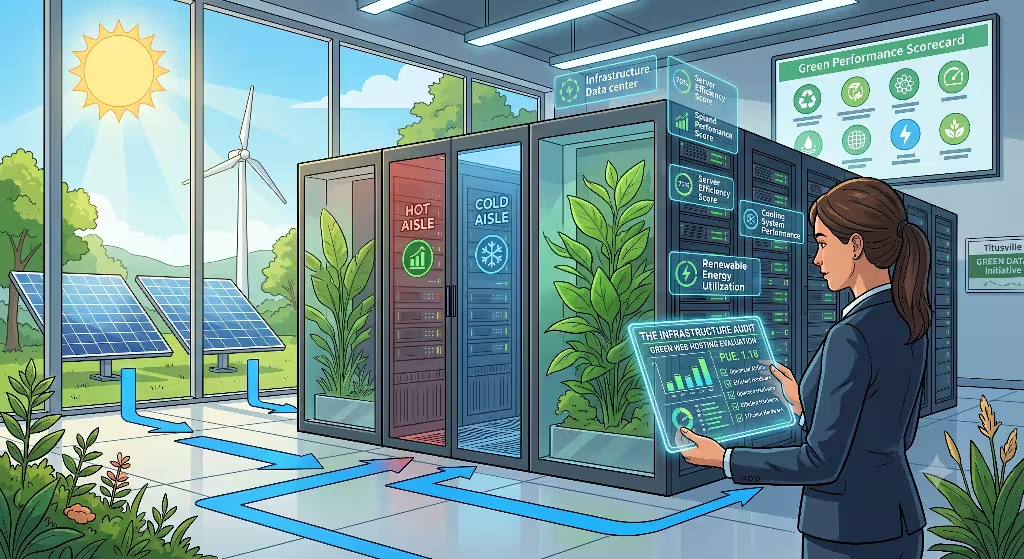
As an expert in both technology and sociology, I always remind companies that true sustainability cannot just be a marketing slogan. Your digital infrastructure has a real, physical impact on our planet. Every time someone loads a webpage, likes a post, or saves a file, a computer in a giant data center has to run. These data centers require massive amounts of electricity to power the computers and keep them cool. Right now, global digital emissions account for a significant portion of greenhouse gases, and that number is growing every year. If you want your eco-conscious branding to be completely honest, you have to look at the machines running your social media accounts.
This brings us to a critical technical measurement known as Power Usage Effectiveness, or PUE. PUE is a simple ratio that tells us how efficiently a data center uses its electricity. To calculate it, you take the total amount of power entering the data center facility and divide it by the power actually used to run the computers.
$$\text{PUE} = \frac{\text{Total Facility Power}}{\text{IT Equipment Power}}$$
The perfect PUE score is 1.0, which means every single watt of electricity coming into the building goes directly into the computers, with zero energy wasted on things like lights or cooling systems. Standard data centers often have a PUE of 1.5 or higher, meaning they waste a lot of energy. When you are researching servers for your eco-conscious branding, you should look for instances that use hosting providers with a PUE rating very close to 1.0. This ensures that your online presence uses as little energy as possible.
Beyond energy efficiency, you also need to verify where that energy comes from. Some companies claim to be green simply because they buy carbon offsets, which are financial credits meant to balance out their pollution. A much better approach is to use data centers that run directly on local renewable energy, such as regional solar farms, wind turbines, or hydroelectric dams.
To protect the integrity of your eco-conscious branding, you should use the Green Web Foundation database. This is a public, open-source tool where you can type in any server’s web address to see if it runs on green energy. Before you sign up for a Mastodon instance, or before you choose a company to host your own self-hosted server, check them against this database. Being able to prove to your audience that your social media records are stored on a server powered by 100% clean energy adds incredible value and trust to your business identity.
Actionable Checklist: Transitioning Your Eco-Brand to Mastodon
Moving your business to the Fediverse can feel overwhelming, but it is easy if you take it one step at a time. This checklist will guide your eco-conscious branding transition smoothly without causing technical headaches.
+-----------------------------------------------------------------+
|               MASTODON TRANSITION CHECKLIST                     |
+-----------------------------------------------------------------+
| [ ] STEP 1: DEFINE YOUR TECHNICAL AND OPERATIONAL CAPACITY      |
|     Identify if you will join an existing community server      |
|     (like Mastodon.green) or self-host your own infrastructure. |
|                                                                 |
| [ ] STEP 2: SECURE YOUR EXACT HANDLES ACROSS KEY NODES          |
|     Register your brand name quickly on your chosen primary     |
|     server to protect your identity from copycats.              |
|                                                                 |
| [ ] STEP 3: SET UP GREEN WEBSITE VERIFICATION                   |
|     Add the rel="me" link to your homepage HTML metadata        |
|     to turn your Mastodon profile link green.                   |
|                                                                 |
| [ ] STEP 4: ESTABLISH A CONTINUOUS COMMUNITY-FUNDING MODEL      |
|     Set up a regular donation to the volunteer administrators   |
|     who pay for and maintain your chosen instance.             |
+-----------------------------------------------------------------+
First, you must define your technical capacity. You need to decide if your team has the time and skill to run a self-hosted server, or if it makes more sense to join an established community like Mastodon.green. For most small to medium businesses, joining an existing server is the smartest way to start because it allows you to focus entirely on talking to people rather than updating server software.
Second, secure your exact brand handles across key green nodes. Even if you only plan to use one server right now, it is a wise idea to register your business name on the top green instances to protect your identity. This prevents other people from accidentally or intentionally using your name and confusing your customers.
Third, set up your green website verification. This step is incredibly important for your eco-conscious branding because it creates an official connection between your website and your social profile. Open your website code and insert the verification link in the head section of your homepage. Within a few minutes, your Mastodon profile will show a bright green box around your website link, proving to everyone that your account is authentic.
Fourth, establish a continuous community-funding model. Remember that existing Mastodon instances are not run by billionaires; they are maintained by volunteers who pay for the servers out of their own pockets or through donations. If your business is using their infrastructure to build its eco-conscious branding, you should support them financially. Set up a monthly contribution through platforms like Patreon or Open Collective to help cover their hosting costs. This shows that your brand understands the cooperative spirit of the Fediverse and is willing to pay its fair share to keep the community thriving.
Detailed Content Strategy: Crafting Posts That Convert Without Ads

Since you cannot buy ads to drive traffic to your website, your content strategy must be incredibly smart. To make your eco-conscious branding successful, you need to write posts that naturally encourage people to share them. On Mastodon, sharing a post is called boosting. When someone boosts your post, it goes out to all of their followers, creating a powerful wave of organic growth.
The key to getting boosts is to focus on education and storytelling rather than selling. If you sell reusable water bottles, do not just post photos of the bottles with a price tag. Instead, write a detailed post explaining how plastic recycling actually works in your town, or share a surprising statistic about ocean pollution. When you provide high-quality information, people will naturally boost your post because they want to share that knowledge with their friends. This organic sharing builds massive trust for your eco-conscious branding and brings high-quality visitors to your website who are already interested in your mission.
Another beautiful strategy is what we call building in public. This means you share the honest, messy process of running an environmentally friendly company. If you are struggling to find a sustainable supplier for a certain material, write a thread about it. Explain the choices you have to make and ask your followers for their advice.
This open approach does wonders for your eco-conscious branding. It turns your customers into partners who feel invested in your success. It shows that you value transparency over a perfect corporate image. When you finally solve the problem and launch the product, your community will be excited to buy it because they watched the hard work that went into creating it.
You should also actively participate in local community events and weekly hashtag traditions. For example, many users participate in #FollowFriday to recommend their favorite accounts, or share green tips on specific days of the week. Joining these existing community conversations helps your eco-conscious branding feel natural and welcome.
When you reply to other users, write real answers that contribute to the topic. Do not just say “Great post!” or tell them to check out your store. Treat every interaction like a conversation with a neighbor at a local community garden. Over time, these small, friendly chats build a strong network of brand advocates who will gladly recommend your business to others, driving sustainable traffic to your website for years to come.
Advanced Community Relations: Navigating the Fediverse Culture
Understanding the culture of Mastodon is just as important as understanding the technology. The people who spend their time here have often left traditional social media because they felt mistreated by corporate systems. They are highly protective of their online home and can be skeptical of corporate entry. To make sure your eco-conscious branding succeeds, you must approach the community with deep respect and humility.
One of the most important cultural rules is to avoid uppercase corporate speak. Do not use loud, aggressive language filled with marketing buzzwords like “disruptive,” “synergy,” or “world-class.” Instead, speak plainly and directly. Use a friendly, casual tone that sounds like a real person talking to another real person. This shift in vocabulary is essential for authentic eco-conscious branding because it signals to the community that you are here to join them, not to exploit them.
You also need to understand how to handle criticism openly. Because Mastodon users are highly educated about environmental issues, they will look closely at your claims. If someone questions your manufacturing process or points out a flaw in your packaging material, do not get defensive or delete their comment.
Answering critics with honesty and kindness is a massive opportunity to strengthen your eco-conscious branding. Acknowledge their point, thank them for their interest, and explain your choices clearly. If they point out a real mistake, admit it and share your plan to fix it. This level of radical honesty is incredibly rare in the corporate world, and it will earn you immense respect from the community. It proves that your dedication to sustainability is real, not just a polished marketing tactic.
Finally, remember to use your influence to support the wider green community. Do not just talk about your own company. Use your account to highlight local environmental activists, share important climate news, and boost other small ethical businesses, even if they are semi-competitors.
By lifting up others, your eco-conscious branding becomes a central hub for green thought and action. The community will see your business as a valuable asset to the network rather than just another commercial entity. This deep cultural integration is the ultimate secret to long-term success on Mastodon, turning social capital into lasting brand loyalty.
Analyzing Performance: Metrics That Matter in an Algorithm-Free World
On standard social networks, managers are obsessed with numbers like impressions, click-through rates, and viral reach. These metrics are often inflated by algorithms and do not tell you if people actually care about your business. When you track the performance of your eco-conscious branding on Mastodon, you have to look at different, more meaningful numbers.
The most valuable metric on Mastodon is the boost. A boost is a deliberate action by a user who wants to stake their own reputation on your content. Unlike a simple like, which is often private and easy to do without thinking, a boost means someone wants your words to appear on their personal profile timeline. By tracking which types of posts get the most boosts, you can easily see what kind of educational content or stories resonate deepest with your audience, allowing you to refine your eco-conscious branding strategy over time.
+-----------------------------------------------------------------+
|                  METRIC VALUE HIERARCHY                         |
+-----------------------------------------------------------------+
|  RANK 1: THE BOOST (Highest Value)                              |
|  Shares your content to new timelines based on user trust.      |
|                                                                 |
|  RANK 2: DETAILED REPLIES                                       |
|  Indicates real human conversation and community engagement.     |
|                                                                 |
|  RANK 3: DIRECT WEBSITE REFERRALS                               |
|  Measures high-intent traffic moving to your green platform.    |
|                                                                 |
|  RANK 4: THE FAVORITE (Lowest Value)                            |
|  Acts as a polite nod or bookmark, but has no viral reach.      |
+-----------------------------------------------------------------+
Another critical area to monitor is the depth of your reply sections. Are people leaving long, thoughtful comments on your posts? Are they asking deep questions about your sustainability practices? A high number of detailed replies is a clear sign that your eco-conscious branding is successfully creating real human connection. It shows that your followers do not see you as a distant corporate entity, but as an approachable expert they can talk to safely.
You should also pay close attention to your direct website referral traffic using privacy-friendly web analytics tools. Look at how long visitors coming from Mastodon stay on your site and what pages they read. Because Mastodon users are naturally curious and values-driven, you will often find that traffic from the Fediverse stays on your site much longer and views more pages than traffic from old ad-based networks. This high-quality engagement proves that your eco-conscious branding is attracting the exact type of loyal, long-term customers your business needs to grow sustainably.
The Long-Term ROI of Decentralized Green Branding
Building a presence on Mastodon is an investment in the future of your company. It is not a place where you will see overnight viral success or millions of cheap views. But for businesses dedicated to real environmental change, the long-term return on investment is incredibly high. By aligning your digital infrastructure with your environmental values, you protect your company from the rising public backlash against big tech and corporate surveillance.
When you invest time into your eco-conscious branding within the Fediverse, you are building an audience that you truly own. There is no corporate algorithm that can suddenly change tomorrow and hide your posts behind a paywall. Your connections are direct, honest, and permanent. This independent setup gives your company immense stability and resilience as the internet continues to evolve.
Ultimately, Mastodon rewards patience, transparency, and a genuine love for community. If you treat the network like a shared resource, pay your share to support your server hosts, and speak with an honest, human voice, your business will thrive. Your eco-conscious branding will stand out as a shining example of how a modern company can conduct itself ethically in the digital age, creating deep, lasting connections that benefit both your business and the planet.