
Every time you open a web browser, tap an app, or post a update, you set off a chain reaction of physical energy. Just like a forest depends on a healthy root system, our internet depends on physical servers that draw power from an electrical grid. Social media networks have a huge impact on our physical environment because they require massive amounts of electricity to run around the clock.
If you are looking to move away from giant corporate platforms, you have likely come across the Fediverse and its decentralized networks. However, not all servers are built the same way when it comes to the environment. In this comprehensive guide, we will look at the best eco-friendly Mastodon Instances with green hosting so you can minimize your digital footprint while staying connected.
Table of Contents
The Hidden Carbon Footprint of the Fediverse
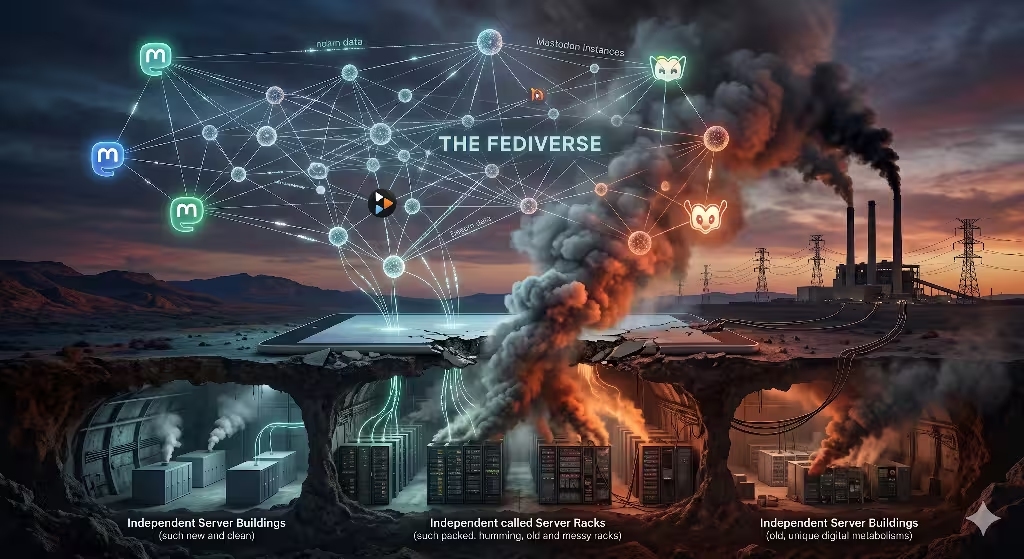
When we talk about the cloud, it sounds like something weightless and clean. In reality, the cloud is a collection of massive, windowless brick buildings packed with hot, loud computers called servers. These servers require continuous electricity to process data, store your photos, and send messages across the globe. When you join the Fediverse, you are choosing a network made of independent servers rather than one giant company. Because these systems are run by different people, you have the power to choose options that run on renewable energy. Choosing sustainable Mastodon Instances is one of the most direct ways to align your online life with your ecological values.
The Digital Metabolism
Every single computer on the internet has a digital metabolism. This means it consumes energy to perform tasks and releases heat as waste. When you view a timeline, upload an image, or search for a profile, servers must work hard to deliver that data to your screen. This process requires electricity not just for the computer chips, but also for giant air conditioning units that keep the equipment from overheating.
Data transit is the process of moving information from a server through miles of cables to your local device. This movement relies on routers and switches that also consume power every second. When you look at different Mastodon Instances, you are looking at different server setups with unique metabolic rates. Some setups are highly optimized and clean, while others waste a lot of power. By understanding this metabolism, we can see why our choices matter.
The Centralized vs. Decentralized Paradox
Centralized networks keep all their data in a few massive server farms owned by a single corporation. These corporations have the money to buy highly efficient systems, but they also use dark patterns to keep you scrolling for hours. This constant scrolling causes massive, non-stop processing loads.
Decentralized networks work differently because they break the network into thousands of smaller pieces. Instead of one giant computer farm, the network is built from many separate Mastodon Instances run by individuals or small groups. This creates a fascinating paradox. On one hand, smaller servers might not always have access to the multi-million dollar cooling systems of a tech giant. On the other hand, these smaller Mastodon Instances do not use addictive algorithms designed to waste your time and server power. Furthermore, decentralization gives you the freedom to choose a server that is explicitly dedicated to clean energy. You are no longer trapped using whatever power grid a single corporation chooses.
Definition of Intent
The main goal of this article is to help you find and understand the most sustainable Mastodon Instances available today. Many users switch to decentralized platforms to escape tracking and advertisements, but they do not realize they can also escape carbon heavy hosting.
By analyzing the infrastructure behind various Mastodon Instances, we can make choices that actively protect our physical planet. This guide will give you the tools to evaluate server efficiency, read hosting statements, and find a digital home that respects the earth. We will look at real data, clear definitions, and simple steps to help you make an eco-friendly transition.
Core Architectural Criteria for Green Hosting
To evaluate Mastodon Instances fairly, we need to look at the hard data behind web hosting. We cannot just rely on a website having a green logo or a statement about loving nature. True green hosting requires specific engineering standards and transparent energy sourcing.
Power Usage Effectiveness (PUE) Demystified
Power Usage Effectiveness, or PUE, is the standard math formula used to measure data center efficiency. It is calculated by dividing the total amount of energy a facility uses by the energy that actually goes into running the computers.
PUE = Total Facility Energy/IT Equipment Energy
If a data center has a PUE score of 2.0, it means that for every watt of power used to run the computers, an extra watt is wasted on cooling and lights. The closer a data center can get to a score of 1.0, the more efficient it is. When searching for sustainable Mastodon Instances, you should look for options hosted in facilities with a PUE of 1.2 or lower. A lower PUE means the server uses less extra energy to keep itself running, which directly reduces waste.
The Grid Matters
A data center can have an amazing PUE score, but if it plugs into a power grid fed by coal and gas, it is still causing heavy pollution. That is why the physical location of the server matters so much. Some countries and states have grids that rely mostly on wind, solar, or water power.
You also need to understand the difference between a server that uses true renewable energy and one that uses carbon offset credits. Carbon offsets mean the company buys credits to plant trees or build wind farms elsewhere to make up for the fossil fuels they burn. True green hosting means the data center connects directly to a clean energy grid or buys local renewable power that matches their usage in real time. The top eco friendly Mastodon Instances make sure their hosting providers use direct renewable energy whenever possible.
The Hardware Lifecycle
True sustainability goes beyond the electricity coming out of the wall. Computer hardware requires mining rare metals and manufacturing complex parts, which creates a large amount of pollution before the server is even turned on.
When evaluating Mastodon Instances, we should consider how the server operators handle their physical equipment. Good green hosts keep their servers running for as long as safely possible instead of upgrading every single year. They also make sure old components are recycled properly to prevent toxic e-waste from filling up landfills. Furthermore, they use a technique called server virtualization. This lets one physical computer act as multiple separate virtual servers, ensuring that no hardware sits idle and wastes power.
The Best Eco-Friendly Mastodon Instances with Green Hosting
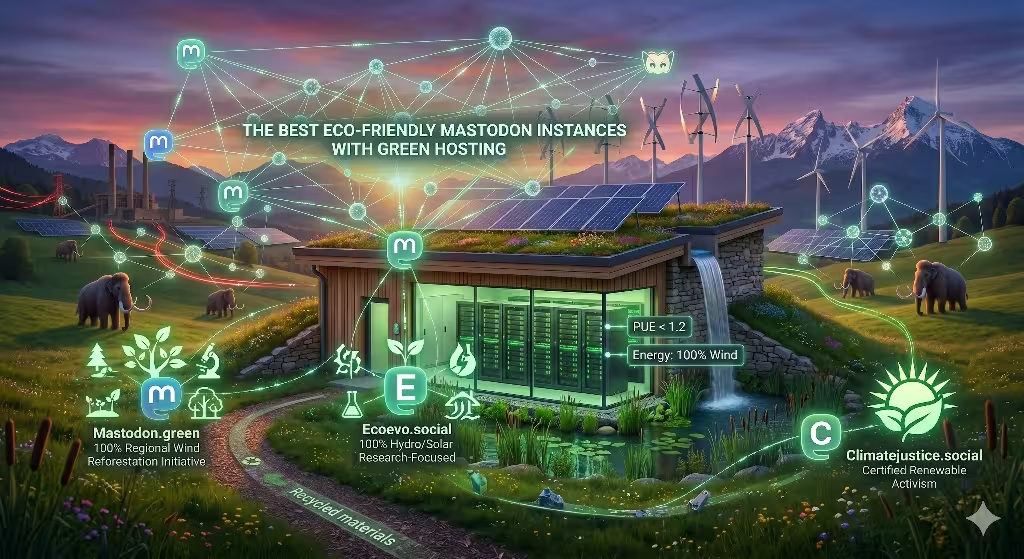
Now that you know what technical metrics to look for, let us examine the specific Mastodon Instances that are leading the way in green hosting. These platforms show that we can build reliable social networks without harming our natural ecosystems.
Mastodon.green (General & Sustainable Community)
Mastodon.green is one of the most prominent eco friendly Mastodon Instances available to the public. It was built from the ground up with the explicit goal of providing a sustainable alternative for general social media users.
The server infrastructure for this option is located in the European Union, utilizing data centers that run on 100% certified wind energy. The operators are completely transparent about their setup and actively track their monthly power metrics. To add extra environmental value, a portion of the financial support received from users goes directly toward local tree planting and ecosystem restoration projects. This makes it an excellent choice if you want a reliable, active community that takes its carbon footprint seriously.
Ecoevo.social (Academic, Biological, & Ecological Focus)
If your interests lean toward science, nature, and research, Ecoevo.social is one of the best Mastodon Instances you can join. It serves as a digital gathering place for biologists, ecologists, and climate scientists.
This server is physically located on highly optimized German infrastructure known for its low impact cooling designs. The data center uses advanced environmental controls to keep its PUE score incredibly low, relying on hydro and solar power to run its systems. Because the community is focused on ecological topics, the discussions themselves often center around sustainability. The moderation team ensures a safe space for scientific discourse, making it a great functional match for anyone who loves biology and wants to use green hosted platforms.
Climatejustice.social (Environmental Activism & Justice)
Climatejustice.social is designed specifically for activists, organizers, and anyone passionate about climate action. It is one of the Mastodon Instances that views digital sustainability as a core part of its human rights mission.
The server runs on green aligned hosting stacks that use highly efficient software configurations. The administrators have stripped away unnecessary database processes, which reduces the amount of work the server chips have to do. By minimizing the CPU duty cycles, the server requires less electricity minute by minute. The hosting providers are certified by international green monitoring groups, ensuring that your activist communication does not rely on fossil fuel systems.
Comparative Architectural Metrics
To help you choose between these Mastodon Instances, it helps to see their technical specifications side by side. The following table breaks down the key environmental metrics for each option.
| Instance | Primary Energy Source | Data Center PUE | Operational Focus |
| Mastodon.green | 100% Regional Wind | Less than or equal to 1.20 | General Public / Tree Planting |
| Ecoevo.social | 100% Hydro / Solar | Less than or equal to 1.15 | Biological Sciences / Researchers |
| Climatejustice.social | Certified Renewable | Less than or equal to 1.25 | Climate Action / Grassroots |
By comparing these Mastodon Instances, you can see that you do not have to sacrifice technical performance to protect the environment. Each server offers an incredibly low PUE score and relies on verified renewable energy sources.
Architectural Carbon Optimization Tool
To help you understand how your choice of Mastodon Instances impacts the environment, I have designed this calculator tool. You can adjust the parameters to see the difference between standard corporate hosting and green hosted decentralized options.
How to Verify an Instance’s Green Credentials

It is easy for any online community to claim they are eco friendly, but as digital citizens, we must know how to verify those claims. You do not need to be a professional programmer to double check the hosting of your favorite Mastodon Instances.
Utilizing The Green Web Foundation Database
The Green Web Foundation is an open source organization that tracks the energy usage of the internet. They maintain a massive database of web hosts that use renewable energy.
To check specific Mastodon Instances, you can take the main domain name and plug it directly into the Green Web Foundation search tool. The tool will check the unique IP address of the server against their verified registry. If the host uses documented renewable power, you will see a clear green checkmark. This simple check gives you independent proof that your chosen platform is actually putting its values into practice.
Investigating Server Metadata
Another way to audit Mastodon Instances is to look closely at their official “About” pages. Responsible server administrators will explicitly list the name of their physical hosting provider.
Look for names like Hetzner green zones, Greenhost, 20i, or Krystal. Once you have the name of the hosting provider, you can look up their environmental policy. Transparent providers will freely share their PUE scores, their energy suppliers, and their carbon accounting data. If a server administrator hides their hosting provider or refuses to answer questions about their power source, it is best to look at other Mastodon Instances for your digital home.
Commonly Asked Questions about Mastodon Instances
When people look into sustainable social media options, they often have the same core questions. Let us address these common queries directly to clear up any confusion about how these systems function.
Q1: Does Mastodon use less energy than Twitter/X?
Yes, Mastodon generally uses significantly less energy per user than older centralized networks like Twitter or X. The main reason comes down to how your feed is built.
Centralized corporate platforms use complex machine learning algorithms that constantly analyze your behavior. These algorithms process millions of data points every second to show you posts that will keep you angry or engaged, which burns massive amounts of server power. Mastodon Instances simply display posts in chronological order, meaning the order they were written. This requires very simple database lookups that use minimal computer processing. While it is true that sending updates between different Mastodon Instances requires constant background synchronization traffic, this background traffic uses far less power than continuous algorithmic data manipulation blocks.
Q2: How can you tell if a Mastodon instance is green-hosted?
You can tell if a server is green hosted by tracking its digital footprint back to its physical data center. Every server has an Autonomous System Number, or ASN, which acts like a postal code for a group of IP addresses.
You can use online lookup tools to find the ASN of any Mastodon Instances you are considering. Once you have that number, you can check it against open source carbon intelligence registries or the Green Web Foundation. Furthermore, green hosted servers usually display their environmental certifications proudly on their landing page. If they provide a link to their hosting company’s real time energy dashboard, you can be highly confident that their green hosting claims are genuine.
Q3: Can I migrate my existing Mastodon account to an eco-friendly server?
Absolutely. One of the best features of the Fediverse is that you are never locked into a single server. The underlying system uses an open standard protocol called ActivityPub, which allows different Mastodon Instances to talk to each other seamlessly.
If you are currently on a server that uses standard fossil fuel hosting, you can move your entire profile to an eco friendly option without starting over. The migration process automatically moves your followers, your blocklists, and your muted accounts to your new home. Your old profile will display a message telling people where you moved, and anyone who follows your old account will be automatically redirected to your new, sustainable account.
Architectural Migration Protocol
If you are ready to make the switch to a green hosted server, you should follow the proper technical sequence. Moving between Mastodon Instances must be done in a specific order so you do not lose your connections or social graph history.
1. Export Current Account Archives: Prerequisite Phase.
Log into your current profile and open your account settings. Go to the data export section and download your follower list, blocklists, and bookmarks. This saves a copy of your personal social data to your local device.
2. Establish New Green-Hosted Identity: Instance Onboarding.
Go to the home page of your chosen eco friendly server among the available Mastodon Instances. Register for a new account, complete the email confirmation, and set up your basic profile information.
3. Configure Account Aliasing: ActivityPub Handshake.
Log into your new green account and navigate to the account settings page. Look for the option to create an account alias and enter the web address of your old profile. This tells the network that both accounts belong to the same person.
4. Initiate Core Move Command: Final Redirection.
Log back into your old account on your previous server. Go to the account settings and find the section labeled move to a different account. Enter your new profile address and submit the command. The network will now migrate your followers over to your new green home automatically.
Digital Biophilia and Network Architecture
As we look to the future of the internet, we must realize that our online spaces cannot be separated from our physical environment. True digital biophilia means designing systems that work in harmony with the natural world rather than destroying it. By choosing sustainable Mastodon Instances, you are taking an active role in reducing global carbon emissions and supporting cleaner infrastructure.
Decentralization gives us a unique opportunity to vote with our data. When we move our communities to servers that respect the earth, we encourage the web hosting industry to build more efficient data centers. Take a look at your current digital footprint today, explore the eco friendly Mastodon Instances we discussed, and make the choice to support a healthier, greener web.