
Table of Contents
Throughout human history, artists depicting nature have created works that connect human psychology with the living world. When we examine artists depicting nature, we see a bridge between raw biology and visual culture. Today, as digital designers create online environments, we still study historical artists depicting nature to understand how visual balance, color harmony, and organic patterns affect the human brain. This article explores how artists depicting nature have transformed our understanding of the natural world, from ancient landscape masters to modern environmental sculptors.
The Human-Nature Connection in Visual Art
The bond between human perception and the physical landscape is fundamental to human history. From ancient cave drawings to modern digital canvases, artists depicting nature have responded to an evolutionary need called biophilia. Biophilia is the natural tendency of humans to seek connections with nature and other living things. When artists depicting nature compose a scene, they often use natural forms, flowing lines, and fractal patterns. Fractals are repeating geometric shapes found in trees, coastlines, waves, and clouds. Research in psychology shows that viewing fractal patterns can lower stress levels and improve mental clarity.
Historically, the natural world was not always the main focus of visual art. In early Western painting, landscapes served mostly as flat backgrounds for religious figures, historical battles, or royal portraits. Over time, artists depicting nature began to realize that the environment itself held deep meaning, spiritual value, and scientific wonder. Artists depicting nature gradually shifted natural scenery from the background to the center of the canvas. This shift turned landscape painting into its own respected category of fine art.
When we look at artists depicting nature across different centuries, we notice two distinct approaches. Some artists depicting nature take an objective approach, focusing on botanical accuracy, correct perspective, and physical anatomy. Other artists depicting nature focus on emotional and psychological interpretation, using dramatic light and expressive brushstrokes to share personal feelings. Both approaches highlight how artists depicting nature help viewers appreciate the complexity of our planet.
Today, digital designers and architects study how artists depicting nature use visual hierarchy. When artists depicting nature paint open horizons, dense forests, or winding streams, they guide the eye across the canvas. Learning from artists depicting nature allows modern creators to build digital layouts and living spaces that feel calm, organized, and welcoming.
Masters of the Sublime: Romanticism and the Untamed Wilderness
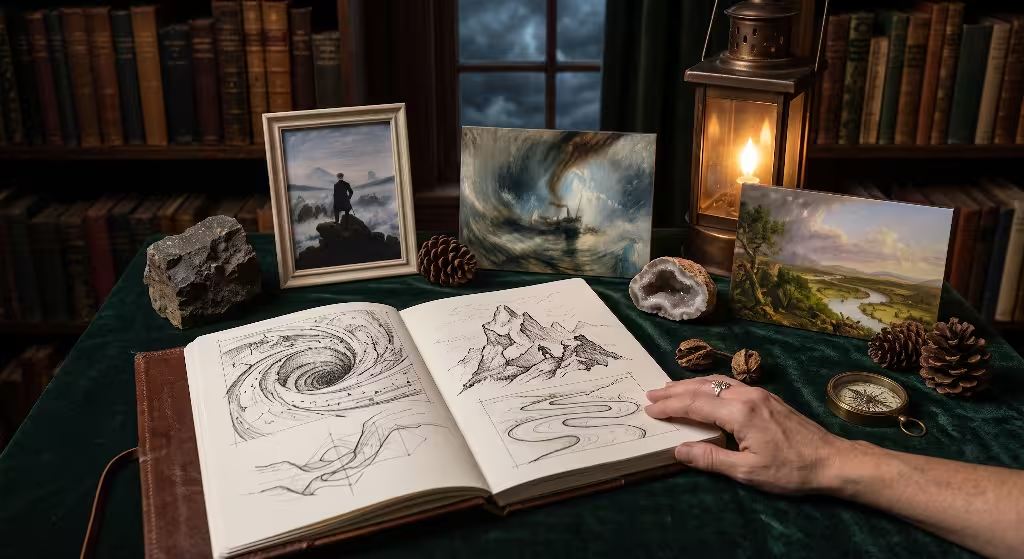
During the late eighteenth and early nineteenth centuries, the Romantic movement changed how society viewed the wilderness. Before this period, people often viewed wild landscapes as dangerous obstacles. Romantic artists depicting nature began to portray the wilderness as a place of spiritual awe, mystery, and immense scale. This concept became known as the Sublime, a feeling of wonder mixed with a healthy respect for the power of natural forces.
Caspar David Friedrich
Caspar David Friedrich was one of the most influential German Romantic artists depicting nature. Born in 1774, Friedrich created quiet, contemplative scenes that paired human figures with vast landscapes. In his famous 1818 painting, Wanderer above the Sea of Fog, a lone traveler stands atop a rocky cliff, looking out over a blanket of mountain mist. Friedrich positioned the figure with his back to the viewer, encouraging us to look through the traveler’s eyes and reflect on the scale of creation.
In another major work, The Sea of Ice, painted in 1824, Friedrich showed jagged sheets of ice crushing a wooden ship in the Arctic. Friedrich stood out among artists depicting nature because he used landscape elements to explore themes of mortality, faith, and human limits. His quiet color schemes, misty horizons, and stark rock formations proved that artists depicting nature could evoke deep philosophical questions without adding crowded details.
J.M.W. Turner
In Britain, J.M.W. Turner pushed the boundaries of light and atmosphere. Turner was among the most daring artists depicting nature of his generation, earning the nickname the painter of light. Instead of painting crisp, rigid outlines, Turner used swirling brushstrokes, bright yellows, and deep grays to capture moving air, ocean spray, and stormy skies.
His 1842 oil painting, Snow Storm: Steam-Boat off a Harbour’s Mouth, places a struggling vessel in the center of a swirling vortex of wind and sea. Turner claimed he had himself tied to the mast of a ship during a real storm to witness the event firsthand. In his 1844 masterpiece, Rain, Steam, and Speed: The Great Western Railway, Turner showed a train crossing a bridge through driving rain. Turner showed how artists depicting nature could contrast new industrial technology with ancient weather forces, using dynamic light to create emotional energy.
Thomas Cole and the Hudson River School
In North America, Thomas Cole founded the Hudson River School, a mid-nineteenth-century art movement focused on the vast landscapes of the American continent. Cole and his fellow artists depicting nature traveled throughout New York, New England, and the American West to paint untouched rivers, valleys, and mountains.
Cole’s famous 1836 painting, The Oxbow, provides a panoramic view of the Connecticut River after a thunderstorm. The canvas is divided diagonally into two distinct halves. The left side displays untamed wilderness with broken trees and dark storm clouds, while the right side shows cultivated farmland with peaceful sunshine. Through this work, Cole established a standard for artists depicting nature who wanted to comment on the delicate balance between wild ecosystems and human expansion. His series The Course of Empire further demonstrated how artists depicting nature could warn societies about over-development and the temporary nature of human empires compared to the lasting power of the Earth.
Light, Optics, and Flora: Impressionism and Post-Impressionism
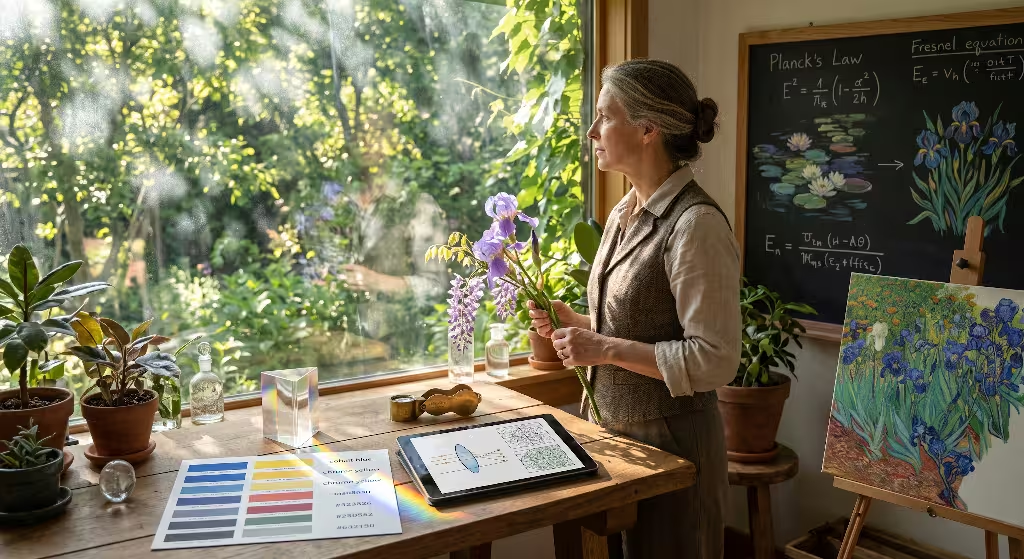
In the late nineteenth century, new discoveries in optics, photography, and tube paint manufacturing transformed how painters worked. Artists depicting nature began to leave their indoor studios to paint outdoors in natural daylight, a technique known as en plein air. These artists depicting nature wanted to capture changing light, moving water, and vibrant plant life as they existed in real time.
Claude Monet
Claude Monet was the central figure of the French Impressionist movement and remains one of the most famous artists depicting nature in history. Monet believed that an object’s appearance changes constantly depending on the time of day, weather conditions, and seasonal light. To study this idea, Monet created series of paintings depicting the exact same subject under different lighting conditions.
Monet’s series of Haystacks, Poplars, and the Rouen Cathedral showed that light itself was the real subject of the painting. In his later years at his home in Giverny, Monet designed a lush water garden with a Japanese footbridge, weeping willows, and floating water lilies. His Water Lilies series, consisting of roughly two hundred and fifty individual oil paintings, represents a major achievement among artists depicting nature. Monet applied strokes of pure, unblended color side by side on the canvas, allowing the viewer’s eye to blend the colors optically. His work showed that artists depicting nature could capture fleeting daylight, water reflections, and living plant surfaces with scientific care and artistic freedom.
Vincent van Gogh
Working during the Post-Impressionist era, Vincent van Gogh brought intense emotion, personal expression, and vivid color to his work. Van Gogh was among the most passionate artists depicting nature, using thick paint and rhythmic, swirling brushmarks to give trees, fields, and skies a sense of living energy.
In his celebrated 1889 painting, The Starry Night, painted while staying at the Saint-Remy asylum, Van Gogh transformed a night sky into a flowing field of bright stars and swirling clouds above a quiet village and a dark cypress tree. Scientists who have analyzed the swirling patterns in The Starry Night have found that Van Gogh’s brushstrokes match the mathematical principles of turbulent flow in physics. In works like Irises and Wheatfield with Crows, Van Gogh used bold outlines, warm yellows, and deep blues. Van Gogh proved that artists depicting nature could convey psychological truth and biological vitality through expressive color choices and rhythmic movement.
Katsushika Hokusai
In Japan, Katsushika Hokusai created woodblock prints that influenced Western Impressionist and Post-Impressionist painters. Hokusai was a master of the ukiyo-e genre, which translates to pictures of the floating world. Hokusai spent decades studying the movements of water, the shapes of mountains, and the lives of birds and plants.
His renowned print series, Thirty-Six Views of Mount Fuji, created between 1830 and 1832, showed Mount Fuji from different angles, seasons, and social settings. The most famous print from this series, The Great Wave off Kanagawa, features a towering wave framing the sacred mountain in the distance. The wave’s foam forms claw-like shapes, showing the raw power of the ocean compared to the fragile wooden boats below. Hokusai helped inspire European artists depicting nature through his clean outlines, flat areas of color, and dynamic arrangements. Hokusai proved that artists depicting nature could combine spiritual respect with precise technical design.
Modernism, Abstraction, and Botanical Intimacy
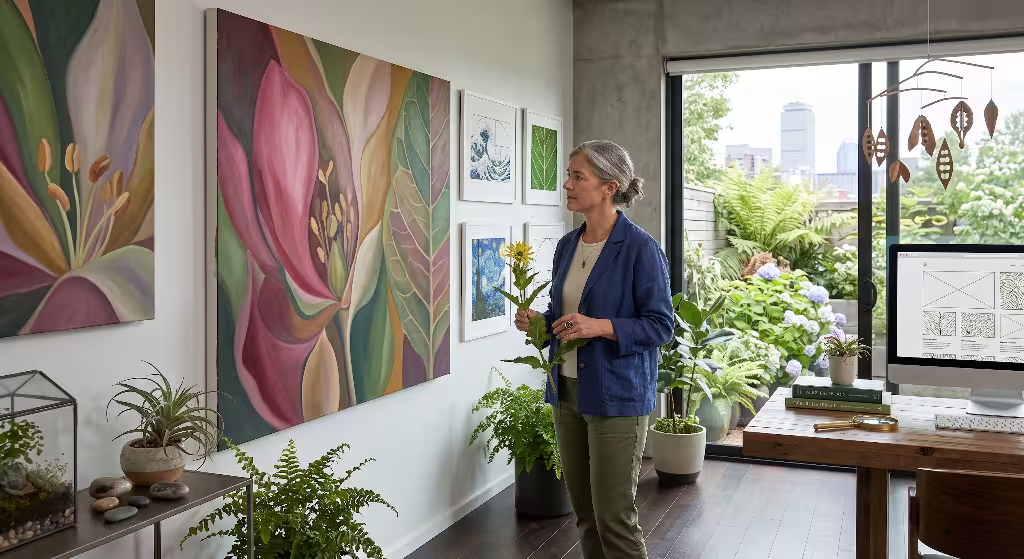
As the twentieth century began, artists depicting nature moved beyond traditional landscape formats. Instead of painting wide horizons from a distance, Modernist painters zoomed in on individual flowers, tree branches, and geological shapes, creating fresh ways to experience the physical world.
Georgia O’Keeffe
Georgia O’Keeffe was an American Modernist painter who changed how we look at flowers and desert landscapes. Rather than painting a traditional bouquet in a vase, O’Keeffe filled entire large canvases with the petals, stamens, and centers of individual blooms. Works such as Jimson Weed / White Flower No. 1 and Red Canna invite viewers to pause and explore the fine architecture of plants.
O’Keeffe explained that people in busy cities often rushed past flowers without really seeing them. By painting flowers at an enormous scale, she made viewers pay attention to subtle curves, gradient colors, and botanical forms. When she moved to New Mexico, O’Keeffe painted red desert hills, sun-bleached animal bones, and wide desert skies. O’Keeffe remains a standout among artists depicting nature because she used close-up framing and clean abstraction to highlight the organic geometry of living and non-living elements.
Henri Rousseau
Henri Rousseau was a self-taught French Post-Impressionist painter known for his lush jungle scenes. Although Rousseau never left France, he regularly visited the botanical gardens, natural history museums, and greenhouses of Paris to study exotic plants and wild animals.
In famous works like Tiger in a Tropical Storm, painted in 1891, and The Dream, painted in 1910, Rousseau layered dozens of different plant leaves, vines, and flowers to build dense forest environments. His unique style featured sharp outlines, flat shapes, and rich green tones. Rousseau showed that artists depicting nature could combine observed botany with imagination to build captivating, dreamlike ecosystems on canvas.
Earth as Canvas: Land Art and Environmental Sculpture
In the late 1960s and 1970s, a new generation of creators stepped away from traditional canvas painting and indoor galleries. These creators, known as Land Artists or Earth Artists, began using the earth itself as their primary medium. These artists depicting nature sculpted with soil, rocks, water, logs, and living crops, creating site-specific installations that interacted directly with weather patterns and geological forces.
Andy Goldsworthy
Andy Goldsworthy is a British sculptor and photographer who works directly within forests, fields, and riverbeds. Goldsworthy is unique among modern artists depicting nature because his artworks are often temporary and made entirely from found natural materials, such as fallen autumn leaves, river stones, icicles, flower petals, and pine needles.
Goldsworthy uses no glue, wire, or artificial fasteners. Instead, he uses morning frost to weld icicles together, thorns to pin leaves in place, or natural gravity to balance stone arches. After finishing a piece, Goldsworthy photographs it before wind, tides, or sunlight cause the work to dissolve back into the landscape. Goldsworthy demonstrates that artists depicting nature can highlight the cycles of growth, decay, and transformation that define all living systems.
Robert Smithson
Robert Smithson was a pioneer of the American Land Art movement who explored ideas of entropy, geological time, and human scale. His most famous earthwork, Spiral Jetty, built in 1970 on the northeastern shore of the Great Salt Lake in Utah, consists of over six thousand tons of black basalt rocks and earth arranged into a 1,500-foot-long coil extending out into the reddish water.
Smithson designed Spiral Jetty to change over time. Depending on rainfall and lake levels, the sculpture becomes completely submerged or emerges covered in white salt crystals. Smithson showed how artists depicting nature could create massive works that invite viewers to consider deep geological time and the dynamic power of natural environments.
Agnes Denes
Agnes Denes is an American conceptual artist who uses agriculture, ecology, and public participation to address global issues. In May 1982, Denes completed one of the most famous environmental artworks of the twentieth century, titled Wheatfield: A Confrontation.
Denes cleared a two-acre landfill in downtown Manhattan, two blocks from Wall Street and facing the Statue of Liberty. She brought in soil, planted golden wheat, maintained the field through the summer, and harvested over one thousand pounds of healthy grain. The harvested wheat was later sent to cities around the world to highlight issues of global hunger, resource distribution, and environmental stewardship. Denes proved that artists depicting nature could use living agriculture as a powerful tool for social and ecological commentary.
Commonly Asked Questions about Artists Depicting Nature
What is art that depicts nature called?
Art that depicts the natural world is known by several specific terms depending on its style, subject, and medium:
- Landscape Art: Artworks that show wide physical environments, including mountains, valleys, rivers, forests, and countryside vistas.
- Botanical Art: Detailed, accurate drawings or paintings of plant species, often used historically for scientific identification and herbal medicine.
- Marine Art or Seascapes: Artworks that focus on the open ocean, coastal shores, moving waves, and ships at sea.
- Wildlife Art: Paintings, drawings, and sculptures that focus primarily on non-human animal species in their natural habitats.
- Land Art or Earth Art: Site-specific sculptures and installations made directly in the landscape using natural earth materials like soil, rocks, ice, and plants.
- Biophilic Art and Design: Art and architectural installations designed specifically to connect human spaces with natural geometries, organic materials, and living plant systems to support well-being.
Who is the most famous landscape painter in history?
While many painters have earned widespread recognition, Claude Monet is widely considered the most famous landscape painter in history. His focus on outdoor lighting, color vibration, and his celebrated Water Lilies series made him a household name worldwide. Other historic masters include Caspar David Friedrich for his Romantic scenes of mountains and mist, J.M.W. Turner for his dynamic sea storms and atmospheric light, and John Constable for his realistic portrayals of the English countryside.
How does depicting nature in visual art influence human well-being?
Scientific studies show that viewing artworks depicting natural landscapes, trees, and water has measurable physical and mental benefits. Research in environmental psychology confirms that looking at natural scenery:
- Reduces Stress: Viewing nature imagery helps lower cortisol levels, reduces blood pressure, and calms the autonomic nervous system.
- Restores Attention: Natural patterns and soothing scenery help reduce cognitive fatigue, allowing the brain to regain focus and problem-solving energy.
- Supports Healing in Healthcare Settings: Hospitals that display landscape paintings and natural photography report that patients experience lower pain perception and shorter recovery times.
- Improves Mood: Natural colors, especially balanced greens and sky blues, improve emotional regulation and promote feelings of comfort.
How have contemporary artists transitioned from painting nature to environmental activism?
In recent decades, artists depicting nature have shifted from passive observation to active environmental advocacy. While early landscape painters focused on beauty, contemporary artists depicting nature use their work to raise awareness about climate change, habitat loss, and pollution.
Artists depicting nature today often use sustainable materials, track environmental data, and design public installations to inspire action. For example, contemporary sculptors place melting ice blocks in city centers to illustrate glacier loss, while other artists depicting nature create artificial reefs that provide new habitats for marine life. Through these projects, artists depicting nature demonstrate that creativity can play an active role in restoring ecosystems and educating communities.
Biophilic Design, Web Architecture, and the Future of Nature in Art
As a biophilic design specialist and computer scientist at Silphium Design LLC, I see a clear link between historic landscape art and modern digital experiences. Just as classical artists depicting nature studied light, proportion, and visual harmony on canvas, digital designers must apply these same principles to websites and user interfaces.
When we build digital products, we study how artists depicting nature organized visual information. By studying artists depicting nature, we learn how to balance open space, introduce organic textures, and select color palettes drawn directly from natural ecosystems. For example, the way artists depicting nature like Monet layered soft gradients helps web designers create background layers that prevent visual fatigue during long screen sessions.
Furthermore, artists depicting nature who used fractal geometries, such as Hokusai and Van Gogh, provide a clear model for how to structure digital content. When layouts use proportional spacing based on the golden ratio and natural growth sequences, users can scan and read information more naturally. By looking to artists depicting nature for guidance, modern web creators can design digital spaces that feel intuitive, restorative, and grounded in biological principles.
Summary Table of Featured Artists
| Artist Name | Lifespan | Primary Art Movement | Key Masterpieces | Primary Focus in Nature |
| Caspar David Friedrich | 1774 to 1840 | German Romanticism | Wanderer above the Sea of Fog, The Sea of Ice | The spiritual Sublime, misty mountains, solitude |
| J.M.W. Turner | 1775 to 1851 | British Romanticism | Snow Storm, Rain, Steam, and Speed | Swirling light, oceanic storms, weather forces |
| Thomas Cole | 1801 to 1848 | Hudson River School | The Oxbow, The Course of Empire | American wilderness, ecological balance, rivers |
| Katsushika Hokusai | 1760 to 1849 | Japanese Ukiyo-e | The Great Wave off Kanagawa, Thirty-Six Views of Mount Fuji | Wave dynamics, Mount Fuji, sacred geography |
| Claude Monet | 1840 to 1926 | French Impressionism | Water Lilies series, Haystacks series | Natural daylight, optical color mixing, ponds |
| Vincent van Gogh | 1853 to 1890 | Post-Impressionism | The Starry Night, Irises, Wheatfield with Crows | Dynamic turbulence, vibrant energy, plant life |
| Georgia O’Keeffe | 1887 to 1986 | American Modernism | Jimson Weed / White Flower No. 1, Red Canna | Close-up floral architecture, desert geology |
| Henri Rousseau | 1844 to 1910 | Post-Impressionism (Naïve Art) | Tiger in a Tropical Storm, The Dream | Dense jungle canopies, imaginative plant foliage |
| Andy Goldsworthy | 1956 to Present | Land Art / Environmental Sculpture | Ephemeral leaf patterns, river rock cairns | Natural decay, seasonal cycles, found materials |
| Robert Smithson | 1938 to 1973 | Land Art | Spiral Jetty (Great Salt Lake) | Earthworks, geological time, entropy |
| Agnes Denes | 1931 to Present | Conceptual / Environmental Art | Wheatfield: A Confrontation | Agriculture in urban centers, social ecology |
Historical Evolution of Natural Depiction
The work done by artists depicting nature follows a clear evolutionary timeline across art history:
- Ancient and Medieval Eras: Natural settings were used primarily as symbolic backdrops for religious or mythological figures.
- Renaissance and Dutch Golden Age: Artists began treating landscapes with greater scientific realism, studying atmospheric perspective and realistic foliage.
- Romantic Era: Artists depicting nature elevated wild nature to the highest level of emotional and spiritual power through the Sublime.
- Impressionist Era: Artists depicting nature moved outdoors to study direct sunlight, seasonal light variations, and optical color blending.
- Modernist Era: Artists depicting nature explored close-up botanical details, organic shapes, and abstract forms.
- Land Art and Contemporary Era: Artists depicting nature transformed the earth itself into a medium, using living materials to address global ecological issues.
The Role of Natural Geometry in Visual Perception
Understanding how artists depicting nature structure their work requires looking at the science of human vision. When our eyes view paintings by artists depicting nature, our brains process visual elements such as edge contrast, color saturation, and spatial symmetry.
Artists depicting nature often use the Fibonacci sequence and golden ratio spirals, which appear naturally in sunflower seed heads, pinecones, and nautilus shells. When artists depicting nature include these proportions, viewers find the compositions visually pleasing and easy to understand. Furthermore, artists depicting nature who incorporate realistic textures help the human brain map visual depth accurately.
Whether examining historic oil paintings or designing modern responsive web layouts, the lessons provided by artists depicting nature remain highly relevant. By studying how artists depicting nature balance light, structure organic shapes, and honor ecological systems, we can create physical and digital environments that support human well-being and keep our connection to nature alive.