
To build a great website, we must understand how people see and feel when they look at nature. This is why natural landscape perception is so important for design and is the topic of this article.
When we talk about natural landscape perception, we are looking at how the shapes and forms of the world change our mood and thoughts. Shape is a simple outline, like a flat drawing of a leaf. Form is more complex. Form has depth and weight, like a whole tree standing in a field. Our research shows that humans have an old, deep connection to these patterns. Our brains were built to live in the wild, not in gray boxes.
Because of this, natural landscape perception affects how we react to everything, including the websites we use every day. If a design uses the right shapes, it can lower stress levels and help people feel calm. This is because our eyes are tuned to the specific geometries found in the woods or by the sea. By using these ideas, we can make the internet feel like a breath of fresh air.
Table of Contents
Taxonomy of Natural Forms: Organic vs. Euclidean
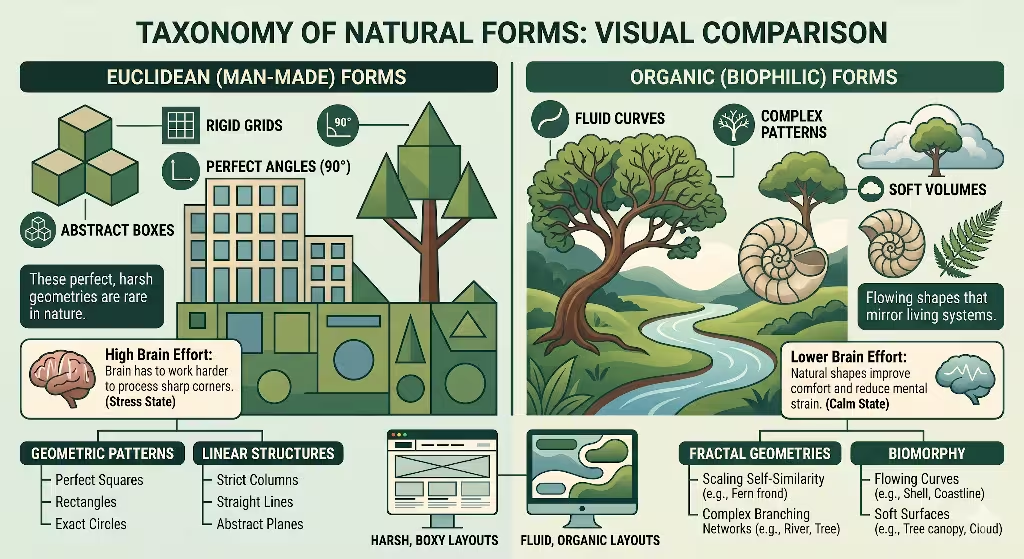
To understand natural landscape perception, we first have to look at the different kinds of shapes that exist. Most of the things humans build are based on Euclidean geometry. These are shapes like squares, perfect circles, and straight lines. Think about a standard office building or a typical website grid. They are full of hard edges and 90 degree angles. However, these shapes are very rare in the wild. Nature does not usually work in straight lines.
Instead, nature uses organic shapes. These are flowing, uneven, and soft. When we think about natural landscape perception, we notice that our brains actually have to work harder to look at a sharp square than a soft curve. A sharp corner can sometimes trigger a tiny “fight or flight” response in the brain. It is like a warning sign. On the other hand, a soft, curved form makes us feel safe. This is a core part of natural landscape perception. In my work at Silphium Design LLC, I try to replace those harsh digital boxes with rounded edges and fluid paths. This makes the user feel more at home.
The way we group these forms helps us design better spaces. We can look at “biomorphic” forms, which are shapes that look like living things. Think of the curve of a shell or the way a river winds through a valley. These forms are the backbone of natural landscape perception. When a person sees these shapes on a screen, they feel a sense of relief. It is as if their brain recognizes a friend. By moving away from rigid grids, we improve the way people experience digital landscapes.
The Mathematics of Perception: Fractal Geometry
One of the most fascinating parts of natural landscape perception is something called fractals. Fractals are patterns that repeat at different sizes. You can see them in trees, where a big branch looks like a small tree, and the tiny twigs look like the big branches. You can see them in clouds, mountains, and even our own lungs.
Scientists have found that our eyes are most comfortable when they look at a specific level of fractal detail. If a pattern is too simple, we get bored. If it is too messy, we get stressed. There is a “sweet spot” in the middle that creates a positive natural landscape perception. This math is what makes a forest look beautiful rather than cluttered. When we use these repeating patterns in web design, we help the viewer process information faster. It is called “perceptual fluency.” This means the brain can read the page without getting tired.
In web design, we can use code to create these patterns. We can use textures and layouts that follow these natural rules. This is not just about looking pretty. It is about how the brain handles data. A website that respects natural landscape perception by using fractals will keep people interested for longer. They will not feel the “digital fatigue” that comes from staring at flat, boring layouts. We want the screen to have the same depth and richness as a real view of the mountains.
Evolutionary Drivers: Prospect and Refuge Theory
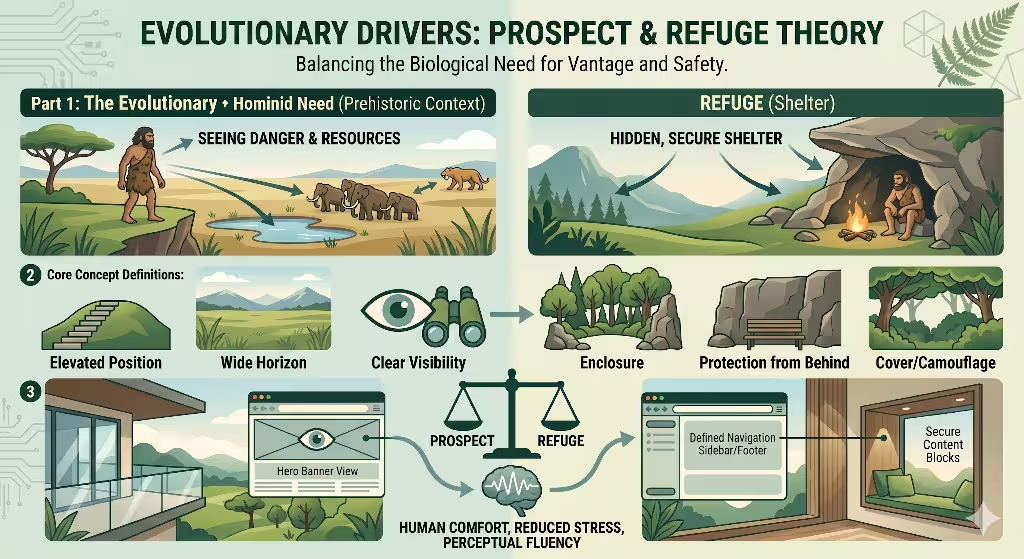
Our history as a species shapes our natural landscape perception today. Long ago, humans needed to find places where they could see far away but also stay hidden. This is called “Prospect and Refuge.” Prospect means having a wide view. It allows you to see food or danger coming from a distance. Refuge means having a safe place to hide, like a cave or a thick circle of trees.
This balance is a major part of natural landscape perception. We love a room with a view, but we also like a cozy corner with a solid wall behind us. In website design, we can use this. A big, open “hero” image at the top of a page provides prospect. It gives the user a sense of the whole site. A clear sidebar or a well defined footer provides refuge. It tells the user where they are and makes them feel secure.
When we ignore these needs, natural landscape perception becomes negative. A website that is too open feels empty and confusing. A website that is too crowded feels like being trapped in a dark closet. At Silphium Design LLC, we try to balance these two needs to create a digital environment that feels balanced. We want the user to feel powerful, like they are standing on a hill looking out over a beautiful valley.
What is the difference between shape and form in landscape design?
This is a question often asked when discussing natural landscape perception. While they sound the same, they serve different roles. Shape is the two dimensional outline of an object. It is the silhouette of a mountain against the sunset. Form is the three dimensional version. It includes the height, width, and depth.
In terms of natural landscape perception, shape is what we notice first. It helps us identify what we are looking at. Form is what we feel. Form gives us a sense of space and weight. In a digital world, we often deal with flat shapes. However, we can use shadows, gradients, and overlapping layers to create a sense of form. This adds a layer of realism that improves natural landscape perception. When a button looks like it has real volume, it is easier for our brains to understand that we can click it. This is why understanding the move from flat shapes to deep forms is so important for modern design.
How does the shape of a landscape affect human perception?
The shape of the world around us changes how we think. This is the heart of natural landscape perception. If you stand in a wide, flat field, you might feel a sense of freedom, but you might also feel exposed. If you are in a narrow canyon with tall, jagged walls, you might feel excitement or even a bit of fear.
These shapes tell our bodies how to react before we even realize it. Sharp, vertical shapes often represent energy and growth, like a forest reaching for the sun. Horizontal shapes represent rest and stability, like the ocean horizon. When we apply this to a website, we can guide the user’s mood. If we want them to feel calm, we use horizontal lines. If we want them to feel excited about a new product, we might use more vertical and diagonal shapes. Natural landscape perception is a tool we use to talk to the user’s subconscious. It is about creating a feeling of harmony between the person and the screen.
How do biomorphic forms influence website UX?
User Experience, or UX, is all about how easy a website is to use. Biomorphic forms, which are shapes inspired by nature, play a huge role here. Most websites are built on a “box model.” Everything is a rectangle. But humans do not naturally move in boxes. We move in curves.
By using biomorphic forms, we can improve natural landscape perception on a site. This might mean using a curved “S” shape for a scroll path or using rounded buttons that look like smooth river stones. These choices make the site feel more “human.” When natural landscape perception is high, the user does not have to think about how to use the site. They just follow their instincts.
At Silphium Design LLC, we look at how eyes move across a screen. Our eyes like to follow flowing lines. By creating a digital landscape that mimics a forest path, we can lead the user exactly where they need to go. This reduces “bounce rates,” which is when people leave a site quickly because they are annoyed or confused. Good natural landscape perception keeps people happy and engaged.
Translating Landscape Forms to Digital Landscapes
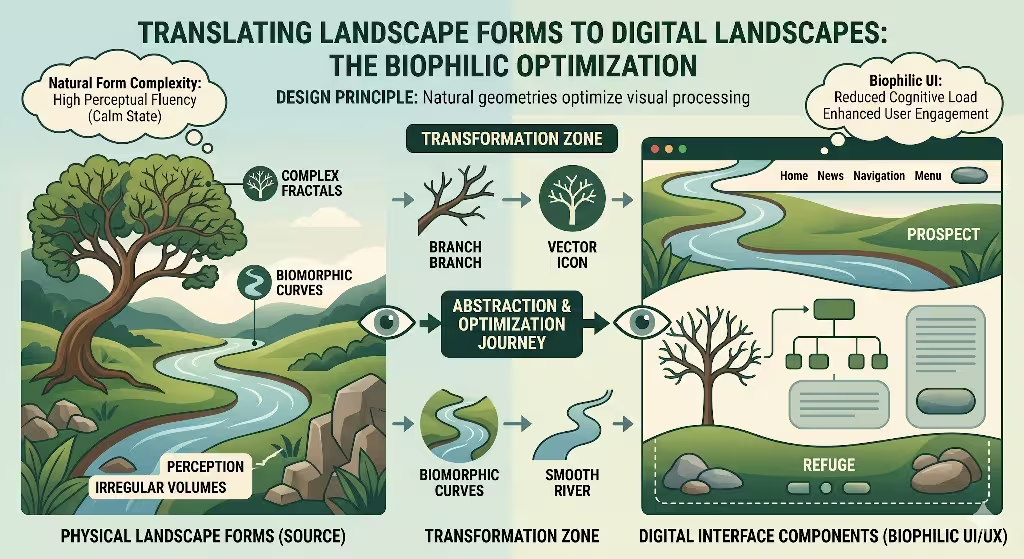
To bring natural landscape perception into the digital world, we have to think like an artist and a scientist. We look at the “visual hierarchy.” In a forest, your eye might be drawn to the tallest tree or the brightest flower. We do the same thing on a webpage. We use size, color, and form to create focal points.
We also look at how things move. In nature, things do not just appear and disappear. They grow, they sway, and they fade. We use animations that follow these rules to boost natural landscape perception. If a menu slides out smoothly like a leaf unfolding, it feels right. If it flashes onto the screen with a harsh blink, it feels mechanical and jarring.
SEO, or search engine optimization, also benefits from this. Google and other search engines want to provide a good experience for users. When a site has high natural landscape perception, users stay longer. They click more links. They share the site with others. Search engines see this behavior and rank the site higher. So, biophilic design is not just good for the soul; it is good for business. We use keywords like natural landscape perception to make sure the right people find our work, but the design is what makes them stay.
The Future of Biophilic Digital Environments
As we spend more time online, natural landscape perception becomes more vital than ever. We cannot afford to live in a world of boring, gray digital boxes. It is not good for our mental health, and it is not good for our productivity. We must learn to bring the lessons of the outdoors into our digital lives.
By understanding the impact of shape and form, we can build websites that feel alive. We can use fractals to soothe the mind and prospect and refuge to provide comfort. Natural landscape perception is the bridge between our biological past and our technological future. At Silphium Design LLC, we are committed to this path. We believe that every website should be a place where a person can feel a connection to the beauty of the natural world.
When we prioritize natural landscape perception, we create a better internet for everyone. We make tools that are not just useful, but also beautiful and calming. If you are a designer or a business owner, think about the shapes you are using. Ask yourself if your digital space feels like a cold office or a vibrant garden. By choosing the garden, you are choosing a future where technology and nature work together in perfect harmony.
The study of natural landscape perception is still growing. Every day, we learn more about how our brains react to colors, patterns, and forms. As we continue to refine our work at Silphium Design LLC, we will keep pushing the boundaries of what a website can be. We want to ensure that every click and every scroll is an experience that honors the human spirit. Natural landscape perception is not just a trend; it is a fundamental truth of how we see the world.