
The Digital Ecosystem and its Discontent
We exist in a digital environment that is, by design, sterile. It is an ecosystem of flat glass, hard edges, and high cognitive load. This constant exposure to high stress, unnatural interfaces leads to digital fatigue, a state of mental exhaustion and disconnect. The modern internet, for all its utility, has largely ignored a fundamental human need: our innate connection to the natural world.
This is where the discipline of biophilic web design enters. Answering the common question, “What is biophilic web design?”, it is the practice of integrating elements and principles of nature into digital interfaces. The goal is to improve user well being, reduce stress, and enhance focus. It is a direct response to the sterile digital world.
For years, this practice was largely static. It meant adding a high resolution photograph of a forest or using a wood grain texture for a background. But a new catalyst has emerged. Artificial Intelligence (AI) is now being applied, not as a replacement for human designers, but as a powerful collaborator. AI allows us to analyze, generate, and adapt digital spaces in real time.
The synthesis of these two fields creates something new: AI-enhanced biophilic web design. This article will argue that AI is the catalyst that elevates biophilic design from a static aesthetic to a dynamic, personalized, and truly responsive digital ecosystem. AI-enhanced biophilic web design is not just a new trend; it represents a fundamental shift in how we create digital spaces, creating unprecedented value for both the user and the platform. We are moving from building static pages to cultivating living digital habitats, and AI-enhanced biophilic web design is the key.
Table of Contents
The Foundations: Understanding the Two Disciplines
To understand the power of AI-enhanced biophilic web design, we must first analyze its two main components. One is a deep seated human science, and the other is a powerful modern technology. Separately, they are impactful. Together, they are revolutionary.
The “Why” of Biophilia
The entire field of biophilic design rests on a simple, profound concept: the Biophilia Hypothesis. This idea, popularized by the biologist E.O. Wilson, proposes that humans have an innate, genetic tendency to seek connections with nature and other forms of life. We evolved in nature, and our brains are wired to respond positively to it. When we are disconnected from it, as we are in most digital and urban environments, it creates stress.
This is not just a feeling. Studies show that exposure to natural elements can lower blood pressure, reduce cortisol (the stress hormone), and improve cognitive function. Biophilic design is the attempt to bring those benefits into our built environments, like offices and hospitals. Biophilic web design simply extends that logic to the digital environments where we now spend so much of our time.
To standardize this, the design firm Terrapin Bright Green outlined the 14 Patterns of Biophilic Design. These provide a framework for designers. When answering, “What are examples of biophilic design?”, these patterns are the answer. They are grouped into three main categories:
- Direct Nature (Nature in the Space): This involves a direct, physical connection to natural elements. In a building, this means indoor plants, a water feature, or natural airflow. On a website, this translates to dynamic elements like animations of wind or water, natural sounds (like birdsong), and light that changes.
- Indirect/Natural Analogues (Natural Analogues): These are elements that mimic nature. This is where traditional biophilic web design has focused. It includes using biomorphic forms (shapes from nature), fractal patterns (like those in leaf veins or snowflakes), and materials that evoke nature, such as stone or wood textures.
- Space and Place (Nature of the Space): This is the most complex category. It involves creating spatial experiences that feel natural. This includes:
- Prospect: A clear, open view of the “landscape” of the website, which makes a user feel safe and in control.
- Refuge: A small, protected space where a user can focus without distraction, like a well designed checkout page.
- Organized Complexity: A layout that is rich in detail but follows a clear, underlying order, just like a forest.
This framework is the foundation of all biophilic design. But when applied traditionally, it is static. The wood texture is the same for every user, every time. The AI-enhanced biophilic web design model seeks to change that.
The “How” of AI in Design
Now let’s look at the second component: Artificial Intelligence. When we ask, “How is AI used in web design?”, most people think of chatbots or simple website builders. But its true role is far deeper. AI, specifically machine learning, is a tool for finding patterns and making predictions.
In web design, AI has been used for years in several key ways:
- Personalization: The most common example is Netflix or Amazon. An AI algorithm analyzes your past behavior (what you watch, what you buy) and compares it to millions of other users. It then predicts what you will want to see next and serves you a personalized homepage.
- A/B Testing Optimization: Designers often test two versions of a page (Version A and Version B) to see which one performs better. An AI can run thousands of these tests at once, changing button colors, headlines, and layouts. It learns in real time what combination leads to the most conversions.
- Behavior Analysis: AI tools can analyze user behavior on a massive scale. They watch how users scroll, where their mouse hovers, and where they get “stuck.” This gives designers incredible insight into what parts of the site are confusing or frustrating.
Until now, this power has been used almost exclusively for commercial goals: increase sales, get more clicks, reduce bounce rates. But what happens when we take this powerful predictive and analytical engine and apply it to a human centered goal?
This is the central question that AI-enhanced biophilic web design answers. It takes the “why” of biophilia (our need for nature) and combines it with the “how” of AI (personalization and adaptation). The result is AI-enhanced biophilic web design, a system that doesn’t just show you nature, but creates a natural and responsive environment just for you.
The Synergy: How AI Enhances Biophilic Web Design
This is where the theory becomes practice. The combination of AI and biophilia creates enhancements that were impossible just a few years ago. AI-enhanced biophilic web design is not just a cosmetic upgrade; it is a functional one. It creates digital spaces that are generative, adaptive, and data driven.
Enhancement 1: Generative AI for Infinite Natural Analogs
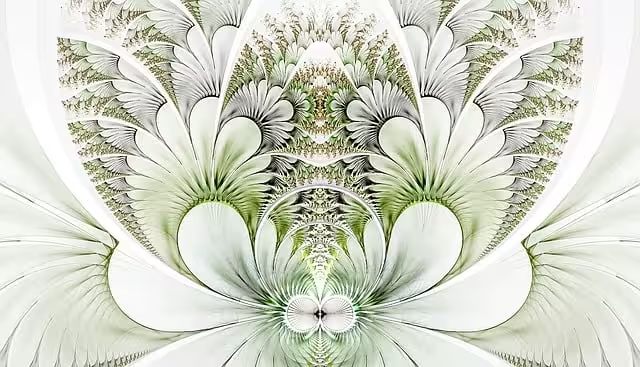
“Can AI create natural patterns?”, is one of the most exciting developments. The answer is a definitive yes. This is done through Generative AI.
You may know these tools by names like Midjourney or DALL-E. A specific type of this AI is a Generative Adversarial Network (GAN). In simple terms, a GAN works by having two AIs compete. One AI, the “Generator,” creates an image (e.g., a leaf pattern). The other AI, the “Discriminator,” tries to guess if the image is a real photo or the Generator’s fake. They compete millions of times, with the Generator getting progressively better at “drawing” until its creations are indistinguishable from reality.
How does this apply to AI-enhanced biophilic web design?
- Infinite, Non Repeating Patterns: Nature’s most calming patterns are fractal. This means the pattern looks similar at all scales, like a coastline, a fern, or a cloud. A traditional website would use a single, repeating image file for a fractal background, which the human eye quickly recognizes as artificial. With AI-enhanced biophilic web design, a generative AI can create a fractal pattern live in the user’s browser. It is mathematically generated, so it is infinitely large and never, ever repeats. The user can scroll forever and never see the same pattern twice. This creates a much more authentic and calming natural analog.
- Unique Biomorphic Assets: A designer can prompt a generative AI to create unique UI elements. For example: “Create a ‘settings’ icon that looks like the inside of a nautilus shell” or “Design a ‘buy’ button that mimics the texture of smooth river stone.” This allows for a level of unique, organic design that would take a human designer hundreds of hours to create. AI-enhanced biophilic web design uses AI to create a library of limitless, unique assets.
This generative ability means that AI-enhanced biophilic web design can ensure that every user’s experience is unique. It moves beyond a static “nature” skin and into a world where the natural elements are as unique as nature itself.
Enhancement 2: Hyper Personalization and Dynamic Environments
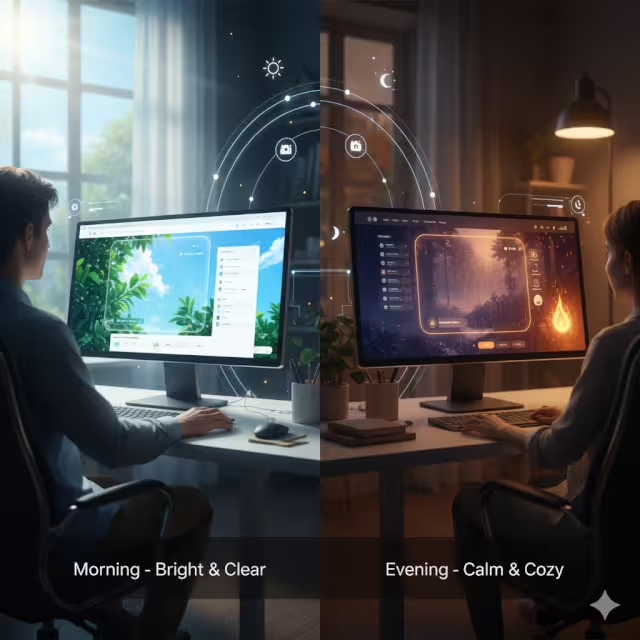
This is the most critical enhancement. AI allows a biophilic website to move from static to living. It can read and respond to the user and their environment in real time. This is the core of AI-enhanced biophilic web design.
This personalization goes far beyond Netflix recommendations. It is about personalizing the environment to improve a user’s well being.
- Dynamic Content and Environmental Matching: An AI powered website can use an API (a way for programs to talk to each other) to check a user’s actual local environment.
- Time of Day: If a user in Boston visits the site at 8:00 AM, the AI can serve a version with bright, cool “morning” light. If the same user visits at 8:00 PM, the interface will automatically shift to a warmer, softer “evening” palette. This subtly connects the user to the natural circadian rhythm, rather than blasting them with blue light at all hours.
- Local Weather: The AI-enhanced biophilic web design can go even further. If the API reports it is raining at the user’s location, the website’s background could show a subtle, generative animation of rain on a window. If it’s sunny, the “digital light” in the site could be brighter. This creates a powerful “Connection with Natural Systems” (one of the 14 patterns) by bridging the gap between the digital space and the user’s real world.
- Predictive User Experience (UX) and Stress Reduction: This is where AI-enhanced biophilic web design becomes truly restorative. A machine learning model can be trained to analyze user behavior for signs of stress or cognitive load.
- Stress Indicators: These include erratic, fast mouse movements, “rage clicking” (clicking many times in one spot), or rapid, frustrated scrolling.
- The AI Intervention: When an AI-enhanced biophilic web design detects these stress behaviors, it can proactively intervene. It doesn’t pop up a “Are you stressed?” message. Instead, it makes subtle, calming changes. It might:
- Slow down UI animations to a more soothing pace.
- Subtly increase the “Refuge” (one of the 14 patterns) of the layout by adding more white space.
- Introduce a non looping, AI generated natural soundscape at a very low volume.
- Shift the color palette to more calming blues and greens.
This is the ultimate promise of AI-enhanced biophilic web design. It creates a digital environment that is not just passive, but actively cares for the user’s well being. It senses their stress and adapts to help reduce it.
Enhancement 3: Data Driven Biophilic Strategy
For years, biophilic design has been seen as a “soft” science. Designers felt it worked, but it was hard to prove it with data. This made it a difficult sell to executives focused on KPIs (Key Performance Indicators) and ROI (Return on Investment).
AI-enhanced biophilic web design solves this problem. It turns biophilic design into a hard, data driven science.
- AI Powered A/B Testing: As mentioned, AI can run thousands of tests. We can now apply this to biophilic elements.
- Question: Do users convert better with a fractal background or a solid blue background?
- Question: Does adding a subtle, AI generated birdsong soundscape actually lower the bounce rate on a high stress page like a checkout?
- Question: Which of the 14 patterns (Prospect, Refuge, Complexity) has the biggest impact on website engagement?An AI can run these tests in the background, analyzing millions of data points to give definitive answers.
- Computer Vision and Heatmaps: AI-enhanced biophilic web design uses tools like computer vision to analyze how users see the page. An AI-powered heatmap can show not just where a user clicks, but where their eyes are looking.
- Application: We can place a natural image on a page and use AI to see if users are “visually resting” on it. Does their gaze linger on the natural element when they are thinking? This proves the element is providing a cognitive break.
This data driven approach is critical. It gives us, as designers, the proof we need. We can now go to a client and say: “Implementing an AI-enhanced biophilic web design strategy is projected to lower user-reported stress by 15% and increase session duration by 30%.”
AI-enhanced biophilic web design is no longer just a nice to have aesthetic. It is a measurable, high performance design strategy that benefits both the user’s well being and the company’s bottom line.
Practical Applications and Future Horizons
This combination of generative art, hyper personalization, and data analysis is not just theory. It is being applied in new and exciting ways. The future of AI-enhanced biophilic web design is moving from just mimicking nature to behaving like it.
Case Study: The “Living” E commerce Site
Let’s imagine a practical example of AI-enhanced biophilic web design: an e commerce website. This site sells outdoor gear.
- User 1: “The Task Focused Buyer”
- Who: Sarah. It’s Tuesday morning. She is at work and quickly needs to buy a specific tent for a weekend trip.
- AI Analysis: The AI detects her behavior: she used a specific search term, she is scrolling quickly, and her mouse movements are fast and direct. It classifies her as “Task Focused” and “High Stress.”
- AI-Enhanced Biophilic Response: The website’s AI-enhanced biophilic web design adapts. It serves her a layout that emphasizes the Prospect pattern. The navigation becomes large and clear. The background textures become very subtle. The search bar is prominent. It removes all distracting “discovery” modules. The AI-enhanced biophilic web design helps her complete her task efficiently, reducing her stress by providing a clear, unimpeded path.
- User 2: “The Leisurely Browser”
- Who: David. It’s Sunday evening. He is relaxing on his sofa, browsing on a tablet. He is dreaming about a future hiking trip.
- AI Analysis: The AI detects his behavior: he is scrolling slowly, lingering on large images, and clicking on “related stories” links. His mouse movements are slow and flowing. The AI classifies him as “Leisure Focused” and “Low Stress.”
- AI-Enhanced Biophilic Response: The website’s AI-enhanced biophilic web design adapts again. It serves David a layout that emphasizes Refuge and Mystery. The images are large and immersive. The generative fractal backgrounds are richer and more complex. It suggests blog posts and videos. The “digital light” is warm, matching the evening. The goal here is not efficiency, but engagement and inspiration.
Both users are on the same website, but their AI-enhanced biophilic web design experience is completely different, tailored to their emotional and cognitive state. This is the power of this new field.
The Link to Sustainable Web Design
An often overlooked benefit of AI-enhanced biophilic web design is its connection to sustainable web design.
The internet uses a massive amount of energy. Data centers and data transmission are a huge source of carbon emissions. A major part of this is the “weight” of websites, specifically large, high resolution images and videos.
This is where AI-enhanced biophilic web design offers a more “green” solution.
- Generative Assets vs. Photos: A 4K, high resolution photograph of a forest can be 5 to 10 megabytes. This file has to be stored on a server and sent to every single user, consuming energy each time.
- Code Based Fractals: An AI generated fractal pattern, by contrast, is not an image file. It is a small piece of JavaScript code that runs in the user’s browser. This code might be only a few kilobytes.
By using generative AI to create its natural analogs, an AI-enhanced biophilic web design can be dramatically smaller and “lighter.” It loads faster, uses less data, and therefore consumes less energy. This creates a beautiful harmony: the design that is psychologically beneficial for the human is also ecologically beneficial for the planet. AI-enhanced biophilic web design is, in many ways, inherently sustainable web design.
The Future: Biomimicry and AI
We have mostly discussed the aesthetics of AI-enhanced biophilic web design. But the future lies in biomimicry: learning from and mimicking nature’s systems and strategies.
Nature is the most efficient designer in the universe. A forest, for example, is a perfectly optimized system for capturing energy, distributing nutrients, and processing information.
- Beyond Aesthetics: What if a website didn’t just look like a forest, but worked like one?
- AI and Mycelial Networks: Think about a website with thousands of pages. How do you organize it? The current model is a rigid, top down “sitemap.” But in a forest, nutrients are shared through a vast, adaptive mycelial network (the root system of mushrooms). This network finds the most efficient paths to send resources where they are needed.
- The Future Application: The most advanced form of AI-enhanced biophilic web design will use an AI to structure a website’s information like a mycelial network. The AI would analyze all the site’s content and all the user’s behaviors. It would then create dynamic, adaptive links between pages, learning the most efficient “paths” for a user to find the information they need.
This is the true horizon of AI-enhanced biophilic web design. It’s a system where the AI, inspired by natural biomimicry, organizes the digital ecosystem not like a human filing cabinet, but like a living, breathing, and highly efficient natural organism.
From Static Page to Digital Habitat
We began by observing that the modern internet is a sterile, stressful place. It creates digital fatigue and disconnects us from the natural world our brains are wired for.
For years, biophilic design was the best solution, but it was static. It was a poster of a forest hanging on a digital wall.
The introduction of Artificial Intelligence has changed everything. The integration of AI and biophilia, or AI-enhanced biophilic web design, creates a revolutionary shift.
- It is Generative: AI can create infinite, unique, and authentic natural patterns, moving beyond static, looping images.
- It is Adaptive: AI-enhanced biophilic web design allows a website to become a living environment. It can read a user’s local weather, time of day, and even their stress level, and adapt the interface in real time to be more calming and restorative.
- It is Data Driven: AI analytics finally give us the hard data to prove that biophilic design works. It connects user well being directly to business KPIs, making it an essential strategy, not just a “nice to have.”
The future of AI-enhanced biophilic web design is moving even deeper, into biomimicry, where our digital spaces will be organized with the same efficiency as a natural ecosystem.
We are at a critical junction in web design. We no longer have to build static, lifeless pages. We can build habitats. The future of the web is not just “human centered design.” It is “human as part of nature centered” design. AI-enhanced biophilic web design is the powerful and essential tool that will allow us to build it.
Is your website just a tool, or is it an environment? Contact Silphium Design LLC to explore how AI-enhanced biophilic design can transform your digital user experience.