
We spend our lives in a state of digital saturation. We stare at glowing rectangles, navigate rigid grids, and process an endless stream of sterile information. This constant disconnection from the natural world creates a low-level, persistent stress. We call it digital fatigue. We are, by our very nature, biological beings. Yet, the digital environments we now inhabit are often the opposite of life. What if we could change that? What if our websites, apps, and digital spaces were not just tools, but places of restoration?
This is the core concept of biophilic web design. This field of design translates our innate human connection to nature, known as biophilia, into the digital world. It uses organic shapes, earthy colors, and natural patterns to make us feel calmer, more focused, and less stressed.
Now, a new evolution is beginning. We are starting to merge this nature-inspired design with a powerful new technology: artificial intelligence. This synthesis is the future of digital experience. This is AI biophilic web design. It is the practice of using artificial intelligence to create, personalize, and optimize these nature-inspired experiences. AI is the tool that allows us to move web design from a static layout into a dynamic, responsive, and living environment. This article will explore this synthesis. We will analyze how AI biophilic web design is building a web that actively supports human well-being.
Table of Contents
The Foundation: Understanding Biophilia and Biophilic Web Design
To understand AI biophilic web design, we must first understand its two core parts. The first part is not a technology, but a human instinct. The second is the design practice that builds upon it.
What is Biophilia? (The ‘Why’)
The term “biophilia” was popularized by the Harvard biologist Edward O. Wilson in his 1984 book of the same name. The Biophilia hypothesis is simple but profound: humans have an innate, genetic connection to nature and other forms of life.
Think about why you feel better when you walk through a forest. Or why you are drawn to the sound of ocean waves. Or why you place a potted plant on your desk. This is not just a preference; it is a biological need. For 99% of human history, we lived as part of the natural world, not separate from it. Our brains evolved to respond to its signals.
The benefits of honoring this connection are proven:
- Stress Reduction: Exposure to natural elements lowers blood pressure and reduces levels of cortisol, the body’s stress hormone.
- Improved Cognitive Function: We are more creative, solve problems better, and have longer attention spans in environments that contain natural elements.
- Enhanced Well-being: Biophilic spaces simply make us feel happier and more positive.
This is the “why.” Biophilic design works because it satisfies a deep, biological need.
What is Biophilic Web Design? (The ‘What’)
Biophilic web design is the practice of applying these principles to digital interfaces. It is about translating the positive feelings of a forest or a coastline into the pixels of a screen.
This goes far beyond just adding a photo of a plant as your background. It is a complete design strategy. We can break down the elements of biophilic web design into three main categories.
1. Direct Nature Analogues
This is the most direct and obvious form. It involves using clear representations of nature in your design.
- Natural Imagery: Using high-quality, high-resolution images and videos of plants, water, forests, and landscapes. The travel website Airbnb does this very well. Its homepage is filled with images of beautiful, natural destinations, which creates a feeling of calm and adventure.
- Natural Sounds: This is used more in apps than websites. The Calm app is a primary example. It uses subtle, optional soundscapes of rain, birds, or wind to create an immersive, peaceful environment.
- Natural Processes: Showing the passage of time. This could be a background that subtly changes from a sunrise, to midday, to a sunset, following the time of day.
2. Indirect Nature Analogues

These are more subtle. They involve using elements that mimic nature or remind us of it, without being a literal picture of it.
- Earthy Color Palettes: Moving away from harsh, artificial neon or sterile corporate blues. Instead, a biophilic palette uses the colors of nature: deep greens, rich browns, sky blues, and warm terracotta. These colors are less straining on the eyes and create an immediate sense of calm.
- Organic Shapes and Forms: Nature rarely uses straight lines or perfect 90-degree angles. It uses flowing curves, organic shapes, and complex patterns. Biophilic web design breaks free from the rigid grid. It uses rounded corners, wave-like dividers between sections, and layouts that feel more fluid and natural.
- Fractal Patterns: Fractals are complex, never-ending patterns that are common in nature. You see them in snowflakes, leaf veins, river systems, and ferns. Our brains are hard-wired to find these patterns fascinating and calming. Incorporating subtle fractal patterns into website backgrounds or borders is a very effective biophilic technique.
- Natural Lighting: Instead of flat, uniform color blocks, this technique uses soft gradients, shadows, and layers to create a sense of depth and time. It simulates how light works in the real world. A well-designed “dark mode” is a perfect example of this. It reduces eye strain and can be set to follow circadian rhythms, our body’s natural sleep-wake cycle.
3. Human-Centered Spaces (Digital)
This is the most complex category. It is about how the layout of the website makes a user feel. It borrows from a key architectural concept called “prospect and refuge.”
- Prospect: This is the feeling of having a clear, unobstructed view of your surroundings. In web design, this means a clear dashboard, an easy-to-understand navigation menu, and a layout where you can see your main options. It makes you feel in control.
- Refuge: This is the feeling of being in a safe, protected, and cozy space. In web design, this translates to clear “back” buttons, easily closable pop-ups, and a design that does not feel overwhelming. It is the feeling that you can explore without getting lost.
A good biophilic website gives you a clear “prostpect” (the homepage) from a position of “refuge” (clear, intuitive navigation). This combination makes a user feel safe, in control, and comfortable.
The AI Revolution: What Does Artificial Intelligence Add?
For years, biophilic web design has been static. A designer would manually pick the earthy color palette. A developer would code the wave-like border. A photographer would provide the landscape image. The experience was the same for every single user, every single time.
This is where AI changes everything.
The core of AI biophilic web design is dynamism. AI gives a website the ability to be intelligent, adaptive, and personal. It takes the static principles of biophilia and makes them alive.
Generative AI for Dynamic and Unique Aesthetics
Generative AI is a branch of artificial intelligence that can create new content. It is not just analyzing data; it is making new images, text, sounds, and patterns. When applied to AI biophilic web design, the results are incredible.
- Application 1: Truly Unique Backgrounds. Instead of using the same stock photo of a forest for every visitor, a generative AI can create a new, unique, and completely original biophilic image or pattern for every single person who visits the site. This could be a fractal pattern that is generated based on the time of day, or a digital painting of a landscape that does not exist in the real world. This ensures the design is never static or boring.
- Application 2: Living, Evolving Art. This is where AI biophilic web design gets really exciting. The AI can be programmed to make the design “grow” or change as the user interacts. Imagine a background with a simple vine pattern. As you scroll down the page, the AI makes the vines slowly grow and sprout new leaves. Or, a loading animation is not a spinning wheel, but a flower that slowly blooms. This mimics the constant, subtle change of a real natural environment, making the website feel organic and responsive.
Personalization and Adaptive User Experience (UX)
This is perhaps the most powerful function of AI biophilic web design. AI can create a personalized experience that actively works to improve a user’s well-being. A website can now be less of a static pamphlet and more of a caring partner.
This directly answers the question, “How can AI improve user well-being on a website?” It does this by adapting the biophilic elements to the user in real time.
- Adaptive Interfaces: An AI can analyze all kinds of data to tailor the experience. This data could include the user’s local time, their local weather, or even their behavior on the site.
- Example 1: Circadian Rhythms. The AI knows you are visiting the site at 7:00 AM. It serves you a bright, high-energy version of the site with a “sunrise” color palette to help you wake up. When you visit again at 10:00 PM, the AI automatically serves a “dark mode” version with a soft, moonlit palette and reduced blue light to support your body’s natural circadian rhythm and prepare you for sleep.
- Example 2: Stress-Based Adaptation. This is a more advanced concept. Machine learning models (a type of AI) can be trained to recognize patterns of user stress. This could be erratic, fast mouse movements, “rage clicking” a button that is not working, or scrolling up and down a page very quickly. An AI biophilic web design could detect this behavior. In response, it could subtly and automatically shift the website’s color palette to a more calming blue or green. It might slow down the pace of animations. It could even trigger a small, polite pop-up that says, “You seem busy. Would you like to take a 30-second breathing exercise?”
- Example 3: AI-Driven Interactions. We see this in the Forest App, which uses a gamified biophilic principle. To help you focus, you “plant a tree.” If you leave the app, the tree dies. This creates a powerful connection. An AI biophilic web design can use this same idea. It can provide a “focus mode” that gently fades out distracting elements, or it can learn what parts of the site you find most calming and suggest them to you when it detects you have been working for a long time.
Biomimicry and AI-Driven Optimization
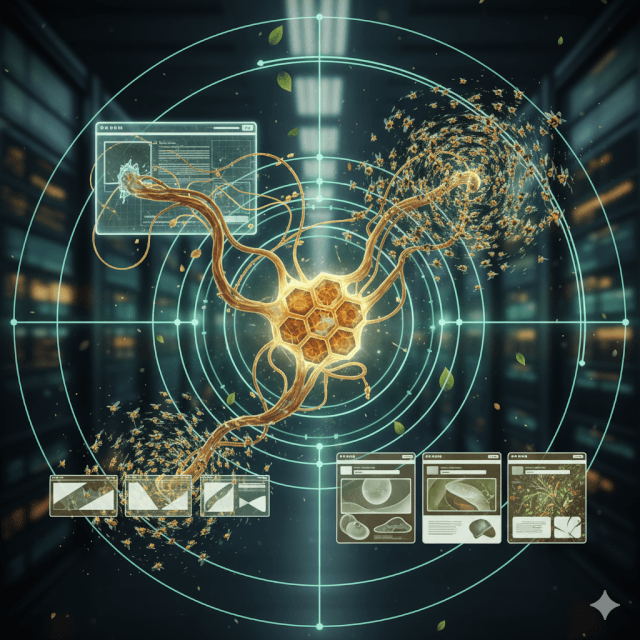
This is the deepest and most technical layer of AI biophilic web design. This is where we move from mimicking nature’s look (biophilia) to mimicking nature’s functional genius (biomimicry).
Biomimicry is the practice of learning from and emulating nature’s time-tested strategies to solve human problems. Nature has been running R&D for 3.8 billion years. Its solutions are incredibly efficient. AI is the key that unlocks these solutions for the digital world.
- Example 1: AI-Optimized Navigation (The Slime Mold). A slime mold is a simple organism with no brain. Yet, when placed in a maze, it will grow to find the most efficient possible path to a food source. This is a brilliant natural algorithm. In AI biophilic web design, an AI can be programmed to act like that slime mold. It can analyze the behavior of all users on a website—where they click, where they get lost, where they leave. Over time, the AI can “evolve” the website’s navigation, finding the most efficient and intuitive paths for users to find information.
- Example 2: AI-Driven Server Load (The Bee Swarm). A swarm of bees is a master of decentralized efficiency. Bees spread out to find flowers, and they communicate to direct the swarm to the best patches, all without a central leader. This is called “swarm logic.” An AI can use this same logic to manage website traffic. Instead of one server getting overwhelmed, an AI can distribute the load efficiently across multiple servers, just like a bee swarm. This makes the website faster, more stable, and use less energy.
- Example 3: AI-Evolved UI (Natural Selection). An AI can be programmed to use “evolutionary design.” The AI can generate thousands, or even millions, of slightly different design variations—different button colors, different layouts, different font sizes. It then “tests” these designs with real users (or in a simulation). The designs that perform best (e.g., lead to more engagement or less stress) are “selected.” The AI then “breeds” them together to create a new generation of even better designs. The ones that perform poorly “die off.” This process repeats, allowing the website to evolve into the most optimized version of itself, just like a species in nature.
The Tangible Benefits of AI-Driven Biophilic Design
This fusion of nature and technology is not just a fascinating experiment. It has clear, measurable benefits for both the people using the website and the business that owns it.
For the User
The benefits of AI biophilic web design for the user are primarily psychological and emotional.
- Reduced Stress & Digital Fatigue: This is the primary benefit. By creating a calming, non-threatening, and adaptive digital environment, AI biophilic web design actively works to lower user stress. The organic shapes, soothing colors, and personalized “calm” adaptations make browsing the web feel less like a chore and more like a restorative experience.
- Improved Focus & Cognitive Performance: Natural patterns are less cognitively demanding than chaotic or sterile designs. When a website feels intuitive and calm, our brains do not have to work as hard to navigate it. This frees up mental resources, allowing us to focus on the actual content, whether we are reading an article, learning a new skill, or shopping for a product.
- Enhanced Well-being: The combined effects of AI biophilic web design lead to a greater sense of overall well-being. The site understands you. It adapts to your needs. It respects your circadian rhythms. It feels less like a machine and more like a place. This human-centered approach builds a positive, enjoyable online experience.
For the Business (The SEO & Conversion Case)

The benefits of AI biophilic web design for the business are a direct result of a better user experience. What is good for the user’s well-being is also good for the bottom line.
- Increased User Engagement (Dwell Time): When a website makes people feel good, they stay longer. This is a simple fact. Increased “dwell time” (how long a user stays on your page) is a critical signal to search engines like Google. It tells them your content is valuable, which can significantly boost your SEO rankings.
- Higher Conversion Rates: A calm, focused user is a more confident user. A stressed user is more likely to abandon their shopping cart. An AI biophilic web design, by reducing stress and friction, leads to more methodical and confident decision-making. This means higher conversion rates, whether your “conversion” is a purchase, a newsletter sign-up, or a contact form submission.
- Stronger Brand Affinity: Brands that use AI biophilic web design are perceived as more thoughtful, more modern, and more human-centered. You are showing your users that you care about their well-being, not just their data. This builds deep-seated brand loyalty that is very hard for competitors to copy.
- A “Greener” Website: The principles of AI biophilic web design also connect to digital sustainability. The same AI that optimizes the user’s experience can also optimize the website’s code. It can create “lightweight scripts” and lean code that require less server energy to run. When paired with Green Hosting (servers powered by renewable energy), your website is not only about nature, it is actively working to protect it by reducing its own carbon footprint.
Real-World Examples, Key Entities, and Future Trends
The field of AI biophilic web design is still in its infancy, but we can see the building blocks of it everywhere.
Current Examples (Mostly Biophilic, Aspiring to AI)
Right now, the best examples are biophilic in design, but use very little AI. They are the foundation that AI will build upon.
- Entities: Calm (App/Website): The gold standard for static biophilic design. It uses serene, full-screen video landscapes (water, mountains) and ambient nature sounds. It is a perfect digital “refuge.” The next step is an AI biophilic web design that would generate a unique landscape for you.
- Entities: Forest App: This app gamifies focus by linking it to a natural metaphor. You plant a digital tree, and it grows over 30 minutes. If you leave the app to check social media, the tree dies. This is a brilliant use of biophilic principles to change behavior.
- Entities: Airbnb: While a commerce site, its design is deeply biophilic. It uses earthy, natural tones in its interface and high-quality images of nature to sell an “experience” of a place, not just a room.
The AI-Powered Future (Hypothetical & Emerging)
This is where AI biophilic web design is headed.
- True Personalization: Imagine the Calm website, but the landscape it shows you is not a pre-recorded video. It is a unique, generative landscape created by an AI just for you. The AI checks your local weather and sees it is raining, so it generates a cozy, rainy-day scene. Or, it links to your smartwatch, detects a high heart rate, and generates a scene with slow-moving water to help you calm down.
- Immersive, Multi-Sensory Environments: As virtual reality (VR) and augmented reality (AR) become more common (e.g., Apple Vision Pro), AI biophilic web design will be essential. AI will be needed to create responsive, immersive, and fully interactive digital worlds that feel natural and restorative. Imagine an AR app that lets you place a “virtual garden” on your real desk, with AI-generated plants that grow and bloom over time.
- The “Living” Website: The ultimate future of AI biophilic web design is a website that functions like a living ecosystem. Its code will be optimized by AI for maximum energy efficiency. Its navigation will evolve based on user paths, like a slime mold. Its content will be personalized, like a natural process. It will not be a static “page” at all, but a dynamic, growing, and adaptive digital partner.
Designing a More Human (and Natural) Internet
AI biophilic web design is not just a new aesthetic trend. It is not just about adding plants to your homepage. It is a fundamental shift in our approach to technology. It is a human-centered design methodology that finally acknowledges our biological reality.
This approach synthesizes three powerful forces:
- Biophilia: Our innate, psychological need for nature.
- Biophilic Design: The practical design principles that apply this need to our environment.
- Artificial Intelligence: The intelligent technology that makes these designs adaptive and personal.
For decades, we have been building a digital world that drains us. We have prioritized efficiency over well-being, and data over human feeling. The path of AI biophilic web design offers a different future.
By using artificial intelligence, one of the most powerful tools of human logic, we can finally begin to reintegrate our most ancient, natural instincts into our digital lives. We can build a web that supports our well-being rather than draining it. We can design websites that are not just smart, but wise.
Ready to bring your digital space to life? Explore Silphium Design’s biophilic web design services and see how we can build a more engaging and restorative website for you.