
Table of Contents
Native plant e-commerce operates at the friction point between precise biological constraints and traditional consumer digital behavior.
In standard consumer e-commerce (apparel, electronics, consumer packaged goods), product attributes are predominantly static, aesthetic, or functional. A wool sweater fits the same whether worn in Duluth, Minnesota, or Savannah, Georgia. If a buyer selects the wrong size, return logistics handle the variance.
In native plant e-commerce, context determines viability. A specimen of Asclepias tuberosa (Butterfly Weed) or Solidago rigida (Stiff Goldenrod) is not an interchangeable SKU. It is a genetically situated biological organism bound to rigid abiotic conditions: photoperiod, annual precipitation cycles, minimum winter temperatures, soil chemistry, drainage dynamics, and historic evolutionary adaptations.
When a digital storefront treats botanical inventory like generic consumer goods, two compounding failure modes emerge:
- High Bounce Rates & Search Paralysis: Novice and intermediate native plant enthusiasts encounter overwhelming, clunky taxonomies or flat faceted filters that surface hundreds of incompatible options. Frustrated by impenetrable botanical jargon or missing environmental constraints, they bounce.
- Ecological Mismatch & Post-Purchase Mortality: Customers purchase species unsuited for their local EPA Level III/IV Ecoregion or micro-hydrology (e.g., planting an obligate wetland carex in dry sandy loam, or sourcing a southern ecotype of Echinacea purpurea for an open, wind-swept Zone 4b prairie). When the plant fails over winter or rots in heavy clay, customer satisfaction collapses, driving costly customer support tickets, refund requests, and negative reviews that blame the nursery rather than the site’s information architecture.
Solving this requires dismantling the conventional “Search & Facet” model. We must architect a digital commerce pipeline that encodes botanical taxonomy, geographic information systems (GIS), EPA Ecoregion boundaries, and soil pedology into a performant, biophilic, and low-friction user experience.
The Anatomy of Native Plant Search Failure
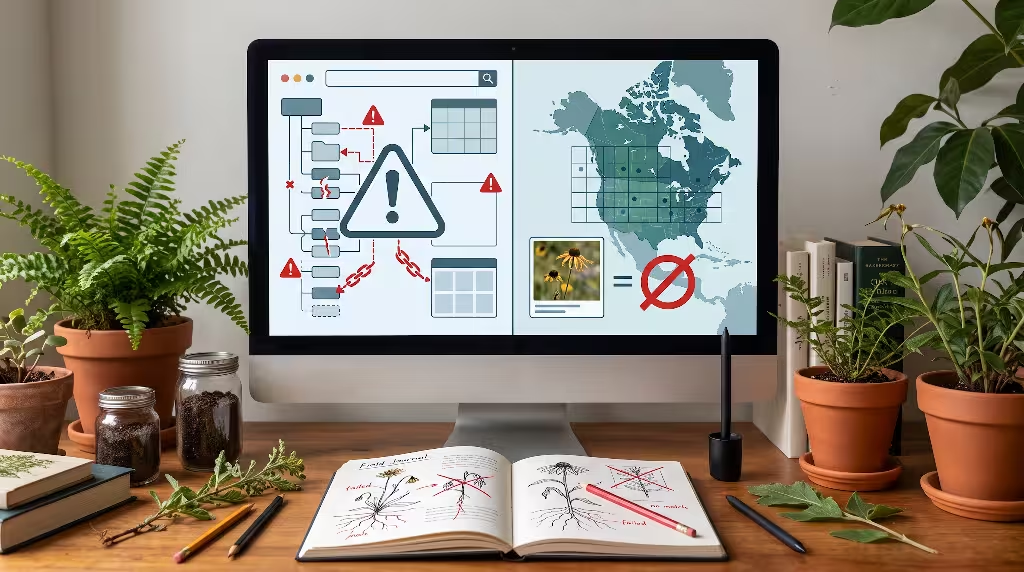
To diagnose why native plant shoppers bounce or buy doomed inventory, we must analyze the structural limitations of standard e-commerce platforms (such as basic WooCommerce, Shopify, or BigCommerce setups).
   [ Traditional Flat Taxonomy Engine ]
   ├── Category: Perennials
   │     └── Attribute: Full Sun
   │           └── Result: 450 SKUs (Ignores Ecoregion, Soil Type, Cold-Hardiness)
   │
   [ Context-Aware Botanical Architecture ]
   ├── Buyer Input: Lat/Long or ZIP (Auto-resolved to EPA Level III/IV + USDA Zone)
   ├── Dynamic Soil & Moisture Intersection: (e.g., Hydric/Mesic + Sandy Loam)
   └── Taxonomic & Floristic Query: Filtered Native Guilds & Ecotypic Provenance
The Inadequacy of USDA Plant Hardiness Zones
Most mass-market garden centers rely exclusively on the USDA Plant Hardiness Zone Map. While USDA zones measure the single variable of average annual extreme minimum winter temperature (in 10°F increments), they provide zero insight into ecological suitability.
For example, both coastal Seattle, Washington, and coastal Charleston, South Carolina, encompass areas designated as USDA Zone 8 or 9. Sourcing an Asclepias perennis (Aquatic Milkweed) adapted to the humid, sub-tropical coastal plain of the Southeast and shipping it to the Pacific Northwest marine climate will lead directly to specimen failure due to insufficient summer heat units, fungal pathogens in cool-wet soils, and incompatible photoperiod triggers. Relying on USDA hardiness as the primary geographical filter is an architectural flaw.
The Taxonomic Dilemma: Jargon vs. Common Name Ambiguity
Native plant nomenclature presents extreme user segmentation challenges:
- The Academic/Professional Persona: Landscape architects, ecological restorationists, and experienced botanists search strictly by binomial nomenclature (Symphyotrichum novae-angliae, Symphyotrichum laeve). They become frustrated when search engines return loose fuzzy matches based on consumer synonyms.
- The Novice/Ecological Enthusiast Persona: Suburban homeowners aiming to replace lawn turf or attract pollinators search by vernacular names (“New England Aster”, “Smooth Blue Aster”, or worse, simply “purple aster”).
When an e-commerce engine relies on standard full-text relational search without an underlying taxonomic graph:
- Common names introduce massive ambiguity. The term “Ironweed” can refer to Vernonia fasciculata, Vernonia missurica, Vernonia gigantea, or Vernonia noveboracensis, each requiring radically different hydrological niches (obligate wetland to upland prairie).
- Reclassifications break native search queries. When taxonomists moved aster species from Aster to Symphyotrichum, Doellingeria, and Ionactis, legacy nursery catalogs left users searching for Aster novae-angliae stranded with empty result sets (
HTTP 200: 0 Products Found).
The Facet Explosion Trap
Standard multi-select faceted navigation frequently results in empty states or contradictory queries. When a user selects Sunlight: Full Sun + Moisture: Wet + Height: Under 12 Inches + Soil: Pure Sand, standard product filters run rigid SQL AND queries across tags, resulting in zero results. Without intelligent, graceful fallbacks or progressive disclosure, the customer assumes the nursery is out of stock and terminates the session.
Structural Data Foundation: Building a Resilient Botanical Schema
A high-converting search interface cannot be built on an ad-hoc relational database. It requires a normalized, extensible data schema that binds traditional e-commerce product entities with authoritative botanical registries (e.g., USDA PLANTS Database, BONAP, and NatureServe).
Core Botanical Entity Architecture
                      +-------------------+
                      |   Catalog Item    |
                      |   (WooCommerce /  |
                      |     Shopify)      |
                      +---------+---------+
                                | 1:1
                                v
                      +-------------------+
                      | Botanical Profile |
                      +---------+---------+
                                |
        +-----------------------+-----------------------+
        |                       |                       |
        v                       v                       v
+---------------+       +---------------+       +---------------+
|   Taxonomy    |       | Site Ecology  |       | Geographic &  |
|    Module     |       |    Module     |       |   Genetics    |
+---------------+       +---------------+       +---------------+
| - Family      |       | - Soil Texture|       | - EPA Level   |
| - Genus       |       | - Soil pH     |       |   III & IV    |
| - Specific    |       | - Hydrology   |       | - County-Level|
|   Epithet     |       | - Canopy/Sun  |       |   Presence    |
| - Infraspecies|       | - Stratum     |       | - Provenance  |
| - Synonyms    |       | - Salinity    |       |   Coordinates |
+---------------+       +---------------+       +---------------+
Key Relational Entities
1. Taxonomy & Synonyms
family: string (e.g., Asteraceae)genus: string (e.g., Symphyotrichum)specific_epithet: string (e.g., novae-angliae)infraspecific_rank: enum (var.,subsp.,f.,none)infraspecific_epithet: string, nullablebotanical_synonyms: array of strings (e.g.,["Aster novae-angliae L.", "Lasallea novae-angliae (L.) Greene"])common_names: array of strings (indexed with primary regional weighting, e.g.,["New England Aster", "Michaelmas Daisy"])
2. Ecological Site Requirements
light_exposure: bitmask / multi-enum (Full Sun,Partial Sun,Partial Shade,Full Shade)hydrology_regime: enum based on the National Wetland Indicator system:Xeric(Excessively Drained / Drought Tolerant)Mesic(Medium, Well-Drained)Wet-Mesic(Moist, Periodically Saturated)Hydric(Obligate Wetland / Standing Water / Poorly Drained)
soil_texture: set (Clay,Clay-Loam,Silt,Loam,Sandy-Loam,Sand,Gravel/Rocky)soil_ph_tolerance: range object ({ min: 5.2, max: 7.5 })salt_tolerance: enum (None,Moderate Spray,High Salinity)
3. Geographic, Ecoregion & Provenance Indexing
epa_ecoregions_level_3: array of integers (e.g.,[66, 67, 68, 69]for Blue Ridge, Ridge and Valley, Central Appalachians, Western Allegheny Plateau)epa_ecoregions_level_4: array of alphanumeric identifiers (e.g.,["66a", "66b", "69b"])usda_hardiness_zones: array of strings (["5a", "5b", "6a", "6b", "7a", "7b"])fips_county_presence: array of FIPS strings (linking county-level botanical verification via BONAP/state flora checklists)ecotype_provenance_point: GeoJSON Point/Polygon indicating the verified mother-stock seed harvest location (essential for high-tier restoration buyers demanding strict local ecotypes).
Resolving the Spatial Variable: EPA Ecoregions vs. ZIP Codes
Retail consumers rarely know their EPA Level III or IV Ecoregion. They do not navigate life knowing they reside in Level III Ecoregion 67 (Ridge and Valley) or Ecoregion 69 (Western Allegheny Plateau). They know their 5-digit ZIP code.
If an e-commerce platform forces users to select from a raw dropdown of ecoregions, bounce rates will spike immediately. The platform must perform this translation automatically and deterministically.
+-----------------------------------------------------------------------+
|                       ZIP-to-Ecoregion Ingestion Pipeline             |
+-----------------------------------------------------------------------+
|  User Enters ZIP: "16354" (Titusville, PA)                            |
|                                                                       |
|  1. Spatial Boundary Intersect:                                       |
|     - Centroid: Lat 41.5978° N, Long 79.6748° W                       |
|     - Point-in-Polygon Query against EPA Ecoregion GIS GeoJSON:       |
|       --> EPA Level III: 69 (Western Allegheny Plateau)               |
|       --> EPA Level IV: 69a (Permian Hills / Glaciated Plateau Edge)  |
|       --> USDA Hardiness: Zone 5b                                     |
|                                                                       |
|  2. Resolution Rule:                                                  |
|     If boundary crosses multiple ecoregions within single ZIP:        |
|     Compute intersecting area weights -> Present user with gentle    |
|     topographic clarifier:                                            |
|     "Do you live in the glaciated valley bottom or rocky ridge?"       |
|                                                                       |
|  3. Store in Session State & Apply Global Facet Filter                |
+-----------------------------------------------------------------------+
The Spatial Polling Algorithm
To minimize database overhead, avoid executing expensive point-in-polygon calculations on every page render. Instead, implement a pre-indexed spatial mapping table during the build or ETL phase:
SQL
CREATE TABLE location_ecoregion_map (
    zip_code CHAR(5) PRIMARY KEY,
    latitude DECIMAL(9,6) NOT NULL,
    longitude DECIMAL(9,6) NOT NULL,
    usda_zone VARCHAR(4) NOT NULL,
    epa_level_3_id INT NOT NULL,
    epa_level_4_code VARCHAR(10) NOT NULL,
    ecoregion_name VARCHAR(128) NOT NULL,
    confidence_score DECIMAL(3,2) NOT NULL DEFAULT 1.00
);

CREATE INDEX idx_ecoregion_query ON location_ecoregion_map (epa_level_3_id, usda_zone);
When a user visits the storefront:
- Initial Assessment (Zero Click): The site reads client geolocation via reverse IP (or HTML5 Geolocation API on explicit user permission) to offer a gentle, non-intrusive banner:
“Showing plants native to the Western Allegheny Plateau (Zone 5b). [Change Region]” - Explicit Verification: A persistent, minimal input field in the site header or search overlay allows the user to enter their ZIP code or city.
- Graceful Handling of Split Boundaries: Certain western or mountainous ZIP codes span dramatic elevation gradients (e.g., 2,000 feet of vertical relief across a single mail route). In such instances, the database flags
confidence_score < 0.85, triggering an instant UI sub-toggle:
“We noticed your area has variable topography. Select your elevation/setting: Valley/Mesic Lowland vs. Dry Upland Ridge.”
Engineering the Search Experience: Taxonomy-Aware Algolia/Elasticsearch Pipeline
Standard keyword search engines fail when handling biological nomenclature. Searching for “Butterfly Weed” should match Asclepias tuberosa, but it should not return Buddleja davidii (an invasive non-native commonly called “Butterfly Bush”). Similarly, searching for “Aster” should return modern clades like Symphyotrichum, Eurybia, and Doellingeria.
Custom Elasticsearch / Opensearch Analyzer Configuration
To achieve resilient taxonomic resolution, build a dedicated search index with custom token filters, synonym graphs, and n-gram edge matching:
JSON
{
  "settings": {
    "analysis": {
      "filter": {
        "botanical_synonym_filter": {
          "type": "synonym_graph",
          "synonyms": [
            "butterfly weed, asclepias tuberosa, chigger flower, pleurisy root",
            "swamp milkweed, asclepias incarnata, rose milkweed",
            "common milkweed, asclepias syriaca",
            "aster => aster, symphyotrichum, eurybia, doellingeria, ionactis",
            "new england aster, symphyotrichum novae-angliae, aster novae-angliae",
            "joe pye weed, eutrochium, eupatorium purpureum, eutrochium maculatum",
            "goldenrod, solidago, oligoneuron"
          ]
        },
        "botanical_ngram": {
          "type": "edge_ngram",
          "min_gram": 3,
          "max_gram": 15
        }
      },
      "analyzer": {
        "botanical_text_analyzer": {
          "type": "custom",
          "tokenizer": "standard",
          "filter": [
            "lowercase",
            "asciifolding",
            "botanical_synonym_filter"
          ]
        },
        "botanical_autocomplete": {
          "type": "custom",
          "tokenizer": "standard",
          "filter": [
            "lowercase",
            "botanical_ngram"
          ]
        }
      }
    }
  },
  "mappings": {
    "properties": {
      "scientific_name": {
        "type": "text",
        "analyzer": "botanical_autocomplete",
        "search_analyzer": "standard",
        "fields": {
          "keyword": { "type": "keyword" }
        }
      },
      "common_names": {
        "type": "text",
        "analyzer": "botanical_text_analyzer"
      },
      "family": {
        "type": "keyword"
      },
      "epa_level_3": {
        "type": "integer"
      },
      "epa_level_4": {
        "type": "keyword"
      },
      "hydrology": {
        "type": "keyword"
      },
      "light": {
        "type": "keyword"
      },
      "soil_texture": {
        "type": "keyword"
      },
      "hardiness_min": {
        "type": "byte"
      },
      "hardiness_max": {
        "type": "byte"
      }
    }
  }
}
Implementing Progressive Botanical Fallbacks
When a user executes a specific filtered query that yields zero direct stock, the search pipeline should execute a fallback matrix rather than serving a dead end:
[ Tier 1: Exact Match ]
   Same Species + Same Ecoregion + In-Stock Local Ecotype
          │
          ▼ If Zero Stock
[ Tier 2: Ecoregional Sister Match ]
   Same Species + Adjacent Contiguous Ecoregion (Same EPA Level II Realm)
          │
          ▼ If Unavailable
[ Tier 3: Ecological Guild Equivalent ]
   Different Species + Same Botanical Family/Ecology Guild + Identical Hydrology/Sun
   (e.g., Out of Asclepias incarnata -> Suggest Asclepias exaltata for partial shade,
    or Asclepias tuberosa for well-drained locations)
This tiered architectural structure prevents the customer from abandoning the site, directly answers their ecological needs, and educates them on viable alternatives for their site.
UI/UX Design System: Biophilic UI Meets Botanical Precision

Biophilic UI design does not mean adding green backgrounds and leafy vector patterns to an off-the-shelf theme. In modern digital product design, biophilic UI design means structuring digital interactions to reflect natural systems: visual rest, clear spatial hierarchy, organic transitions, and cognitive coherence.
1. The Context-First Location Bar (“Ecoregion HUD”)
Instead of burying region selectors inside a sidebar filter accordion, surface the ecological context as a global heads-up display (HUD) anchored in the top navigation header:
+---------------------------------------------------------------------------------------------------+
|  [Silphium Nursery Logo]   | Your Garden: [ 16354 - Titusville, PA ] (Ecoregion 69 - Zone 5b) ⚙ |
+---------------------------------------------------------------------------------------------------+
|  Filters: [x] Verified Native to My Ecoregion  [ ] Full Sun (6+ hrs)  [ ] Wet-Mesic  [ ] Sandy-Loam |
+---------------------------------------------------------------------------------------------------+
- Clicking on the region pill triggers a focused modal allowing quick modifications: changing the postal code, overriding the ecoregion, or selecting a custom hardiness zone.
- An active toggle: “Strict Ecoregion Mode” vs. “Broader Continental Matrix”.
- Strict Ecoregion Mode filters exclusively to plants documented as indigenous to that specific EPA Level III/IV Ecoregion.
- Broader Mode includes plants native to neighboring regional provinces within 200 miles, badging them clearly:
Adjacent Ecotype.
2. Dual-Taxonomy Card Design: Mitigating Split Attention
E-commerce product cards must balance technical precision with consumer accessibility. A common mistake is rendering only scientific names (alienating beginners) or rendering only vernacular common names (alienating professionals).
+-------------------------------------------------------------+
| [ High-Res Image: Natural Setting, Not Cutout ]             |
| [ Seed Provenance Badge: Erie Drift Plain, PA ]             |
+-------------------------------------------------------------+
| Symphyotrichum novae-angliae                                |
| NEW ENGLAND ASTER                                           |
| Asteraceae Family                                           |
|                                                             |
| +---------------------------------------------------------+ |
| | [O] Full Sun    [~] Wet-Mesic to Mesic   [#] Clay/Loam  | |
| +---------------------------------------------------------+ |
|                                                             |
| Ecological Value: Keystone Host (112 Lepidoptera spp.)      |
| In Native Range: YES (Verified Native in Crawford Co.)      |
|                                                             |
| 1-Quart Deep Plug: $8.50                 [ Add to Garden ]  |
+-------------------------------------------------------------+
- Visual Typography Hierarchy: Scientific binomial names should be typeset in an elegant, legible serif typeface with true italicization (e.g., Fraunces or Newsreader), signaling botanical authority. Common names should sit directly below in high-contrast, clean sans-serif (e.g., Inter or Cabinet Grotesk), slightly smaller and spaced for legibility.
- Environmental Data Matrix (Micro-Badges): Replace bulky blocks of descriptive copy with an intuitive, standardized micro-iconography ribbon:
- Sun icon with fill-percentage (Full, Part, Shade).
- Droplet level indicating the moisture spectrum (Xeric to Hydric).
- Substrate icon indicating drainage dynamics.
- Keystone Badging: Highlight biological interactions (e.g., larval host status, specialist bee dependencies) to appeal to the growing segment of conservation-focused shoppers.
3. Hydrology & Soil Slider: The Soil Matrix Selector
Traditional multi-select checkboxes for soil (Clay, Sand, Loam) fail because real garden soil exists along a continuum. A customer whose soil is a wet clay-loam often checks Clay and Wet, eliminating species that thrive in damp soils but do fine in slightly looser textures.
Replace separate dropdowns with an interactive two-dimensional coordinate system or synchronized range sliders:
Sunlight:
[ Shade ] ────────────── [ Partial ] ────────────── [ Full Sun ]
                               ▲ (Selected: Partial to Full)

Moisture / Hydrology:
[ Xeric/Dry ] ────────── [ Mesic/Medium ] ────────── [ Hydric/Wet ]
                                      ▲ (Selected: Mesic to Wet)

Soil Type:
( ) Pure Sand   ( ) Sandy Loam   (X) Rich Loam   (X) Heavy Clay   ( ) Silt
When users manipulate these sliders, the interface updates the product grid via asynchronous AJAX/JSON requests, displaying dynamic match counts in real time: “Showing 42 species suited for moist loam in Ecoregion 69.”
The Cart-Level Ecological Audit: Preventing Incompatible Plantings
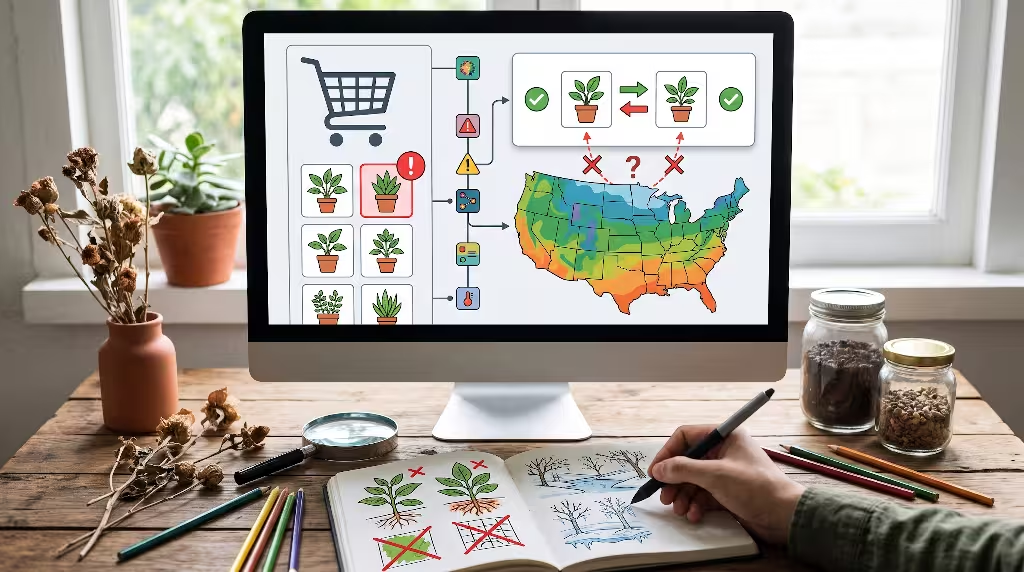
The digital architecture must not end at the product grid. To definitively eliminate the nursery pain point of “customers buying non-hardy species,” the final defense mechanism belongs within the checkout funnel: The Cart-Level Ecological Audit Engine.
The Problem
A user in Zone 4a (Upstate New York / Northern Vermont) browses the catalog, browses past the ecoregion warnings, searches for a showy plant they remember from a Southern vacation (Callicarpa americana – American Beautyberry), and adds it to their cart alongside appropriate native Northern species like Cornus sericea (Red Osier Dogwood).
If the order ships, the Callicarpa dies during the first sustained -20°F freeze. The nursery faces an angry customer demanding a replacement or leaving a 1-star review on Google Business Profile stating: “The plants I received died immediately; poor stock quality.”
Architectural Solution: The Pre-Checkout Conflict Resolver
When the cart page renders, an automated validation script runs a cross-compatibility audit comparing the shipping address destination (or selected garden ZIP) against the biological metadata of every SKU in the cart.
+---------------------------------------------------------------------------------------------------+
|                                     SHOPPING CART AUDIT: 1 ISSUE FOUND                            |
+---------------------------------------------------------------------------------------------------+
| [!] Ecological Warning: Regional Hardiness Conflict                                              |
|                                                                                                   |
| You have added:                                                                                   |
| 1x American Beautyberry (Callicarpa americana)                                                    |
|                                                                                                   |
| Destination: Burlington, VT (Zone 5a / Ecoregion 83 - Northern Highlands)                         |
| Plant Tolerance: Hardy to Zone 7b-10 (Cold-intolerant below 0°F)                                   |
|                                                                                                   |
| This plant will not survive winter conditions in your region if planted outdoors.                |
|                                                                                                   |
| Recommended Hardy Native Alternatives for Ecoregion 83:                                           |
|   [+] Viburnum lentago (Nannyberry) - Zone 2-8                                  [Swap This Item]  |
|   [+] Sambucus canadensis (Elderberry) - Zone 3-9                               [Swap This Item]  |
|                                                                                                   |
| [ Proceed Anyway (Acknowledge Risk) ]                     [ Remove Item & View Recommendations ]   |
+---------------------------------------------------------------------------------------------------+
Business Logic Implementation
TypeScript
interface PlantSKU {
  id: string;
  scientificName: string;
  commonName: string;
  minHardinessZone: number; // e.g., 7.0 for 7a, 7.5 for 7b
  maxHardinessZone: number;
  epaLevel3Regions: number[];
  soilTexturesAllowed: string[];
  hydrologyTolerance: string[];
}

interface DestinationContext {
  zipCode: string;
  hardinessZone: number; // e.g., 5.0 for 5a
  epaLevel3Region: number;
}

interface AuditResult {
  isCompatible: boolean;
  severity: 'OK' | 'WARNING' | 'CRITICAL_ERROR';
  skuIssues: Array<{
    skuId: string;
    issueType: 'COLD_HARDINESS' | 'ECOREGION_DISJUNCT' | 'SOIL_MISMATCH';
    message: string;
    recommendedAlternatives: string[];
  }>;
}

function auditEcologicalCart(
  cartItems: PlantSKU[],
  destination: DestinationContext
): AuditResult {
  const result: AuditResult = {
    isCompatible: true,
    severity: 'OK',
    skuIssues: []
  };

  for (const item of cartItems) {
    // 1. Cold Hardiness Check (Physical Survival Floor)
    if (destination.hardinessZone < item.minHardinessZone) {
      result.isCompatible = false;
      result.severity = 'CRITICAL_ERROR';
      result.skuIssues.push({
        skuId: item.id,
        issueType: 'COLD_HARDINESS',
        message: `${item.commonName} (${item.scientificName}) requires minimum Zone ${item.minHardinessZone}. Destination is Zone ${destination.hardinessZone}. High winter mortality expected.`,
        recommendedAlternatives: findEcologicalSubstitutes(item, destination)
      });
      continue;
    }

    // 2. Ecoregion Disjunct Check (Ecological Viability)
    if (!item.epaLevel3Regions.includes(destination.epaLevel3Region)) {
      if (result.severity !== 'CRITICAL_ERROR') {
        result.severity = 'WARNING';
      }
      result.skuIssues.push({
        skuId: item.id,
        issueType: 'ECOREGION_DISJUNCT',
        message: `${item.commonName} is not documented as indigenous to EPA Ecoregion ${destination.epaLevel3Region}.`,
        recommendedAlternatives: findEcologicalSubstitutes(item, destination)
      });
    }
  }

  return result;
}
This single architectural intervention achieves three distinct business goals:
- Dramatically Drops Mortality-Related Guarantees & Chargebacks: It prevents customers from blindly ordering plants doomed to freeze or desiccate.
- Builds Institutional Trust: Demonstrating genuine concern for plant survival transforms the nursery from a transactional vendor into a trusted ecological partner.
- Improves Average Order Value (AOV): By offering 1-click alternative swaps, customers seamlessly substitute dead-loss items with healthy, locally appropriate stock without leaving the conversion funnel.
Search Engine Optimization (SEO) & Information Architecture: Semantic Schema for Ecoregions
Native plant e-commerce represents a major organic SEO opportunity. National big-box stores cannot effectively target hyper-local ecological queries because their taxonomy stops at general categories (“Perennials”, “Shrubs”, “Groundcovers”).
By constructing a programmatic taxonomy based on taxonomic clades and EPA Ecoregions, the nursery can rank for high-intent, long-tail search queries:
- “Plants native to EPA Ecoregion 69”
- “Milkweeds native to Western Allegheny Plateau”
- “Full sun clay soil native perennials Zone 5b”
- “Native deer resistant shrubs for Ridge and Valley PA”
Programmatic Dynamic Landing Pages
To capture this search volume without generating thin, duplicate content, architect dynamic landing pages that serve localized plant communities:
URL Structure:
/native-plants/[state]/[ecoregion-slug]/
/native-plants/[ecoregion-slug]/[habitat-type]/
/botanical/[genus]/[species]/ecotypes/[ecoregion-slug]

Examples:
/native-plants/pennsylvania/western-allegheny-plateau/
/native-plants/western-allegheny-plateau/wet-meadow-clay/
/botanical/asclepias/incarnata/ecotypes/lake-erie-drift-plain
JSON-LD Structured Data Schema for Native Plant Items
Search engine crawlers require explicit semantic markup to extract ecological attributes for Google’s Knowledge Graph and localized shopping surfaces. Standard Product schema must be enriched with biological ontology references using additionalProperty and @id bindings to authoritative sources (such as Wikidata and the National Agricultural Library):
HTML
<script type="application/ld+json">
{
  "@context": "https://schema.org/",
  "@type": "Product",
  "name": "New England Aster (Symphyotrichum novae-angliae)",
  "image": [
    "https://gardens.silphiumdesign.com/images/symphyotrichum-novae-angliae-bloom.jpg",
    "https://gardens.silphiumdesign.com/images/symphyotrichum-novae-angliae-habit.jpg"
  ],
  "description": "True native perennial plug grown from local ecotype seed. Vital late-season nectar source for monarch butterflies and nesting native bees.",
  "sku": "SYM-NOV-EQ69",
  "mpn": "SNA-16354",
  "brand": {
    "@type": "Brand",
    "name": "Silphium Botanical Nursery"
  },
  "offers": {
    "@type": "Offer",
    "url": "https://gardens.silphiumdesign.com/shop/symphyotrichum-novae-angliae",
    "priceCurrency": "USD",
    "price": "8.50",
    "priceValidUntil": "2027-12-31",
    "itemCondition": "https://schema.org/NewCondition",
    "availability": "https://schema.org/InStock"
  },
  "additionalProperty": [
    {
      "@type": "PropertyValue",
      "name": "Botanical Family",
      "value": "Asteraceae",
      "propertyID": "https://en.wikipedia.org/wiki/Asteraceae"
    },
    {
      "@type": "PropertyValue",
      "name": "Taxon Rank",
      "value": "Species"
    },
    {
      "@type": "PropertyValue",
      "name": "Scientific Binomial",
      "value": "Symphyotrichum novae-angliae",
      "sameAs": "https://www.wikidata.org/wiki/Q1087363"
    },
    {
      "@type": "PropertyValue",
      "name": "EPA Level III Ecoregion Range",
      "value": "69 - Western Allegheny Plateau; 66 - Blue Ridge; 67 - Ridge and Valley"
    },
    {
      "@type": "PropertyValue",
      "name": "USDA Plant Hardiness Range",
      "value": "Zone 3a through Zone 8b"
    },
    {
      "@type": "PropertyValue",
      "name": "Soil Moisture Needs",
      "value": "Mesic to Wet-Mesic"
    },
    {
      "@type": "PropertyValue",
      "name": "Sunlight Exposure",
      "value": "Full Sun, Partial Sun"
    },
    {
      "@type": "PropertyValue",
      "name": "Larval Host Plant For",
      "value": "Pearl Crescent (Phyciodes tharos)"
    }
  ]
}
</script>
By providing structured arrays of taxonomic data, Google and other search indices parse relationships directly into rich shopping snippets, giving the nursery a decisive SEO advantage over generic nurseries that dump raw botanical descriptions into unformatted paragraph tags.
Frontend Engineering: Fast, Headless Filtering with Reactive State Management
When users interact with complex multi-attribute filtering (hydrology, light, ecoregion, bloom time, flower color, height, wildlife value), traditional server-rendered page reloads are catastrophic to conversion rates. A 2-second full-page PHP refresh on every checkbox selection quickly drives potential buyers off the site.
The modern native plant storefront requires a headless, reactive client-side architecture (e.g., Vue.js, Svelte, or React) communicating with a fast edge index or local memory array.
Client-Side State Machine & Bitmask Filtering Architecture
Because most regional native plant nurseries maintain an active catalog between 150 and 800 distinct species, the entire product catalog’s ecological metadata array can be compressed into a compact JSON payload (typically under 120 KB gzip).
This allows the browser to perform instantaneous filtering in under 5 milliseconds using bitwise operations:
JavaScript
// Compact Bitwise Representation of Ecological Traits
const TRAITS = {
  // Sunlight (Bits 0-3)
  SUN_FULL:     1 << 0, // 1
  SUN_PARTIAL:  1 << 1, // 2
  SUN_SHADE:    1 << 2, // 4

  // Hydrology (Bits 4-7)
  HYD_XERIC:    1 << 4, // 16
  HYD_MESIC:    1 << 5, // 32
  HYD_WET_MES:  1 << 6, // 64
  HYD_HYDRIC:   1 << 7, // 128

  // Soil Substrate (Bits 8-11)
  SOIL_SAND:    1 << 8, // 256
  SOIL_LOAM:    1 << 9, // 512
  SOIL_CLAY:    1 << 10 // 1024
};

// Example Plant Record
const plantDatabase = [
  {
    id: "SYM-NOV",
    scientific: "Symphyotrichum novae-angliae",
    common: "New England Aster",
    price: 8.50,
    // Full Sun (1) + Partial (2) + Mesic (32) + Wet-Mesic (64) + Loam (512) + Clay (1024) = 1635
    traits: 1 | 2 | 32 | 64 | 512 | 1024,
    ecoregions: [66, 67, 68, 69, 83]
  },
  {
    id: "ASC-TUB",
    scientific: "Asclepias tuberosa",
    common: "Butterfly Weed",
    price: 9.00,
    // Full Sun (1) + Xeric (16) + Mesic (32) + Sand (256) + Loam (512) = 817
    traits: 1 | 16 | 32 | 256 | 512,
    ecoregions: [64, 65, 66, 67, 68, 69]
  }
];

// High-Performance Filtering Engine
function filterCatalog(plants, activeFilters, selectedEcoregion) {
  return plants.filter(plant => {
    // 1. Ecoregion Constraint
    if (selectedEcoregion && !plant.ecoregions.includes(selectedEcoregion)) {
      return false;
    }

    // 2. Bitwise Trait Matching (Evaluates in microseconds)
    if (activeFilters.requiredTraits) {
      if ((plant.traits & activeFilters.requiredTraits) === 0) {
        return false;
      }
    }

    return true;
  });
}
UX Micro-Interactions: Eliminating the “Dead-End State”
- Disabled Facet Pre-Calculation: The client application continuously checks all remaining facets against the active selection. If selecting
ShadealongsideHydricleaves zero available species, theShadebutton does not remain active to return an empty screen; it visually changes state:- It transitions to a faint, muted border with a subtle label:
(0 available). - Clicking it does not clear the board—it displays a polite notification:
“No shade species match standing water currently in stock. Would you like to view our shade-tolerant mesic alternatives?”
- It transitions to a faint, muted border with a subtle label:
- Instant Visual Feedback: When the user adjusts their ZIP code, avoid jarring visual flashes. Use smooth CSS transitions (
opacity,transform) that gracefully cross-fade out ineligible plants while maintaining layout continuity. This directly reinforces the biophilic design tenet of natural, organic motion and visual equilibrium.
Comprehensive Comparison: Traditional vs. Botanical Search
The following matrix contrasts standard e-commerce implementations with a context-aware botanical architecture:
| Design Dimension | Traditional E-Commerce (Shopify / BigCommerce / Standard Woo) | Botanical & Ecoregional Architecture (Custom / Headless) |
| Geographic Filtering | Limited to state-level shipping restrictions or generic USDA Hardiness Zone filters. | Resolves ZIP codes down to EPA Level III & IV Ecoregions and elevation gradients via spatial indexing. |
| Taxonomy Handling | Flat categorization (Perennials, Shrubs). Common names used as single title strings. | Full taxonomic hierarchy (Family, Genus, Species, Infraspecific epithet) with bidirectional synonym mapping. |
| Search Queries | Relies on exact text match or rudimentary fuzzy spelling checks. | Semantic graph parsing linking obsolete synonyms (Aster) to modern taxa (Symphyotrichum). |
| Site Hydrology & Soil | Rudimentary checkboxes (Moist, Dry, Sun). Rigid SQL AND queries result in frequent zero-result pages. | Continuum sliders matching realistic soil pedology and the National Wetland Indicator spectrum. |
| Out-of-Stock Handling | Generic “Out of Stock” badge; prompts user to sign up for an email alert. | Automated ecological fallback suggesting identical niche guild members (e.g., swapping missing Asclepias species). |
| Cart-Level Validation | Evaluates only shipping weight, inventory count, and credit card validation. | Runs an automated ecological suitability audit comparing shipping destinations to biological requirements. |
| Visual Architecture | Dense product grids, generic clip-art icons, and unformatted technical blocks. | Biophilic UI design: dual typography, visual micro-badges, and calming, nature-derived UI pacing. |
| SEO Impact | Competes in hyper-saturated generic categories; high bounce rates from irrelevant traffic. | Captures hyper-targeted long-tail search traffic across localized botanical and regional ecoregion queries. |
Implementation Roadmap for Native Plant Nurseries
For nursery operators and digital teams modernizing an existing storefront, this phased implementation roadmap establishes a clear, measurable deployment sequence:
[ Phase 1: Weeks 1-4 ]  Normalize Botanical Database & Index Synonyms
[ Phase 2: Weeks 5-7 ]  Deploy ZIP-to-EPA Ecoregion GIS Ingestion Pipeline
[ Phase 3: Weeks 8-10]  Implement Headless Reactive Frontend & Bitmask Filtering
[ Phase 4: Weeks 11-12] Launch Cart-Level Ecological Audit Engine & Structured Data
Phase 1: Data Audit & Taxonomic Normalization (Weeks 1–4)
- Extract the existing nursery catalog into an explicit tabular or JSON structure.
- Match every SKU against the USDA PLANTS Database to generate canonical scientific binomials, verified authorities, and recognized common name arrays.
- Populate the synonym mapping table to capture older botanical classifications and popular vernacular variations.
Phase 2: Geographic & Soil Attribute Enrichment (Weeks 5–7)
- Assign EPA Level III and IV Ecoregions to every inventory SKU based on known wild collection ranges, state flora atlases (BONAP), or nursery seed provenance records.
- Ingest the USGS/EPA Ecoregion GIS boundary dataset and construct the fast
location_ecoregion_maptable mapping 5-digit ZIP codes to ecoregion IDs and USDA zones. - Establish standard hydrology values (Xeric, Mesic, Wet-Mesic, Hydric) and soil texture tolerances across all items.
Phase 3: Headless Faceted Filtering Deployment (Weeks 8–10)
- Deploy Algolia, Elasticsearch, or a lightweight client-side bitmask filtering engine to replace legacy server-rendered taxonomy dropdowns.
- Implement the Ecoregion HUD in the global site navigation, surfacing instant location verification to users upon landing.
- Redesign catalog cards to showcase the Dual-Taxonomy layout, micro-badge environmental indicators, and larval host indicators.
Phase 4: Cart-Level Audit & Schema Optimization (Weeks 11–12)
- Implement the client-side pre-checkout validation script to cross-audit cart SKUs against shipping address zones and ecoregions.
- Inject comprehensive JSON-LD structured data into all product templates, linking botanical properties to Wikidata and standard ontologies.
- Conduct split A/B testing on product pages, measuring bounce rates, time-on-page, session depth, and post-purchase support inquiries.
Ecological Architecture as a Competitive Advantage
In native plant e-commerce, botanical precision and conversion optimization are not opposing priorities.
When an e-commerce platform forces plant lovers to navigate generic, unformatted category trees and leaves them to guess whether a specimen will survive in their yard’s damp clay or cold mountain winters, the digital experience breaks down. Customers bounce out of confusion, or worse, they order mismatched specimens that fail in the ground, undermining their confidence and burdening the nursery with customer service overhead.
By grounding an e-commerce platform in the actual biology of native flora—integrating EPA Ecoregions, dynamic soil continuum sliders, bidirectional taxonomic synonym graphs, and intelligent cart audits—the nursery eliminates the cognitive friction of native gardening.
The result is a clean, resilient digital ecosystem: bounce rates decline, conversion rates climb, post-purchase plant mortality drops toward zero, and the nursery establishes itself as a trusted regional authority in ecological restoration and sustainable landscaping.
Immediate Verification Checklist for Silphium Design Clients
- [ ] Taxonomic Mapping Check: Run test searches across your catalog for historical generic synonyms (e.g., search “Aster”, “Eupatorium”, “Chrysanthemum”). Do they seamlessly return modern clades (Symphyotrichum, Eutrochium, Chrysogonum)?
- [ ] Geographic Fallback Verification: Test a remote or split-boundary ZIP code. Does your search engine gracefully query adjacent ecoregions without throwing a blank page?
- [ ] Mobile Performance Audit: Ensure your reactive filter state evaluates in
<50mson mobile devices over cellular connections. - [ ] Cart Validation Stress-Test: Add a tender Zone 8 southern ecotype to your cart and attempt checkout with a Zone 4 shipping destination. Does your cart engine flag the survival hazard and suggest an appropriate local sister species?
For custom implementations, headless botanical integrations, and biophilic UI design audits, consult the digital architecture team at Silphium Design LLC.