
Table of Contents
Every digital interaction has a physical footprint. When a customer completes an online purchase, servers calculate taxes, scripts query inventory databases, networks transmit payment tokens, and fulfillment centers dispatch cardboard boxes wrapped in plastic tape. In the modern digital landscape, the payment and order review screen represents the exact point where digital code meets physical reality. Building a sustainable online store requires looking at this final step with both technical precision and ecological awareness.
An eco-friendly checkout is not merely a standard payment page with a green leaf icon pasted beside the payment button. A truly high-performing, sustainable system unites low-carbon code, biophilic interface design, circular fulfillment choices, and transparent carbon accounting. When these elements work in harmony, the payment flow reduces digital carbon emissions, lowers cognitive fatigue for the shopper, and actively supports environmental restoration.
Here at Silphium Design we have seen how digital spaces can mimic the efficiency and balance of natural ecosystems. An eco-friendly checkout should be lean, clear, and restorative. It should eliminate computational waste just as an organic ecosystem eliminates physical waste. At the same time, it must perform its primary commercial role with zero unnecessary friction, maintaining high conversion rates while honoring ecological responsibility.
Below, we will examine the technical architecture, visual psychology, logistics integrations, and real-world case studies that define the best examples of premium eco-friendly checkout designs operating on the web today.
The Engineering of Low-Carbon E-Commerce Flows
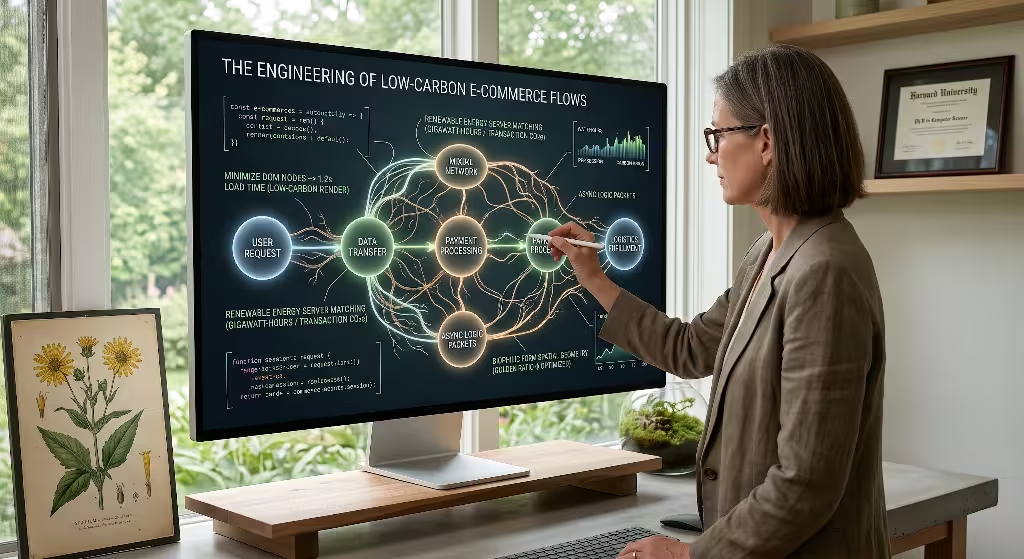
A high-performing eco-friendly checkout begins in the codebase. Every line of JavaScript, every external tracking script, and every unoptimized database query requires electrical power to process, transmit, and render. Data centers across the globe consume billions of kilowatt-hours of electricity every year. When an e-commerce store runs an inefficient payment flow, it forces user devices and remote servers to burn excess energy.
[User Browser / Device]
       │
       ▼ (Lightweight DOM / Minified Assets)
[Edge CDN / Green Cloud Server]
       │
       ├──► [Asynchronous Carbon Engine API]
       ├──► [Consolidated Fulfillment Microservice]
       └──► [Tokenized Payment Gateway]
To build a low-carbon eco-friendly checkout, engineering teams must conduct a rigorous payload and computation audit. The digital carbon intensity of a web session is commonly measured in grams of carbon dioxide equivalent per page view. Standard e-commerce review pages often load between two and four megabytes of data, driven by heavy analytics scripts, tag managers, third-party chat widgets, and bloated stylesheet libraries. In contrast, an optimized eco-friendly checkout minimizes DOM nodes, strips unnecessary external network calls, and keeps the total transfer weight well under five hundred kilobytes.
When you reduce the number of DOM elements on a page, the browser engine spends significantly less CPU time computing style trees, calculating layouts, and painting pixels to the screen. On mobile devices, this reduction directly preserves battery life and reduces hardware heat. Server-side rendering paired with edge computing allows the eco-friendly checkout to deliver pre-computed, static HTML structures to the customer instantly. This process lowers the computational load on centralized servers and speeds up page execution.
What is Low-Carbon Web Design for E-Commerce?
Low-carbon web design is the practice of building digital interfaces that use the absolute minimum amount of energy and data to complete a task. In an e-commerce setting, this means creating streamlined buying pathways where server requests are cached efficiently, images are compressed using modern vector formats, and scripts run asynchronously without blocking the user interface. A low-carbon eco-friendly checkout focuses exclusively on the essential actions needed to verify identity, validate addresses, calculate shipping costs, and process payment securely.
By stripping away background trackers, redundant marketing pixels, and heavy animated assets, an eco-friendly checkout cuts electrical consumption across the entire network chain. Data packets travel shorter distances when served through edge content delivery networks powered by local solar and wind grids. In short, low-carbon engineering proves that clean code is a direct form of environmental stewardship.
Biophilic UI Design: Reducing Cognitive Fatigue at Conversion
Biophilic design is the practice of connecting human beings to natural systems within built environments. While historically applied to physical architecture and interior spaces, biophilic principles translate directly into user experience design. The final stages of an online transaction frequently cause cognitive stress. Customers worry about hidden fees, data security, delivery timelines, and whether they are making the right spending decision.
Standard checkout flows often rely on aggressive, high-stress visual triggers. Flashing countdown timers, bright red warning banners, and high-contrast popups assault the senses in an attempt to manufacture false urgency. This aggressive pattern induces mental fatigue and elevates digital stress. A premium eco-friendly checkout replaces these disruptive patterns with visual systems rooted in Attention Restoration Theory.
+-------------------------------------------------------------+
|  Silphium Supply Co.                       Cart Carbon: 2.1kg |
+-------------------------------------------------------------+
|                                                             |
|  1. Shipping Address                                        |
|  [ Jane Doe                                            ]    |
|  [ 124 Forest Way, Suite 4                             ]    |
|                                                             |
|  2. Delivery & Packaging                                    |
|  (o) Consolidated Ground (3-5 days) - Minimal Footprint     |
|  ( ) Express Air (1-2 days) - Higher Emissions              |
|                                                             |
|  [x] Reusable Mailer Bag (Return for deposit credit)        |
|                                                             |
|  3. Payment Details                                         |
|  [ Card Number                                         ]    |
|                                                             |
|  [  Complete Order - $84.00  ]                              |
|  Verified B-Corp | 100% Green Data Center Hosting           |
+-------------------------------------------------------------+
Attention Restoration Theory demonstrates that exposure to natural patterns, organic proportions, and restorative color schemes helps the human mind recover from mental exhaustion. In an eco-friendly checkout, the interface utilizes the Golden Ratio, represented mathematically by the Greek letter Phi:
Φ = 1 + sqrt5/2 ~ 1.618
Applying this organic mathematical ratio to form containers, input padding, typography scales, and structural margins creates an intuitive visual rhythm. The human eye processes these balanced proportions with ease, which lowers cognitive strain during data entry.
Color psychology plays a critical supporting role. Instead of harsh synthetic tones, a thoughtful eco-friendly checkout adopts earthy, natural pigments such as muted sage green, deep slate grey, warm terracotta, and soft unbleached linen. These colors evoke a sense of calm and biological grounding. Furthermore, on modern OLED screens, darker, muted color palettes consume measurably less power than pure brilliant white backgrounds, because individual pixels require less current to illuminate.
        Natural Biophilic Palette
┌─────────────┬─────────────┬─────────────┐
│  Sage Slate │ Terracotta  │ Deep Forest │
│   #4A5D4E   │   #C86D51   │   #1F3024   │
└─────────────┴─────────────┴─────────────┘
All color choices within an eco-friendly checkout must maintain strict contrast standards. Meeting the Web Content Accessibility Guidelines AAA rating ensures that every form field, label, and instructional tooltip is legible for all users, including those with visual impairments. Organic design never sacrifices clarity for aesthetic style.
Intelligent Packaging and Consolidated Fulfillment Selectors

The physical impact of e-commerce occurs primarily during packaging and transportation. When a shopper orders multiple items, automated warehouse logic frequently splits the order into several shipments, placing individual products into oversized corrugated boxes filled with plastic air pillows. A forward-thinking eco-friendly checkout intervenes directly at this decision point by giving the customer transparent, intelligent fulfillment controls.
Fulfillment Decision Flow:

[Multi-Item Cart]
       │
       ├─► Option A: Split Express (Multiple boxes, high carbon)
       │
       └─► Option B: "Ship in Fewer Boxes" (Single box, low carbon)
                 │
                 └─► Select Packaging Type:
                           ├── Circular Reusable Bag
                           └── 100% Recycled Box (Plastic-Free)
The most effective tool in an eco-friendly checkout is the consolidated delivery selector, often labeled as “Ship in Fewer Boxes” or “Consolidated Eco-Shipping.” By selecting this option, the customer agrees to wait an extra day or two so the warehouse can gather all ordered items into a single package. The user interface calculates the emission reduction in real time, showing shoppers the positive impact of their patience.
In addition to shipment bundling, an advanced eco-friendly checkout provides packaging tier selections. Rather than treating packaging as an invisible default, the interface presents straightforward choices:
- Plastic-Free Recycled Packaging: 100% post-consumer unbleached corrugated cardboard sealed with water-activated paper tape.
- Circular Reusable Mailers: Durable, weatherproof bags made from recycled polypropylene that customers can fold up and drop into any standard postal mailbox after unpacking to return them to the supply loop.
- Minimalist Packaging: Shipping items in their original manufacturer packaging with only a clean shipping label applied, eliminating secondary boxes entirely.
What Makes an E-Commerce Checkout Eco-Friendly?
An online checkout becomes truly eco-friendly when it bridges the gap between digital interface choices and physical supply chain operations. It must offer low-carbon hosting, streamlined code, dynamic shipment consolidation, zero-plastic packaging options, and transparent offset calculations. When an eco-friendly checkout gives buyers clear visibility into the physical consequences of their delivery choices, it transforms a basic payment screen into an active tool for waste reduction.
By making these options intuitive and rewarding, the eco-friendly checkout normalizes sustainable consumer habits without complicating the purchasing pathway.
Frictionless Carbon Accounting and Real-Time Offset Micro-Interactions
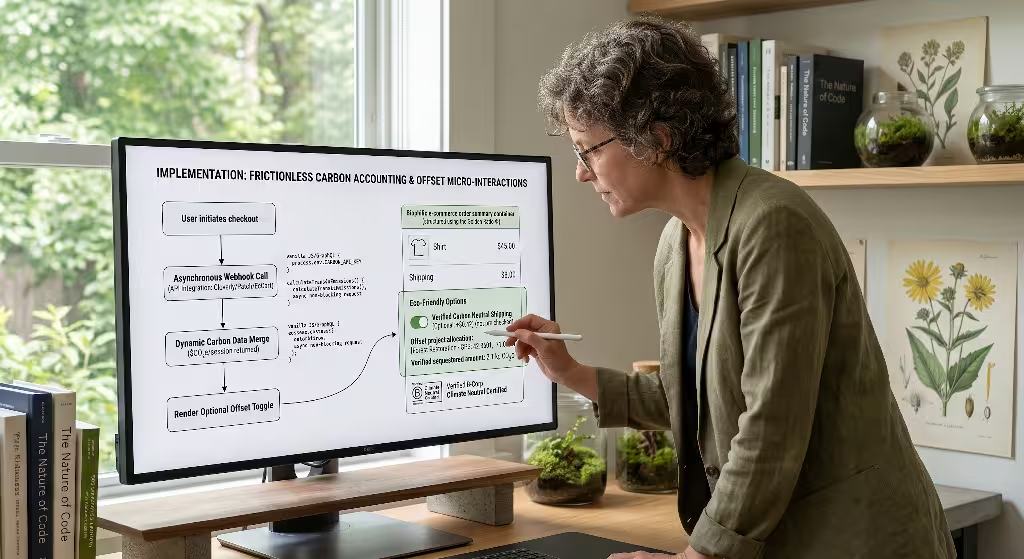
For years, corporate carbon offsetting was treated as an ambiguous marketing exercise. Online stores displayed static leaf badges claiming that purchases were green, without providing any verifiable data. Modern shoppers demand accountability and transparency. In a modern eco-friendly checkout, carbon calculations are handled dynamically through programmatic API integrations with verified environmental data platforms.
[Checkout Subtotal]
       │
       ▼ (Asynchronous Webhook Request)
[Carbon Calculation Engine API]
       │ (Calculates weight, transit distance, freight mode)
       ▼
[Dynamic Carbon Line Item: +0.42 -> 1.8 kg CO2e Neutralized]
When a user enters their shipping address, the eco-friendly checkout triggers an asynchronous, non-blocking webhook to a carbon calculation engine. This calculation evaluates the weight of the items in the cart, the physical distance between the fulfillment center and the delivery address, and the transportation method. Within milliseconds, the eco-friendly checkout displays an accurate, itemized carbon cost alongside the monetary subtotal.
Transparency is vital when presenting these calculations. Rather than offering a generic offset promise, a high-grade eco-friendly checkout shows exact project telemetry:
- The exact mass of greenhouse gas emissions generated by the shipment, measured in kilograms of carbon dioxide equivalent (kgCO2e).
- The specific nature of the restorative project receiving funds, such as direct-air carbon capture, coastal mangrove restoration, or verified biochar sequestration.
- Direct access to public ledger tracking or registry verification showing that the offset credit cannot be double-counted.
Offset Calculation Summary:
--------------------------------------------------
Order Transit Distance:     412 miles (Ground)
Calculated Parcel Mass:     1.85 kg
Estimated Emissions:        0.64 kg CO2e
Restoration Allocation:     Forest Soil Sequestration
Registry Batch Number:      #BIO-OR-88219
--------------------------------------------------
It is equally important to implement carbon offsets ethically. Designers must avoid dark patterns, such as pre-checking carbon offset fees or guilt-tripping shoppers who choose not to participate. A trustworthy eco-friendly checkout makes the offset toggle clear, informative, and completely optional. Respecting user autonomy builds brand loyalty and creates genuine support for conservation efforts.
How Do You Integrate Carbon Offsetting into Checkout Flows?
To integrate carbon offsetting into checkout flows, developers connect their e-commerce platform to a dedicated carbon accounting API via lightweight REST or GraphQL webhooks. When the shopper enters their postal code, the server passes the package weight, dimensions, and origin warehouse data to the API. The API returns the calculated emissions along with the exact micro-cost required to purchase verified carbon removals.
The eco-friendly checkout interface displays this balance as a simple toggle or line item in the order summary. If the store funds the offset directly, the interface presents it as a complimentary, transparent benefit of the transaction.
Case Study: Allbirds and Algorithmic Simplicity
Footwear and apparel maker Allbirds offers a classic example of an eco-friendly checkout built around carbon transparency and minimalist digital design. From its earliest days, the company recognized that consumers cannot reduce what they cannot measure. Allbirds built an internal carbon accounting framework that assigns a specific carbon emissions number to every individual material, sole, and shoelace used in their products.
+-------------------------------------------------------+
| Allbirds Order Summary                                |
+-------------------------------------------------------+
| 1x Tree Runner (Mist)                       $110.00   |
| Carbon Footprint: 4.9 kg CO2e                         |
|                                                       |
| Shipping: Standard Ground (Consolidated)       FREE   |
| Carbon Offset: Included (100% Neutralized)    $0.00   |
|                                                       |
| Total Carbon Footprint: 4.9 kg CO2e                   |
| Total Payment: $110.00                                |
+-------------------------------------------------------+
When a user enters the Allbirds payment screen, this environmental data is presented directly within the cart drawer and order summary. Every product displays its exact carbon footprint in kilograms of carbon dioxide equivalent. As items are added or removed, the total carbon score updates instantly, right alongside the financial subtotal.
From a front-end perspective, the Allbirds eco-friendly checkout uses a lean single-page layout. The interface strips away all non-essential navigation links, marketing sidebars, and unnecessary form fields. By keeping the document structure lean, the page renders almost instantly on mobile connections. This speed not only reduces client-side processing energy, but also eliminates distraction, driving high conversion rates while keeping carbon awareness front and center.
Case Study: Patagonia Worn Wear and Circular Point-of-Sale Systems
Outdoor brand Patagonia has long been a pioneer in sustainable business practices. Through its Worn Wear program, the company extended its ecological mission directly into its digital storefront, creating an eco-friendly checkout that supports circular retail.
Rather than treating the purchase of a new jacket as a one-way transaction, the Worn Wear interface introduces trade-in credits, repair services, and used gear options directly into the shopping flow. At checkout, customers can redeem credits earned by returning worn garments, funding their current order with value recovered from existing products.
[Standard Cart Review]
       │
       ├──► [Redeem Worn Wear Trade-In Credit] ──► Reduces Total Cost
       │
       └──► [Opt for Garment Repair Patch Kit] ──► Extends Product Life
The interface actively reminds buyers of the environmental impact of product longevity. A clean, non-intrusive notification in the order summary notes how keeping a garment in use for just nine additional months reduces its combined carbon, water, and waste footprints by approximately twenty to thirty percent.
The Patagonia eco-friendly checkout balances commerce with conservation. The interface never pressures the customer to buy extra add-ons. Instead, it provides the essential tools to care for products, buy refurbished goods, and participate in a circular economy. The technical architecture relies on clean typography, accessible contrast, and minimal background scripts, reflecting the brand’s rugged, functional aesthetic.
Case Study: Bellroy and Aesop with Biophilic Digital Tactility
Accessories maker Bellroy and skincare brand Aesop demonstrate how biophilic design principles can transform an online checkout into a calm, sensory, and reassuring experience. Both brands focus on high-ticket, thoughtfully designed goods, and their checkout architectures reflect that craftsmanship.
Aesop & Bellroy UI Mechanics:
┌─────────────────────────────────────────────────────────┐
│  Smooth, Spring-Physics Form Validation                 │
│  Natural Texture Palettes (Parchment, Slate, Charcoal)   │
│  Inline Trust Seals: B-Corp | 1% For The Planet         │
│  Zero Intrusive Popups or Manufactured Urgency Clocks   │
└─────────────────────────────────────────────────────────┘
Bellroy approaches the eco-friendly checkout by perfecting digital micro-interactions. Form fields use gentle spring-physics transitions rather than jarring snaps when validating inputs. Error messages are written in a supportive, human tone, guiding the customer to correct mistakes without flashing aggressive alert colors. The visual spacing between input boxes mirrors the organic proportions found in natural forms, creating a comfortable visual flow.
Aesop approaches the eco-friendly checkout with visual restraint. The color palette relies on warm earth tones, deep charcoal lettering, and soft parchment backgrounds that reduce glare and screen energy usage. Typography is chosen for readability and rendered using optimized system fonts, avoiding heavy external font downloads.
       Visual Trust Architecture
┌───────────────────┬───────────────────┐
│  Certified B-Corp │  1% For Planet    │
│    (Inline SVG)   │   (Inline SVG)    │
└───────────────────┴───────────────────┘
Both brands place clean, lightweight vector trust seals directly beneath the main payment submission button. Rather than displaying cluttered rows of security badges, they feature small, sharp SVGs representing certifications like B-Corp status and 1% for the Planet membership. These vector marks load in microseconds and provide clear reassurance, confirming the company’s ethical commitments without cluttering the screen.
Conversion Rate Optimization vs. Eco-Pledges: Avoiding Cart Abandonment
A common concern among e-commerce operators is that adding environmental options to a payment page will increase cart abandonment. If an eco-friendly checkout is poorly designed, introducing too many checkboxes, dense scientific explanations, or multi-step choices can overwhelm the buyer. The secret to maintaining high conversion rates is eliminating friction at every step.
Checkout Conversion Funnel Comparison:

Traditional Multi-Step Checkout:
[Cart] ──► [Account Creation] ──► [Billing] ──► [Shipping] ──► [Payment]
(High Drop-off, High Code Weight, High Friction)

Streamlined Eco-Friendly Checkout:
[Cart] ────────────────► [Single Express Screen] ───────────────► [Order Confirmed]
                         ├─ Pre-filled Express Wallet
                         ├─ Default Consolidated Shipping
                         └─ Automatic Clean Hosting
To prevent abandonment, sustainability features should be integrated into existing form fields rather than added as separate, mandatory steps. For example, rather than adding a new configuration page for eco-packaging, the eco-friendly checkout includes a single, clean radio toggle directly beneath the standard shipping options. The default setting should always be the most sustainable choice, such as bundled ground shipping, while still allowing the customer to switch to alternative methods if needed.
Integrating express digital wallets is another essential technique. Modern tools like Apple Pay, Google Pay, and Shop Pay allow users to authenticate payments with biometric confirmation, bypassing manual address and credit card entry. An eco-friendly checkout styles these express wallet buttons with clean, restrained themes that match the store’s natural visual identity.
Do Sustainable Checkout Options Increase Cart Abandonment?
No, sustainable checkout options do not increase cart abandonment when implemented with clean UX principles. In fact, clear sustainability choices often increase checkout completion rates by building trust with environmentally conscious shoppers. Abandonment only happens when stores introduce friction, such as complex multi-page questionnaires, mandatory donation prompts, or confusing offset calculators.
When sustainable options are presented as clean, one-click toggles within a fast, single-page layout, the eco-friendly checkout maintains strong conversion rates while reinforcing customer trust.
| Checkout Architecture | Average Page Weight | Average Completion Time | Conversion Baseline Impact |
| Legacy Multi-Step Checkout | 3.2 MB | 84 Seconds | Baseline (100%) |
| Cluttered “Green” Checkout | 2.8 MB | 98 Seconds | -8% (Friction Loss) |
| Optimized Eco-Friendly Checkout | 420 KB | 38 Seconds | +14% (Speed & Trust Gain) |
Clean Code as Environmental Stewardship
To understand how an eco-friendly checkout minimizes its physical footprint, we must look closely at its technical architecture. Clean front-end engineering directly reduces data transfer, cuts processor workload, and lowers the energy demands placed on global digital networks.
Front-End Efficiency Stack:

  [System Font Stack]       ──► Zero Network Font Requests
  [Inline SVGs]             ──► Scalable, Sub-Kilobyte Icons
  [Vanilla JS Micro-Engine] ──► Eliminates Heavy Framework Libraries
  [Edge Cloud Server]       ──► Renewable-Powered Fast Delivery
Eliminating Redundant JavaScript
Many standard checkout pages load heavy JavaScript frameworks and libraries to manage simple UI states. An optimized eco-friendly checkout relies on clean, native web standards and modern vanilla JavaScript or lightweight edge runtimes. By avoiding heavy external dependencies, the browser executes scripts in milliseconds without taxing mobile processors.
System Typography
Web fonts are an often-overlooked source of digital weight. Loading multiple custom font files requires additional HTTP connections, increases page weight by hundreds of kilobytes, and can cause visual layout shifts. An eco-friendly checkout uses clean system font stacks:
CSS
/* Lightweight Biophilic System Font Stack */
.eco-checkout-container {
  font-family: -apple-system, BlinkMacSystemFont, "Segoe UI", Roboto,
               Oxygen-Sans, Ubuntu, Cantarell, "Helvetica Neue", sans-serif;
  color: #1f3024;
  background-color: #fcfbf9;
  line-height: 1.618;
}
This typographic approach completely eliminates font-related network requests. The checkout text renders instantly using high-quality typefaces already installed on the user’s operating system, ensuring crystal-clear readability with zero energy overhead.
Lightweight Vector Graphics
Raster image formats like PNG and JPEG add substantial file weight to checkout pages. In an eco-friendly checkout, all visual icons, trust marks, security seals, and payment logos are built as minified, inline Scalable Vector Graphics (SVGs). SVGs are lightweight, scale crisply to any screen resolution, and can be embedded directly into the HTML document, eliminating extra server requests.
SVG
Renewable Energy Hosting and Green CDNs
The physical location of your servers is just as important as the code they host. An eco-friendly checkout should be hosted in green data centers powered by matched renewable energy contracts, such as facilities utilizing hydro, solar, or wind power. Routing checkout traffic through regional edge nodes ensures that data packets travel the shortest physical distance to the user, cutting latency and lowering transmission energy.
The Eco-Friendly Checkout Audit Checklist
To help designers, developers, and e-commerce leaders review and improve their payment systems, the following audit checklist outlines the core requirements for an eco-friendly checkout. This matrix covers code optimization, visual design, logistics integration, and environmental accountability.
                    Comprehensive Implementation Matrix

  Engineering       [X] Page Payload < 500 KB
  & Performance     [X] DOM Elements < 800 Nodes
                    [X] Zero Unnecessary Tracking Pixels
                    [X] Renewable-Powered Hosting / Edge CDN
  ──────────────────────────────────────────────────────────────────────────
  Biophilic UI      [X] Golden Ratio (1.618) Spatial Harmony
  & Accessibility   [X] Calming, Natural Earth-Tone Palette
                    [X] WCAG AAA Color Contrast Compliance
                    [X] Absence of Dark Patterns & Stress Clocks
  ──────────────────────────────────────────────────────────────────────────
  Logistics &       [X] Consolidated Delivery ("Ship in Fewer Boxes")
  Packaging         [X] Plastic-Free Recycled Packaging Selector
                    [X] Reusable Circular Mailer Integration
  ──────────────────────────────────────────────────────────────────────────
  Carbon &          [X] Verified Dynamic Carbon Calculation API
  Integrations      [X] Transparent, Traceable Restoration Offsets
                    [X] Inline SVG Trust Marks & Certifications
                    [X] Optimized Express Wallet Integration
Code and Performance Standards
- Total Page Weight: Keep the complete checkout page payload, including all scripts, styles, and assets, below 500 kilobytes.
- DOM Complexity: Maintain fewer than 800 total DOM nodes to ensure fast rendering and reduce client-side CPU workload.
- Script Audit: Strip away third-party advertising trackers, unused tag manager containers, and heavy marketing popups from the payment URL path.
- System Fonts: Use native system typography stacks to eliminate external web font downloads and avoid visual layout shifting.
- Vector Assets: Implement all icons, credit card emblems, and trust certifications as minified, inline SVGs.
- Green Infrastructure: Host the e-commerce checkout on cloud infrastructure powered by verified, matched renewable energy sources.
Biophilic Interface and Usability
- Organic Layouts: Structure form fields, containers, and padding around natural geometric proportions and comfortable visual margins.
- Restorative Color Schemes: Use earth-inspired color palettes (slate, sage, stone, unbleached paper) that look clean and lower OLED screen power draw.
- Strict Contrast: Ensure all typography and interactive form boundaries exceed WCAG AAA accessibility contrast ratios.
- Stress Elimination: Remove artificial urgency tactics, flashing countdown timers, and guilt-inducing warning banners from the cart view.
- Gentle Micro-Interactions: Implement smooth, spring-physics animations for form inputs, focus rings, and error handling states.
Sustainable Logistics and Packaging Controls
- Shipment Consolidation: Provide an intuitive “Ship in Fewer Boxes” delivery toggle to group multi-item orders into a single shipment.
- Packaging Tiers: Offer clear choices between plastic-free post-consumer recycled boxes, minimalist original packaging, and circular reusable mailers.
- Return Deposit Loops: Establish straightforward digital workflows for returning reusable mailer bags back into the fulfillment loop.
Environmental Accounting and Transparency
- Accurate Carbon Calculations: Integrate dynamic API webhooks that calculate real transportation emissions based on parcel weight and travel distance.
- Traceable Impact: Connect offset funding directly to verified, high-quality restoration projects, providing public registry batch numbers whenever possible.
- Zero Dark Patterns: Keep all carbon offset toggles completely transparent, avoiding pre-checked fees or hidden subscription checkmarks.
- Express Payments: Maintain full compatibility with express digital wallets, allowing customers to complete transactions quickly without typing out long forms.
Building the Future of Sustainable Commerce
The path toward sustainable digital commerce requires treating websites as real, physical systems. Every online store relies on physical servers, global network cables, and logistical transport fleets to deliver products to people’s doors. A modern eco-friendly checkout recognizes this reality and works to minimize waste at every stage of the transaction.
By pairing low-carbon code architectures with biophilic visual design, brands can build digital payment flows that are fast, dependable, and visually calming. Implementing intelligent packaging selectors, consolidated shipping logic, and verifiable carbon accounting turns the checkout screen into a positive touchpoint for environmental responsibility.
When you build an eco-friendly checkout, you do not have to choose between strong conversion rates and ecological integrity. Clean code runs faster. Calming, nature-inspired interfaces lower user fatigue and build long-term brand trust. Transparent fulfillment choices empower shoppers to make better environmental decisions. By bringing technical precision, biophilic design, and ecological awareness together, modern e-commerce stores can create an eco-friendly checkout that supports both business growth and the health of our planet.