
Table of Contents
When we think about environmental pollution, we often picture smoke billowing from factory chimneys, plastic floating in ocean currents, or lines of gas-powered cars stuck in traffic. Very few people look at their laptop screen, open a web browser, and picture an energy grid burning fossil fuels. Yet, every single click, search, download, and page load demands physical electricity from massive server farms, transcontinental fiber optic cables, and local network routers.
For non-profit organizations dedicated to conservation, social justice, and humanitarian aid, this creates an unspoken paradox. Many charities spend countless hours fighting for ecological health while running digital systems that quietly consume vast amounts of electrical power. The internet currently accounts for roughly 4% of global greenhouse gas emissions, a footprint larger than the commercial aviation industry. Going beyond the internet, nowadays, we also have the impacts of data centers related to AI as well.
Solving this digital footprint requires a new way of building digital tools. This guide explores the core principles of low carbon web architecture, explaining how non-profits can cut digital waste, slash hosting costs, and build high-speed websites that respect both nature and human attention.
The Hidden Cost of Digital Infrastructure
The Digital Carbon Footprint Problem
Every website lives on a physical computer called a server. When a visitor loads a web page, that server has to wake up, process complex code, pull data from a database, and send data packets across thousands of miles of wire to the visitor’s screen.
[User Browser Request]
       │ (Data transfer over network routers)
       ▼
[Edge / Origin Server] ──► [CPU Execution] ──► [Database Query]
       │                                              │
       ◄──────────────── [Compiled Data Packet] ◄──────┘
This entire pipeline demands electrical power at every step:
- The Data Center: Electricity powers the processors, storage drives, memory, and cooling systems needed to keep servers from overheating.
- The Transmission Network: Underground and subsea cables, mobile cell towers, and home Wi-Fi routers consume constant power to route information.
- The End-User Device: The visitor’s smartphone, tablet, or desktop computer consumes battery or wall power to decode files and illuminate the screen.
When a non-profit operates a heavy, unoptimized website, it forces every visitor’s device and every network router along the way to work harder than necessary. If a charity site attracts 100,000 visitors per month and sends heavy files on every page load, it can produce hundreds of kilograms of carbon dioxide every year. For an organization working to protect wildlife or combat climate change, this invisible pollution works directly against its core mission. Adopting low carbon web architecture provides a clear path to eliminate this hidden ecological debt.
The Definition of Low Carbon Web Architecture
What is low carbon web architecture for non profits? In technical terms, low carbon web architecture is a holistic engineering and design methodology that reduces the total kilowatt-hours of electricity required to build, host, deliver, and view a website.
Rather than relying on brute-force computing power, low carbon web architecture focuses on structural efficiency. It replaces heavy database lookups with lightweight, pre-built pages. It strips out unnecessary software scripts, minimizes data payloads, uses renewable-powered edge servers, and designs interfaces that load instantly.
┌─────────────────────────────────────────────────────────────┐
│             Low Carbon Web Architecture Model               │
├──────────────────────────────┬──────────────────────────────┤
│  Pre-Rendered Code (SSG)     │  Static HTML / Lean Assets   │
│  Renewable Edge Hosting      │  Zero Database Queries       │
│  Biophilic User Flow         │  Minimal Energy per Visit    │
└──────────────────────────────┴──────────────────────────────┘
By applying low carbon web architecture, an organization can reduce its digital carbon emissions by 60% to 80% per page view while simultaneously creating a faster, safer, and more accessible user experience.
The Intersection of Ecology and Architecture: The Biophilic Angle
In the natural world, living organisms survive through biological economy. A leaf does not waste surface area; it arranges its cells to gather sunlight with maximum photosynthetic efficiency. A tree does not build unnecessary wood; it distributes nutrients through vascular channels designed to minimize fluid resistance. Nature builds systems where form and function work together without excess waste.
In traditional physical architecture, masters like Frank Lloyd Wright spoke of organic design, where buildings emerge naturally from their environment rather than dominating it. Digital systems must learn this same lesson.
When we design websites using low carbon web architecture, we apply this biophilic principle directly to computer science. Code should not be bloated, redundant, or confusing. By stripping away digital waste and honoring structural elegance, low carbon web architecture creates a digital ecosystem that mirrors the balance, efficiency, and beauty of natural living systems.
Traditional Monoliths vs. Low Carbon Web Architecture
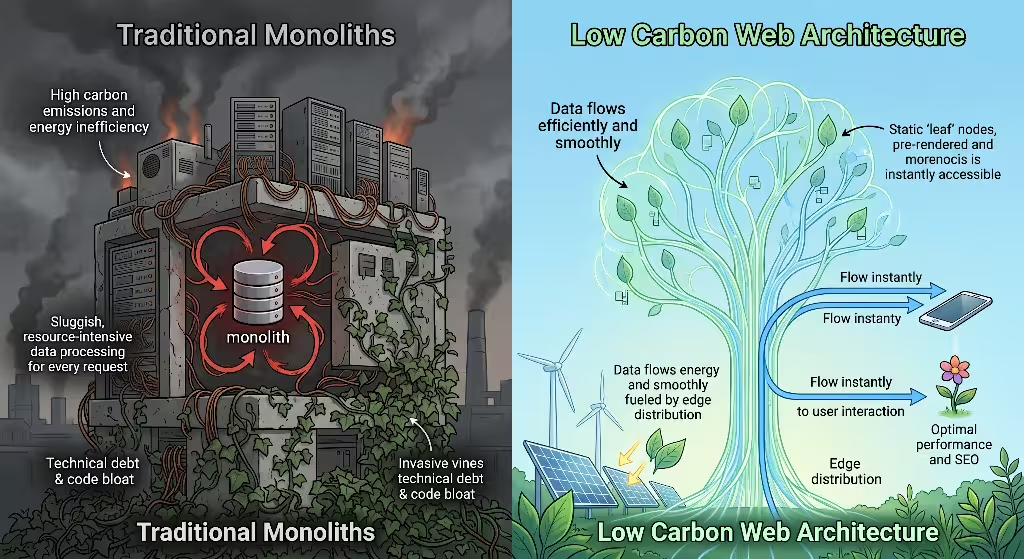
To understand the benefits of low carbon web architecture, we must examine how standard websites operate compared to lean, modern frameworks.
| Architectural Layer | Legacy Dynamic CMS (e.g., Standard WordPress) | Modern Low Carbon Web Architecture |
| Server Computation | Executes PHP scripts and SQL queries for every visitor | Serves pre-built, flat HTML files directly from memory |
| Energy Consumption | High CPU cycles per request, requiring active cooling | Near-zero server compute at runtime |
| Payload Delivery | Large uncompressed images, unused CSS, heavy plugins | Tree-shaken bundles, modern formats (AVIF, WebP), lean code |
| Hosting Energy Grid | Often powered by standard fossil-fuel grid mixes | Powered by verified 100% renewable energy providers |
| Average Carbon / View | 0.80 grams to 1.80 grams of CO2 | Less than 0.15 grams to 0.25 grams of CO2 |
| Page Speed & TTLB | 1.5 to 4.0+ seconds Time to First Byte | Under 200 milliseconds globally via edge cache |
Why Dynamic Server Calls Waste Energy
Most non-profit websites run on traditional dynamic Content Management Systems (CMS). When a donor clicks on a dynamic web page, the host server must assemble that page from scratch:
[Visitor Clicks Link]
        │
        ▼
[Web Server Starts Process Engine]
        │
        ▼
[Executes Multiple PHP Scripts]
        │
        ▼
[Sends Queries to MySQL Database]
        │
        ▼
[Database Gathers Data & Sends Back]
        │
        ▼
[Server Assembles HTML & CSS File]
        │
        ▼
[Data Sent Back to Visitor]
If five hundred people visit that page at the exact same moment, the server performs those calculations five hundred separate times. This causes server processors to run at high temperatures, consuming heavy electrical wattage and requiring continuous air conditioning in the data center.
This dynamic process is largely unnecessary. Most non-profit pages, such as “About Us”, mission statements, educational articles, and campaign updates, do not change every second. Rebuilding the exact same page hundreds of times an hour is computational waste. Low carbon web architecture eliminates this cycle by changing how pages are compiled and delivered.
Decoupled and Static Architectures (JamStack)
Low carbon web architecture solves server bloat by using static site generation (SSG) and decoupled architectures, commonly known as the Jamstack.
Instead of generating a web page when a visitor asks for it, a static site generator builds the entire website ahead of time. When an editor publishes an article, the system generates clean, flat HTML, CSS, and image files once.
[Editor Publishes Content] ──► [Build Engine Runs Once] ──► [Flat Static HTML Files]
                                                                     │
                                                                     ▼
[User A] ◄────────────── [Edge CDN Delivery (Zero Compute)] ◄────────┴──────► [User B]
When a visitor navigates to the website, the server simply hands them the pre-made file. There are no database queries, no server-side script executions, and no wasted processor cycles.
By removing database overhead, low carbon web architecture allows non-profits to host their digital platforms on lightweight edge networks. This approach drastically lowers the energy needed to run the website while making it nearly immune to common database security hacks.
Main Pillars of Low Carbon Web Engineering
Building an effective platform using low carbon web architecture requires three core technical pillars: clean hosting, asset optimization, and intelligent network delivery.
       ┌────────────────────────────────────────────────────────┐
       │     Pillars of Low Carbon Web Architecture             │
       └───────────────────────────┬────────────────────────────┘
                                   │
         ┌─────────────────────────┼────────────────────────┐
         ▼                         ▼                        ▼
┌──────────────────┐     ┌──────────────────┐     ┌──────────────────┐
│  Renewable Edge  │     │  Payload & DOM   │     │ Caching & Transit│
│  Infrastructure  │     │   Optimization   │     │    Strategies    │
└──────────────────┘     └──────────────────┘     └──────────────────┘
Renewable Edge Infrastructure and Hosting
The foundation of low carbon web architecture begins at the physical data center. However, not all green hosting claims represent true sustainability:
- Renewable Energy Certificates (RECs): Many hosting providers purchase offsets or certificates after running on fossil-fuel grids. While helpful, this does not eliminate direct, real-time emissions.
- Power Purchase Agreements (PPAs): High-standard green hosts match their real-time hourly energy usage with dedicated local solar, wind, or hydroelectric power plants.
- Power Usage Effectiveness (PUE): PUE measures how efficiently a data center uses energy. A score of 1.0 represents perfect efficiency, where all electricity goes directly to computing hardware rather than cooling fans or lighting. Modern green data centers achieve PUE ratings below 1.2.
When implementing low carbon web architecture, non-profits should verify their hosting providers through organizations like the Green Web Foundation. Selecting a host that runs on verified renewable energy ensures that whatever baseline energy the server consumes comes directly from clean sources.
Front-End Payload and DOM Optimization
Every kilobyte of data transferred across the internet requires electrical energy. Therefore, low carbon web architecture enforces a strict data budget, aiming to keep total page weights below 500 kilobytes.
Modern Image Formats
Images make up the largest portion of data on most non-profit websites. Low carbon web architecture replaces outdated JPEG and PNG files with modern image formats like AVIF and WebP.
File Size Comparison for High-Resolution Photograph:
Original JPEG:  [████████████████████████████████] 1,450 KB
Optimized WebP: [████████] 320 KB
Optimized AVIF: [████] 160 KB (89% Reduction in Data Payload)
In addition to using modern formats, low carbon web architecture applies native lazy loading (loading="lazy"). This attribute ensures that off-screen images do not download until the visitor scrolls down to view them, preventing wasted data for visitors who only read the top of a page.
Lean Typography and Font Subsetting
Custom web fonts often require users to download multiple heavy font files before text becomes readable. Low carbon web architecture streamlines typography through several practical techniques:
[Standard Web Font File] ──► Contains 1,000+ Glyphs (Cyrillic, Greek, Math Symbols) = 250 KB
                                          │
                                          ▼
[Subsetted Font File]   ──► Latin Alphabet + Basic Numbers Only = 18 KB
- System Fonts: Using clean system fonts (such as system-ui, Apple-system, or standard sans-serif stacks) requires 0 kilobytes of data transfer because the fonts already exist on the user’s device.
- Font Subsetting: If custom brand fonts are necessary, developers can strip out unused language characters and symbols, reducing font file sizes from 200 kilobytes down to less than 20 kilobytes.
- Self-Hosting Fonts: Storing font files locally avoids extra connection handshakes to external font servers.
Code Pruning and Tree-Shaking
Many non-profit platforms load entire JavaScript libraries just to run a simple photo gallery or mobile menu. Low carbon web architecture uses modern build tools to perform tree-shaking, a process that removes unused code before the website is published. By writing modular, vanilla JavaScript and lean CSS, low carbon web architecture keeps the Document Object Model (DOM) simple and fast.
Caching Strategies and Data Transit
The shortest distance for data to travel is no distance at all. Low carbon web architecture relies on intelligent caching rules to prevent repeat downloads:
First Visit:
[User Browser] <======= (Full Page Download from Edge CDN) ======= [Data Center]

Second Visit (Cached):
[User Browser] <--- (Loaded Instantly from Local Browser Cache) --- [Local Storage]
- Browser Caching: By configuring HTTP response headers (such as
Cache-Control: max-age=31536000, immutable), assets like logos, styles, and scripts remain stored on the visitor’s device. When they click to another page, their device reuses these local assets without requesting new data. - Content Delivery Networks (CDNs): A global CDN stores copies of static files on edge servers located close to users. When a donor in Boston visits the site, the files load from a local Massachusetts server rather than a distant facility across the country. Shorter transmission pathways reduce the electrical load on internet routing hubs.
Biophilic UX Design Meets Digital Efficiency
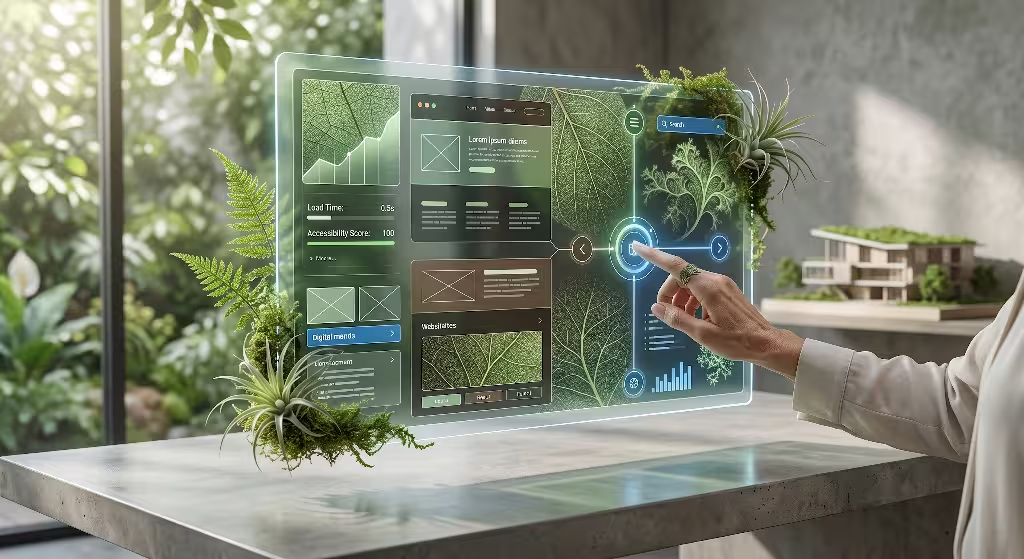
Visual design and sustainability are closely linked. An interface built on the principles of low carbon web architecture does not have to look plain or bare; rather, it uses visual hierarchy and natural harmony to create a frictionless experience.
┌─────────────────────────────────────────────────────────────┐
│             Biophilic Digital User Experience               │
├──────────────────────────────┬──────────────────────────────┤
│  Visual Clarity & White Space│  Natural, Earth-Toned Colors │
│  Zero Dark Patterns          │  Direct Navigation Paths     │
│  Reduced Visual Noise        │  Lower Screen Power Draw     │
└──────────────────────────────┴──────────────────────────────┘
Functional Minimalism as an Organic Discipline
In nature, an ecosystem thrives when energy flows without obstruction. Visual clutter on a website acts like debris in a stream: it slows the user down and forces their device to process unnecessary visual elements.
Low carbon web architecture uses functional minimalism. Every element on the page must serve a clear purpose for the visitor. By replacing auto-playing background videos, flashing banners, and invasive pop-ups with clear typography and natural white space, the website honors the user’s focus while saving computational energy.
Palette, Pixels, and Energy Consumption
The colors displayed on a screen directly influence how much electricity a device consumes, particularly on modern OLED and AMOLED displays found in millions of smartphones and laptops.
OLED Display Energy Characteristics:
Pure White Pixels (#FFFFFF): [████████████████████] (Maximum Backlight Power)
Natural Earth Tones:        [████████████] (Moderate Power)
Dark / Charcoal Pixels:     [████] (Low Power)
Pure Black Pixels (#000000):[ ] (Pixels Turned Completely Off = 0 mW)
On OLED screens, each pixel produces its own light. Displaying bright white backgrounds requires every sub-pixel to run at full brightness. Displaying dark grays, deep forest greens, rich earth tones, or soft charcoals draws noticeably less power.
Low carbon web architecture embraces color palettes inspired by the natural world. Implementing an automatic dark mode switch (prefers-color-scheme: dark) allows visitors to view the site using minimal display energy while reducing eye strain.
Information Architecture that Prevents Click Rot
Every time a user gets lost on a website, clicks the wrong link, and has to navigate back, they generate extra page views and server requests.
Confusing Navigation (3 Extra Page Requests):
[Home Page] ──► [Wrong Category] ──► [Back] ──► [Wrong Subpage] ──► [Target Article]

Streamlined Navigation (1 Direct Request):
[Home Page] ──────────────────────────────────────────────────────► [Target Article]
Low carbon web architecture emphasizes direct information architecture. When non-profits design intuitive menus, clear breadcrumbs, and fast search tools, donors find donation forms, volunteer signups, and campaign reports in fewer clicks. Streamlining the user journey protects the visitor’s time and prevents wasted transmission energy.
Measuring, Benchmarking, and Reporting Digital Emissions

To improve digital sustainability, an organization must be able to measure it. Low carbon web architecture gives non-profits clear metrics to evaluate and report their digital footprint.
Calculation Methodologies
Digital emissions are commonly calculated using the Sustainable Web Design (SWD) model. This framework evaluates four core factors:
Carbon per Page View = Data Transfer (GB) X Energy Intensity (kWh/GB) X Grid Carbon Factor X New Visitor Ratio
- Data Transfer per Visit: The total payload transferred during a page load, measured in gigabytes.
- Energy Intensity of Internet Data: The average electrical energy required to move one gigabyte of data across global networks (estimated at roughly 0.8 kWh per GB across data centers, networks, and devices).
- Carbon Intensity of Electricity: The amount of carbon dioxide produced per kilowatt-hour of energy based on local power grids (global average around 442g CO2/kWh).
- Caching Adjustments: Adjusting for returning visitors who load assets from local storage rather than making fresh network requests.
By using low carbon web architecture to lower data transfer from 3 MB down to 300 KB, an organization reduces the carbon formula’s base input by 90%.
Auditing and Benchmarking Toolset
Non-profits can evaluate their current systems using several free, reliable auditing tools:
┌─────────────────────────────────────────────────────────────┐
│                 Digital Sustainability Audit                │
├──────────────────────────────┬──────────────────────────────┤
│  Tool                        │  Core Metric Evaluated       │
├──────────────────────────────┼──────────────────────────────┤
│  Website Carbon Calculator   │  Grams of CO2 per page view  │
│  Ecograder                   │  Page weight & green hosting │
│  Google Lighthouse           │  Performance & Core Vitals   │
│  Browser Network Panel       │  Total transferred kilobytes │
└──────────────────────────────┴──────────────────────────────┘
- WebsiteCarbon.com: Provides a clear estimate of grams of CO2 produced per page load and compares the result against global averages.
- Ecograder.com: Analyzes resource efficiency, caching headers, and hosting source to produce an overall sustainability score.
- Google PageSpeed Insights / Lighthouse: While designed for performance, Lighthouse metrics (such as Largest Contentful Paint and Total Blocking Time) correlate directly with energy efficiency. A site scoring 95+ on Lighthouse performance is almost always executing low carbon web architecture effectively.
Aligning with Global Standards
Digital emissions fall under international greenhouse gas accounting frameworks:
- Scope 2 Emissions: Indirect emissions from the electricity purchased to power an organization’s owned office servers and computer equipment.
- Scope 3 Emissions: Indirect emissions generated across an organization’s broader value chain, including cloud hosting providers, third-party software services, and visitor traffic.
Furthermore, the World Wide Web Consortium (W3C) has developed the Web Sustainability Guidelines (WSG). These guidelines establish clear benchmarks for digital accessibility, energy consumption, and sustainable code. Embracing low carbon web architecture helps non-profits document concrete progress toward these global standards in their annual impact reports.
Non-Profit Implementation Roadmap (Low Budget, High Impact)
Transitioning to low carbon web architecture does not require a massive IT budget. Non-profits can roll out improvements in clear, manageable stages.
Phase 1: Zero-Cost Quick Wins (Weeks 1-2)
  ├── Compress media into WebP/AVIF formats
  ├── Turn on server-level Gzip / Brotli compression
  └── Audit and remove obsolete tracking pixels

Phase 2: Infrastructure Optimization (Weeks 3-6)
  ├── Connect DNS to a global edge CDN
  ├── Configure browser caching rules (30-day minimum)
  └── Migrate hosting to a verified green provider

Phase 3: Architecture Refactoring (Months 2-3)
  ├── Decouple front-end using Static Site Generation
  ├── Replace complex plugins with lean vanilla code
  └── Deploy zero-bloat, direct-API donation workflows
Step 1: The Third-Party Script Audit
The fastest way to reduce digital weight is to remove third-party tracking scripts. Many non-profit websites accumulate years of abandoned marketing tags, social media widgets, and multiple analytics trackers.
Common Third-Party Payload Weight:
Tracking Scripts & Ad Pixels: [████████████████] 450 KB
Embedded Social Feeds:         [████████████████████████] 680 KB
Live Chat Pop-up Engine:       [████████████████████████████] 820 KB
─────────────────────────────────────────────────────────────
Total Unnecessary Overhead:    1,950 KB (Nearly 2 Megabytes of Waste)
By replacing heavy multi-platform analytics packages with lightweight, privacy-focused alternatives (such as Plausible or Fathom, which weigh less than 2 kilobytes), a non-profit can instantly remove megabytes of code from every page load.
Step 2: Headless CMS and Static Site Transition
Non-profit staff members need an easy way to write blog posts, add campaign updates, and edit content without touching raw code. Low carbon web architecture supports this workflow through headless content management.
[Non-Technical Staff Editor]
             │ (Edits text in user-friendly dashboard)
             ▼
[Headless CMS (e.g., Decap, Sanity, Strapi)]
             │ (Triggers static build hook)
             ▼
[Static Site Generator (e.g., Astro, 11ty, Hugo)]
             │ (Pre-renders flat HTML)
             ▼
[Global Edge CDN (Zero Carbon Footprint)]
Editors work in a clean, intuitive visual dashboard. When they click save, the static site generator compiles the updates in the background. Donors view lightning-fast static pages, while the communications team enjoys the simplicity of a modern CMS.
Step 3: Lean Donation Flows
Fundraising is the lifeblood of any charitable organization. Unfortunately, many third-party donation widgets rely on heavy embedded frames (iframes) that load dozens of external scripts before a donor can even type their name.
Low carbon web architecture creates custom, direct-API donation interfaces using modern payment backends like Stripe Elements.
Legacy Donation Embed:
[Loads 14 External Scripts] ──► [Loads 3 Heavy iframes] ──► [High Carbon & Slow Load]

Low Carbon Web Architecture Donation Flow:
[Native HTML Form] ──► [Direct API Tokenization] ──► [Instant, Secure, Low Carbon]
A clean donation form loads instantly, keeps donors focused, and reduces transaction abandonment rates, directly supporting both fundraising goals and environmental efficiency.
Frequently Asked Questions about Low Carbon Web Architecture
How much CO2 does the average non-profit website produce?
The typical web page generates between 0.5 and 1.5 grams of CO2 for every single visit. If a non-profit website receives 50,000 visits per month, it produces between 300 and 900 kilograms of CO2 every year. If the platform uses uncompressed video headers or un-cached dynamic databases, that number can easily double. Adopting low carbon web architecture reduces that footprint down to less than 60 kilograms per year.
Does low carbon web architecture hurt website functionality or visual appeal?
No. Building a sustainable site does not mean creating a plain text document. Low carbon web architecture supports rich imagery, responsive layouts, smooth CSS animations, and full multimedia. The difference lies in engineering discipline: images are optimized, scripts are loaded only when needed, and code is compiled cleanly. The resulting websites look modern, feel responsive, and load noticeably faster.
What is the difference between green hosting and low carbon web architecture?
Green hosting refers exclusively to the energy source powering the server data center. Low carbon web architecture refers to the entire technical construction of the website itself.
Green Hosting:                  Low Carbon Web Architecture:
Focuses on WHERE energy comes   Focuses on HOW MUCH energy is needed
from (Solar, Wind, Hydro).      across servers, networks, and screens.
If a website is bloated, slow, and heavy, hosting it on green servers still wastes electricity across the transmission network and on the user’s phone. True digital sustainability combines verified green hosting with low carbon web architecture.
How does low carbon web architecture improve non-profit SEO and fundraising?
Search engines like Google rank websites based on speed and user experience through Core Web Vitals. Because low carbon web architecture removes computational bloat, static pages consistently earn top speed and accessibility scores, improving organic search visibility.
Furthermore, conversion studies show that every 100-millisecond delay in page load time reduces conversion rates. Fast, streamlined pages encourage donors to complete their gifts rather than leaving out of frustration with a slow-loading screen.
An Action Plan For Your Website
Digital sustainability is no longer an optional consideration for mission-driven organizations. As the world transitions toward cleaner energy and responsible resource use, our digital infrastructure must evolve to match our environmental values.
Low carbon web architecture offers a practical, proven engineering framework that aligns digital tools with ecological principles. By choosing renewable edge hosting, eliminating dynamic database waste, delivering lean assets, and designing biophilic user flows, non-profits can build an online presence that operates in harmony with nature.
       ┌────────────────────────────────────────────────────────┐
       │             The Sustainable Digital Future             │
       └───────────────────────────┬────────────────────────────┘
                                   │
         ┌─────────────────────────┼────────────────────────┐
         ▼                         ▼                        ▼
┌──────────────────┐     ┌──────────────────┐     ┌──────────────────┐
│  Lower Carbon    │     │   Higher Search  │     │ Greater Donor    │
│    Emissions     │     │     Rankings     │     │   Conversions    │
└──────────────────┘     └──────────────────┘     └──────────────────┘
At Silphium Design, we believe that web architecture should reflect the elegance, efficiency, and balance of living ecosystems. Embracing low carbon web architecture is not simply about cutting kilobytes; it is about building a faster, more accessible, and more ethical web for everyone. By taking practical steps today, your organization can turn its website into a powerful showcase for modern, low-impact innovation.