
Table of Contents
The modern online world can feel overwhelming. Every day, people look at glowing screens filled with stiff gray boxes, bright red alert badges, and flashing banners. Most websites look almost identical, using rigid grids and cold shapes that feel like concrete walls. This endless digital noise causes eye strain, mental fatigue, and stress. When people feel tired and overwhelmed by a screen, they click away. They close the browser tab, tune out the message, and forget the company behind it.
Smart companies are realizing that the old way of building digital brands is broken. To stand out and connect with real human beings, brands need a completely fresh approach. That fresh approach brings together two powerful forces: artificial intelligence and our natural human love for the living world. By studying how nature works and using smart computer systems to bring those lessons online, businesses can create digital spaces that feel alive, calming, and deeply memorable.
When you explore the benefits of AI and Biophilia in brand strategy, you discover a better way to design websites, apps, and digital campaigns. This guide will walk you through everything you need to know. You will learn the science behind human attention, how smart algorithms create natural visual patterns, how digital designs can adapt to the time of day, and how this strategy delivers real business growth. Combining AI and Biophilia is not a passing trend. It is the future of thoughtful, human centered brand strategy.
The Convergence of Synthetic Intelligence and Organic Form
To understand why this movement matters, we have to look at what each piece brings to the table. The word biophilia was popularized by biologist Edward O. Wilson. It describes an innate, biological bond that human beings share with nature and all living systems. For hundreds of thousands of years, humans lived outdoors among trees, rivers, shifting clouds, and rolling hills. Our eyes, brains, and nervous systems evolved to thrive in environments filled with natural sunlight, curved shapes, and gentle organic movements. We never evolved to stare at flat, unmoving rectangles under harsh blue light for ten hours every day.
When we are cut off from natural patterns, our stress levels rise. In offices and homes, people bring in indoor plants, open windows for fresh air, and hang landscape art because those elements make them feel grounded and calm. The exact same principle applies to digital spaces. When a website or an app mirrors the shapes, colors, and rhythms of the living earth, people instantly feel more relaxed, welcome, and focused.
This is where artificial intelligence enters the story. In the past, trying to make a digital brand feel truly alive was difficult and time consuming. Web designers had to hand draw static illustrations or film video clips, which often made websites heavy, slow to load, and hard to update. Artificial intelligence changes the game entirely. Modern algorithms can study millions of natural structures, such as the way water ripples across a pond or how leaves branch out from a stem. These algorithms can then generate light, flexible digital assets on demand.
When you unite AI and Biophilia, technology stops acting like a barrier between humans and the natural world. Instead, technology becomes a bridge. Through AI and Biophilia, software learns to speak the visual language of biology. The partnership of AI and Biophilia allows digital designers to build websites that feel less like cold machines and more like peaceful gardens. In brand strategy, embracing AI and Biophilia helps a company tell a cohesive story. The combination of AI and Biophilia shows customers that the company values human wellness, balance, and thoughtful innovation. By weaving AI and Biophilia into every customer touchpoint, modern brands can build meaningful relationships that last for years.
The Scientific Engine: Attention Restoration Theory and Computational Fluency
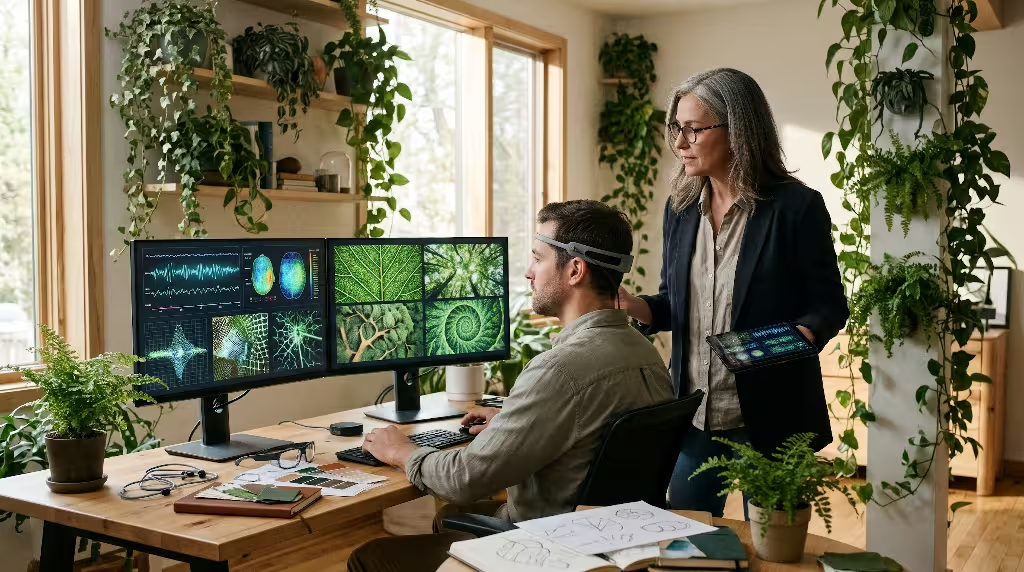
To build an effective brand, you have to understand how the human brain uses its energy. Decades ago, psychologists Rachel and Stephen Kaplan developed a powerful framework known as Attention Restoration Theory. They discovered that human attention falls into two main categories: directed attention and soft fascination. Understanding these two types of attention explains why the mixture of AI and Biophilia creates such dramatic improvements in digital engagement.
Directed attention is the mental muscle you use when you have to concentrate on a difficult task. When you balance a budget, read a dense contract, or search through a crowded digital store, your brain works hard to ignore distractions. This directed attention requires significant mental effort, and the prefrontal cortex of your brain quickly runs out of fuel. When your directed attention is depleted, you feel irritable, tired, and mentally drained. Most corporate websites demand heavy directed attention. They hit visitors with pop-up windows, competing buttons, and busy layouts that exhaust the user in seconds.
Soft fascination works in the exact opposite way. Soft fascination occurs when your mind takes in effortless, natural sights and sounds. Think about what happens when you watch ocean waves roll onto the shore, watch clouds drift across a blue sky, or watch sunlight flicker through tree leaves. Your mind does not have to struggle to understand those sights. You do not have to solve a puzzle. Instead, your brain enters a relaxed state of open awareness. This gentle stimulation allows your directed attention muscle to rest, recharge, and heal.
+-------------------------------------------------------------+
|               ATTENTION RESTORATION COMPARISON              |
+-------------------------------------------------------------+
| Directed Attention (Traditional UI)                         |
| - High mental strain and cognitive load                     |
| - Prefrontal cortex depletion and digital fatigue           |
| - Rigid grids, harsh contrast, intrusive pop-up windows     |
+-------------------------------------------------------------+
| Soft Fascination (AI and Biophilia Strategy)                |
| - Effortless processing and cognitive recovery              |
| - Calming visual engagement and prolonged dwell time        |
| - Natural fractals, organic easing, circadian color balance |
+-------------------------------------------------------------+
By bringing AI and Biophilia together, digital strategists can build soft fascination directly into user interfaces. When a visitor lands on a webpage designed with AI and Biophilia, the visual patterns soothe their eyes instead of tiring their brain. The visitor does not feel attacked by bright lights or sharp angles. Because the human visual system is biologically wired to process natural shapes with high computational fluency, the brain reads organic patterns with very little effort.
Scientists have found that humans show a clear neurological preference for statistical fractal patterns. Fractals are patterns that repeat themselves at different scales, like the branching limbs of an oak tree, the structure of a fern, or the jagged edge of a mountain range. Researchers have noted that when people look at fractals with a mathematical dimension between 1.3 and 1.5, their brain waves shift toward a relaxed alpha state.
By utilizing AI and Biophilia, designers can use smart algorithms to verify that digital layouts and backgrounds hit these ideal visual ratios. Applying AI and Biophilia ensures that every page layout supports mental recovery. The thoughtful application of AI and Biophilia turns an ordinary browsing session into an effortless, rejuvenating experience for every customer.
Generative Bio-Analogues: Algorithmic Nature at Scale
Many people make the mistake of thinking that biophilic design simply means slapping a picture of a green houseplant onto a homepage. Real biophilic design goes much deeper than surface decoration. True biophilic design uses the underlying mathematical rules and structural principles of living organisms. These structural elements are called bio-analogues, meaning digital shapes and systems that work like natural forms.
Nature builds complex, beautiful things using simple mathematical rules. Consider the Fibonacci sequence and the golden spiral, which determine how sunflower seeds pack together and how seashells curve. Consider Voronoi patterns, which form the delicate veins in a dragonfly wing, the skin of a giraffe, and the cell structure of plant leaves. Consider reaction diffusion systems, first mathematically described by Alan Turing, which explain how spots, stripes, and ripples form on tropical fish and zebras.
In the past, generating these mathematical patterns for a large company was nearly impossible to do by hand across thousands of digital pages. Today, the marriage of AI and Biophilia makes procedural creation simple and fast. Generative artificial intelligence can take the mathematical equations of leaf veins, river deltas, or crystal growth and turn them into scalable vector patterns for digital design.
Through AI and Biophilia, a brand can have a visual identity that never repeats itself, yet always feels harmonious. For example, an outdoor clothing brand can use AI and Biophilia to create unique packaging patterns where every single box features a slightly different, algorithmically grown fern structure. The brand identity stays completely consistent, but each customer receives a one of a kind item, just like no two oak leaves in a forest are ever identical.
Furthermore, AI and Biophilia can power parametric typography. These are computer generated fonts whose letterforms can subtly shift their curves, widths, and serifs based on natural rules. A header can gently curl like a morning vine or stand strong like the trunk of an ancient redwood tree. By using AI and Biophilia, brand designers unlock an endless library of organic textures, water ripple transitions, and natural geometric grids. The fusion of AI and Biophilia elevates a brand above generic corporate templates. When businesses deploy AI and Biophilia, their visual identity feels crafted, authentic, and rooted in the physical beauty of our planet.
The Living Identity: Real-Time Circadian and Environmental Adaptation
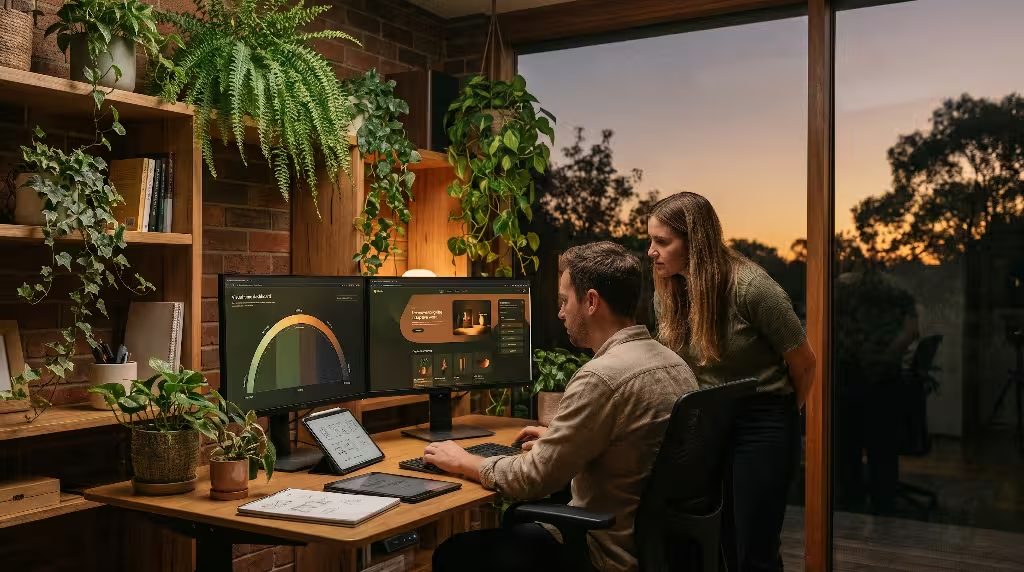
Living creatures do not stay under constant, unchanging lighting conditions throughout the day. Life on Earth is governed by circadian rhythms, which are internal 24-hour biological clocks that respond to the movement of the sun. In the early morning, the sun sits low on the horizon, bathing the world in gentle amber and soft gold light. At noon, the sun shines brightly from overhead with crisp blue tones that stimulate alertness, focus, and physical energy. In the evening, the sun sinks again, shifting back to warm oranges and deep purples, signaling to our bodies that it is time to produce melatonin, relax, and prepare for restful sleep.
Standard web design completely ignores this natural cycle. Traditional websites blast visitors with cold, intense 6500K blue light whether they visit at nine in the morning or eleven at night. When a customer browses an e-commerce store in bed before sleeping, that harsh blue light tricks their brain into thinking it is midday, which ruins their sleep quality and strains their eyes.
+-------------------------------------------------------------+
|              CIRCADIAN BRAND COLOR CYCLE                    |
+-------------------------------------------------------------+
| Morning (Sunrise to 10 AM)                                  |
| Warm Amber & Soft Gold (3000K) -> Awakens visual attention  |
+-------------------------------------------------------------+
| Midday (10 AM to 4 PM)                                      |
| Crisp Slate & Clear Daylight (5500K) -> Enhances focus      |
+-------------------------------------------------------------+
| Evening & Night (Sunset Onward)                             |
| Terracotta, Moss & Deep Charcoal (2400K) -> Calms nervous   |
| system and protects sleep                                   |
+-------------------------------------------------------------+
Brand strategy powered by AI and Biophilia fixes this biological mismatch. By combining lightweight client-side scripts with environmental data, a brand can create a living website that adapts its appearance based on the visitor’s local time of day and regional sunlight. When you practice AI and Biophilia, your digital storefront behaves like a living organism that respects the human body.
In the morning, a website built with AI and Biophilia can welcome visitors with warm earth tones, soft contrast, and gentle lighting effects that ease the eyes into the workday. During peak afternoon hours, the platform can subtly adjust its color temperature to crisp, high contrast tones that make text effortless to scan and read. When evening arrives, the system smoothly shifts into an organic dark mode, using moss greens, muted bark browns, terracotta hues, and warm charcoal backgrounds.
This circadian awareness is a primary benefit of AI and Biophilia. Modern AI and Biophilia tools can even take local weather conditions into account. If a visitor is browsing during a rainy afternoon, the site can soften its contrast and adopt cozy, grounded tones. If the user is browsing on a crisp, sunny morning, the interface can feel airy and bright. Embracing AI and Biophilia shows customers that your company respects their health and natural rhythms. When people notice that a website feels comfortable to look at in the dark without hurting their eyes, they appreciate the care behind the brand. The practice of AI and Biophilia builds deep subconscious goodwill and makes visitors eager to return.
Affective Brand Physics: Natural Kinetics in Interaction Design
Have you ever visited a website and felt startled by an aggressive pop-up window that snapped onto your screen without warning? Have you noticed how frustrating it feels when dropdown menus drop down instantly with sharp, mechanical clicks? In the physical world, solid objects do not appear out of thin air, and things do not move with robotic, unyielding speed.
In nature, everything moves according to the laws of physics. A river speeds up as it flows around a bend, but it slows down gently as it pools into an eddy. A maple leaf detaches from a high branch, sways softly from side to side in the breeze, and drifts down to land quietly on the grass. A water droplet falls into a puddle and creates concentric rings that expand, lose energy, and fade away. These movements have momentum, mass, friction, and fluid viscosity. Because humans have watched these physics since infancy, natural movements feel predictable, safe, and soothing.
When digital interfaces use stiff, linear animations, our nervous system feels a tiny jolt of friction. It feels fake and mechanical. This is where AI and Biophilia transform interaction design. By studying physical dynamics, AI and Biophilia allow developers to create natural motion systems for buttons, menus, and page transitions.
| Traditional UI Motion | Biophilic UI Motion (AI and Biophilia) | Neurological Effect |
| Linear Easing | Viscous Damping & Fluid Easing | Eliminates jarring visual stops |
| Instant Pop-Ups | Organic Unfolding & Canopy Bloom | Prevents startle responses |
| Stiff Hover Sliders | Water Tension & Ripple Dynamics | Creates tactile satisfaction |
| Robotic Click Feedback | Soft Haptic Decay & Leaf Sways | Signals physical stability |
Through AI and Biophilia, artificial intelligence can model fluid dynamics and spring physics directly in code. When a customer scrolls down a page, the elements do not slide like rigid sheets of metal. Instead, they move with a gentle sense of weight and float, mimicking the way underwater kelp sways in a gentle ocean current. When a user clicks a button, a subtle wave ripples outward, giving positive feedback that feels as satisfying as skipping a flat stone across a calm lake.
Using AI and Biophilia to refine digital animation eliminates the robotic feel of modern software. The smooth pacing created by AI and Biophilia guides the user’s eyes naturally across the screen without causing motion sickness or visual confusion. Instead of feeling pushed or startled by flashing graphics, the visitor feels guided by a calm, steady hand. This level of physical empathy is a hallmark of AI and Biophilia. When a digital brand feels as natural to navigate as walking down a shaded woodland trail, users stay longer, browse more comfortably, and develop deep trust in the company.
Sustainable Digital Infrastructure: Biophilia as Engineering Ethics
It is impossible to talk about the benefits of nature in branding without talking about real world environmental impact. Many people do not realize that the internet has a massive physical footprint. Millions of server racks in giant data centers across the globe hum day and night, consuming vast amounts of electricity and water to cool their processors. Every time a heavy, unoptimized website loads, power plants burn fossil fuels to deliver that data across thousands of miles of cables.
A brand cannot claim to love nature while running bloated, power hungry digital systems. That is the definition of digital greenwashing. If a company covers its homepage with pictures of rainforests but requires several megabytes of inefficient code and video to display it, that brand is harming the very environment it pretends to celebrate. True biophilia requires an engineering ethic rooted in ecological responsibility.
+-------------------------------------------------------------+
|             SUSTAINABLE DIGITAL STACK                       |
+-------------------------------------------------------------+
| [Clean Energy Hosting & Serverless Edge Caching]            |
|                   |                                         |
|                   v                                         |
| [Small, Quantized AI Models (Low Compute Footprint)]        |
|                   |                                         |
|                   v                                         |
| [Procedural SVG Vector Graphics (<40 KB Asset Size)]        |
|                   |                                         |
|                   v                                         |
| [Sub-Second Load Time (Green Core Web Vitals Score)]        |
+-------------------------------------------------------------+
The union of AI and Biophilia offers the perfect solution to this modern challenge. First, artificial intelligence can be used to dramatically reduce the data weight of digital assets. Instead of loading heavy, multi-megabyte photo files of natural textures, AI and Biophilia allow designers to generate procedural vector graphics using tiny snippets of code. A mathematical formula describing a beautiful leaf pattern can take up less than forty kilobytes of data, which is a tiny fraction of a standard photo file. This means pages load in a fraction of a second while using almost no electrical energy.
Second, the responsible practice of AI and Biophilia focuses on small, efficient computational models. Rather than relying on massive, power hungry cloud computing systems that burn enormous amounts of electricity for simple tasks, AI and Biophilia emphasize lightweight algorithms and edge computing. These compact models run directly on the user’s local device or on energy efficient edge servers powered by renewable solar and wind energy.
When you engineer your digital presence using AI and Biophilia, you create a sustainable digital ecosystem. The website runs faster, consumes less data, and respects the user’s mobile data plan and battery life. Search engines like Google strongly reward websites that load quickly and perform cleanly, making this eco-friendly approach a major win for organic search rankings. By uniting AI and Biophilia behind the scenes, a company proves that its commitment to the earth is not just a marketing trick, but a core engineering principle that guides every line of code.
Commercial Performance: Measurable Returns on Biophilic Brand Investment

While creating a calm, nature-inspired digital environment is morally and aesthetically wonderful, executive teams need to know whether it makes financial sense. The wonderful truth is that adopting AI and Biophilia delivers strong, measurable returns on investment across every key business metric.
Consider the metric of dwell time, which measures how long a visitor stays on your website. When a website causes eye strain and cognitive overload, visitors leave within seconds. But when a site uses AI and Biophilia to create an inviting, restful atmosphere, people naturally stay longer. They read your articles, explore your product offerings, and engage with your interactive tools. Search engines notice when users spend several minutes exploring a site rather than immediately hitting the back button. High dwell time signals to search engines that your content is valuable and satisfying, which boosts your organic search rankings.
+-------------------------------------------------------------+
|               MEASURABLE BUSINESS IMPACT                    |
+-------------------------------------------------------------+
| Longer Session Duration: Up to 35% higher dwell time        |
| Lower Bounce Rates: Calmer visual layouts reduce exits      |
| Higher Conversion Rates: Stress-free checkout flows         |
| Premium Brand Valuation: High craft commands higher prices  |
+-------------------------------------------------------------+
Next, look at conversion rate optimization. The most critical moments in digital commerce, such as signing up for a service, filling out a contact form, or entering credit card details, are filled with customer hesitation and anxiety. If the checkout page looks harsh, cluttered, and stressful, customer anxiety spikes, leading to abandoned shopping carts. When companies use AI and Biophilia, they design checkout experiences that feel secure, peaceful, and grounded. By lowering visual noise and offering soft, organic color palettes, AI and Biophilia soothe customer hesitation, leading to higher completion rates.
Furthermore, integrating AI and Biophilia elevates brand perception and pricing power. In modern markets, consumers are flooded with cheap, generic commodities. When a brand presents itself through a living, biophilic digital experience, customers instinctively recognize high craftsmanship, care, and intentionality. Studies show that consumers are willing to pay higher prices for products from companies that demonstrate authenticity, health consciousness, and thoughtful design.
Investing in AI and Biophilia also future proofs your digital marketing. As consumer awareness of digital wellness grows, brands that continue to rely on noisy, irritating advertising will face increasing backlash and ad blocking. By adopting AI and Biophilia early, your company positions itself as an empathetic leader. The strategic application of AI and Biophilia helps you build loyal communities of customers who genuinely enjoy interacting with your brand, driving higher lifetime value and steady word-of-mouth recommendations.
Frequently Answered Questions About AI and Biophilia
To help you gain complete clarity on this emerging field, here are direct answers to the most common questions people ask about AI and Biophilia.
What is the core difference between green design and biophilic design?
Green design focuses on environmental sustainability, such as reducing energy consumption, cutting waste, and using recycled materials. Biophilic design focuses on human biological connection and emotional health, using natural shapes, textures, lighting, and patterns to lower stress and improve cognitive well-being. When you combine AI and Biophilia, you achieve both: an energy efficient digital platform that also nourishes the human mind.
How does combining AI and Biophilia help a small business stand out from competitors?
Most small business websites use generic templates with identical square boxes and stock photos. By using AI and Biophilia, a small business can build a distinctive digital identity with custom organic patterns, circadian color palettes, and fluid motion that looks custom crafted. The implementation of AI and Biophilia makes a small brand look remarkably sophisticated, trustworthy, and memorable without requiring massive agency budgets.
Can AI and Biophilia work effectively on mobile phone screens?
Yes, mobile screens are actually where AI and Biophilia shine brightest. Because smartphone screens are small and held close to the face, eye strain and visual fatigue happen quickly. Implementing AI and Biophilia on mobile interfaces introduces gentle contrast, thumb friendly organic curves, and daylight responsive color shifts that make handheld reading comfortable anywhere.
Does incorporating biophilic design elements slow down website performance?
Not when implemented correctly through AI and Biophilia. Traditional websites slow down when designers upload heavy photos and uncompressed videos. With AI and Biophilia, natural patterns are generated using lightweight mathematical code and scalable vector graphics (SVG) that often weigh less than standard icon packs. As a result, websites built with AI and Biophilia regularly achieve top performance scores on Google Core Web Vitals.
How can a creative team start using AI and Biophilia without starting from scratch?
You do not have to rebuild your entire business overnight to enjoy the benefits of AI and Biophilia. Creative teams can start by auditing their current design system, replacing harsh pure black and pure white backgrounds with warm, organic tones, smoothing out stiff button animations with natural easing curves, and using AI to generate bio-analogue vector accents for brand collateral.
Strategic Implementation and Governance for Modern Brands
Bringing AI and Biophilia into an existing organization requires a clear, disciplined roadmap. You cannot simply instruct your design team to make things look like nature and expect great results. To achieve real commercial success, leaders must follow a structured implementation plan.
+-------------------------------------------------------------+
|                4-PHASE IMPLEMENTATION ROADMAP               |
+-------------------------------------------------------------+
| Phase 1: Digital Fatigue Audit                              |
| - Measure current bounce rates, page weight, and contrast   |
| - Identify stressful customer drop-off points               |
+-------------------------------------------------------------+
| Phase 2: Biophilic Design Token Architecture                |
| - Formulate earth-toned palettes, circadian shifts & curves |
| - Build reusable, accessible UI component tokens            |
+-------------------------------------------------------------+
| Phase 3: Generative AI Asset Pipelines                      |
| - Establish procedural vector generation using math rules   |
| - Test lightweight, local edge computing scripts            |
+-------------------------------------------------------------+
| Phase 4: Measurement, Testing & Governance                  |
| - Track dwell time, conversion gains & Core Web Vitals      |
| - Audit against greenwashing, accessibility & model bias    |
+-------------------------------------------------------------+
The first phase is a comprehensive digital fatigue audit. Examine your current customer touchpoints: your website, mobile app, email newsletters, and customer portals. Look for areas of high friction and directed attention fatigue. Are your forms crowded? Are your colors blindingly harsh? Are your pop-up notifications annoying your visitors? Auditing your brand reveals where AI and Biophilia can provide immediate relief.
The second phase involves creating a biophilic design token system. Design tokens are the foundational building blocks of your brand identity, including color palettes, typography scales, border radiuses, and animation curves. In this phase, replace stark clinical grays with warm stone, sand, and charcoal tones. Define your circadian color schedule, setting up the exact color shifts that will take place between sunrise and twilight. Grounding your design tokens in AI and Biophilia ensures complete consistency across all digital channels.
The third phase is deploying your generative AI pipelines. Train or prompt your creative tools to generate procedural textures based on biological models like Voronoi cells or fractal tree branches. Ensure that these visual assets are exported as lightweight vector graphics rather than bloated image files. By standardizing this process through AI and Biophilia, your marketing team can generate endless, beautiful brand collateral for new campaigns in seconds.
The fourth phase is establishing ethical governance. Whenever you combine AI and Biophilia, you must maintain strict ethical standards. Ensure that your automated algorithms do not introduce unintentional biases. Verify that all color palettes meet standard Web Content Accessibility Guidelines (WCAG) so that people with visual impairments can read your content clearly. Finally, audit your digital carbon footprint to confirm that your hosting providers use clean, renewable power. By following these governance principles, your brand avoids greenwashing and ensures that your embrace of AI and Biophilia remains honest, helpful, and effective.
Implementation Verification Checklist
Use this direct checklist to guide your team’s immediate execution and ensure every aspect of your brand aligns with the principles of AI and Biophilia:
- [ ] Visual Fatigue Check: Replace all pure stark white (#FFFFFF) backgrounds with soothing, natural warm paper or sand tones (#F9F8F6 or #F4F1EA) to immediately reduce screen glare.
- [ ] Contrast Verification: Ensure all text and foreground elements maintain a minimum 4.5:1 contrast ratio against their backgrounds to satisfy accessibility standards while preserving organic warmth.
- [ ] Fractal Dimension Calibration: Test background patterns and decorative textures to confirm they maintain an organic fractal dimension between 1.3 and 1.5 for optimal cognitive relaxation.
- [ ] Motion Curve Overhaul: Remove all linear and abrupt animation curves in your CSS and replace them with fluid cubic-bezier curves that mimic natural spring and viscous friction dynamics.
- [ ] Circadian Schedule Setup: Configure client-side CSS variables to adjust ambient color temperatures across morning, afternoon, and evening browsing hours.
- [ ] Asset Weight Optimization: Convert all decorative brand backgrounds from raster image formats (JPEG, PNG) to procedural SVGs that stay under 40 KB in total file size.
- [ ] Carbon and Speed Testing: Run all updated pages through performance auditing tools to confirm sub-second Largest Contentful Paint (LCP) times and zero layout shifts.