
Table of Contents
The Acoustic Dimension of Biophilic Design
When people talk about biophilic design, they almost always talk about what we can see. They talk about large windows that bring in sunlight. They point out living green walls covered in ferns, indoor trees reaching toward skylights, and desks made of reclaimed oak. These visual elements are wonderful, but they leave out half of how human beings experience the world.
Human biology evolved in wild environments filled with rich, organic acoustic textures. For hundreds of thousands of years, our survival depended on listening to the outdoors. Today, modern buildings cut us off from those natural patterns. We sit inside silent concrete boxes or noisy open-plan offices where the only noises come from heating units, computer fans, clicking keyboards, and ringing phones.
This is where the science of biophilic sound comes into the conversation. Biophilic sound brings the acoustic health benefits of nature back into our everyday indoor spaces. It does not just mean playing a recording of birds outside. Instead, it involves using modern technology to weave restorative audio into physical buildings and digital platforms. When we restore natural acoustic principles to modern spaces, our minds and bodies feel the difference right away. Stress markers decline, mental fatigue lifts, and focus returns.
The Overlooked Sense
Our ears never sleep. Even when our eyes are closed, our auditory system monitors the room around us. In an ancient forest, natural background sounds tell the brain that everything is safe. A gentle breeze blowing through leaves or distant running water tells your nervous system that no predators are near.
In modern life, our ears are constantly stressed. Loud, unpredictable sounds from city traffic, slamming doors, and office conversations trigger our stress response. Even completely silent rooms can cause distress. When a room is totally dead and silent, the human brain strains to hear faint noises. Every tiny click of a keyboard or distant footstep sounds like an alarm.
By introducing biophilic sound, designers can give the auditory system a healthy, organic baseline. Biophilic sound gives our hearing something steady, pleasant, and natural to rest upon. It stops the brain from overreacting to small office distractions. Researchers have found that paying attention to sound is just as important as choosing natural paint colors or indoor plants. If a space looks like a forest but sounds like a noisy factory, the human brain stays stressed. True biophilic sound solves this problem by caring for the ears as much as the eyes.
Beyond Static Nature Recordings
For years, people tried to solve acoustic stress by playing simple sound loops. You have likely heard these before. Someone buys a cheap sound machine, plugs it into a wall, and plays an audio file of rain falling on a roof or ocean waves hitting a beach.
At first, this audio track might feel relaxing. But after fifteen or twenty minutes, your brain notices something wrong. A recorded audio file repeats the exact same pattern over and over. You hear the same bird chirp at the two-minute mark. You hear the exact same crack of thunder every six minutes.
The human brain is an incredible pattern-recognition engine. When your auditory system detects an artificial loop, the calming effect vanishes. Instead of feeling relaxed, your brain feels annoyed. Scientists call this auditory habituation and fatigue. When the brain realizes the sound is a fake recording that does not match the real room, it treats the sound as unwanted noise. Static nature loops simply do not provide the restorative power of real nature. Real nature never loops. A living forest never plays an identical sound file twice. Every gust of wind is slightly different, and every bird call responds to real life around it.
Defining the Intersection
To fix the problems of static audio, engineers and designers have turned to artificial intelligence. This is the intersection where machine learning meets natural acoustic ecology. When we talk about AI-composed biophilic sound, we mean using software that creates new, organic audio in real time.
Artificial intelligence does not just play back an old recording. Instead, the AI acts like a trained composer that understands the mathematical rules of natural environments. The system uses algorithms to generate water murmurs, wind flows, and animal calls that change constantly.
Furthermore, this type of biophilic sound can listen to the room it is playing in. If an office gets louder at lunchtime, the biophilic sound system can adjust its frequencies and volume to protect speech privacy. If the weather outside turns cloudy, the soundscape can gently shift to reflect the day. This technology creates an acoustic ecosystem that lives, breathes, and updates itself without ever repeating a single phrase.
The Main Idea
Natural sound is not random, and it is never repetitive. It follows deep mathematical patterns that soothe the human nervous system. By using artificial intelligence, we can bring authentic biophilic sound into our homes, schools, hospitals, and websites.
AI-composed biophilic sound does not just cover up noise. It actively rebuilds human focus, supports cognitive health, and reduces mental fatigue. Moving from repetitive nature loops to dynamic, intelligent biophilic sound represents the next great leap forward in human-centered design.
Foundational Science: Acoustic Ecology Meets Algorithmic Synthesis

To understand how artificial intelligence creates realistic nature audio, we must first look at the science of acoustic ecology. Acoustic ecology is the study of the relationship between living things and their sound environment. Decades of field research show that healthy natural environments have clear acoustic structures. When computers generate biophilic sound, they rely on these biological rules.
The Tripartite Soundscape Model
Renowned acoustic ecologist Bernie Krause discovered that every soundscape in the world is made up of three distinct sound sources. When building an effective biophilic sound engine, programmers use this three-part model as their blueprint:
- Geophony: These are the non-living sounds of the natural world. Geophony includes wind blowing through pines, rain tapping on soil, ocean waves rolling across sand, and water rushing down a rocky creek. In biophilic sound systems, geophony forms the broad, soothing foundation. It behaves like an organic acoustic blanket that fills the room with steady, calming energy.
- Biophony: These are the sounds made by living wild organisms. Biophony includes the songs of morning birds, the buzzing of summer cicadas, and the evening calls of tree frogs. In nature, animals do not all sing at the same pitch or at the exact same moment. They find their own acoustic niche, much like different instruments in an orchestra. When software builds biophilic sound, it schedules biophonic events so they do not clash with each other or with human voices.
- Anthrophony: These are the sounds made by human beings and our machines. Anthrophony includes highway traffic, airplane engines, construction drills, and heating units. Most anthrophony is loud, harsh, and repetitive. The goal of an intelligent biophilic sound installation is to manage and balance anthrophony. The biophilic sound gently masks harsh human noise by replacing it with healthy organic acoustic energy.
The Neurobiology of Auditory Restoration
Why does biophilic sound make us feel better? The answer lies in human neurobiology and Attention Restoration Theory. Psychologists Stephen and Rachel Kaplan developed Attention Restoration Theory to explain how human focus works.
Our brains use two types of attention. The first type is directed attention. You use directed attention when you balance a budget, write code, or read a complex document. Directed attention requires a lot of mental energy. It burns glucose in the prefrontal cortex, and over time, it leads to brain fatigue and irritability.
The second type of attention is soft fascination. Soft fascination happens when you watch clouds move across the sky or listen to a bubbling brook. Your brain pays attention effortlessly without getting tired. Biophilic sound provides acoustic soft fascination. When your ears take in the gentle, changing textures of biophilic sound, your prefrontal cortex gets a chance to rest and recover.
At the same time, your autonomic nervous system responds. Studies show that listening to organic, nature-based sound reduces heart rate and lowers cortisol levels in the bloodstream. Because biophilic sound mimics safe natural habitats, the primitive parts of our brain turn down the fight-or-flight response. We feel calm, safe, and alert.
Why Generative AI?
Nature sounds have a special mathematical shape called pink noise, or one-over-f noise (1/f). In pink noise, energy is distributed evenly across octaves. It strikes a balance between total chaos, like television static, and total order, like a single beep.
Noise Energy Spectrum Comparison:
White Noise (flat):         Equal energy per Hertz (harsh hiss)
Pink Noise (1/f drop):      Equal energy per octave (natural water, wind)
Biophilic Sound (dynamic):  Pink noise base + organic biophonic events
Generative artificial intelligence is good at learning and producing these mathematical curves. A regular computer program might just pick random sounds, but true artificial intelligence learns the subtle transitions of nature. It knows how the tempo of raindrops changes as a storm approaches. It understands that birds do not sing during heavy wind, but begin calling again as the wind dies down.
By applying machine learning to real environmental field recordings, generative software can compose endless variations of biophilic sound. The software makes sure that the resulting soundscape never sounds synthetic, never loops, and never distracts the listener. It creates an authentic stream of biophilic sound that feels as fresh and alive as an actual mountain valley.
Real-World Examples of AI-Composed Biophilic Sound
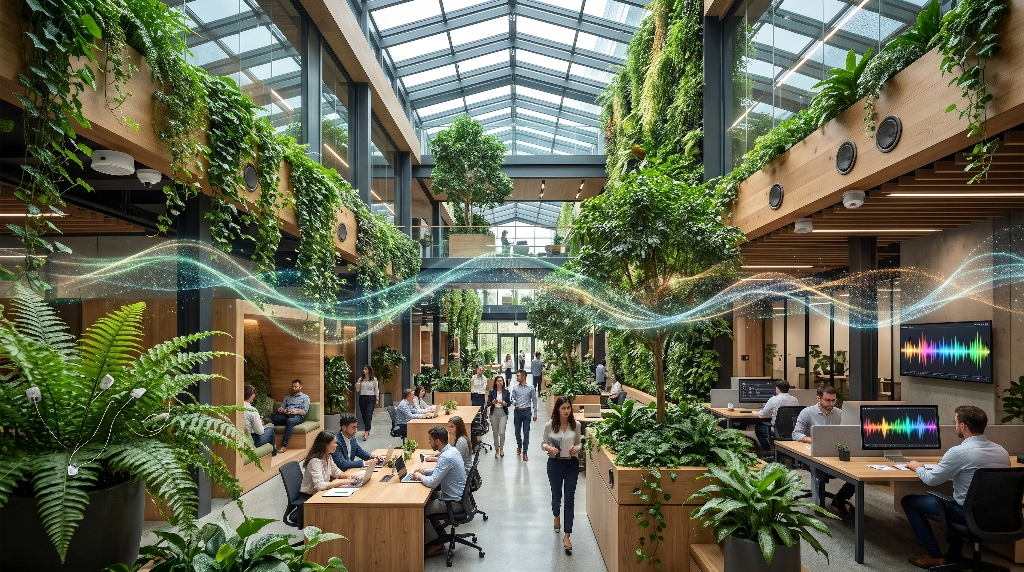
The combination of artificial intelligence and biophilic design has moved out of research labs and into real-world applications. Organizations around the world are installing generative sound systems to improve human well-being. Below are four major examples of how AI-composed biophilic sound is being used today.
Algorithmic Workplace Soundscaping: The Moodsonic Architecture
One of the most clear commercial examples of biophilic sound in architecture is the Moodsonic platform. Modern office buildings face a major noise crisis. When companies tore down private cubicles to build open-plan offices, they accidentally created loud, distracting acoustic environments. Employees in open offices frequently report that hearing other people talk on phone calls is their biggest workplace frustration.
Moodsonic approaches this challenge by treating the entire office as an adaptive acoustic ecosystem. Instead of blasting irritating white noise from ceiling speakers, the system plays generative biophilic sound. The platform uses small ceiling sensors that monitor the room in real time. These sensors measure ambient sound levels, speech frequencies, and room occupancy.
When a conference room empties out and the office grows quiet, the AI shifts the biophilic sound to soft, gentle forest breezes or distant flowing water. If a large team gathers in the kitchen or breakroom and noise levels climb, the algorithm raises the sound energy. It introduces specific water-trickle frequencies and light insect textures designed to mask speech. Because the biophilic sound fills the frequency gaps where human speech travels, words become unintelligible across short distances. You can still hear your coworker sitting right next to you, but you can no longer understand a conversation happening thirty feet away. This reduces mental distraction without making people feel isolated.
Companies using this form of adaptive biophilic sound report measurable drops in employee stress, fewer headaches at the end of the day, and improved focus on complex tasks.
Meteorological Sensor-Driven Soundbeds: Sister City Hotel and Bjork
Another notable example of generative natural audio took place at the Sister City hotel in New York City. The hotel teamed up with world-renowned Icelandic artist Bjork and technology engineers from Microsoft to create an innovative lobby soundscape.
The project, called Kórsafn, relied on a smart camera placed high on the hotel roof. This camera looked up at the sky over Lower Manhattan. It was paired with computer vision software that was trained to identify changing environmental conditions. The system observed cloud cover, barometric changes, sunlight intensity, rain showers, and flocks of migrating birds.
Inside the hotel lobby, an artificial intelligence engine composed a continuous, evolving stream of biophilic sound. Rather than using typical field recordings, the software used choral recordings, organic acoustic instruments, and natural audio textures composed by Bjork.
[Sky Camera on Roof]
        │
        ▼ (Live Sky Data: Clouds, Birds, Sun, Rain)
[Computer Vision Neural Network]
        │
        ▼ (Environmental Parameters)
[Generative AI Composition Engine]
        │
        ▼ (Custom Choral & Natural Stems)
[Hotel Lobby Biophilic Sound System]
When a thick rain cloud rolled across the city sky, the algorithm deepened the tone of the lobby audio, playing rich, resonant acoustic passages that matched the storm. When the sun broke through the clouds, the biophilic sound became light, airy, and bright. When birds flew across the camera frame, the AI triggered delicate melodic passages that tracked their flight patterns.
This installation showed that biophilic sound does not have to be limited to literal recordings of crickets or streams. Biophilic sound can also be an artistic translation of natural forces. By connecting the indoor lobby to the living atmosphere outside, the system reconnected urban travelers to the rhythms of nature.
Digital Environments and Web Audio API Integrations
Biophilic design is not just for physical brick-and-mortar buildings. As human beings spend more of their waking lives working inside web browsers and digital software, the need for digital biophilic sound has grown. At Silphium Design LLC, we study how natural website design can transform online user experiences.
In the past, web designers avoided playing sound on websites because auto-playing audio tracks were loud, intrusive, and chewed up valuable mobile data bandwidth. If a website wanted to play background nature audio, it had to download a massive thirty-megabyte MP3 file. That file would play on a loop, quickly driving the user crazy.
Modern browsers now support the Web Audio API, which allows web developers to build synthetic biophilic sound directly inside the user’s browser using lightweight code:
JavaScript
// Minimal Web Audio API pink noise generator for digital biophilic sound
const audioCtx = new (window.AudioContext || window.webkitAudioContext)();
const bufferSize = audioCtx.sampleRate * 2;
const noiseBuffer = audioCtx.createBuffer(1, bufferSize, audioCtx.sampleRate);
const output = noiseBuffer.getChannelData(0);

let b0 = 0, b1 = 0, b2 = 0, b3 = 0, b4 = 0, b5 = 0, b6 = 0;
for (let i = 0; i < bufferSize; i++) {
    const white = Math.random() * 2 - 1;
    b0 = 0.99886 * b0 + white * 0.0555179;
    b1 = 0.99332 * b1 + white * 0.0750759;
    b2 = 0.96900 * b2 + white * 0.1538520;
    b3 = 0.86650 * b3 + white * 0.3104856;
    b4 = 0.55000 * b4 + white * 0.5329522;
    b5 = -0.7616 * b5 - white * 0.0168980;
    output[i] = (b0 + b1 + b2 + b3 + b4 + b5 + b6 + white * 0.5362) * 0.05;
    b6 = white * 0.115926;
}

const whiteNoise = audioCtx.createBufferSource();
whiteNoise.buffer = noiseBuffer;
whiteNoise.loop = true;
whiteNoise.connect(audioCtx.destination);
Instead of downloading audio clips, a digital biophilic sound engine generates sound waves mathematically on the fly. Lightweight neural network models running in JavaScript can create procedural wind, rustling grass, and water sounds using only a few lines of code.
Furthermore, this biophilic sound can react directly to how a person uses the site. If a user is scrolling rapidly through an article, the biophilic sound might increase its tempo slightly to match their energy. When the user stops to read a long paragraph, the biophilic sound settles into a peaceful, steady frequency that aids deep concentration. The digital world becomes a living, responsive landscape rather than a sterile white page.
Bio-Algorithmic Plant Neurobiology Transduction
One of the most fascinating frontiers in modern sound design is turning living plants into real-time composers of biophilic sound. This field combines botanical biology with algorithmic sound composition.
Every living plant experiences tiny electrical changes across its leaves, stems, and roots. As a plant takes up water from the soil, processes sunlight through photosynthesis, or responds to a human touching its leaves, its micro-voltage shifts. Scientists can attach small, sensitive electrodes to a plant’s leaves, similar to how an EKG machine measures the human heart.
[Living Botanical Specimen] (Transpiration, Light, Touch)
         │
         ▼ (Micro-Voltage Fluctuations: 0-5V)
[Analog-to-Digital Converter / Microcontroller]
         │
         ▼ (Control Voltage / Raw MIDI Streams)
[Algorithmic Synthesizer & Sound Engine]
         │
         ▼ (Harmonic Tuning & Natural Envelopes)
[Live Biological Biophilic Sound]
These tiny electrical signals are fed into a computer running specialized music software. The software maps the plant’s raw voltage signals to musical parameters, such as pitch, volume, timbre, and rhythm. The plant itself becomes the conductor of the biophilic sound.
When the plant is well-watered and bathed in warm morning light, its active transpiration produces lively, flowing streams of biophilic sound. In the evening, as photosynthesis slows down, the biophilic sound deepens into calm, meditative drones. This setup creates a direct bridge between plant biology and human ears. Visitors sitting in an office or greenhouse can literally listen to the health and vitality of the plants around them.
Structural Comparison: Traditional Audio vs. AI Biophilic Synthesis
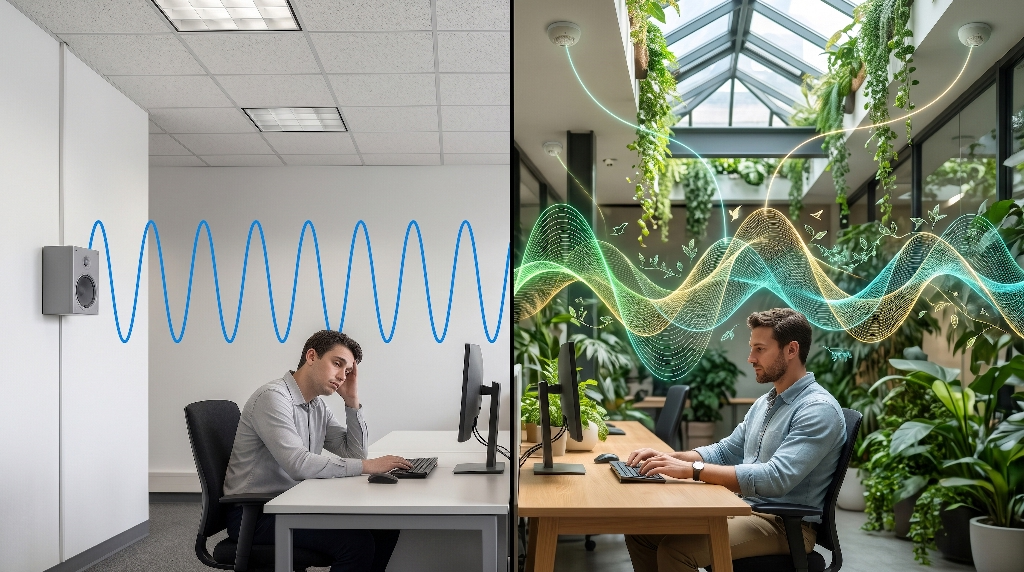
To see why modern artificial intelligence is transforming this field, it helps to compare traditional sound solutions directly against generative systems. The table below outlines how regular recorded sound stacks up against AI-composed biophilic sound.
| Feature or Quality | Looped Audio Tracks (Static MP3/WAV) | Procedural Ambient Sound (Rule-Based) | Generative AI Biophilic Sound (Sensor-Driven) |
| Cognitive Fatigue | High. The human brain detects repeating loops within minutes, causing irritation. | Moderate. The system randomizes sound clips, but patterns remain somewhat predictable. | Very Low. Simulates the infinite, non-repeating variety of an actual outdoor ecosystem. |
| Environmental Adaptation | None. The audio track plays blindly regardless of what happens in the room. | Low. Can trigger specific sounds based on simple timers or button presses. | High. Continuously adapts to live room volume, room occupancy, and outdoor weather. |
| Spectral Balance | Fixed. The equalization curve never changes, leading to frequency buildup. | Semi-static. Uses simple filters that can sound artificial or muffled. | Dynamic. Constantly adjusts frequencies to match organic $1/f$ pink noise curves. |
| Speech Masking Efficacy | Poor. Often clashes with human voices or makes the room sound crowded. | Moderate. Covers general noise, but lacks precision targeting for spoken syllables. | Excellent. Accurately blankets speech frequencies without raising overall room volume. |
| Network & File Footprint | Heavy. Requires downloading large audio files that consume storage and bandwidth. | Medium. Requires storing a library of individual sound samples. | Very Light. Generates sound mathematically via code or lightweight algorithmic models. |
| Circadian Alignment | Static. Sounds the same at midnight as it does at eight in the morning. | Manual. Requires an operator to schedule morning and evening sound sets. | Automatic. Naturally shifts its tone and energy to follow the local solar cycle. |
As this comparison shows, generative biophilic sound is fundamentally different from playing a simple nature recording. It turns sound from a fixed, passive decoration into an active, intelligent building utility that supports human performance.
Implementation Architecture: Translating Algorithmic Sound to Code and Built Spaces
Creating an effective AI-driven biophilic sound environment requires a well-planned technical pipeline. You cannot simply place a speaker on a desk and expect miraculous results. A professional installation involves three separate layers working together in real time: telemetry, inference, and output.
┌─────────────────────────────────────────────────────────────┐
│                 1. TELEMETRY & INPUT LAYER                  │
│  Occupancy Sensors │ Decibel Meters │ Weather APIs │ Lux    │
└──────────────────────────────┬──────────────────────────────┘
                               │
                               ▼
┌─────────────────────────────────────────────────────────────┐
│             2. INFERENCE & COMPOSITION ENGINE               │
│  Neural Audio Models │ Markov Chains │ Frequency Matching   │
└──────────────────────────────┬──────────────────────────────┘
                               │
                               ▼
┌─────────────────────────────────────────────────────────────┐
│           3. ACOUSTIC OUTPUT & SPATIALIZATION               │
│  Distributed Speakers │ Multi-Zone Routing │ EQ Filtering   │
└─────────────────────────────────────────────────────────────┘
Data Inputs: The Telemetry Layer
An intelligent biophilic sound engine needs to know what is happening in the physical space. This is handled by the telemetry layer. A network of small, privacy-safe sensors is distributed across the environment.
These sensors do not record private conversations or take identifiable photos of people. Instead, they capture raw environmental metrics:
- Ambient sound decibels: Measures how loud or quiet the room is throughout the day.
- Frequency distribution: Checks whether the room is filled with low-frequency air conditioner hums or high-frequency chatter.
- Occupancy levels: Tracks how many people are using a particular zone at any given moment.
- Indoor climate: Monitors indoor temperature, carbon dioxide levels, and ambient light.
- External weather telemetry: Pulls real-time data from local weather stations, tracking outdoor temperature, wind speed, cloud cover, and sunrise/sunset times.
All of this data feeds continuously into the central software engine, giving the AI a clear picture of the physical room.
The Inference and Composition Engine
The inference engine is the brain of the biophilic sound installation. It runs on a local computer, an edge computing device, or a secure cloud server. The engine processes incoming telemetry and generates sound instructions.
The system uses a mix of computational methods to build authentic biophilic sound:
- Markov Chains: A Markov chain is a mathematical system that transitions from one state to another based on probability. In a biophilic sound system, Markov chains decide when specific natural events occur. For instance, if a virtual gust of wind blows through the audio soundscape, the Markov chain calculates a high probability that rustling leaf sounds should follow two seconds later.
- Granular Synthesis: Granular synthesis takes short micro-samples of recorded nature sounds, often only one to fifty milliseconds long, and splits them into tiny grains. The software then rearranges, stretches, and layers these grains into brand new audio textures. This allows the AI to generate endless variations of running water or falling rain without using looped files.
- Autoregressive Neural Audio Models: Modern machine learning architectures can generate raw audio waveforms from scratch. Trained on thousands of hours of pristine ecological soundscapes, these neural networks compose flowing biophilic sound that maintains natural harmonic relationships.
The engine constantly balances these audio elements to make sure the biophilic sound never overwhelms human speech, never repeats, and always sounds pleasant to the ear.
Acoustic Output and Spatialization
The final layer is the physical sound system. Even the best AI-composed biophilic sound will fail if it is played through cheap, poorly placed speakers. In nature, sound does not come from a single tiny point. Sound surrounds you. It moves through three-dimensional space.
To deliver realistic biophilic sound, buildings use distributed multi-channel speaker networks. Instead of using two loud speakers at the front of a room, installers place dozens of small, high-quality transducers throughout the ceiling and walls. Sometimes, flat surface exciters are attached directly to drywall or wooden acoustic panels, turning the architectural walls themselves into gentle acoustic emitters.
The biophilic sound engine uses spatial audio panning to move sounds naturally through the room. A gentle gust of wind might begin in the northeast corner of the building and slowly drift toward the southwest wall over thirty seconds. A virtual bird might call softly from an overhead speaker, followed moments later by an answering call from across the room.
This gentle spatial movement mimics the non-rhythmic sensory stimuli found in wild nature. It creates an immersive, calming environment where the biophilic sound feels like an organic part of the room rather than an artificial broadcast.
Common Questions Answered about Biophilic Sound
When architects, designers, and business owners research this technology, they have specific, practical questions. Below are direct, detailed answers to the most common questions people ask about biophilic sound.
How Does Biophilic Sound Design Improve Cognitive Productivity?
Biophilic sound boosts cognitive productivity primarily by protecting working memory from distractions. Human working memory has a limited capacity. When you sit in an office or study area, your brain’s phonological loop automatically processes any intelligible human speech within earshot. If someone behind you is talking about their weekend plans, your brain cannot help but decode those words. This forces your prefrontal cortex to work twice as hard to stay focused on your job.
Distracting Speech in Office ──► Phonological Loop Hijacked ──► High Brain Fatigue
                                            │
                                            ▼
               Protected by Intelligent Biophilic Sound Masking
                                            │
                                            ▼
               Preserved Working Memory ──► Sustained Deep Focus
Biophilic sound solves this problem through natural acoustic masking. The broad frequency spectra of running water, rustling leaves, and soft wind cover up the sharp, distracting syllables of human speech. Because the biophilic sound is non-intrusive and organic, your brain does not waste energy processing it.
Furthermore, biophilic sound reduces background physiological stress. When stress drops, mental fatigue decreases. Workers in spaces supported by biophilic sound can sustain deep concentration for longer periods without feeling exhausted.
Can AI Create Truly Natural Biophilic Soundscapes?
Yes, artificial intelligence can create natural-sounding environments, provided the system is built with high-fidelity acoustic principles. The human ear is remarkably sensitive to digital artifacts. If an audio file is poorly compressed, or if a synthetic bird call sounds robotic, our brains immediately recognize it as fake.
Modern generative AI systems achieve natural realism by avoiding mechanical repetition. Traditional synthesizers often use rigid oscillators that sound cold and artificial. In contrast, modern neural audio models are trained on real acoustic ecologies recorded with high-resolution field microphones.
The AI learns the tiny, chaotic micro-variations that make natural sounds authentic. It understands how sound waves bend around obstacles, how wind changes pitch when it hits different types of trees, and how water droplets splash against stones. When these physics-based models generate biophilic sound, the human auditory system accepts the result as genuine, relaxing nature.
What Is the Difference Between White Noise, Pink Noise, and Biophilic Soundscapes?
While white noise, pink noise, and biophilic sound are all used to manage room acoustics, they are very different tools:
- White Noise: White noise contains equal energy across all audible frequencies. Because human ears are naturally more sensitive to high pitches, white noise sounds like a harsh, hissing television broadcast. While it can mask speech, many people find it annoying and tiring over long periods.
- Pink Noise: Pink noise reduces high-frequency energy by three decibels per octave ($1/f$ distribution). This creates a deeper, smoother, more balanced sound that resembles steady rainfall. Pink noise is much more comfortable than white noise, but it remains a continuous, unvarying acoustic hiss.
- Biophilic Sound: Biophilic sound uses the balanced frequency curve of pink noise as a starting point, but it goes much further. It introduces rich organic textures, subtle changes in volume, spatial movement, and natural biophonic events like birdsong and water ripples. While pink noise is purely static, biophilic sound is alive, dynamic, and meaningful. It provides psychological and emotional comfort that plain noise generators cannot match.
What Software Tools Are Used to Generate AI Biophilic Audio?
Professionals use several software tools and programming frameworks to build generative biophilic sound systems:
- Moodsonic Studio & API: A dedicated platform built specifically for commercial architecture and corporate real estate. It connects building sensors to generative sound engines to create adaptive workplace soundscapes.
- Max/MSP (Cycling ’74): A visual programming language widely used by sound designers and acoustic engineers. Max allows developers to build custom algorithmic sound networks, process live sensor feeds, and design complex generative biophilic sound models.
- Web Audio API: A native JavaScript framework built into all modern web browsers. It allows web developers to synthesize biophilic sound directly on client devices without streaming heavy audio files.
- FMOD and Wwise: Interactive audio engines originally designed for modern video games. Sound designers use these tools to build complex, responsive environmental audio systems that react dynamically to user inputs.
- PyTorch and TensorFlow: Machine learning frameworks used by software engineers to train deep neural audio models (such as AudioCraft and custom autoregressive networks) on raw acoustic field recordings.
Strategic Synthesis and Future Trajectory
As biophilic sound technology continues to advance, it is expanding into exciting new areas of health, architecture, and technology. What began as an experimental acoustic concept is rapidly becoming standard practice for progressive designers.
Circadian Audio Regulation
One of the most promising developments in this field is circadian biophilic sound design. Human biology is governed by the circadian rhythm, a twenty-four-hour biological clock that regulates our sleep cycles, energy levels, hormone releases, and digestion. This biological clock is synchronized primarily by natural sunlight.
In modern society, many people spend all day inside buildings under dim, artificial fluorescent lights. This confuses the body’s internal clock, leading to poor sleep and low energy. Forward-thinking architects have addressed this by installing dynamic circadian lighting that changes color and brightness from morning to night.
Now, acoustic designers are pairing circadian lighting with circadian biophilic sound. The acoustic profile of the building changes to match the natural solar day:
08:00 AM ──► High-frequency birdsong, crisp breezes (Alertness & Energy)
12:00 PM ──► Full canopy murmurs, gentle water flows (Productivity & Masking)
03:00 PM ──► Soft brook sounds, light insect rhythms (Fatigue Reduction)
06:00 PM ──► Warm evening crickets, deep low-frequency wind (Relaxation & Wind-down)
In the morning, the biophilic sound system introduces higher frequencies, such as dawn chorus birdsong and energetic river rapids. This encourages natural dopamine production, helping workers wake up and feel energized. As the afternoon progresses, the soundscape transitions into calm, steady water murmurs that protect focus during the mid-afternoon slump. By the end of the workday, the system gently lowers its frequencies, playing soothing crickets and distant dusk breezes. This helps people transition out of work mode without carrying acoustic tension home.
Accessibility and Neurodiversity
Biophilic sound also provides vital support for neurodivergent individuals, including people with autism spectrum conditions, attention deficit hyperactivity disorder (ADHD), and sensory processing sensitivities.
Traditional office buildings and public spaces can be overwhelming for people with sensory sensitivities. Flickering lights, squeaking shoes, echoing hallways, and overlapping conversations can trigger sensory overload, anxiety, and severe mental exhaustion. For someone with ADHD, every sudden noise can shatter twenty minutes of hard-won concentration.
Intelligent biophilic sound creates an acoustic buffer that softens the surrounding world. Because the system continuously smooths out sudden volume spikes, the acoustic environment becomes far more predictable.
Furthermore, biophilic sound gives neurodivergent individuals an organic anchor for their attention. Many people with ADHD find that working in a space filled with gentle, flowing biophilic sound helps quiet internal mental chatter, allowing them to focus calmly on their tasks. In schools and pediatric clinics, sensory-calibrated biophilic sound rooms are being built as quiet decompression zones where children can reset their nervous systems after sensory meltdowns. Designing for acoustic comfort makes spaces welcoming for everyone.
The Next Frontier
The future of biophilic sound lies in complete sensory integration. Up to this point, buildings have treated their systems as separate silos. The heating and ventilation system did not talk to the lighting system, and the lighting system did not talk to the background music system.
Over the coming years, building operating systems will bring these elements together into unified, living habitats. Imagine walking into an office where smart glass windows tint automatically to match the passing clouds outside. As the clouds dim the sunlight, the circadian lighting system warms its color temperature. At that exact moment, the biophilic sound system senses the atmospheric shift and gently introduces the soft, rhythmic patter of rain on cedar leaves.
Simultaneously, responsive websites and digital applications will adopt biophilic sound as a standard user interface element. When you open a complex web application to manage data, the website will generate a quiet, personalized biophilic sound bed that lowers your heart rate and sharpens your focus.
The boundaries separating natural ecosystems, physical architecture, and digital design are fading. By using artificial intelligence to compose and deliver authentic biophilic sound, we can build a world where our built environments do not drain our mental energy, but actively restore it. We can listen to the wisdom of nature, translated through technology, wherever our modern lives take us.