
Table of Contents
The Intersection of Biophilia, Computation, and Psychoacoustics
When we step into an old forest, our ears pick up hundreds of tiny events every minute. Leaves brush against bark. Wind shifts across the canopy. Water rolls over smooth gravel in a creek nearby. A robin calls from three trees over. None of these sounds ever repeat in the exact same pattern, yet they feel completely familiar, calm, and orderly to our senses.
For decades, digital creators tried to capture this peaceful feeling on computers. Most of the time, they did this by recording three minutes of woodland audio, saving it as a compressed audio file, and setting it to loop in the background of a meditation app or a webpage. Within five minutes, however, the human brain detects the cycle. The repeated snap of the same twig or the identical pitch of a recorded bird chirp breaks our focus. Instead of soothing us, the repeated sound creates mental fatigue.
This problem brings us to a revolutionary solution: the AI biophilic soundscape. An AI biophilic soundscape is not a recorded loop. An AI biophilic soundscape is an intelligent, algorithmic audio system that creates restorative natural sound in real time. Rather than playing back a captured snapshot of a forest or river, an AI biophilic soundscape computes every whisper of wind, every droplet of rain, and every insect pulse as it happens. It relies on mathematical models of nature and machine learning systems to generate continuous, organic sound that never loops, never jars the senses, and never causes listener exhaustion.
At Silphium Design, we study how nature and digital interfaces work together. In the physical world, biophilic architecture brings daylight, real plants, natural wood, and stone into offices and homes. In the digital world, we must do the exact same thing for screens and online experiences. A modern screen is often an unnatural, sterile environment made of static text, high contrast light, and silent pixels. By introducing an AI biophilic soundscape to a web environment, we reconnect digital technology with the sensory patterns human biology evolved to trust.
The concept rests on the biophilia hypothesis, first introduced in depth by biologist Edward O. Wilson. Wilson showed that human beings hold an innate, biological need to connect with living systems. We did not evolve in silent boxes or amid the hum of computer server fans. We evolved under open skies filled with natural acoustic information. When an environment completely strips away those sounds, our nervous system remains on subtle alert. An AI biophilic soundscape fills that empty auditory void, translating ancient environmental signals into pure, real time digital code.
Algorithmic Stochasticity Versus Looped Audio
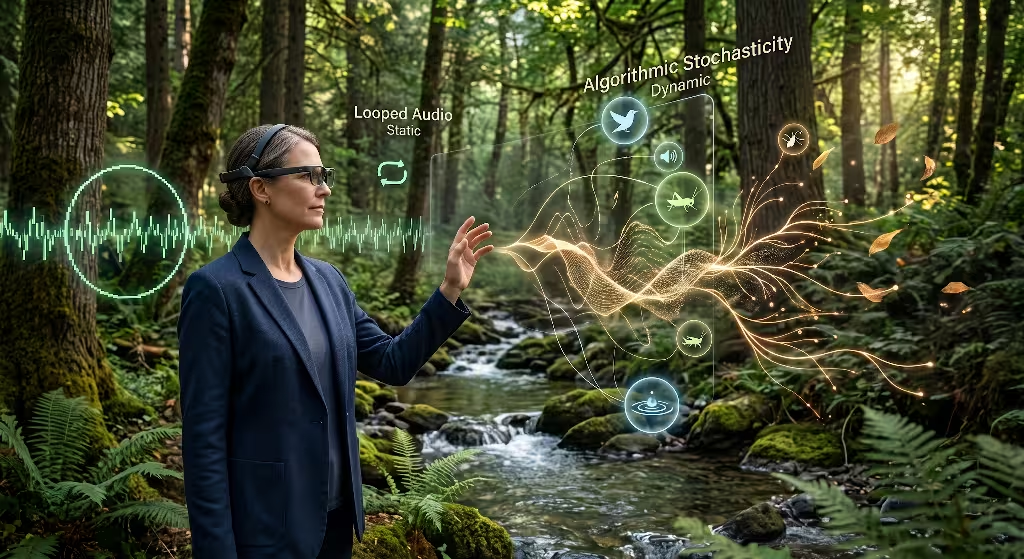
To understand why an AI biophilic soundscape works so well, we have to look at how real natural acoustics behave. In nature, sound is stochastic. That means it follows broad statistical rules, but the individual events happen with controlled randomness. Consider a gentle ocean breeze blowing through an oak grove. The speed of the wind varies across seconds and minutes. The flexibility of each branch changes as leaves flutter and twist. The physical density of the air shifts with temperature and humidity.
Because of these countless physical factors, no two wind gusts sound identical. An AI biophilic soundscape mimics these physics using mathematical formulas. Instead of replaying an old audio track, the AI biophilic soundscape algorithm continuously adjusts parameters such as audio filters, resonance, volume envelopes, and pitch.
In contrast, traditional looped audio relies on static files. When an audio file loops, the human brain quickly picks out distinctive peaks in the waveform. If a woodpecker knocks twice at minute two, your auditory cortex waits for that exact same knock at minute four, minute six, and minute eight. This mental expectation is called habituation tracking. It drains mental energy. Once your brain realizes it is being fed a fake, repeating audio loop, the sound moves from relaxing to irritating.
An AI biophilic soundscape completely avoids this trap. Because the AI biophilic soundscape generates audio continuously, there are no seams, no repeated waveforms, and no predictable audio markers. The algorithm balances familiarity with novelty. It offers the exact same sense of calm variation you would experience sitting next to an actual mountain stream.
Pink Noise Distributions and Fractal Scaling
The natural world has a distinct mathematical signature. When scientists measure the frequency and amplitude of natural sounds, they discover that most ecological acoustics follow a pink noise curve, often referred to by physicists as one over f noise.
In pure white noise, every single audio frequency carries the exact same amount of energy. To human ears, white noise sounds harsh, bright, and hissy, much like television static. In brown noise, lower frequencies dominate heavily, creating a deep, muffled rumble. Pink noise sits directly in between. In pink noise, energy drops off as frequency rises, producing equal energy per octave.
Natural sounds like rushing rivers, falling rain, distant surf, and blowing leaves naturally align with this pink noise balance. Furthermore, natural sound patterns display fractal scaling. A fractal is a pattern that repeats its basic geometry at different scales of time and size. In a forest, the overall roar of a storm follows broad swells over hours. Within those hours, individual gusts surge over minutes. Within those gusts, leaves flutter over seconds. Within those flutters, microscopic vibrations hum over milliseconds.
An AI biophilic soundscape uses neural networks and procedural algorithms designed around these exact fractal equations. By structuring audio synthesis around one over f energy curves, the AI biophilic soundscape speaks the native language of the human ear. The sound feels balanced, soft, and warm. It masks annoying background noises without demanding any direct mental concentration.
Attention Restoration Theory and Soft Fascination
To understand how an AI biophilic soundscape heals mental strain, we must examine Attention Restoration Theory, developed by psychologists Rachel and Stephen Kaplan. The theory explains that human attention comes in two primary forms: directed attention and involuntary attention.
Directed attention is the mental energy you use to complete focused, analytical work. You use directed attention when writing computer code, balancing a budget, reading a technical document, or fixing bugs in a database. Directed attention requires conscious effort. It forces your brain to filter out distractions, ignore irrelevant details, and stay locked on a single goal. Directed attention is a finite resource. When you use it for hours without a break, your brain becomes depleted. You make mistakes, feel cranky, and struggle to concentrate.
Involuntary attention is completely different. It requires zero conscious effort. It occurs when your mind gently drifts toward interesting, non threatening sensory patterns, such as watching clouds drift across the sky, flames dance in a fireplace, or ripples move across a pond. The Kaplans called this state soft fascination. Soft fascination lets your directed attention rest, recover, and rebuild its reserves while keeping your mind pleasantly occupied.
An AI biophilic soundscape is an exceptional tool for generating soft fascination. When you work inside an environment supported by an AI biophilic soundscape, your ears take in soothing, complex natural cues. The sound is not boring, so your mind does not feel starved for stimulation. At the same time, the sound carries no urgent cognitive messages, so your brain does not jump into high alert. The gentle, ever changing textures of an AI biophilic soundscape invite your auditory cortex into soft fascination, allowing you to sustain deep analytical work for much longer stretches without burning out.
Autonomic Nervous System Regulation
The human auditory system is our primary early warning radar. Unlike our eyes, which close when we sleep and point in only one direction, our ears remain open every second of our lives, listening in 360 degrees. For millions of years, hearing sudden, sharp, or unnatural sounds meant danger was near.
When we sit in modern indoor offices or work in silent home rooms interrupted by traffic horns, slamming doors, elevator chimes, and phone rings, our sympathetic nervous system remains lightly triggered. This is the fight or flight system. It elevates our resting heart rate, increases muscle tension, and releases cortisol into the bloodstream. Even if you believe you have gotten used to urban racket, clinical measurements show your body still reacts physically to those harsh acoustic spikes.
An AI biophilic soundscape acts as a biological signal of safety. In the wild, animals sing, insects chirp, and water flows peacefully only when predators are absent. When danger approaches, nature goes dead silent or erupts in alarm cries. Therefore, continuous, non threatening natural acoustics inform our primitive brain that the surrounding environment is safe.
Clinical research demonstrates that exposing individuals to an AI biophilic soundscape triggers the parasympathetic nervous system, commonly known as the rest and digest branch. Heart rates slow down to healthy baseline rhythms. Blood pressure stabilizes. Salivary cortisol levels drop steadily. By deploying an AI biophilic soundscape in digital interfaces and physical workspaces, we transform a space from a subtle stress engine into a restorative biological refuge.
Spectral Analysis: Why Repetitive Loops Fail
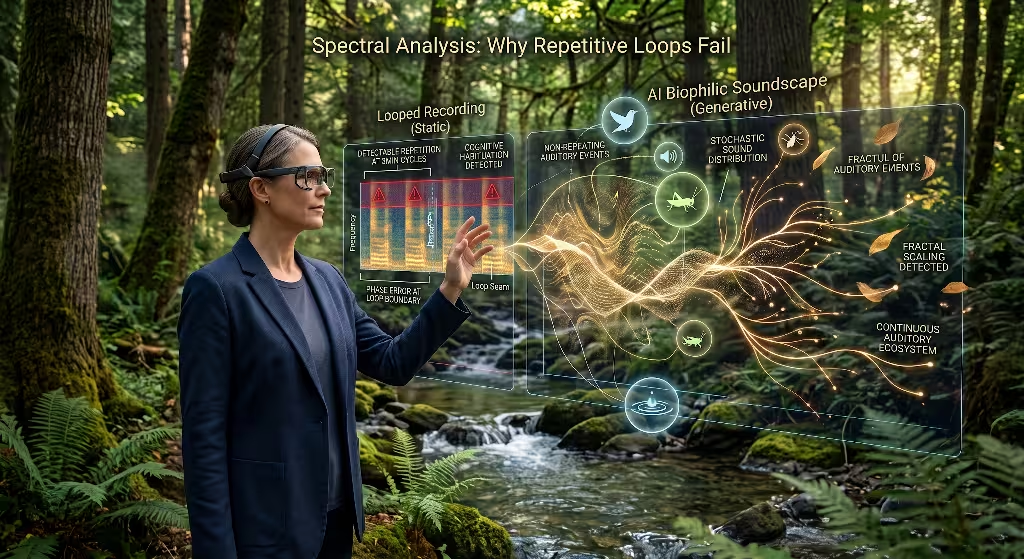
Let us analyze the acoustic mechanics of sound waves to understand why recorded loops fail so consistently. In acoustic science, a spectrogram graphs time along the horizontal axis, frequency along the vertical axis, and sound intensity as color brightness.
When you look at a spectrogram of a standard recorded ocean track looping on a media player, you immediately notice rigid vertical lines and repetitive horizontal bands. Every three minutes, identical spikes appear at the exact same frequencies. The sound pressure level follows an artificial, unchanging pattern.
The human brain is an elite pattern recognition computer. Even when you are not consciously paying attention, your subcortical auditory pathways scan incoming sound for repeats. When an audio loop runs, the repetitive phase artifacts and identical frequency spikes soon trigger an irritation reflex. Your brain realizes that the acoustic event happening right now is an exact carbon copy of the acoustic event that occurred three minutes ago. In biological reality, no two physical events ever match so completely. The brain flags this artificial repetition as an anomaly. Rather than fading into the background, the looped recording demands cognitive processing, pulling your attention away from your actual tasks.
An AI biophilic soundscape eliminates phase locks and identical frequency spikes. In an AI biophilic soundscape, the algorithmic sound pressure levels, frequency cutoffs, and envelope curves fluctuate within natural, organic limits. The spectrogram of an AI biophilic soundscape looks just like the spectrogram of an unmanaged, wild meadow. It exhibits constant, subtle organic flow. There are no sudden loop boundaries, no static audio files, and no unnatural acoustic artifacts to break the spell.
Input Layer and Sensor Telemetry
How does a computer system build an authentic AI biophilic soundscape? The process begins with an intelligent input layer that gathers information about the surrounding context.
An advanced AI biophilic soundscape does not run in complete isolation from the real world. Instead, it listens, observes, and adapts. The input layer can gather telemetry from many sources, including environmental room sensors, computer hardware data, internet APIs, and even biometric wearables.
For instance, an AI biophilic soundscape operating on a digital website or an enterprise software dashboard can check the user’s local time and local weather via simple API queries. If it is 8:00 AM on a clear spring morning where the visitor lives, the AI biophilic soundscape dynamically tunes its sonic characteristics. It introduces brighter bird calls, higher frequency wind rustles, and lighter acoustic dynamics that match a morning atmosphere. If the visitor opens the page at 11:30 PM during a rainstorm, the AI biophilic soundscape automatically darkens its spectral balance. It introduces low frequency rainfall, soft distant thunder, and gentle night insect hums.
In modern smart offices, the input layer can connect to acoustic decibel monitors placed across open work areas. If the office suddenly fills with loud phone calls or clattering dishes, the AI biophilic soundscape senses the rising ambient noise. It gently raises its own masking frequencies, boosting mid-range water textures or leaves to cloak conversational distractions. Once the room settles back into quiet, the AI biophilic soundscape lowers its output smoothly. It constantly balances human comfort without needing manual human intervention.
Generative Synthesis and Machine Learning Models
Once the input layer provides environmental context, the processing moves to the synthesis and machine learning engines. This is the heart of the AI biophilic soundscape. Modern sound generation uses two modern computing approaches: neural audio synthesis and procedural physical modeling.
Neural audio synthesis uses machine learning models, such as diffusion architectures and neural audio codecs, trained on thousands of hours of high fidelity ecological field recordings. However, unlike traditional samplers that cut and paste audio clips, a neural model generates new audio raw waveforms sample by sample based on learned mathematical representations. The neural network understands the acoustic physics of how water splatters, how wind whips around corners, and how different bird vocal tracts resonate. When requested to generate flowing water, the model dreams up a brand new, physically plausible stream of sound in real time.
Procedural physical modeling takes a more mathematical approach. It uses direct code to solve the equations of motion that describe physical nature. For example, a procedural algorithm can simulate the fluid mechanics of water droplets falling into a pool of variable depth. The code calculates the droplet impact, the air cavity collapse, and the resulting acoustic resonance bubble by bubble.
An enterprise grade AI biophilic soundscape often merges these two techniques. Procedural code handles broad, ambient textures like continuous wind, rain, and stream flow, keeping computing resource use exceptionally low. Meanwhile, lightweight neural networks or Markov chain state machines inject probabilistic, lifelike biological events, such as a solitary bird call or a distant deer stepping on dry brush. The resulting AI biophilic soundscape sounds totally realistic, requires no bulky audio file downloads, and runs without interruption indefinitely.
Spatial Dimensionality and HRTF Processing
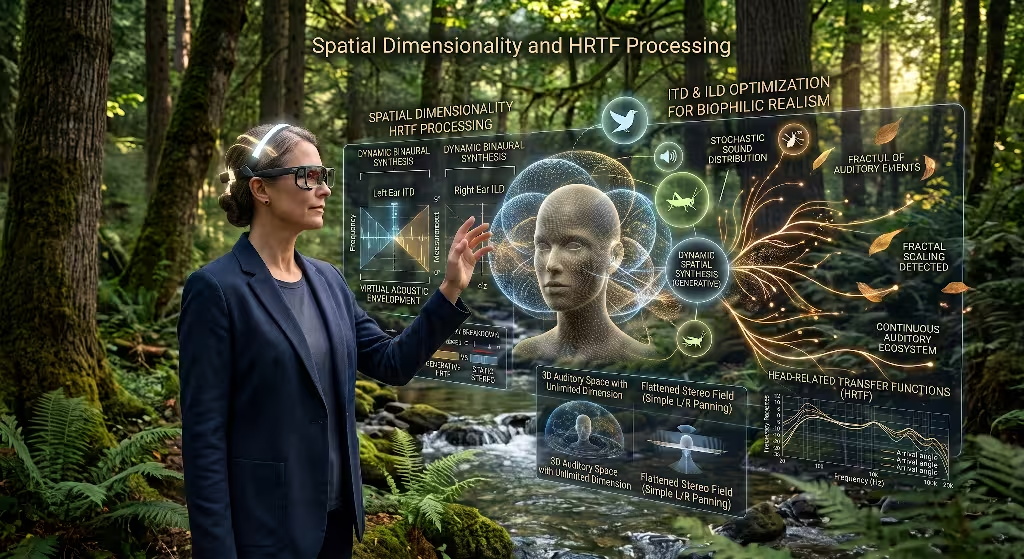
Sound in the real world is three dimensional. When a pinecone drops behind you on the left, sound waves hit your left ear drum a fraction of a millisecond before they hit your right ear drum. In addition, the sound waves bounce off the ridges of your outer ear, your head, and your shoulders, which changes the frequency shape of the sound before it enters your ear canal.
Your brain uses these tiny time differences, known as Interaural Time Differences, and level differences, known as Interaural Level Differences, to calculate the exact distance, elevation, and direction of every acoustic event around you. This complex biological filtering is mapped mathematically as a Head Related Transfer Function, or HRTF.
A standard audio recording squashes sound into a flat, two channel stereo field that sits directly between your ears. If you listen on headphones, the sound feels trapped inside your head. This unnatural acoustic flatness eventually causes listening fatigue.
An AI biophilic soundscape solves this challenge by integrating spatial audio engines powered by real time HRTF processing. When an AI biophilic soundscape spawns an acoustic event, such as a cricket chirping or a breeze passing through branches, it assigns that event coordinates in a virtual 3D space. The system calculates the proper HRTF filters for each ear based on those coordinates. When you listen to an AI biophilic soundscape through headphones or multi channel speaker arrays, the sounds appear to move naturally around you. You perceive depth, height, and open distance. This acoustic airiness opens up the virtual room, making small indoor spaces or computer screens feel expansive and tranquil.
What Is the Difference Between White Noise, Pink Noise, and an AI Biophilic Soundscape?
Many people wonder how an AI biophilic soundscape compares to simple sound masking options like white noise machines or pink noise generators. While all of these tools aim to create better acoustic spaces, they work through entirely different mechanisms.
| Feature | White Noise | Pink Noise | AI Biophilic Soundscape |
| Acoustic Structure | Equal energy across all frequencies | Equal energy per octave (1/f distribution) | Complex, multi-layered organic modeling |
| Sound Profile | Harsh, bright hiss (like TV static) | Deep, warm rushing sound (like a waterfall) | Dynamic blend of water, wind, foliage, and fauna |
| Generation Method | Simple algorithmic random math | Filtered random math | Real-time generative AI and procedural code |
| Listener Adaptation | Causes habituation and eventual fatigue | Good for sleep, but can feel sterile for work | Sustains soft fascination without cognitive fatigue |
| Real-Time Adaptation | Completely static | Completely static | Dynamically adapts to time, weather, and sensors |
| Primary Benefit | Basic sound masking | Gentle acoustic masking | Mental restoration, focus, and stress reduction |
White noise produces equal energy at all audible frequencies. If you turn on a white noise machine, you hear a sharp, static sound. White noise is effective at drowning out unexpected noises, such as dogs barking or doors slamming, because it floods the hearing spectrum completely. However, white noise contains far too much high frequency energy for comfortable daytime listening. It places an active burden on the human ear, which can increase stress if used for hours while working.
Pink noise is much gentler on the nervous system. By decreasing power at higher frequencies, pink noise produces a warm, steady rush that sounds similar to steady rain or blowing wind. Pink noise works wonderfully for helping infants sleep or helping adults drown out city traffic at night. However, pink noise remains a flat, unchanging mathematical wall. It lacks semantic meaning, depth, and spatial variation. When you need to sit at a desk and do creative, high value work, pink noise can feel lifeless, unnatural, and isolating.
An AI biophilic soundscape goes far beyond basic synthetic noise. An AI biophilic soundscape does not just mask unwanted sounds; it actively nourishes human psychoacoustics. Instead of a flat wall of static, it provides rich, biologically meaningful sound layers. You hear the deep, pink noise rumble of rolling water, the gentle mid frequency rustle of birch leaves, and the delicate, high frequency sparkle of water spray. An AI biophilic soundscape provides the noise masking benefits of pink noise while simultaneously delivering the cognitive restoration, stress relief, and natural soft fascination that only a living, adaptive acoustic environment can provide.
Can an AI Biophilic Soundscape Improve Productivity and Focus?
In modern work environments, acoustic distraction is the single largest threat to deep, productive work. Open plan offices, shared coworking spaces, and busy home offices are filled with disruptive noise. The most damaging distraction of all is intelligible human speech.
Human brains are hardwired to process language. When a coworker speaks fifteen feet away, or your family member takes a phone call in the next room, your brain cannot simply ignore the words. Your speech processing centers involuntarily decode every sentence, pulling precious directed attention away from your spreadsheet, design file, or computer program.
An AI biophilic soundscape improves productivity through a process known as acoustic speech privacy and informational masking. The complex, broad spectrum layers of an AI biophilic soundscape wash over the mid-range speech frequencies, blurring the sharp consonants of distant conversations. When speech becomes unintelligible, your brain stops trying to decode it. The conversation dissolves into harmless background texture, allowing you to stay focused on your work.
Furthermore, an AI biophilic soundscape actively restores mental stamina during demanding cognitive tasks. In controlled workplace studies, employees working in environments enriched with natural acoustics consistently report lower subjective stress, fewer headaches, and higher ratings of focus compared to workers in silent or white noise environments. Because an AI biophilic soundscape avoids the mental exhaustion caused by looped recordings, employees can maintain productive flow states for extended periods, finishing tasks faster and with fewer errors.
How Are Biophilic Soundscapes Implemented in Websites and Digital Interfaces?
At Silphium Design, our mission is to take biophilic principles out of the woods and embed them directly into digital products. Implementing an AI biophilic soundscape on a modern website requires technical precision, deep understanding of web performance, and respect for user preferences.
Historically, adding sound to a website was considered poor design practice, and for good reason. In the early days of the internet, sites frequently blasted uncompressed music files at full volume the moment a page loaded, scaring users and eating up cellular data. To do this properly today, an AI biophilic soundscape must be lightweight, respectful, and technologically advanced.
We build an AI biophilic soundscape for the web using the browser’s native Web Audio API. The Web Audio API is a powerful JavaScript system that allows developers to generate, process, and manipulate audio directly inside the client’s web browser. Instead of forcing a visitor to download a massive thirty megabyte audio file, our web code sends only a few kilobytes of lightweight mathematical instructions.
When the user gives permission, the browser’s internal audio context wakes up. The code constructs an audio routing graph consisting of procedural audio nodes, low pass filters, high pass filters, stereo panners, and dynamic gain controllers. The AI biophilic soundscape is synthesized on the fly by the user’s own computer processor. This technical approach guarantees instant load times, zero bandwidth drain, and complete acoustic responsiveness. The soundscape can instantly change its tempo, pitch, or presence based on how the visitor scrolls, clicks, or navigates through the page.
Are Nature Sounds Generated by AI as Effective as Real Field Recordings?
A common question is whether synthetic nature sounds created by an AI biophilic soundscape can match the biological benefits of real field recordings captured in wild national parks.
Recent clinical studies in psychoacoustics reveal a fascinating discovery. The human autonomic nervous system does not require a biological bird to physically sit in front of a microphone to experience acoustic restoration. What the nervous system requires is fidelity to physical and acoustic laws. If an AI biophilic soundscape correctly models the natural fractal decay of frequencies, preserves true dynamic ranges, avoids harsh unnatural digital clipping, and respects the non repeating nature of organic environments, the human body responds with the exact same relaxation markers.
In fact, an AI biophilic soundscape can often outperform real field recordings in workplace and digital applications. Real field recordings are unpredictable. A pristine three hour recording of an Alaskan forest might be interrupted suddenly by a loud, piercing bird shriek, a buzzing mosquito landing directly on the microphone, or the low rumble of a jet engine flying ten miles overhead. While these events are entirely natural, in an office or digital workspace they create jarring acoustic spikes that break a worker’s concentration.
An AI biophilic soundscape gives designers intelligent curation and control. It preserves all the peaceful, restorative, and non repeating characteristics of nature while systematically filtering out disturbing acoustic spikes. The AI biophilic soundscape delivers an idealized, restorative nature experience optimized specifically to soothe the human nervous system and protect mental focus.
The Web Audio API Pipeline
To appreciate how an AI biophilic soundscape operates inside a digital product, let us look at the technical architecture of the Web Audio API pipeline.
A modern web browser treats audio like an assembly line. At the start of the line, you create an AudioContext. The AudioContext acts as the master digital room where all sound operations live. Inside this context, we construct specialized modules called AudioNodes, connecting them together in a chain just like patching physical cables between sound modules in a sound studio.
+------------------+      +-------------------+      +--------------------+
|  Procedural Node | ---> | BiquadFilterNode  | ---> | SpatialPannerNode  |
| (Pink Noise/Gen) |      | (Acoustic Color)  |      |  (3D HRTF Space)   |
+------------------+      +-------------------+      +--------------------+
                                                                |
                                                                v
+------------------+      +-------------------+      +--------------------+
| AudioDestination | <--- | Master GainNode   | <--- |   Dynamic Gain     |
| (Speakers/Heads) |      | (User Volume Adj) |      |  (Swell & Decay)   |
+------------------+      +-------------------+      +--------------------+
In an AI biophilic soundscape, the pipeline begins with a generative audio source. This can be a procedural pink noise generator created using a custom JavaScript AudioWorklet, or a bank of procedural oscillators running frequency modulation algorithms. This raw sound represents the basic physical energy of nature, such as air blowing through space or water rushing down an incline.
Next, the audio signal travels into a BiquadFilterNode. This node functions as an intelligent acoustic shaper. By continuously adjusting the cutoff frequency and resonance of low pass and high pass filters, the algorithm sculpts the raw noise. Lowering the filter frequency creates the muffled, distant rumble of ocean surf rolling onto sand. Raising the filter frequency introduces the crisp, bright hiss of wind dancing through pine needles.
From the filter, the signal flows into a SpatialPannerNode. This node takes the audio and calculates 3D binaural positioning using the browser’s built in HRTF algorithms. The system places the virtual sound source at precise coordinates in front of, behind, or beside the listener.
After spatial processing, the signal enters a series of GainNodes. A GainNode controls volume. An AI biophilic soundscape uses dynamic gain automation to create natural swells, fades, and gusts. By applying non linear mathematical curves to the gain parameters, the system creates the natural breathing rhythms of real wind and water.
Finally, the signal routes through a master GainNode directly to the AudioDestination, which sends the finished sound to the listener’s headphones or speakers. Because this entire pipeline runs locally inside the browser’s audio thread, it uses almost zero central processor power, does not slow down page rendering, and responds instantly to user interaction.
UX/UI Best Practices and Ethical Guardrails
Designing with sound requires tremendous empathy and discipline. Because visual elements are contained on a screen, users can easily look away. Sound, however, surrounds the user completely. A poorly designed sound system can quickly feel invasive and offensive. When building an AI biophilic soundscape for websites and apps, we must follow strict ethical rules.
First and foremost is the zero autoplay rule. Modern web browsers rightly block websites from playing audio automatically without explicit user consent. An AI biophilic soundscape must never start playing out of nowhere. It should always remain completely muted until the user consciously chooses to turn it on.
We recommend providing an elegant, obvious soundscape control in the interface. A small, beautifully designed toggle button featuring a leaf, a sound wave, or an organic water icon allows visitors to choose their experience. When a user clicks the button, the AI biophilic soundscape should never snap on instantly at full volume. Instead, the system must execute an exponential volume ramp, gently fading the sound in over three to five seconds. This gradual swell mirrors the natural sensation of walking into a peaceful outdoor clearing.
Second, the default volume must be set conservatively. An AI biophilic soundscape is an ambient layer, not a musical concert. The sound should sit comfortably between eighteen and twenty four decibels below foreground speech or main media content. If a user needs to concentrate, the sound should sit right at the edge of awareness. The moment they stop thinking about it, it should blend seamlessly into the background.
Third, always offer granular control. Allow users to adjust the overall volume, or even customize the acoustic mix. Some users may prefer the deep, rhythmic rumble of coastal waves, while others feel more grounded listening to summer forest breezes and light rain. Giving users agency over their sensory environment builds trust and empowers personal comfort.
Finally, ensure full accessibility compliance. An AI biophilic soundscape must never clash with screen readers or assistive technologies used by visually impaired visitors. The audio frequencies of the soundscape must be shaped to leave the primary vocal bands clear, and the master toggle must instantly silence all background synthesis the moment a screen reader speaks or an accessible keyboard shortcut is pressed.
The Role of Micro-Interactions and Organic Sonic Feedback
Biophilic digital design does not end with broad background sound. It extends to the micro interactions that occur throughout a user’s journey across an application or website.
Every day, we click buttons, submit forms, slide toggles, and swipe through menus. In traditional interface design, these actions are either completely silent, or they trigger cold, mechanical clicks, digital beeps, and synthetic chirps. These synthetic sounds reinforce the feeling that we are interacting with an impersonal, lifeless machine.
An AI biophilic soundscape system can easily extend its procedural synthesis engine to manage organic micro interactions. Instead of an abrasive mechanical beep when a form submits successfully, the system can trigger the soft, resonant droplet of water falling into a still pool. When a user slides an image carousel, the interface can produce the subtle, dry rustle of silk paper or bending leaves. When a visitor hovers over an important navigation menu, the system can generate a delicate harmonic tone modeled on the natural vibration of a wooden marimba bar.
These organic micro interactions provide clear, immediate usability feedback while keeping the sensory experience grounded in the natural world. They make digital software feel responsive, tactile, and living, replacing digital frustration with subtle moments of sensory delight.
Comparative Analysis: Audio Interventions in Built and Digital Spaces
To visualize how different audio strategies compare across key technical and human dimensions, consider how an AI biophilic soundscape compares to conventional solutions:
Static audio loops, such as simple MP3 files, carry high bandwidth costs because the entire audio file must be downloaded over the network. They lead quickly to cognitive fatigue as the human ear detects repeating patterns, and they cannot adapt dynamically to changes in room conditions or the time of day.
Synthetic sound masking, such as commercial white noise machines, uses little bandwidth and effectively masks outside speech. However, it provides a sterile, unnatural sensory experience that can feel abrasive over long working days, offering zero restorative value to a tired mind.
An AI biophilic soundscape represents the optimal synthesis of nature and technology. Because it runs on procedural code and generative models, network overhead is tiny. It completely eliminates cognitive fatigue by generating infinite, non repeating variations. It aligns smoothly with circadian rhythms, adjusting its tone based on daylight and weather. Most importantly, it actively fosters soft fascination, restoring mental energy while protecting deep focus.
Strategic Value: SEO, Dwell Time, and Digital Metrics
Beyond the proven psychological and biological benefits, implementing an AI biophilic soundscape provides massive commercial value for modern digital businesses.
In modern search engine optimization, search algorithms reward websites that deliver exceptional, engaging user experiences. Search engines closely track user engagement signals, including average session duration, dwell time, and bounce rates. When a visitor lands on a webpage, reads for ten seconds, feels overwhelmed or uninspired, and immediately leaves to return to the search results, search engines take note. They interpret this quick exit as a sign that the webpage failed to satisfy the user’s intent.
Conversely, when a website provides an inviting, comfortable, and restorative environment, visitors stay significantly longer. By offering visitors an opt in AI biophilic soundscape, you create a welcoming digital space where users enjoy reading long form articles, browsing product collections, and exploring technical content.
Consider an architecture firm, an interior design agency, a premium lifestyle brand, or an educational publication. When visitors turn on an ambient AI biophilic soundscape, their stress levels drop, their breathing slows, and their focus deepens. They read articles completely rather than skimming the first three paragraphs. This directly increases on page dwell time, drives down bounce rates, and signals to search engine algorithms that your website provides remarkable, high quality value.
Furthermore, an AI biophilic soundscape serves as an unforgettable element of sonic branding. In a crowded digital world where almost every website looks like a carbon copy of a minimalist template, an organic, responsive acoustic signature makes your brand instantly memorable. Customers remember how your digital space made them feel: calm, focused, and respected.
Future Horizons: Real-Time Biometric Integration and Spatial Computing
We are only at the beginning of what generative acoustic systems can achieve. As computing hardware becomes faster and wearable health technology becomes ubiquitous, the capabilities of an AI biophilic soundscape will expand rapidly.
One of the most thrilling frontiers is the integration of real time biometric telemetry. Smart watches, health rings, and lightweight neural headbands can now track heart rate, heart rate variability, skin temperature, and electrodermal stress activity in real time.
Imagine working inside a software application powered by an adaptive AI biophilic soundscape. As you encounter a stressful problem or enter the fourth hour of intense programming, your wearable device notices a drop in heart rate variability and a rise in muscle tension. It securely signals the application’s audio engine.
Without breaking your concentration or popping up an annoying alert box, the AI biophilic soundscape smoothly adapts its synthesis parameters. It gently introduces softer rainfall textures, lowers high frequency wind noise, and strengthens deep, rhythmic water resonance that guides your autonomic nervous system back to a grounded baseline. The soundscape acts as an ambient biofeedback loop, protecting your health and well-being while you work.
Another frontier is spatial computing and virtual reality. As professionals move from flat desktop monitors to spatial headsets and augmented reality glasses, the need for realistic, responsive acoustic environments becomes critical. An AI biophilic soundscape can map virtual natural elements into your actual physical room. You might glance at your office window and hear the procedural sound of virtual rain gently pattering against the glass, or look up at your ceiling and perceive the spatial whisper of wind passing through virtual leaves. Digital technology stops feeling like an isolating screen and begins feeling like a natural extension of our living planet.
Synthesis and Conclusion
For decades, the story of modern technology has been a story of separation. We separated ourselves from sunlight to work under fluorescent tubes. We separated ourselves from open landscapes to sit in cubicles. We separated our ears from the complex, restorative sounds of the natural world to live among the harsh, monotonous hum of fans, motors, and digital silence.
We do not have to accept this trade off. The emergence of the AI biophilic soundscape proves that our most sophisticated computing tools can be used to heal the very sensory disconnect they once helped create.
By combining the foundational biology of the biophilia hypothesis, the cognitive wisdom of Attention Restoration Theory, the mathematical beauty of fractal noise, and the cutting edge capabilities of generative machine learning, we can build digital spaces that respect and nurture human biology.
An AI biophilic soundscape is not a frivolous gimmick or a simple audio track. It is an intelligent, living bridge between ancient human evolutionary needs and the modern digital landscape. Whether implemented across corporate office buildings, enterprise software platforms, or boutique websites, an AI biophilic soundscape transforms cold digital interfaces into calm, restorative sensory sanctuaries. As designers, developers, and thinkers, our challenge is clear: we must stop designing for screens alone, and start designing for the complete human being.