
Beyond the Headset
At Silphium Design LLC, we believe that the best digital tools are those that mimic the efficiency and beauty of nature. For years, people thought that virtual reality was just for games. They saw it as a way to escape the real world. However, as we move into 2026, we are seeing a major shift. The true benefits of virtual reality in local communities are found in how this technology helps us reconnect with our physical surroundings and each other.
In our local areas, virtual reality acts as a force multiplier. This is a technical term that means it makes our existing efforts much more powerful. Imagine a small town trying to build a new park. In the past, they would show a flat drawing on a piece of paper. Most people cannot visualize a 3D space from a 2D map. With virtual reality, those same residents can put on a headset and walk through the park before a single tree is planted. This creates a biophilic connection, a natural bond between humans and their environment, even before the environment exists in the physical world.
The scope of these benefits is wide. We are not just talking about cool gadgets. We are talking about deep changes in how we learn, how we vote, and how we care for our neighbors. Virtual reality is becoming a cornerstone for local economic development. It is a tool for inclusive education. It is even a way to make our cities smarter and more empathetic. In this article, we will explore how virtual reality is transforming the places we call home. We will look at the hard data, the social impacts, and the innovative ways that local leaders are using this technology to build a better future.
Table of Contents
Revolutionizing Local Education and Skill Development
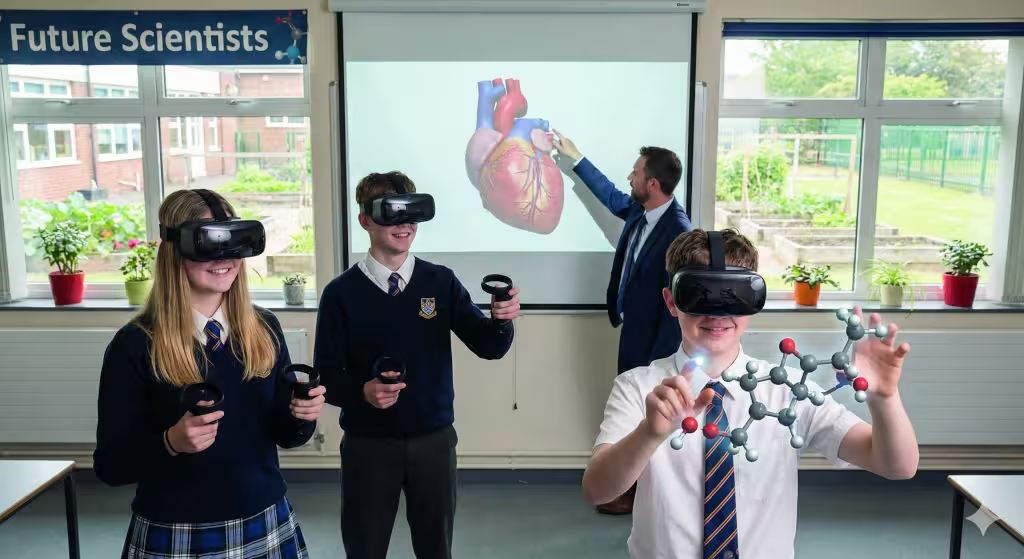
Education is the heartbeat of any community. When schools thrive, the community thrives. One of the biggest benefits of virtual reality in local communities is how it levels the playing field for students. Not every school district in America has the budget for a high-end chemistry lab or a trip to the Great Wall of China. Virtual reality changes that by providing immersive learning experiences that are safe, repeatable, and deeply engaging.
Immersive STEM Labs
In many local schools, science, technology, engineering, and math (STEM) subjects can feel abstract. It is hard to get excited about molecular biology when you are just looking at a textbook. However, using virtual reality, students can shrink down to the size of a cell. They can watch how mitochondria produce energy or how DNA replicates. This kind of experiential learning is much more effective than traditional methods. Research from the U.S. Department of Education shows that when students use virtual reality, their retention rates can jump by over 70%.
Virtual Field Trips
Field trips are a staple of the local school experience, but they are often limited by distance and cost. Virtual reality allows a classroom in rural Vermont to visit the Smithsonian in D.C. or a coral reef in the Pacific. These are not just videos; they are 360-degree experiences where students can look in any direction and interact with the environment. This expands their horizons and helps them understand their place in a much larger world.
Vocational Training and Job Readiness
Local trade schools and community colleges are also seeing the benefits. For example, a student learning to be an electrician can practice wiring a complex circuit in virtual reality. If they make a mistake, there is no risk of a fire or injury. They can keep trying until they master the skill. This “risk-free” training makes them much more confident when they finally step into a real-world job site.
People Also Ask: How is virtual reality used in education and healthcare?
In education, virtual reality is used for “active learning,” where students perform tasks instead of just listening. In healthcare, it is used for surgical simulation, allowing doctors to practice rare procedures. It is also used for physical therapy, where patients play games in virtual reality to help them regain movement after an injury.
Enhancing Civic Engagement and Urban Planning
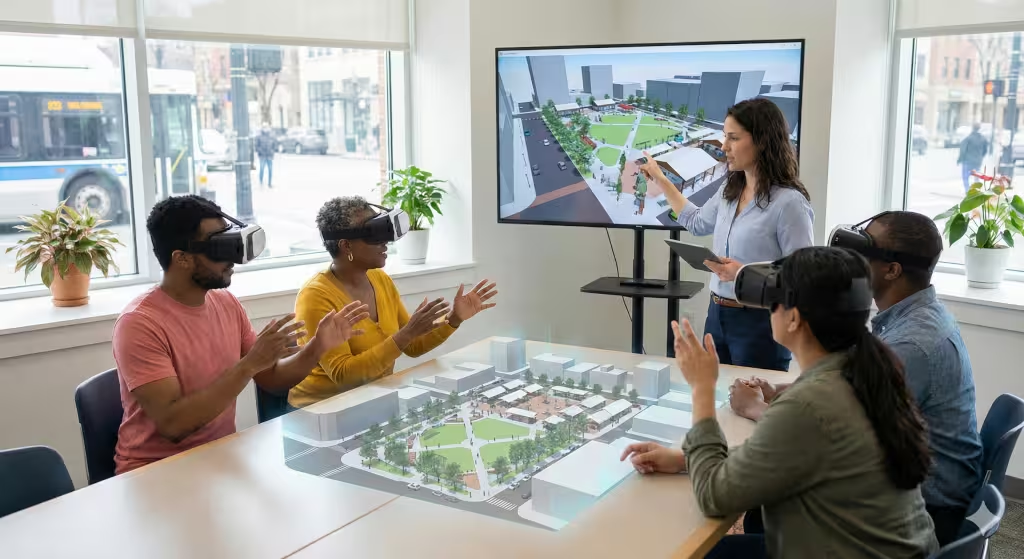
One of the most exciting aspects of my work at Silphium Design LLC is seeing how technology can improve our physical cities. Urban planning is often a source of conflict in local communities. People worry about how new buildings will change their views or how a new road will affect traffic. Virtual reality provides a way to solve these problems through transparency and collaboration.
Participatory Design
Participatory design is the idea that the people who live in a place should have a say in how it is designed. In the past, this was done through town hall meetings where only a few people would speak. Now, cities like Boston are using virtual reality to let every citizen participate. A person can put on a headset at the local library and see exactly how a proposed skyscraper will cast shadows on their street. They can see how a new bike lane will look. This leads to better feedback and fewer surprises.
The Power of the 3D City Model
Instead of looking at blue lines on a white page, planners now use a “Digital Twin.” This is a highly detailed 3D model of the city. When we use virtual reality to explore this twin, we can simulate different scenarios. We can see what happens to traffic if we close one street, or how wind flows between two buildings. This data-driven approach ensures that our cities are built to be comfortable and efficient.
Case Study: Bristol City Council and Iowa DOT
The Bristol City Council in the UK has been a leader in using virtual reality for public engagement. They created immersive models of urban regeneration projects, allowing residents to “walk the streets” of the future. Similarly, the Iowa Department of Transportation used virtual reality for the I-74 bridge project. By letting the public see the bridge in a 3D virtual space, they were able to build trust and excitement for the project.
Boosting Local Economic Growth and Tourism
Small businesses are the backbone of our local economies. However, they often struggle to compete with global online giants. Virtual reality offers local shops and tourist spots a way to stand out. It creates a unique “draw” that brings people back to the physical downtown area.
Virtual Tourism (Pre-visit)
Local museums and historical sites are using virtual reality to give people a “taste” of what they offer. A person might explore a 3D version of a local landmark on their phone or headset at home. This makes them much more likely to visit the site in person. It is a powerful marketing tool that builds a connection before the visitor even arrives.
Supporting Local Boutiques and Retail
In 2026, we are seeing more local shops create virtual reality storefronts. This allows customers to browse a shop from their living room in a way that feels natural. You can see the scale of a piece of furniture or the texture of a fabric. This “try before you buy” approach increases customer confidence and reduces returns.
| Benefit Category | Impact on Local Economy |
| Tourism | Increases foot traffic to local landmarks and historical sites. |
| Retail | Allows small shops to offer immersive “virtual catalogs.” |
| Real Estate | 40% of buyers are influenced by virtual reality tours of local homes. |
| Job Creation | Higher demand for local tech experts to manage VR infrastructure. |
People Also Ask: How does virtual reality impact society?
Virtual reality impacts society by bridging the gap between digital data and human experience. It makes information more accessible and helps people understand complex issues through first-hand experience rather than just reading about them.
Fostering Empathy and Social Equity
There is an immense value of empathy in a healthy community. One of the most profound benefits of virtual reality in local communities is its ability to act as an “empathy machine.” It allows us to step into the shoes of our neighbors and see the world from their perspective.
Social Presence and Perspective-Taking
The term “social presence” refers to the feeling that you are actually with another person in a virtual space. When we use virtual reality for community building, we can create experiences that promote “perspective-taking.” For example, a city official could use a simulation to see how difficult it is to navigate a local sidewalk in a wheelchair. This direct experience often leads to much faster changes in local policy than a thousand written complaints.
Support for Marginalized Groups
Virtual reality creates safe “third spaces” for groups that might feel isolated in their physical town. For example, elderly residents who cannot leave their homes can join a virtual community center. They can play cards, listen to music, and talk with friends in a way that feels like they are truly there. This reduces the health risks associated with loneliness and social isolation.
Mental Health at Scale
Local clinics are increasingly using virtual reality for mental health. It is used for “exposure therapy,” helping people overcome phobias or PTSD in a controlled, safe environment. It is also a powerful tool for mindfulness. By transporting a stressed worker in a busy city to a calm, virtual forest, we can significantly reduce their heart rate and cortisol levels.
Environmental Stewardship through Virtual Connection
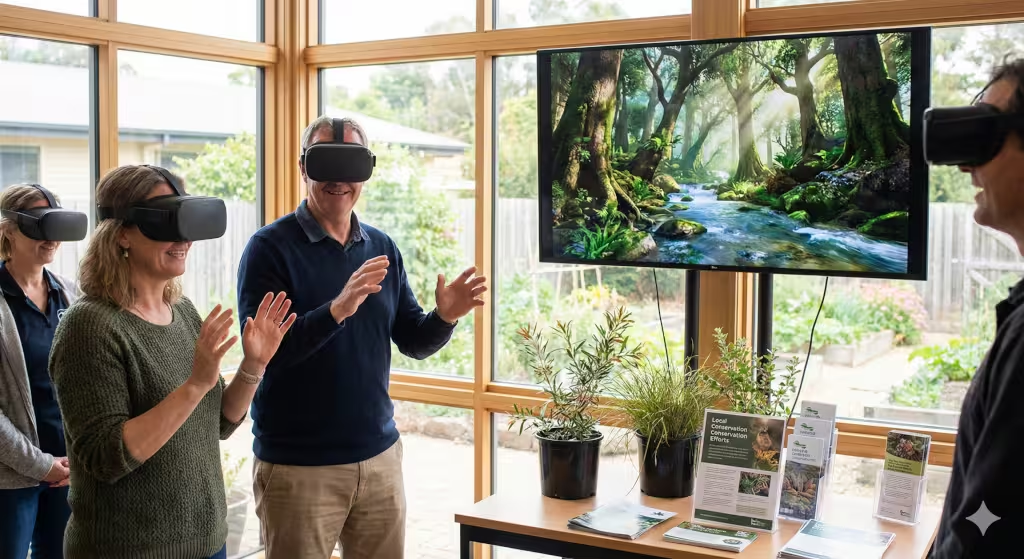
This is where my work in biophilic design truly shines. We know that people only protect what they love. One of the hidden benefits of virtual reality in local communities is how it can foster a love for local nature.
Biophilic Design in Virtual Spaces
At Silphium Design LLC, we incorporate natural patterns into our digital work, following the priniciples of biophilic design. Virtual reality allows us to take this a step further. We can create virtual versions of local parks and forests that follow the laws of biology. These spaces provide the same restorative benefits as real nature. Studies from Harvard have shown that even a few minutes in a biophilic virtual reality environment can improve mood and cognitive function.
Visualizing Climate Impact
It is often hard for people to care about climate change because the effects seem so far away in time. Virtual reality can change that. We can show a local community what their coastline will look like in 50 years if sea levels continue to rise. We can show how a local forest will look after a drought. When people see these impacts in a 3D space that feels real, they are much more motivated to take action today.
Motivating Real-World Action
The goal of using virtual reality for the environment is not to replace the real world. Instead, it is to get people excited about the real world. A virtual tour of a local trail can inspire a family to go for a hike that weekend. A virtual lesson on local bees can lead to more people planting pollinator gardens in their backyards.
The Technical Reality of 2026
When we discuss the technical reality of 2026, we are looking at a world where the barriers to entry have mostly vanished. For many years, virtual reality was held back by three main problems: it was too heavy, it was too expensive, and it made people feel sick. Today, those problems have been solved through a mix of better hardware, faster internet, and the power of artificial intelligence.
Hardware: From Helmets to Eyewear
The biggest change is the form factor. We no longer see the bulky plastic boxes that people had to strap to their faces. Today, we use waveguide optics and MicroLED displays. These allow for glasses that are lightweight and look almost like regular eyewear. Because they are light, people can wear them for longer periods during a town hall meeting or a long classroom lesson. This comfort is essential for biophilic design. If a tool feels unnatural or heavy, our brains remain in a state of stress. By making virtual reality physically comfortable, we allow the user to relax and truly engage with the digital nature or the community data they are viewing.
We also see the rise of new operating systems. The collaboration between Google and Samsung to create Android XR has made the technology as easy to use as a smartphone. This means a local librarian or a small business owner does not need a degree in computer science to set up a virtual reality experience. It is now a plug-and-play reality.
The Speed of 2026: 5G-Advanced and 6G
Connectivity is the nervous system of our virtual neighborhood. In 2026, we are seeing the rollout of 5G-Advanced and the first test programs for 6G. This is important because virtual reality requires a lot of data to be sent very quickly. If there is even a tiny delay, or latency, the user can feel dizzy.
With 6G speeds reaching up to one terabit per second, latency has dropped to microseconds. This makes the experience feel instant. In a local community, this means that a doctor can perform a remote check-up using a high-definition 3D model that moves in real-time. It also means that dozens of people can be in the same virtual town square without the system slowing down. This “cloud rendering” takes the heavy lifting away from the headset and puts it onto powerful local servers, keeping the devices on our heads cool and light.
Artificial Intelligence as a Digital Architect
Artificial intelligence is the quiet force behind the benefits of virtual reality in local communities. AI now acts as a digital architect. When a city planner wants to show a new housing project, AI can instantly generate a photorealistic 3D model based on the real-world location. It can even simulate how local birds will nest in the new trees or how rain will flow down the streets.
AI also creates “Intelligent NPCs” or non-player characters. These are digital residents that students or planners can talk to. For example, a student studying local history can talk to an AI-driven version of a town founder. The AI uses natural language processing to answer questions in a way that feels like a real conversation. This makes the learning process much more personal and memorable.
Advanced Haptics: The Sense of Touch
For a long time, virtual reality was only about what we could see and hear. In 2026, we have added the sense of touch through haptic feedback. New gloves and suits use tiny actuators to simulate the feeling of weight and texture. If a student in a vocational school picks up a virtual wrench, they can feel its weight and the resistance of the bolt they are turning. This builds muscle memory, which is a vital part of learning any trade. This physical connection to the virtual world makes the experience feel grounded and real, rather than just a digital trick.
Spatial Audio and the Natural Soundscape
As someone who loves music and the sounds of nature, I find spatial audio to be one of the most important technical advances. Spatial audio places sound in a 3D space. If a virtual bird chirps in a virtual park, you hear it coming from the specific tree where it is perched. As you turn your head, the sound shifts naturally. This is another key biophilic element. Our ears are highly sensitive to where sounds come from. When the audio matches the visual world perfectly, our brains fully accept the virtual reality as a true environment.
The Integration of Virtual Reality in Local Government
Local governments are often seen as slow to adopt new technology. However, the benefits of virtual reality in local communities have forced a change. In 2026, many city halls in cities like Boston have dedicated “Spatial Planning Rooms.” These are spaces where the public can use virtual reality to participate in the democratic process.
Visualizing the Invisible
One of the hardest things for a local government to explain is infrastructure. No one wants to hear about sewer pipes or electrical grids until they stop working. Using virtual reality, city officials can make the invisible visible. They can show residents how a new green energy project will actually look and function under the ground. They can show how a new seawall will protect the town from a 100-year storm. By making these complex systems visible, they gain more public support for necessary tax spending.
Reducing Town Hall Friction
We have all been to a town hall meeting where emotions run high. Often, people are angry because they feel they aren’t being heard or they don’t understand the plan. Virtual reality acts as a neutral ground. When everyone can see the same 3D model and walk through the same future streets, the conversation moves from “I’m afraid of change” to “How can we make this change better?” This collaborative atmosphere is a huge benefit for community peace and progress.
Sustainable Communities through Virtual Reality
Sustainability is at the core of my values. I believe that we must use technology to protect our planet, not just to build more things. Virtual reality helps us achieve this by reducing the need for physical resources.
The Virtual Prototype
Before 2026, architects often built expensive physical models out of plastic and wood to show off their designs. These models were usually thrown away after the project was approved. Now, we use virtual reality prototypes. These digital models are infinitely more detailed and use zero physical materials. We can test how the sun hits the building at different times of the year to ensure it is as energy-efficient as possible. This “test before you build” approach saves millions of dollars and tons of waste.
Reducing the Carbon Footprint of Travel
We also use virtual reality to reduce the need for travel. Many community meetings or training sessions that used to require people to drive for hours now happen in a virtual space. While I still believe in the importance of physical touch and being in nature, using virtual reality for routine business helps keep cars off the road and lowers our local carbon footprint. It is a tool for balance—using digital space when it makes sense, so we can enjoy our physical space even more.
The Challenges of Virtual Reality
While I am an expert in this field, I must also be direct about the challenges. We cannot ignore the risks of any new technology. At Silphium Design LLC, we focus on making sure technology serves people, not the other way around.
Privacy and Data Security
In 2026, virtual reality devices collect a lot of data. They track where your eyes look and how your body moves. This is known as biometric data. Local communities must ensure that this data is protected. We need strong local laws to make sure that a person’s virtual movements are not being sold to advertisers. Privacy is a human right, even in a digital world.
The Digital Divide
We must also ensure that the benefits of virtual reality in local communities are available to everyone. If only the wealthy parts of town have access to virtual reality labs, we are creating a “digital divide.” Local libraries play a huge role here. By providing free access to high-quality headsets and training, they ensure that every child and senior has the chance to learn and connect.
The Future of the Virtual Neighborhood
The benefits of virtual reality in local communities are not just about “tech for tech’s sake.” They are about using our most advanced tools to solve our most human problems. Whether it is a student in a rural town getting a world-class education, a citizen helping to design a more beautiful park, or a neighbor learning to empathize with someone different from them, virtual reality is making our communities stronger.
At Silphium Design LLC, we will continue to monitor the latest trends in local search and SEO regarding biophilic and natural website design. We believe that the digital and physical worlds should grow together, like a well-tended garden. As virtual reality becomes more integrated into our daily lives, it is our responsibility to ensure it is used to enhance our connection to nature and to each other.
Virtual reality is no longer a distant dream. it is a local reality. By embracing these benefits, we can create towns and cities that are smarter, kinder, and more resilient. The headset is just the beginning; the real magic happens when we take it off and apply what we have learned to the world around us.