
Table of Contents
The Invisible Footprint of the Digital Commons
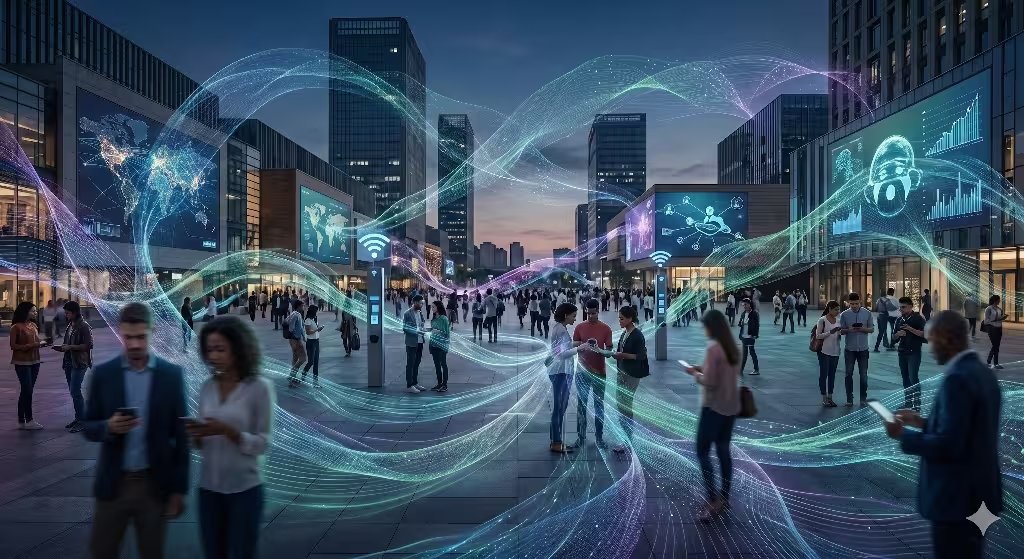
When you open a browser on your phone or laptop, it feels like you are entering an imaginary space. We often talk about the cloud as if it floats invisibly in the sky, free from the physical rules of the earth. But as a web designer and biologist at Silphium Design LLC, I look at the internet differently. The internet is actually a massive infrastructure built out of glass cables, copper wires, and giant data centers that require vast amounts of electricity. Every single click, scroll, and page view triggers a physical reaction somewhere on our planet and require sustainable web design frameworks.
The Paradigm Shift
For a long time, people thought that moving our lives online would automatically save the environment. We thought that sending an email was completely clean compared to mailing a paper letter. While digital systems do save trees, they consume an incredible amount of energy. Right now, the global information and communications technology sector creates between 1.5 percent and 3.2 percent of all global greenhouse gas emissions. That is roughly equal to the amount of pollution created by the entire global airline industry.
When we build heavy websites filled with unoptimized tracking codes, massive images, and automatic videos, we are burning fossil fuels. This realization forces a major shift in how we approach software development. We have to stop thinking of web design as an isolated art form that only exists on screens. Web design must be viewed as an extension of physical architecture. This is where sustainable web design frameworks come into play to fix the structural issues of our digital world.
The Main Thesis
To build a truly green internet, we cannot just buy carbon offsets or switch to green web hosting companies. We have to change how code is actually written. True sustainability happens when we combine technical efficiency with human psychology. By using sustainable web design frameworks, developers can build websites that require less power to load. At the same time, we can use eco-psychology to ensure that these digital environments feel calm, natural, and helpful to the human mind.
When websites are built with sustainable web design frameworks, they naturally lower the stress levels of the user. High-performance code leads to faster loading times, which reduces user frustration. Meanwhile, using design elements inspired by nature helps people feel restored instead of drained. The goal of using sustainable web design frameworks is to protect our physical planet while also protecting human mental energy.
Semantic Integration
We need to understand how low-impact engineering connects directly to positive human behavior. When a website uses sustainable web design frameworks, it values the user’s time and attention. Traditional websites often use tricks called dark patterns to keep people scrolling forever, which burns battery power and causes mental fatigue. Sustainable web design frameworks reject these practices.
Instead, sustainable web design frameworks use clean layouts and clear pathways. This combination of mechanical care and emotional awareness forms a balanced digital ecosystem. When web systems require less energy, they inherently respect human biology. By looking at software through sustainable web design frameworks, we create online spaces that mirror the balance of a healthy forest.
Foundational Concepts
To understand how these concepts work in the real world, we need to break down the two main parts of this approach. We will look at the exact engineering rules that make a website light on energy. Then, we will look at the psychological theories that explain why natural layouts make us feel peaceful.
The Technical Pillar
The first step in understanding sustainable web design frameworks is looking at how data travels across the internet. Every website is made of files. When you visit a page, your browser downloads these files. The total weight of these files is called page weight, and it is usually measured in megabytes. Sustainable web design frameworks focus heavily on dropping this total page weight as low as possible.
Another key part of sustainable web design frameworks is reducing HTTP requests. An HTTP request happens every time your browser has to ask a server for a piece of code, an image, or a font. The fewer requests a site makes, the less energy it uses. Finally, sustainable web design frameworks optimize the Document Object Model, which is often called the DOM tree. The DOM tree is the internal map that a browser uses to organize code. A simple DOM tree means the processor inside your phone or computer does not have to work as hard, which preserves battery life.
The Psycho-Emotional Pillar
The second half of our work relies on eco-psychology. This field of study looks at the emotional connection between human beings and the natural world. One of the main ideas here is the Biophilia Hypothesis, which was popularized by a scientist named E.O. Wilson. This hypothesis states that human beings have an absolute biological need to connect with nature because we evolved in natural environments. When we are separated from nature for too long, our stress levels rise.
Another important idea is Attention Restoration Theory, created by Rachel and Stephen Kaplan. This theory explains that human attention comes in two forms. The first is directed attention, which we use to stare at spreadsheets, read dense text, or navigate confusing menus. Directed attention requires hard work and causes cognitive fatigue, which is a fancy term for brain tiredness.
The second form is soft fascination, which happens when we watch leaves move in the wind or see water ripple. Soft fascination does not require mental effort. It actually gives our brains a chance to rest and recover. When we use sustainable web design frameworks, we try to create digital soft fascination to help users feel relaxed.
As the diagram illustrates, more than half of the environmental impact comes directly from device use, with another 29% stemming from storage and transfer. This shows why sustainable web design frameworks are so vital. By optimizing how code runs on local devices and reducing data transfer, we directly minimize the largest segments of the internet’s carbon footprint.
Comparative Analysis
To see the difference clearly, let us compare a standard website with a site built using modern sustainable web design frameworks.
| Dimension | Standard Web Design | Eco-Psychological Sustainable Framework |
| Primary Goal | Maximize time-on-site and attention capture | Task completion, cognitive restoration, and carbon thrift |
| Visual Assets | Autoplay video, heavy uncompressed images | SVG vectors, CSS procedural textures, optimized biophilic assets |
| Server Footprint | Monolithic setups, un-cached dynamic requests | Static Site Generation (SSG), Edge computing, Green hosting |
| User Psychology | Urgency triggers (FOMO), cognitive friction | Environmental mindfulness, clear choice architecture |
Standard web design often treats human attention like a resource to be mined. It uses heavy tracking tools and loud, bright pop-ups to keep you clicking. Websites built on sustainable web design frameworks prioritize your time. They load instantly because they use clean data paths. They also use visual elements that make your screen consume less electricity while lowering your stress.
The Basic Framework: Connecting Carbon Efficiency with Mental Well-Being
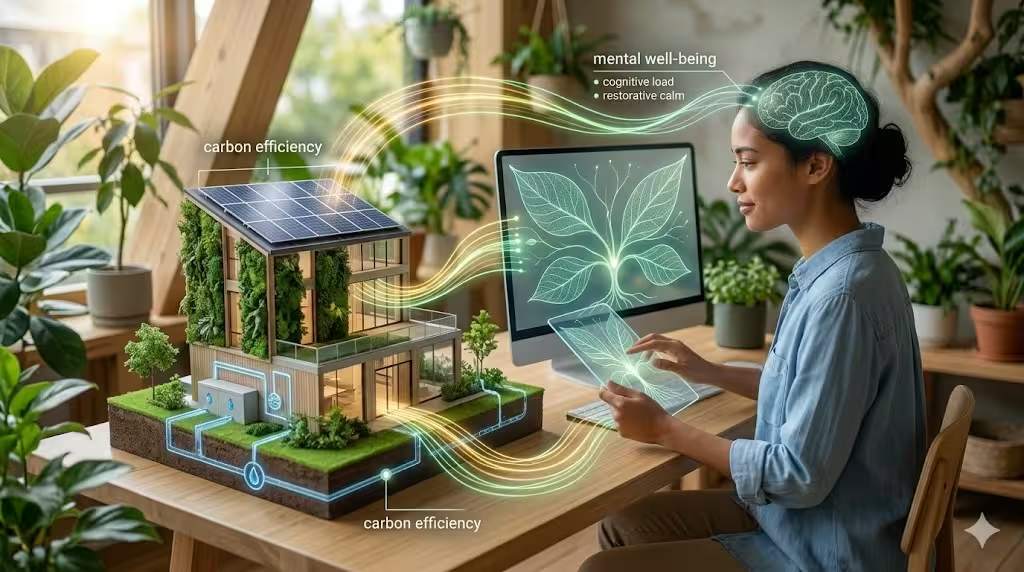
To build these green systems, we break our design process down into three main layers. Each layer focuses on a specific aspect of engineering and psychology.
Level 1: The Structural Layer (Data Cleanliness = Brain Cleanliness)
The structure of a website is its skeleton. If the skeleton is heavy and complicated, the website will be slow and wasteful. Sustainable web design frameworks start by cleaning up the code skeleton. When a website has a clean DOM tree, your browser can read the page quickly. This means the computer chip inside your phone does not have to heat up or consume precious battery power just to display a few paragraphs of text.
Using sustainable web design frameworks directly improves what Google calls Core Web Vitals. These vitals measure how fast a page loads and how stable it looks as it renders on your screen. When a site uses sustainable web design frameworks, it scores perfectly on these tests. This is excellent for search engine optimization because search engines prefer fast websites. More importantly, it helps the user. A clean structure prevents the jarring shifts and slow loading speeds that cause micro-frustrations in our daily lives.
Level 2: The Aesthetic Layer (Digital Biophilia)
Once the structure is clean, we look at the visual layer. Many developers assume that using sustainable web design frameworks means making a website look ugly or boring. That is not true at all. We use digital biophilia to make pages look beautiful and feel organic. For example, instead of using a massive five-megabyte photograph of a forest for a background, we can use procedural CSS code. This code uses mathematical equations to draw smooth, flowing organic lines directly in the browser, which takes up almost zero data.
We also pay close attention to colors. Screens use energy to light up pixels. Darker colors, especially on OLED screens, use far less electricity than bright white backgrounds. By using low-luminance tones, like deep forest greens, earthy brown shades, and soft slate grays, we save energy. These specific colors also calm the human nervous system. They reduce eye strain and protect our natural sleep cycles, showing how sustainable web design frameworks protect both nature and human health.
Level 3: The Behavioral Layer (Digital Nudging & Habit Architecture)
The final layer is all about human choice. Sustainable web design frameworks do not just sit there silently. They actively help users make better environmental decisions. This process uses a concept from behavioral science known as the Habit Discontinuity Hypothesis. This theory states that when people are pulled out of their automatic daily routines, they become much more open to making conscious, positive changes.
[Clean Code Structure] ---> Less CPU Strain ---> Lower Carbon & Faster Loading
                                  |
                                  v
[Biophilic Visuals]    ---> Soft Fascination -> Lower User Stress & Anxiety
                                  |
                                  v
[Mindful UI Choices]   ---> Eco-Nudging     -> Pro-Environmental Actions
Websites built with sustainable web design frameworks use gentle design prompts to encourage mindfulness. For example, if an online store uses sustainable web design frameworks, the checkout page might automatically select ground shipping instead of rushed air shipping. The text will clearly explain that ground shipping creates much less carbon pollution. By changing the default options, sustainable web design frameworks guide users toward green choices without making them feel forced.
Cross-Examining the Search Intent
To truly understand why sustainable web design frameworks matter, we need to answer two very common questions that people ask online. These questions get to the heart of how our digital choices impact the real world.
How does web design affect the environment?
Many people are shocked to learn that web design has any environmental impact at all. To see how it happens, we have to follow a single kilobyte of data on its journey across the network. Let us say you click on a website that does not use sustainable web design frameworks.
First, a giant data center somewhere in the world has to wake up. It spins up hard drives and runs processors to find the requested files. These data centers generate so much heat that they require millions of gallons of water and massive air conditioning systems just to stay cool.
Next, that data travels through transmission networks. It moves through underground fiber-optic cables and bounces across wireless routers and 5G cell towers. Every single one of those routers and towers runs on grid electricity twenty-four hours a day. The larger the file size, the more electricity these transmission systems consume to push the data forward.
Finally, the data arrives at your personal smartphone or computer. Your device has to use its own battery power to open the packages of data, run the complex JavaScript files, and light up the screen. When a website drops these heavy elements by switching to sustainable web design frameworks, it saves power at all three points of this journey.
The Paradox of Over-Stimulation
Modern websites are often built to be as loud and addictive as possible. They use complex scripts to watch your mouse movements, trace your scrolling habits, and load flashing advertisements. This approach creates an environment of total over-stimulation. It demands massive amounts of processing power, which causes carbon emissions to soar.
But there is a secondary problem here. This constant digital noise causes real psychological harm. It triggers our body’s fight-or-flight responses, leading to higher levels of stress and anxiety. When companies ignore sustainable web design frameworks, they create a loop of exhaustion. They exhaust the planet’s physical energy resources, and they exhaust the user’s mental capacity. Choosing sustainable web design frameworks is an intentional decision to step away from this destructive cycle.
Strategic Implementation: Building the Eco-Psychology Web Stack
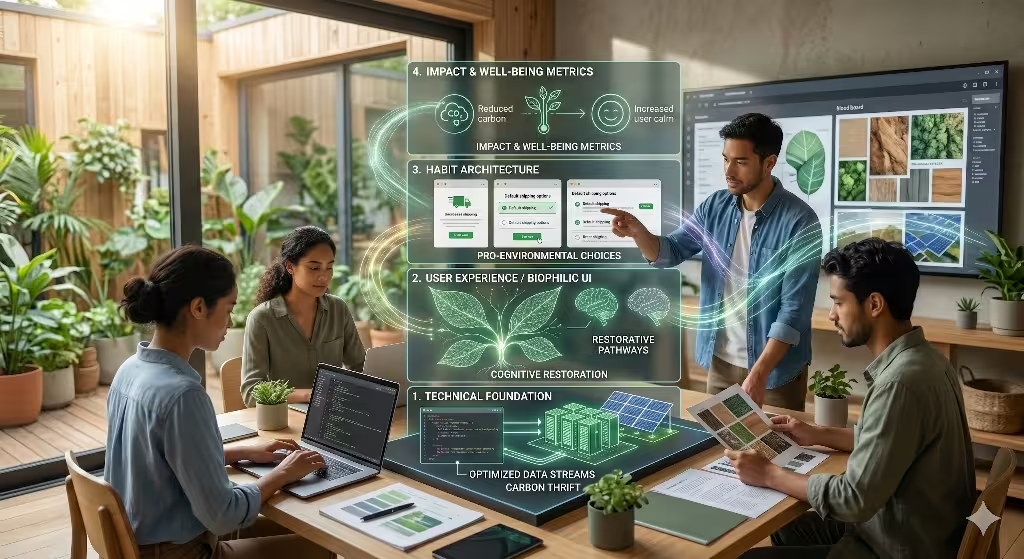
Now that we know the theory, let us talk about how to actually build these systems. Implementing sustainable web design frameworks requires a clear technical plan and a strict set of design rules.
Framework Selection
The foundation of a green website starts with the modern tools we use to write code. Traditional web platforms often build pages dynamically. This means every time a user clicks a link, a server has to build the page from scratch by pulling data from a large database. This method uses a lot of processing energy. Modern sustainable web design frameworks use a different approach called Static Site Generation.
Tools like Astro, Next.js, or Eleventy compile all the code into simple, flat HTML files ahead of time. When a user visits the site, the server simply hands them the pre-made file instantly. There are no heavy database queries required. By hosting these static files on Edge networks, which means storing the files on smaller servers located physically close to the users, we cut down the distance data has to travel. This framework selection forms the core of any serious strategy involving sustainable web design frameworks.
Asset Budgeting
To keep our designs lightweight, we use a strict data budget. When we design websites at Silphium Design LLC using sustainable web design frameworks, we set a hard limit of 500 kilobytes for the entire homepage. This forces us to make deliberate choices about every single asset we include.
- Image Compression: We avoid JPEG and PNG files wherever possible. Instead, we convert images to modern formats like AVIF or WebP, which compress images to a fraction of their original size without losing quality.
- Vector Graphics: We use Scalable Vector Graphics, or SVGs, for logos and icons. SVGs are written in pure text code, meaning they load almost instantly and consume almost zero bytes of data.
- Code Minification: We strip out all unnecessary spaces, comments, and unused scripts from our CSS and JavaScript files to keep the files as small as possible.
Biophilic UI Checklist
When building the interface, we follow a practical guide to ensure the design remains biophilic and carbon-efficient.
As seen in the design layout above, a biophilic design does not need to be heavy to be effective. This template uses simple line illustrations and clear, spacious layouts to create a calm, organic aesthetic. It communicates a deep connection to nature while keeping file sizes low. To achieve this balance consistently, we use a structured implementation process:
1.Establish System Font Fallbacks:Prerequisite Phase.
Avoid downloading heavy custom font files over the network. Configure your CSS to use fonts that are already built into the user’s operating system, such as Arial, Helvetica, or system-ui. This saves data and guarantees instantaneous text rendering.
2.Apply Natural Kinematics to Motion:Animation Optimization.
If you use transitions or micro-interactions, remove heavy JavaScript animation libraries. Use native CSS transitions with easing curves that mirror physical gravity and organic acceleration. This gives the interface a smooth, natural feel without draining the device’s battery.
3.Deploy High-Efficiency Dark Mode:Luminance Tuning.
Design a dark mode option using deep, organic tones instead of pure, stark black. Use soft charcoal tones, muted dark greens, and earth shades. This reduces the glare of the screen, protects the user’s eyes in low light, and cuts screen energy consumption significantly.
Measuring Success: Metrics for Both Planet and Mind
Once a website is live, we must verify that our sustainable web design frameworks are doing their job. We measure success using two distinct categories of data.
Quantitative Metrics
The first set of data is purely physical. We use tools like the Web Carbon API to calculate exactly how many grams of carbon dioxide are emitted every time a user loads a page. A standard web page emits about 1.5 grams of carbon per view. A site built with advanced sustainable web design frameworks should emit less than 0.2 grams of carbon per view.
We also run comprehensive Lighthouse performance audits. These audits look closely at our rendering speeds, file sizes, and structural efficiency. By tracking these numbers over time, we can prove exactly how much energy our sustainable web design frameworks are saving.
Qualitative Psycho-Emotional Metrics
The second set of data focuses on the human mind. We conduct user testing to measure cognitive fatigue and overall satisfaction. We look at the Task Success Rate, which tracks how quickly and easily a user can find what they need without getting lost in confusing design loops.
We also use survey tools to measure the visual fatigue index of our users. Users consistently report that websites built with sustainable web design frameworks feel calmer, more trustworthy, and less stressful than standard sites. This proves that reducing code weight goes hand-in-hand with lowering human stress.
Conclusion & The Future of the Natural Web
As we look toward the future, the internet will only continue to grow. The choices we make as designers, developers, and business owners will have lasting impacts on our physical environment. Relying on old, wasteful design habits is no longer a viable option. We must adopt sustainable web design frameworks to ensure that our digital world can coexist peacefully with our physical planet.
By blending the structural logic of computer science with the restorative wisdom of eco-psychology, we can build a better web. Sustainable web design frameworks offer a clear pathway forward. They allow us to create online spaces that respect the earth, conserve electricity, and protect our mental health. At Silphium Design LLC, we believe that designing for the screen should always be an extension of caring for the living world around us.