
At Silphium Design LLC, we do not view design as a simple coat of paint applied to a frame. Instead, we see it as a living process. My background in biology and web design has taught me a singular truth: every line, curve, and angle in existence serves a purpose. In the natural world, a shape is a solution to a problem.
In the digital world, the same rule applies. If a website cannot change its form to meet the needs of its users, it will fail to survive in the competitive ecosystem of the internet. This process of changing form to fit a specific need is what we call Shape Adaptation. It is the bridge between the wild plants studied by Alice Eastwood and the complex code that runs our modern world. By looking at case studies on Shape Adaptation in different environments, we can learn how to build digital tools that are not just beautiful, but also perfectly functional.
Table of Contents
Biological Case Studies: Nature’s Prototyping
When we study the natural world at Silphium Design LLC, we do not see random beauty. We see a library of solutions that have been tested for millions of years. This is the heart of what I call nature’s prototyping. In the wild, if a plant or animal has the wrong form, it does not survive. Therefore, every living thing we see today is a successful case study in Shape Adaptation. By looking closely at how these organisms have changed their physical structures to meet the challenges of their surroundings, we gain a blueprint for better website design and architecture.
The Namib Desert Beetle: Harvesting the Air
In the Namib Desert, the sun is harsh and water is almost non-existent. However, a small beetle has mastered the art of survival through a very specific kind of Shape Adaptation. The back of this beetle is not smooth. Instead, it is covered in a landscape of tiny bumps. These bumps have a special surface that attracts water, while the valleys between them are coated in a waxy substance that repels water. When the morning fog rolls in from the ocean, the beetle tilts its body forward. This is a deliberate move of Shape Adaptation that allows it to catch tiny droplets of mist.
As the mist hits the hydrophilic bumps, the water sticks and grows into larger drops. Once a drop is heavy enough, it rolls down the waxy slopes and straight into the mouth of the beetle. This perfect example of Shape Adaptation shows how a surface can be engineered to perform a complex task without using any power or moving parts. In my work as a computer scientist, I see this as a form of passive logic. We can use this same kind of Shape Adaptation in design to create systems that gather and direct information or resources exactly where they need to go.
The Lotus Leaf: The Architecture of Purity
Another brilliant case of Shape Adaptation is found in the lotus plant. Many people are amazed at how the lotus stays perfectly clean while growing in muddy water. This is not due to a chemical cleaner. It is entirely due to the Shape Adaptation of the leaf surface. If you were to look at a lotus leaf through a powerful microscope, you would see thousands of tiny, pointed structures called papillae. These structures are covered in a thin layer of wax.
Because of this unique Shape Adaptation, water cannot wet the leaf. Instead, the water forms perfect spheres that sit on top of the tiny points. When the leaf tilts even slightly, these water beads roll off. As they move, they act like tiny vacuum cleaners, picking up dirt and fungus and carrying them away. This is a form of Shape Adaptation that ensures the plant can always perform photosynthesis. For a designer, this teaches us that the texture of a surface can change how it interacts with its environment. At Silphium Design LLC, we apply this lesson by creating digital interfaces that are clean and focused, using Shape Adaptation to remove the “digital dirt” of clutter and distraction.
Shark Skin: Engineering Speed through Texture
The ocean is an environment defined by resistance. To move quickly through water, an animal must overcome drag. The shark is a master of this environment because of a remarkable Shape Adaptation in its skin. If you touch a shark, it feels like sandpaper. This is because the skin is made of millions of tiny, tooth like scales called denticles. The shape of these denticles is very specific. They have small ridges that run parallel to the flow of water.
This specific Shape Adaptation works by breaking up the tiny swirls of water that usually create drag. By smoothing out the flow, the shark can swim faster and use less energy. This is a vital lesson in Shape Adaptation for anyone building a website. Just as a shark needs to move through water, a website needs to move through the internet. We use Shape Adaptation in our code to reduce the “drag” of large files and slow loading times. By streamlining the structure of our digital assets, such as images in .webp or .avif, we ensure that the user experience is as fast and efficient as a shark hunting in the deep sea.
The Pine Cone: Motion without Energy
One of the most fascinating examples of Shape Adaptation in the world of plants is the pine cone. Alice Eastwood would likely agree that the way plants move is often overlooked. A pine cone does not have muscles, yet it can open and close based on the weather. This is a result of a mechanical Shape Adaptation in the way its scales are built. Each scale is made of two layers that react differently to moisture.
When the air is dry, one layer shrinks more than the other. This causes the scale to curl back and open the cone, allowing the seeds to fly away. When it is raining, the scales soak up water and swell, closing the cone to protect the seeds. This is a form of Shape Adaptation that allows a dead structure to respond to its environment. It shows us that Shape Adaptation can create “smart” materials. In website design, we look for ways to make our layouts react to the user without needing complex or heavy code. We want our digital shapes to open or close based on what the user needs at that exact moment.
The Baobab Tree: Storage Through Form
In regions with long dry seasons, trees must find a way to store water. The Baobab tree has used Shape Adaptation to become a living water tank. Instead of having a thin trunk like most trees, the Baobab has a massive, swollen trunk that can store thousands of gallons of water. Its Shape Adaptation includes a spongy bark that can expand as it drinks and shrink during a drought.
This lesson in Shape Adaptation is about planning for times of scarcity. In the world of search and SEO, we must use Shape Adaptation to make our content robust. We build articles that are deep and full of useful information so that they can survive “dry” spells when search algorithms change. A website with a strong, adaptive shape will continue to provide value long after thinner, less prepared sites have vanished.
By studying these biological case studies, we see that Shape Adaptation is the ultimate tool for solving problems. Whether we are trying to catch water in a desert or build a faster website, the answer is usually found in the shape of the solution. At Silphium Design LLC, we continue to use these natural lessons to build digital environments that are as resilient and efficient as the world around us.
Architectural Adaptations: From Termites to Skyscrapers
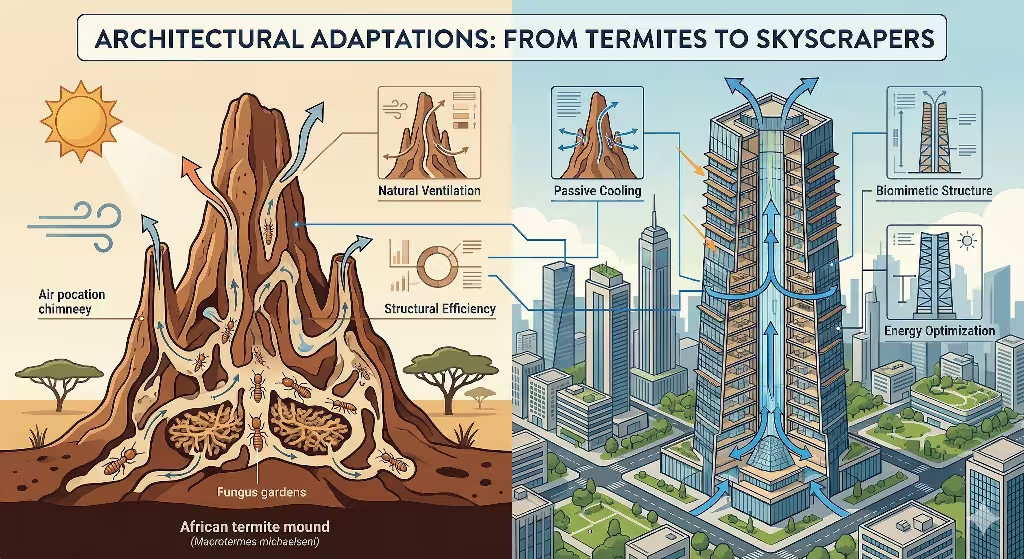
People often think that buildings are static objects that just sit there. However, the best architects know that buildings should be more like living things. In this case it is a structure that grows out of its environment. We can see this in the Eastgate Centre in Zimbabwe. The people who built this office complex looked at how termites build their homes.
Termites are masters of Shape Adaptation. They build tall mounds with many holes that let air flow in and out. This keeps the inside of the mound cool even when the sun is scorching outside. By using this same kind of Shape Adaptation, the Eastgate Centre stays cool without using expensive air conditioning. It is a building that breathes just like an insect colony.
We also see this in the work of Antoni Gaudi at the Sagrada Familia. Gaudi was obsessed with the shapes of trees and bones. He knew that nature uses Shape Adaptation to handle heavy loads. He designed the columns of his church to look like tree trunks that branch out at the top. This was not just for looks. This specific Shape Adaptation allowed the building to hold up a massive roof without needing thick, ugly walls. It creates a space that feels like a forest but functions like a high tech machine. This proves that Shape Adaptation is the key to making structures that are both strong and inspiring.
Digital Morphogenesis: Shape Adaptation in Website Design
Now, let us move from the physical world into the world of pixels and code. When I design a website for Silphium Design LLC, I apply the same rules of Shape Adaptation. In the early days of the internet, websites were like rigid boxes. They did not move or change. Today, a website lives in many different environments. It might be viewed on a giant television, a laptop, or a tiny phone in someone’s hand. To survive, the website must use Shape Adaptation.
We call this responsive design. The layout must fluidly shift its parts to fit the screen size. If a button is too small to click on a phone, the Shape Adaptation has failed. We want the digital form to flow like water into a container.
We also use biomorphic shapes in our user interfaces. These are shapes that look like things found in nature, such as leaves or pebbles. Human brains are wired to find these shapes relaxing. By using Shape Adaptation to make our menus and buttons feel more organic, we reduce the stress that people feel when using technology. This makes the website easier to use and more likely to succeed.
Furthermore, the search engines themselves act as an environment. Google looks for content that is structured correctly. We must use Shape Adaptation on our content by using headers, lists, and clear paths for the search bots to follow. If our data does not have the right shape, it will be lost in the dark corners of the web.
The Environment of Search: SEO and Shape Adaptation
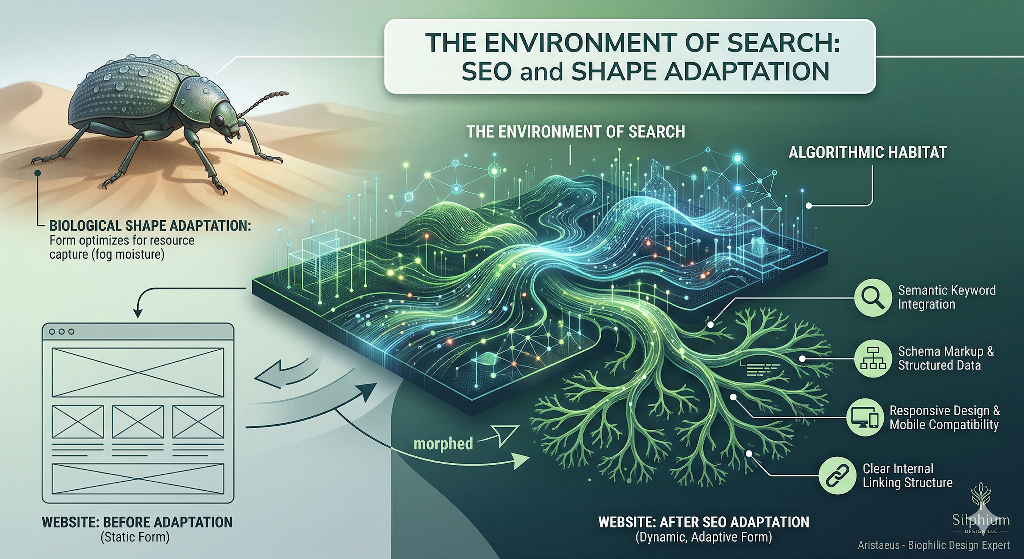
Search Engine Optimization, or SEO, is very much like a biological habitat. There are rules that decide who gets to be at the top of the mountain and who stays at the bottom. To rank well, your website needs to go through a process of Shape Adaptation. This means your text must be shaped in a way that both humans and computers can understand. For example, if we are targeting the topic of Shape Adaptation, we need to make sure the information is laid out clearly. We use keywords like “biomimicry” and “adaptive design” to help the search engine see that our content is relevant.
Many people ask how shapes adapt to their environment in the digital space. The answer is data. We look at how people click and move through a site. If they are getting stuck, we change the shape of the navigation. This is a digital version of Shape Adaptation. It is a constant cycle of testing and improving. We are not just building a page; we are growing a digital organism that wants to be found. By using the right Shape Adaptation techniques, we ensure that the most important information rises to the surface where everyone can see it.
Comparative Analysis: Environmental Pressures vs. Shape Response
To understand this better, we can compare how different pressures lead to different results. In a dry desert, the pressure is a lack of water. The response is a Shape Adaptation that catches fog. In the world of high speed data, the pressure is lag and slow speeds. The response is a Shape Adaptation in the way code is written to make it move faster. Whether we are talking about a fish in the ocean or a packet of data on the internet, the goal is to reduce resistance. A streamlined fish uses Shape Adaptation to swim faster. A streamlined website uses Shape Adaptation to load faster.
We can also look at how urban buildings face stress. A tall skyscraper faces the pressure of wind. Engineers use Shape Adaptation to give the building a curved form that lets the wind pass around it easily. On a website, the “wind” might be a sudden rush of thousands of visitors at once. The Shape Adaptation here is a cloud based server system that grows or shrinks based on how many people are visiting. In every case, the environment sets the rules, and the Shape Adaptation provides the solution. It is a universal law of design that applies to everything from biology to business.
Engineering the Future: Biomimetic SEO and Design
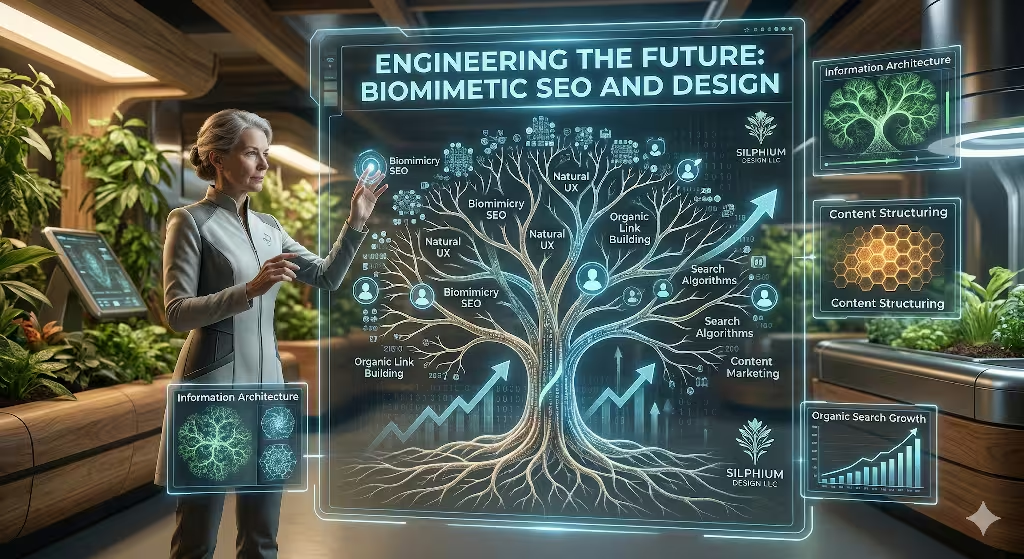
As we look toward the future, the line between technology and biology will continue to blur. We are starting to use computer programs that can “grow” designs the same way a tree grows. This is called generative design. It uses Shape Adaptation to find the lightest and strongest form for a part. Instead of a human drawing a square, the computer tests millions of shapes until it finds the one that works best. This is the ultimate form of Shape Adaptation. At Silphium Design LLC, we are excited to bring these ideas into the world of the internet.
We are also looking at how fractal geometry can be used in web layouts. Fractals are shapes that repeat themselves at different sizes, like the branches of a tree or the veins in a leaf. Using this kind of Shape Adaptation makes a website feel very natural and easy to navigate. It creates a sense of order that our brains recognize instantly. This is what I call the silicon and carbon synthesis. We are taking the best lessons from carbon based life and applying them to silicon based computers. By focusing on Shape Adaptation, we create digital spaces that feel like home.
The Adaptive Imperative
In summary, Shape Adaptation is not just a fancy term for changing how something looks. It is a fundamental strategy for success. Whether it is a beetle in the desert, a building in the city, or a website on your phone, the ability to adapt is what separates the winners from the losers. We have seen through many case studies on Shape Adaptation in different environments that the most successful forms are the ones that respond to their surroundings.
At Silphium Design LLC, we take these lessons to heart. We understand that a great website must be in a constant state of Shape Adaptation. It must change as the world changes. It must grow as its audience grows. If we ignore the environment, we will fail. But if we embrace Shape Adaptation, we can create things that are truly brilliant and lasting. The world is always changing, and our shapes must change with it. This is the core of biophilic design, and it is the future of the internet.