To understand the digital landscape of 2026, we must look at it through the lens of biology. In nature, a forest is a web of connections where every tree and every fungus has a role. In our online world, we have lived for a long time inside walled gardens. These are places like Facebook or X. They look like nature, but they are actually cages. When we talk about mastodon data ownership vs traditional social media, we are talking about the difference between being a tenant and being a landowner.
At Silphium Design, we believe that your digital presence should be like a plant with deep roots. You cannot have deep roots if someone else owns the soil. True data ownership is the only way to make sure your work and your life online are safe for the long term.
This article will show you why the decentralized forest of Mastodon is better for your future than the corporate gardens of the past.
Table of Contents
The Walled Garden vs. The Wild Forest
In the early days of the internet, things felt much more open. But over the last twenty years, giant companies built what we call walled gardens. If you think about a real garden with high stone walls, it looks very safe and pretty. The grass is cut perfectly. The flowers are all in neat rows.
This is like the user interface of a site like Facebook or Instagram. It is designed to be easy to use and very hard to leave. Inside these walls, the company provides everything. They give you the tools to talk to friends and share photos. But the walls are not there to protect you. The walls are there to keep you inside so the company can maintain total control over your data ownership.
The Walled Garden
When you are inside a walled garden, you are a tenant. You do not own the land. You do not even own the plants you put in the ground. If the owner of the garden decides to change the path of the walkway, you have no say. If they decide to tear out the rose bushes you spent years growing, they can do it in a second.
This is what happens when a social media site changes its algorithm or deletes an account. Because you do not have data ownership, you have no legal or technical way to stop them. You are living in an artificial environment that only exists as long as it makes money for someone else. In 2026, we see that these gardens are starting to wilt because they have been over-farmed for profit.
The Wild Forest
The wild forest is a much better way to think about Mastodon and the Fediverse. When I was growing up in Burlington, Vermont, I spent a lot of time in the woods. A forest does not have a single owner. It is a collection of many different things living together. There are tall trees, small bushes, and tiny fungi under the soil. They all talk to each other through a network of roots. Mastodon works just like this. Each server, or instance, is like a stand of trees in the forest. They are all independent, but they are all connected by the same soil. That soil is the ActivityPub protocol.
In the forest, you have true data ownership because you can choose exactly which part of the forest you want to live in. If one stand of trees becomes unhealthy or if the person running that server starts making bad rules, you can simply move your roots. You can pick up your entire digital life and replant it in a healthier part of the forest. Because the forest is decentralized, there is no giant wall keeping you in. You stay because the ecosystem is healthy and because you want to be there, not because you are a prisoner.
The most important part of this forest is the soil. In the digital world, data ownership is the soil. It is the foundation that allows everything else to grow. If the soil is poisoned by corporate greed or tracking, nothing healthy can grow for long.
By moving to a system that respects data ownership, you are choosing to live in a place where the soil is rich and clean. You are moving away from a monoculture, where everything is the same and fragile, and moving toward a polyculture. A polyculture is a diverse system that is much harder to break. This is why a forest can live for thousands of years while a walled garden can die the moment the gardener stops watering it.
The Artificiality of Centralized Platforms
Centralized platforms are built on a model of scarcity. They want to make sure that you feel like you have nowhere else to go. They spend billions of dollars on psychologists to make their apps as addictive as possible. This is the opposite of biophilic design. In biophilic design, we want to connect people to the natural world to make them feel calm and healthy. Centralized platforms want to keep you stressed and clicking. They do this because they need to harvest your information. Without real data ownership, every click you make is a piece of property that they take from you.
These platforms are like a greenhouse where the lights are always on. It might make the plants grow faster, but it is not natural. The plants eventually burn out. We see this with “creator burnout” in 2026. People feel like they have to keep posting just to stay visible. This is because the algorithm, which is the “sun” in this artificial world, is controlled by the company. They decide who gets light and who stays in the dark. If you had data ownership, you would not have to worry about the whims of a computer program. You would be in control of your own growth.
The Cost of the Fence
The “fences” of traditional social media are made of code and legal contracts. When you sign up, you often give away your data ownership in the fine print. These fences are designed to create “friction” when you try to leave. Have you ever tried to download all your data from a major social media site? It is often a mess of files that are hard to read and impossible to use anywhere else. This is a purposeful choice. They make it hard to leave so that they can keep claiming your data ownership as their own.
In the wild forest of Mastodon, there are no fences. There are only paths. These paths are built on open standards. An open standard is like a public road that anyone can drive on. Because the Fediverse uses these open paths, data ownership becomes a reality. You can pack up your digital bags and move along the path to a new server whenever you like. The cost of living in the forest is much lower because you are not paying with your privacy. You might pay a few dollars to a server host, but that is a fair trade for the freedom you get in return.
The Mycorrhizal Network of the Fediverse
In biology, there is something called a mycorrhizal network. This is a web of fungus that connects the roots of different trees. It allows trees to share nutrients and even warn each other about pests. The Fediverse is the digital version of this network. Instead of one giant computer, it is thousands of small computers talking to each other.
This network is what makes data ownership so powerful. Even if you are on a small server with only ten people, you can still talk to someone on a server with ten thousand people. The network carries your messages across the digital soil. This means you get the benefits of a large social circle without having to give up your data ownership to a single giant company. You are part of a community that is held together by mutual respect and common technology, rather than by a corporate boss.
Data Ownership as a Foundation for Creativity
When an artist or a writer works within a walled garden, they are always at risk. I have seen many talented designers lose their entire portfolio because a platform changed its rules or went out of business. Without data ownership, your creative work is on borrowed time. It is like painting a mural on a wall that is scheduled to be torn down.
When you have data ownership on a platform like Mastodon, your work is yours. You can archive it, you can move it, and you can control how it is shared. This creates a much better environment for real creativity. You are not trying to please an algorithm; you are trying to connect with other living beings. This is the heart of what we do at Silphium Design. We want to create digital spaces that feel like home. And you can only feel at home if you know that no one can kick you out of your own house.
Data ownership is the difference between being a product and being a person. In the walled gardens of the past, we were all products. Our interests and our friendships were sold to advertisers. In the wild forest of the future, we can be people again. We can grow at our own pace. We can connect with others in a way that is natural and healthy. The transition from the garden to the forest is not always easy, but it is the most important journey we can take in the digital age. By choosing to value your data ownership, you are choosing a more resilient and beautiful future for yourself and your community.
Technical Architecture: ActivityPub vs. Centralized Stacks
To understand how data ownership works, we have to look at the “plumbing” of the internet. Traditional social media uses something called a centralized stack. This means all the data sits in one giant computer system owned by one company. When you post a photo, it goes into their box. They hold the keys to that box. You might feel like you own it, but without data ownership, you are just looking at a copy while they hold the original.
Mastodon uses a protocol called ActivityPub. Think of this like the way email works. No one owns “email.” You can have a Gmail account and send a message to someone with a Yahoo account. They can talk to each other because they use the same language. ActivityPub is the language of the Fediverse, which is the name for the network Mastodon belongs to.
Because it uses this open language, data ownership is built into the code. The system is designed to share information across different servers without any single company standing in the middle. This decentralized structure is much more like a natural ecosystem. If one tree falls in a forest, the forest survives. If a centralized social media company turns off its servers, everything you built there dies. This is why data ownership is the most important part of a healthy digital life.
Data Sovereignty: Who Truly Owns the Seeds?
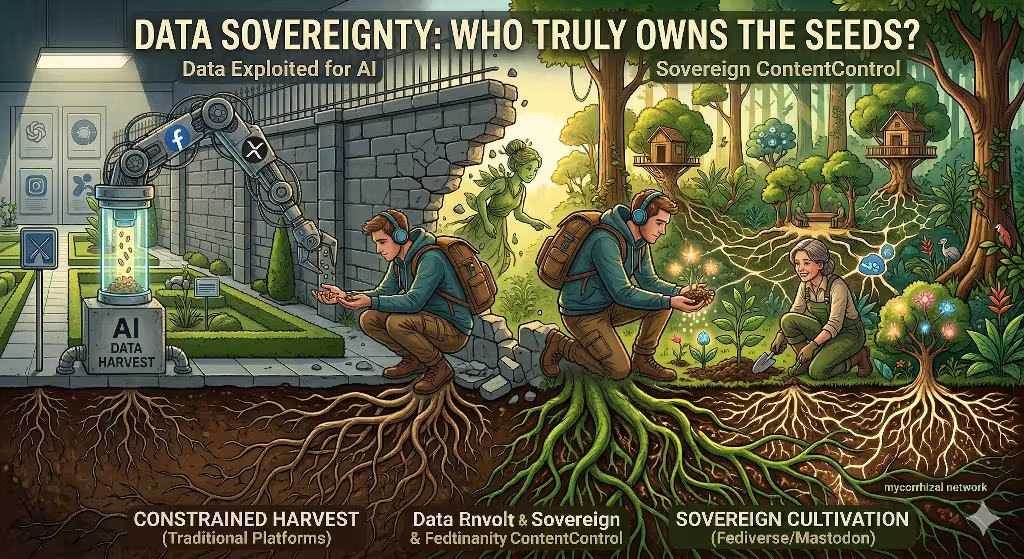
When we talk about seeds in a digital sense, we are talking about your content. Your posts, your likes, and your personal info are the seeds of your digital identity. On traditional platforms, the Terms of Service are very long and hard to read. Usually, these rules say that you give the company a license to use your content however they want. By 2026, many of these companies have used those seeds to train artificial intelligence. They are making money from your creativity without asking you. This happens because you do not have data ownership on those platforms.
On Mastodon, the rules are different because you can choose your server. Each server has its own rules, but the software itself is made to give you control. You own your seeds. You can take them with you. You can even start your own server if you want to be the boss of your own digital land. This is what we call data sovereignty. It means you are the king or queen of your own data. Having data ownership means you decide who gets to see your work and how it gets used. You are no longer just a source of free data for a big corporation.
The Portability of Digital Roots
One of the biggest fears people have is losing their friends when they move to a new site. Traditional social media companies use this fear to keep you trapped. They make it very hard to leave because they want to keep your data ownership in their hands. If you leave, you often have to start from zero. You lose your followers. You lose your history.
Mastodon solves this with something called portability. Because you have data ownership, you can move your account from one server to another. It is like moving your house to a new town but keeping all your furniture and your phone number. You can export your list of followers and import them into your new home. Your old profile will even tell people where you moved. This is only possible because the system respects data ownership. It treats you like a person who has the right to move, rather than a piece of property owned by the site.
Algorithmic Control vs. Chronological Vitality
Have you ever noticed that you don’t see every post from the people you follow on sites like Instagram or X? That is because an algorithm is choosing for you. The algorithm is like a filter that decides which plants in the garden get water. It usually picks the ones that make the company the most money. This takes away your data ownership because you are not in control of what you see or who sees you. You are being manipulated to stay on the site longer.
Mastodon does not use these types of algorithms. It uses a chronological feed. This means you see posts in the order they are shared. It is an organic way to browse. It is like walking through a forest and seeing things as they happen. Because there is no robot trying to sell you things, your data ownership is protected. Your attention is not being sold to the highest bidder. You get to decide what is important. This makes the internet feel like a much more natural and peaceful place to be.
Governance and The Nonprofit Model
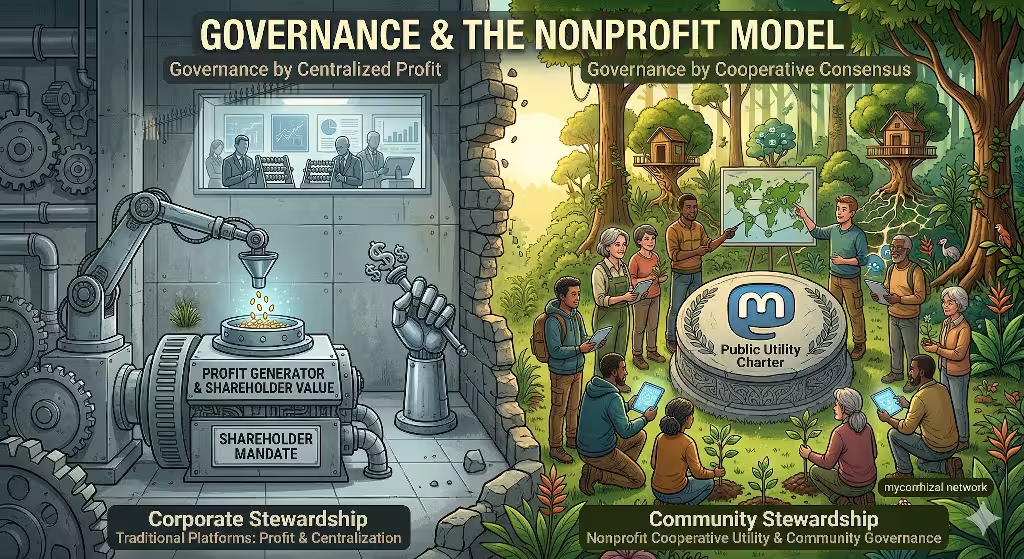
Most social media sites are built to make a profit. They have to answer to people called shareholders. These shareholders want the company to make more and more money every year. This is why those sites often trample on your data ownership. They need to sell your information to make those profits.
Mastodon is different because it is mostly run by non-profit groups and volunteers. The person who started Mastodon, Eugen Rochko, set it up as a non-profit in Germany. Their goal is not to get rich. Their goal is to make a great tool for communication. When a tool is not trying to make a profit from you, it is much easier for that tool to respect your data ownership. You are a member of a community, not a line on a spreadsheet. In 2026, we are seeing that people are tired of being treated like products. They want to be part of something that shares their values.
Safety and Moderation: A Localized Ecosystem
A big question people ask is: Is Mastodon safer than traditional social media? The answer is in how it is managed. On a giant site, a computer or a person far away in another country usually does the moderation. They don’t know you or your community. On Mastodon, moderation is local. It is like having a neighborhood watch instead of a giant, faceless police force.
Because you have data ownership, you can choose a server that has a moderation policy you like. If a server becomes toxic, other servers can stop talking to it. This is called defederation. It is like the immune system of a body. It keeps the bad germs away from the healthy parts. This localized control is part of the power of data ownership. You get to decide what kind of environment you want to live in. You are not forced to see things that make you feel unsafe just because a big company thinks it will get more clicks.
SEO and Discoverability in a Decentralized World
For people who run businesses, like we do at Silphium Design, search engine optimization is very important. You might wonder how data ownership affects how people find you. On traditional sites, you are at the mercy of their search tools. On Mastodon, things are a bit different. Because you have data ownership, your content is yours to share.
Search engines like Google can still find your posts if your server allows it. But you have to be more intentional. You use hashtags to help people find your work. This is actually better for your long-term SEO. Instead of tricking an algorithm, you are building real connections with people who care about what you do. When you have data ownership, you can build a library of content that stays with you. This makes your brand stronger and more resilient. You are not building your house on sand; you are building it on the solid ground of your own data.
Common Questions About Mastodon
People have many questions about how this all works. Let’s look at a few common ones regarding data ownership.
Who owns the data on Mastodon?
You own your posts and your media. However, the person who runs your server has the physical files on their computer. This is why choosing a server you trust is important. But because you have the right to move, you always have the ultimate data ownership. You can take your data and leave whenever you want.
Can Mastodon delete my data?
The owner of your server can delete your account if you break their rules. But they cannot delete your data from the whole internet because Mastodon is not one single thing. And because you have data ownership, you should always keep a backup of your posts. Most people on Mastodon are very helpful and will give you time to move if they have to close a server.
Is Mastodon free?
It is free to use, but it is not free to run. Servers cost money for electricity and storage. Many server owners ask for small donations. This is a much better deal than traditional sites. On those sites, you pay with your privacy and your data ownership. On Mastodon, you might give a few dollars to help the community, but you keep your soul and your data.
Designing for Digital Longevity
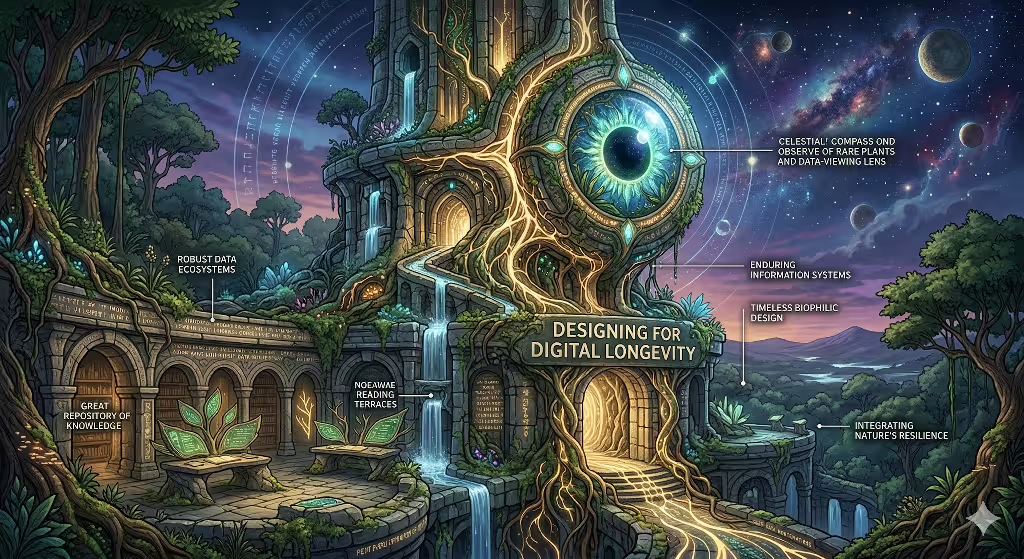
As we look toward the future, we must think about how long our digital work will last. If you put all your effort into a site you don’t own, you are taking a big risk. We have seen many sites disappear over the years. When they go, everyone’s content goes with them. This happens because the users did not have data ownership.
At Silphium Design, we teach our clients to value their digital roots. Choosing Mastodon and the Fediverse is a choice for longevity. It is a choice to own your future. When you have data ownership, you are protected against the whims of billionaires and the changes in the stock market. You are part of a living, breathing network that is built to last.
In conclusion, the debate between mastodon data ownership vs traditional social media is about more than just where you post your cat photos. It is about who has power over your digital life. It is about whether you want to live in a walled garden or a free forest. We believe that nature has the best design. Nature is decentralized, diverse, and strong. By choosing a platform that gives you data ownership, you are choosing a design that matches the natural world. You are making sure that your digital garden can grow and thrive for many years to come.
Data ownership is not just a technical term. It is a human right in the digital age. It means that you are in charge of your own story. It means that your connections with others are yours to keep. As we move further into 2026, the value of data ownership will only grow. Make sure you are standing on your own land. Make sure you are the one who holds the keys to your digital home. Mastodon gives you those keys. Traditional social media keeps them in a corporate office. The choice is yours, but for those of us who love design and biology, the answer is clear. Choose the forest. Choose the network. Choose your own data ownership.