
The internet faces a crisis of sameness. If you open ten different business websites right now, eight of them will look identical. They use the same clean white backgrounds, the same stock photos of people shaking hands, and the same standard fonts. This is the “Homogenized Web.” It is efficient, but it is cold. It lacks a soul. In my work as a biophilic design expert, I see this as a failure to connect the digital world with the physical world. We are building digital spaces that feel like nowhere, when we should be building spaces that feel like somewhere specific.
It is though every website is heading for the same singularity. An analogy is if you look at modern cars. They all very similar and appear to be heading to the same point and appearance.
This is where the concept of local heritage becomes a powerful tool for modern web development. Local heritage is not just about history books or old dusty museums. It is a user experience strategy. It is the convergence of place and pixel. When we talk about local heritage web development, we are talking about using the unique identity of a specific region, its history, its nature, and its culture, to inform how a website looks and functions.
The problem with modern web frameworks is that they encourage generic design. A template made in Silicon Valley is used for a bakery in Paris and a mechanic in Ohio. This alienates local users. It creates a disconnect. The solution is to integrate specific cultural markers and biophilic elements into the code and design. This approach signals to the user that this business belongs to their community. It signals relevance and going further builds interest.
My thesis is simple yet critical for the future of the web. Modern web development must move beyond generic aesthetics. We must incorporate local heritage and biophilic principles into our sites. We must use advanced code structures and organic design systems. This is the only way to signal true relevance to both human users and search engine algorithms. By doing this, we create a digital environment that feels as rich and complex as the natural world outside our windows.
Table of Contents
The Biological & Cultural Connection: A Biophilic Approach
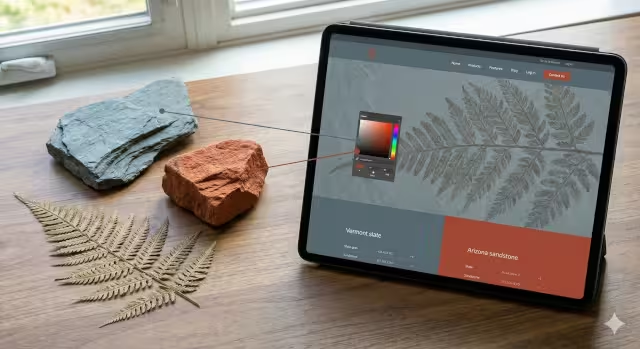
To understand how to build better websites, we must look at local heritage through the lens of biology. In my field, we call this “Heritage Ecology.” This concept suggests that the heritage of a place includes its natural history, not just the buildings humans have built. When we design a website for a company in the Pacific Northwest, the design should not just look “professional.” It should feel like the Pacific Northwest.
Here in the northeastern United States, we try to build websites with the eastern deciduous forest in mind, a coastal theme, or a lake theme to bring in the Great Lakes. These features cut through the blandness of a lot of websites and bring something different.
The above is achieved through color and pattern. Every region has a unique color palette provided by nature. The slate grey of a Vermont winter is different from the red sandstone of an Arizona desert. A skilled designer uses hex codes, the computer codes for colors, that match these local geological features. When a user from that region visits the site, their brain recognizes these colors. It feels familiar. It feels safe.
We also look at patterns. In biology, we study fractals. These are complex patterns that repeat themselves at different scales, like the branching of a tree or the veins of a leaf. Indigenous vegetation in a specific area has specific fractal patterns. By incorporating these patterns into the background textures of a website, we tap into something primal. We reduce the cognitive load on the user.
This is backed by science. Attention Restoration Theory (ART) tells us that looking at nature allows our brains to recover from stress. When we use local heritage cues that mimic the local environment, we are helping the user relax. A relaxed user stays on the website longer. They read more. They are more likely to trust the brand. This is where biophilia meets conversion rate optimization. The local heritage of the land itself becomes a user interface element, helping them feel more at home.
Technical Implementation of Cultural Heritage (The Code Structure)
Design is useless without the code to support it. It has to be remembered that search engines like Google and Bing are blind. They cannot “see” the beauty of your local heritage design. We have to explain it to them using a language they understand. That language is Schema.org.
Most developers stop at the basics. They tell Google, “This is a local business.” That is not enough. To truly leverage local heritage, we need to go deeper. We need to use specific tags like Schema.org/TouristAttraction, Schema.org/LandmarksOrHistoricalBuildings, or Schema.org/Event. These tags help search engines understand the context of the website.
For example, if we are building a site for a historic hotel, we do not just list the price of the rooms. We use JSON-LD, a data linking format, to nest historical data inside the code. We tell Google the year the building was built. We link the building to famous historical figures who stayed there. This turns a simple business listing into an entity in the Google Knowledge Graph. It tells the search engine that this site is an authority on the local area.
We also treat typography as an artifact. Fonts have history. A serif font from the 1800s carries a different meaning than a modern sans-serif font. We are seeing a rise in “Heritage Fonts,” which are digital versions of wood type used in local printing presses centuries ago. Just make sure if you are using specialized fonts that they are considered accessible under the Web Content Accessibility Guidelines (WCAG).
Technically, we can use CSS commands like font-feature-settings to unlock special characters and styles that mimic local calligraphy or historical writing styles. This is not just decoration. It is preserving the visual language of a culture through code. It ensures that the local heritage of the written word is not lost in the digital transition.
Designing for the “Phygital” Experience (Physical + Digital)
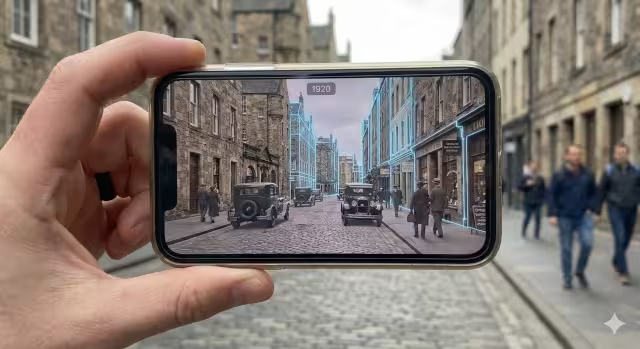
We are entering an era where the line between the physical world and the digital world is blurring. We call this the “phygital” experience. Local heritage plays a massive role here because it anchors the digital experience to a real place.
One of the most exciting technologies for this is Augmented Reality, or AR. Imagine standing on a street corner in Boston. You hold up your phone, and the browser overlays a historical image of that same street from 1920. This is possible right now using WebXR technology. It does not require an app; it works right in the mobile browser.
This type of interaction brings local heritage to life. It transforms a static website into a window through time. It engages users in a way that text alone cannot. It makes the history tangible.
Another technique is “Scrollytelling.” This is a web design trend where the story unfolds as the user scrolls down the page. We can use this to mimic the geography of a place. A website for a town on a river might have a layout that flows and winds like the river itself. As the user scrolls, they travel down the river, learning about the history and culture along the banks.
From a technical standpoint, we have to be careful. Heavy graphics can slow down a website. We use lightweight JavaScript libraries, like GSAP, to handle these animations. This allows us to tell a rich, interactive story about local heritage without hurting the site’s performance or its Core Web Vitals scores.
Frequently Asked Questions about Local Heritage
When people search for local heritage, they are often asking deeper questions about culture and connection. As developers, we must answer these questions through our design choices.
How does culture impact user experience (UX)?
Culture dictates how we browse the web. In design, we talk about “High-Context” and “Low-Context” cultures. A Low-Context culture, like the United States or Germany, usually prefers direct information. They want clean navigation, bullet points, and efficiency. A High-Context culture, which includes many Asian and Latin American cultures, often relies more on relationships and visual storytelling. This is why websites in east Asia often have a lot on them as compared to the minimalist websites of the western world.
If you are building a site for a community with a High-Context culture, a minimalist design might feel empty or rude. You need to include more imagery, more background on the company’s history, and more connection to the community. Understanding the target demographic’s cultural expectations is a key part of honoring their local heritage.
How can museums and heritage sites make websites accessible?
Accessibility is a major concern. We follow the WCAG 2.2 standards. For heritage sites, this presents unique challenges. How do you describe a historical artifact to someone who cannot see? Alt-text (the text descriptions for images) must be very detailed. We cannot just say “image of a vase.” We must describe the texture, the era it is from, and the cultural patterns painted on it. This description is not just for humans though. It is also for the search engines, which also need an accurate description of the image.
We also have to be careful with color contrast. Designers often like to use “aged” paper colors, like beige or sepia, to make a site look old. However, if the text is not dark enough against that beige background, people with vision issues cannot read it. We must balance the aesthetic of local heritage with the strict mathematical requirements of contrast ratios.
What is digital cultural heritage?
This is a common question. Digital cultural heritage is the preservation of things you cannot touch. It includes language, music, folklore, and oral histories. We preserve these by turning them into binary code. A website becomes a vault. By recording a local elder telling a story and embedding that audio file properly, we are saving a piece of local heritage that might otherwise vanish.
Case Studies: The Biophilic-Heritage Hybrid

To see how this works in the real world, let us look at a few examples where local heritage and biophilic design merge successfully. All of these sites help to bring in a local feel and calm the visitors to the website.
Example A: The Metaphor
Consider a tourism website for a region in Scandinavia. The culture there values “Friluftsliv,” which translates to “open-air living.” The design of the site reflects this. It uses massive amounts of white space to represent snow and silence. The lines are clean and sharp, mimicking the architecture and the pine forests. The textures used on the buttons look like raw wood. This is not just a stylistic choice; it is a cultural signal. It tells the user immediately what the local heritage of that region values: nature, simplicity, and light.
Example B: The Architecture
The Barbican Centre in London is a famous example of Brutalist architecture, lots of heavy, rough concrete. Their website reflects this physical reality. It uses blocky, bold layouts that feel like concrete structures. However, they soften it with digital “greenery” and bright accent colors, much like the actual conservatory inside the center. The website is a digital twin of the physical building’s heritage.
Example C: The Commercial Application
Let’s consider a coffee roaster in the Pacific Northwest. Their brand is built entirely on local heritage. Their website uses a dark, moody color palette that reminds you of a rainy day in Seattle. They use UI elements, like dividers and icons, that are shaped like ferns. This signals authenticity. It tells the customer that this coffee is not from a factory; it is from the rainforest. It uses the biophilic identity of the region’s rainforests to sell a product.
Future Trends: AI and The Preservation of Logic

The future of local heritage in web development is going to be influenced heavily by Artificial Intelligence. We are already seeing tools that can generate images and patterns. We can use AI to analyze thousands of images of local historical textiles, rugs, quilts, pottery, and generate new, unique background patterns that honor those traditions without directly copying them.
This allows us to create a “heritage aesthetic” at scale. However, we must be careful. AI can hallucinate. It might mix up styles from different cultures. The role of the human expert is to curate and verify. We must ensure that the AI is respecting the local heritage, not making a caricature of it. This is why it is important to read and edit all material, written and visual, that is created by AI.
We also need to look at the Semantic Web, often called Web 3.0. This involves decentralized storage. For endangered languages or local histories that are at risk of being deleted or forgotten, decentralized storage offers a permanent archive. We can store local heritage data in a way that no single company can turn off. This ensures that the digital footprint of a culture survives as long as the internet exists.
Conclusion
In conclusion, integrating local heritage into modern web development is not just a nice artistic idea. It is a technical and psychological necessity. As the internet becomes flooded with AI-generated content and generic templates, the websites that stand out will be the ones that feel human. They will be the ones that feel like they come from a specific place. In short, they have more interest than the generic websites of everybody else.
By combining biophilic design, the love of nature, with the cultural history of a region, we create a user experience that is deep and meaningful. We use Schema markup to speak to the search engines. We use accessible design to speak to all users. We use AR and interactive stories to bridge the gap between the screen and the street.
This is an authentic approach to the web. It adds immense value to the reader by giving them a sense of belonging. It adds value to the search engines by providing rich, structured data. As we move forward, the most successful web developers will be those who understand that code is just a modern way to tell an ancient story.