
The Death of the “One-Size-Fits-All” Digital Storefront
In the year 2026, we are seeing a massive shift in how we build websites. The old way of making one website and just translating the words into a new language is over. Today, we must focus on hyper-localization. This means we build digital spaces that feel like they belong to the specific place where the user lives.
When we talk about designing e-commerce sites for different geographies, we are talking about building trust. A person buying a coat in Vermont has different feelings and needs than a person buying a coat in Tokyo. Their brains are wired to respond to different colors, shapes, and patterns. At Silphium Design LLC, we use biophilic design to bridge this gap. Biophilic design is the practice of bringing nature into our digital spaces. Since nature looks different everywhere, our websites should too.
E-commerce today is about more than just a cart and a checkout button. It is about a feeling of safety and belonging. If a site feels like an invasive species, the user will leave. If it feels like a native plant that grew from their own soil, they will stay.
Our goal is to use computer science and biology to make e-commerce feel natural for everyone, no matter where they are on the map. We want to increase the global conversion rate by making every user feel at home. This article will show you how to master the art of designing e-commerce sites for different geographies while keeping the human spirit at the center of the machine.
Table of Contents
Technical Infrastructure: Foundations for Geographic Scaling

The first step in global e-commerce is the hidden part of the website. This is the infrastructure. Think of it like the roots of a tree. If the roots are not deep and healthy, the tree will not grow. When you are designing e-commerce sites for different geographies, you must decide how to name your website. You can use a country code, like dot fr for France. You can also use folders, like yoursite dot com slash de for Germany.
Each choice affects how search engines see your site. Using a local country code tells the search engine that you are serious about that specific place. It builds instant trust in the world of commerce. People like to see a web address that looks like it belongs to their home. This is a key part of local search engine optimization. It helps your site show up when local people search for things to buy.
Another big part of technical design is speed. In the world of commerce, every second counts. If a site takes three seconds to load, you might lose half of your shoppers. We use something called the latency equation to understand this. Latency is just a fancy word for delay. The further a user is from your computer server, the slower the site feels. To fix this, we use Content Delivery Networks. These are groups of servers spread all over the world. They keep a copy of your site close to the user. This makes the digital commerce experience feel instant.
In 2026, we also have to think about Generative Engine Optimization. This is a new way to make sure AI tools can read and recommend your site. When an AI agent helps a person shop, it needs to understand that your site is the best fit for that person’s specific area. By structuring your data clearly, you make it easy for these AI tools to promote your commerce activities.
Cultural UX and Visual Semantics: Beyond Translation

Moving past the technical roots, we find the visual parts of the site. This is what the user sees and feels. In e-commerce, visual signals are more powerful than words. Colors have different meanings in different cultures. For example, in many Western countries, red means a sale or a warning. In China, red is a lucky color that stands for wealth and happiness. If you are designing e-commerce sites for different geographies, you cannot use the same color for every country. You must study what each color means to the local people.
We also look at how much information a person wants to see at once. Some cultures, like in Japan, prefer a lot of detail. They want to see many pictures and long descriptions before they trust a store. This is called a high-context culture. Other cultures, like in the United States or Germany, prefer a clean and simple look. They want the facts quickly. If your commerce site is too busy for an American user, they might get confused. If it is too simple for a Japanese user, they might think you are hiding something.
The direction of reading is also vital. Most Western languages read from left to right. But languages like Arabic read from right to left. When you build for these areas, you cannot just flip the text. You must mirror the whole layout. The menu, the search bar, and the pictures should all move to the other side. This makes the commerce journey feel smooth and natural for the user. It shows that you respect their way of seeing the world. This level of care is what makes a brand stand out in global commerce.
Biophilic Localization: Integrating Regional Nature
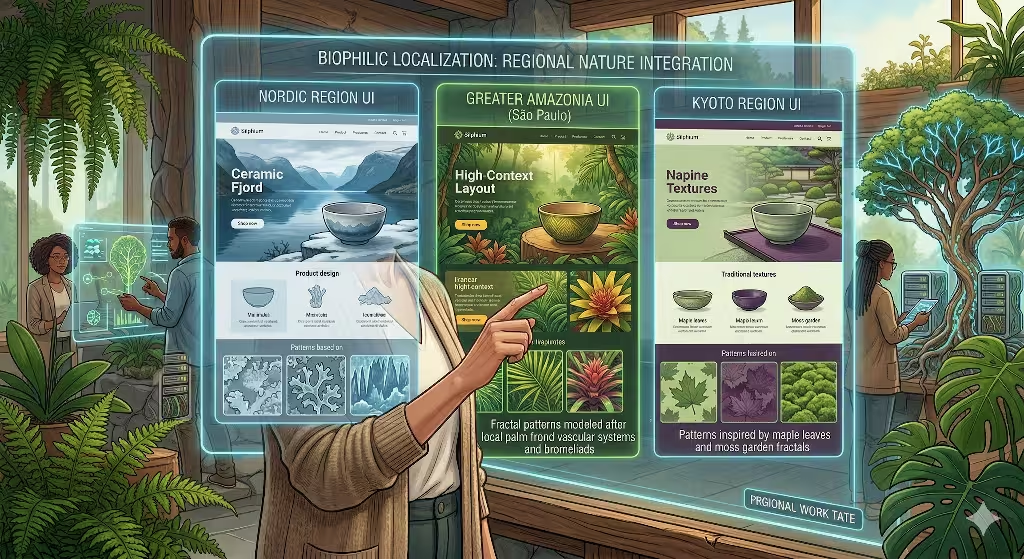
This is where my work at Silphium Design LLC really shines. We believe that digital e-commerce should mirror the physical world. Biophilic design uses patterns from nature to make people feel calm and happy. But nature is not the same everywhere. If I am in Boston, I am used to seeing oak trees and rocky shores. If I am in Arizona, I see cacti and red sand.
When designing e-commerce sites for different geographies, we use regional biophilia. This means we use colors and textures that match the local environment. For a shopper in Scandinavia, we might use cool blues, soft greys, and wood grain patterns. For a shopper in Brazil, we might use vibrant greens and sun-drenched yellows. This creates a subconscious link between the site and the user’s surroundings. It makes the act of commerce feel like a walk in a local park.
We also use something called fractal patterns. These are shapes that repeat at different scales, like the leaves on a fern or the branches of a tree. Humans are hard-wired to love these patterns. They reduce stress. By putting these patterns into the background of a commerce site, we can make the shopping experience more relaxing.
In 2026, we can even make sites change with the seasons. Using a user’s location, the website can change its lighting or color theme to match the time of day and the weather outside. If it is a sunny morning in London, the site looks bright and fresh. If it is a snowy night in Vermont, the site looks warm and cozy. This connection to the real world is the future of digital commerce. It turns a simple transaction into a meaningful experience.
Operational and Regulatory Localization
A beautiful website is useless if the user cannot actually buy anything. This is the operational side of commerce. Every country has its own favorite way to pay. In the United States, credit cards are king. In Brazil, many people use a system called Pix. In China, mobile apps are the main way to handle commerce. If you do not offer the local payment method, the user will leave their cart full and never come back. You must integrate these systems directly into your checkout flow.
Shipping and taxes are also a major hurdle. People hate surprises when they are spending money. You must be very clear about how much shipping will cost and how long it will take. If there are extra fees for bringing an item into their country, tell them upfront. This honesty builds the trust needed for long-term commerce. It is also helpful to show prices in the local currency. No one wants to do math while they are trying to buy a pair of shoes.
Finally, we must talk about the law. Different regions have different rules for data privacy. The European Union has very strict rules called the GDPR. Other places are following their lead. When you are designing e-commerce sites for different geographies, you must make sure you are following all the local laws. This protects your business and shows your customers that you care about their safety. Keeping up with these rules is a full-time job, but it is necessary for a successful commerce brand.
Common Questions About Global Design in e-Commerce
Many people wonder how to localize a website effectively. The answer is to look at it in layers. First, you handle the technical roots, like servers and domains. Second, you handle the words and the visuals. Third, you handle the local habits, like payments and shipping. Finally, you add the biophilic layer to make it feel alive. This total approach is the best way to win at global commerce.
Another common question is the difference between internationalization and localization. Internationalization is the work you do behind the scenes to make sure the site can be changed. It is the code that allows for different currencies or dates. Localization is the actual work of making the changes for a specific place. You need both to succeed. Without the right code, you cannot localize. Without localization, your code is just an empty shell.
People also want to know why cultural design is so important for sales. The reason is simple. People buy from people and places they trust. If a site feels foreign or broken, trust disappears. If a site feels like it was made just for them, they feel valued. In the competitive world of commerce, that feeling of being valued is what turns a one-time shopper into a loyal fan.
Scaling with Soul
In conclusion, designing e-commerce sites for different geographies is both a science and an art. It requires a deep understanding of computer systems, but it also requires a heart for people and nature. We must move away from the idea that the internet should look the same everywhere. Instead, we should embrace the diversity of our planet.
At Silphium Design LLC, we believe that the best e-commerce sites are those that respect the user’s local culture and environment. By using biophilic principles, we can create digital stores that feel like a natural part of the world. We can use tech to bring us closer to nature, not further away. As we move forward into 2026 and beyond, the most successful brands will be those that learn to speak the local language of both words and design.
Success in commerce is not just about the product you sell. It is about the environment you create for your customers. When you build with care, precision, and a love for the natural world, you create something truly special. You create a space where people feel safe, understood, and happy to shop. That is the true goal of our work.
A List of Payment Methods for Different Global Regions
In the world of commerce, the “checkout” is the final handshake between your digital environment and the user’s physical reality. If this handshake feels awkward or unfamiliar, the entire biophilic experience you have built will fail at the last step.
Below is a regional guide to the most essential payment methods you must integrate to ensure your commerce site feels like a native part of the local ecosystem.
North America: The Land of Digital Wallets and Cards
In the United States and Canada, commerce is currently dominated by a “wallet-first” mindset. While credit cards are still the backbone, users prefer to access them through secure, biometric-enabled interfaces.
- Apple Pay & Google Pay: These are the primary choices for mobile and desktop commerce. They provide a frictionless experience that users trust.
- PayPal: A long-standing giant in global commerce, essential for building trust with older demographics and international shoppers.
- Cash App & Venmo: Increasingly popular for younger generations (Gen Z) who treat these apps as their primary bank accounts.
- Buy Now, Pay Later (BNPL): Services like Affirm and Klarna are now standard for high-ticket commerce items.
Europe: A Patchwork of Local Favorites
Europe is highly fragmented. Designing for European commerce requires you to look at each country as a unique biological zone.
- Germany: Users here prefer PayPal, Klarna (Invoice payments), and increasingly SEPA Instant Payments (Pay by Bank).
- Netherlands: You cannot succeed in Dutch commerce without iDEAL. It accounts for nearly 70% of online transactions.
- Poland: The mobile-integrated system BLIK is the dominant force here.
- United Kingdom: High usage of Debit Cards and Apple Pay, with a growing trend toward A2A (Account-to-Account) instant transfers.
Asia-Pacific: The Mobile-First Frontier
This region has bypassed traditional cards almost entirely in favor of “Super Apps” that handle everything from social media to commerce.
- China: Alipay and WeChat Pay are mandatory. Without these, your commerce site will be effectively invisible to Chinese consumers.
- India: The UPI (Unified Payments Interface) system has revolutionized commerce. Integration with apps like PhonePe, Paytm, and Google Pay (via UPI) is critical.
- Southeast Asia: Wallets like GrabPay (Singapore/Malaysia) and GCash (Philippines) are the lifeblood of the local digital economy.
Latin America: The Transition from Cash
In this region, many users are moving directly from cash to high-tech banking apps.
- Brazil: Pix is the undisputed king of Brazilian commerce. It has overtaken credit cards in popularity because it is instant and free for the user.
- Mexico: While cards are growing, OXXO (voucher-based payment) remains vital for reaching customers who prefer to pay for their online commerce orders in person at local stores.
Middle East & Africa: Mobile Money and Regional Schemes
- Africa: M-PESA is a global leader in mobile money, especially in Kenya and Tanzania. It allows commerce to happen entirely through a mobile phone without a traditional bank account.
- Middle East: While card-heavy (Visa/Mastercard), regional debit networks like KNET (Kuwait) and BENEFIT (Bahrain) are essential for local legitimacy.
By offering these local options, you remove the “friction” that causes a user to abandon their cart. In my view, a localized payment gateway is just as important as a localized language—it is the final step in making your commerce platform feel like it truly belongs to the user’s home soil.
Structuring Your E-Commerce Terms and Conditions for a Global Setting
When you are designing e-commerce sites for different geographies, the Terms and Conditions page is often seen as a digital desert. It is usually dry, hard to read, and full of complex legal jargon. At Silphium Design LLC, we believe that every part of your website should be clear and natural. This includes the legal parts of commerce. A well-structured legal page builds trust and helps the user feel safe in their digital environment.
In the world of global commerce, the legal structure must be modular. This means you have a core set of rules that apply to everyone, but you add specific branches for different regions. This approach respects the local laws of each geography while keeping your brand consistent. Below is a structured guide to creating a biophilic and professional Terms and Conditions page for international commerce.
1. Introduction and Acceptance of Terms
This is the starting point of your legal garden. You must state clearly that by using the site, the user agrees to your rules for commerce. When you are designing e-commerce sites for different geographies, make sure this section is translated perfectly. It should explain that these terms govern all commerce activities on the website.
2. Regional Eligibility and Accounts
Different countries have different rules about who can buy things online. In some places, you must be 18 to engage in commerce. In others, the age might be different. This section should explain how users create an account and what their responsibilities are. It should also state that users are responsible for keeping their login data safe to protect the integrity of their commerce transactions.
3. Product Descriptions and Accuracy
In global commerce, what you see is not always what you get. You must explain that while you try to show products accurately, colors and textures may look different on different screens. This is very important for biophilic design, where we use many natural tones. State that you have the right to change product details or stop selling certain items to keep your commerce catalog fresh.
4. Pricing, Taxes, and Payments
This is the most technical part of commerce. You must explain how prices are set for different geographies. This includes:
- Currency: Which currency will be used for the commerce transaction.
- Taxes: How Value Added Tax (VAT) or sales tax is calculated based on the user’s location.
- Payment Methods: List the local payment gateways you use for commerce in that region.
- Errors: State what happens if a price is listed wrong on the commerce site.
5. Shipping, Delivery, and Risk of Loss
Shipping is the physical link in the chain of commerce. This section should outline how long delivery takes for different geographies. It must also explain when the ownership of the item passes from you to the buyer. In international commerce, you should also mention who is responsible for customs duties and import fees.
6. Returns, Refunds, and Consumer Rights
A good return policy is a sign of a healthy commerce ecosystem. Many regions, like the European Union, have very specific laws about returns. Your terms must respect these local rights. Explain how a user can start a return, how long they have to decide, and how they will get their money back. Clear rules here reduce the stress often found in digital commerce.
7. Privacy and Data Protection
Modern commerce relies on data, but you must protect that data like a precious resource. Mention that your privacy policy is a separate document but is part of the commerce agreement. Mention specific laws like the GDPR for Europe or the CCPA for California to show you are following the rules of each geography.
8. Intellectual Property Rights
Your website design, photos, and words are your unique species. You must state that all content on the commerce site belongs to your company. This prevents others from stealing your hard work and using it for their own commerce purposes.
9. Limitation of Liability and Governing Law
This section protects your business if something goes wrong. It limits how much you can be sued for in the course of commerce. Most importantly, you must state which country’s laws will be used to solve any disagreements. When designing e-commerce sites for different geographies, you might need to pick a central location for legal disputes.
A Silphium Design Tip: User-Friendly Summaries
To make your commerce site even better, I recommend adding a “Short Version” or “Human-Readable Summary” next to each major legal section. This uses the direct and professional tone we value at Silphium Design LLC. It allows the user to understand the rules of commerce quickly without getting lost in a thicket of legal text.