
The modern web is changing fast. We are all feeling a bit of burnout from the constant “post or perish” cycle of traditional social media. As a Mastodon expert and web designer at Silphium Design LLC, I have watched a new trend grow in the Fediverse. People are moving away from the loud, fast stream of blogs. Instead, they are tending to something more quiet and lasting. This is where the digital garden comes in. To understand why this matters, we need to look at the digital garden vs. blog differences that are shaping how we share knowledge in 2026.
A blog is like a performance. You write a long, perfect piece, hit publish, and hope people like it. But a digital garden is different. It is a place where ideas can grow slowly over time. It is not about being perfect; it is about being helpful and curious. Whether you are a developer at MIT or a writer in Austin, choosing between these two paths will change how you think and how you connect with others online.
Table of Contents
Topography vs. Timeline: The Structural Divide
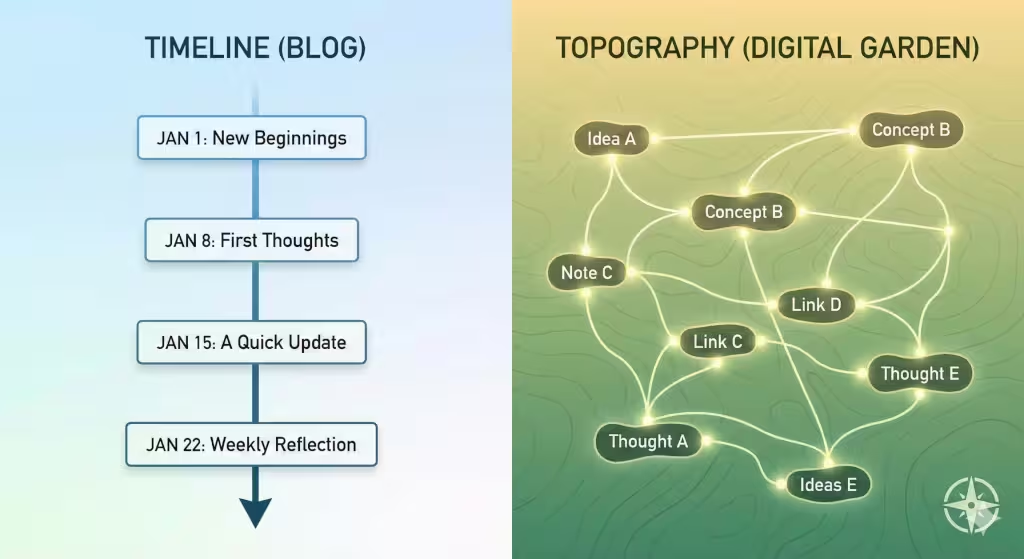
To understand the digital garden vs. blog differences, you have to imagine two different kinds of libraries.
A blog is like a pile of newspapers. Every day, a new paper comes out. It has the latest news and the most recent date at the top. If you want to know what happened today, it is very easy to find. But if you want to find a specific story from three years ago, you have to dig through a very deep, dusty pile. The blog is built on a timeline. It moves in one direction: forward. This is why we call it a “stream.” It is meant to flow past you. If you stop posting, the stream dries up, and people stop visiting.
A digital garden is more like a public park or a map. It is built on topography. In a park, you don’t care which tree was planted first. You care about the paths that connect the fountain to the bench, or the flowers to the shade. In a digital garden, the “date” of a note is much less important than the “topic” of the note.
The Problem with the Timeline
When you use a blog, you are always fighting against time. Because the newest post is always at the top, the blog structure tells the reader that “new is better.” But in reality, some of our best ideas are old ones. In a blog, those old ideas die. They become “archived.” For a professional or a researcher, this is a waste of good work. You spend hours writing a great piece, and two weeks later, it is gone from the front page. This creates a “treadmill” feeling where you have to keep writing new things just to stay relevant.
The Strength of Topography
A digital garden solves this by using context instead of time. Instead of a list of posts, a digital garden often looks like a web. When you write a new note about “soil health,” you don’t just put it at the top of a list. You link it to your notes on “organic farming,” “earthworms,” and “home gardening.”
This creates a “topography” of knowledge. When a reader visits, they don’t see a list of dates. They see a map of your interests. They can choose their own adventure. They might start reading about “open-source software” and end up reading about “community building” because you linked those two ideas together.
Bi-directional Linking: The Secret Sauce
One of the most technical digital garden vs. blog differences is something called a bi-directional link. On a normal blog, if you link to another website, that’s it. It is a one-way street.
In a digital garden, the links go both ways. If Note A links to Note B, Note B will automatically show a “backlink” to Note A. This is a very competent way to organize data. It means that as you add more notes to your digital garden, the whole system gets smarter. You start to see connections you didn’t even know were there. It turns your website from a simple broadcast tool into a “second brain” that grows with you.
Why This Matters for the Reader
For the person reading your site, the digital garden vs. blog differences change how they learn. On a blog, the reader is passive. They just read what you gave them today. In a digital garden, the reader is an explorer. They can follow their curiosity through your web of notes. This makes the information much more “sticky” and useful. It moves away from the “look at me” style of social media and toward a “learn with me” style that I find much more rewarding in the Fediverse.
The Mindset Shift: Perfection vs. Growth

One of the biggest digital garden vs. blog differences is the mindset of the creator. When I was a blogger, I felt like I had to be an expert every time I wrote a post. I would spend hours editing until every comma was in the right place. This creates a lot of pressure. If you don’t have a “finished” thought, you don’t post anything.
In a digital garden, you are allowed to be “in progress.” You plant a “seed” (a rough note). Later, it might become a “sprout” (a note with some links and quotes). Finally, it becomes “evergreen” (a solid piece of knowledge). You are learning in public. This is much more friendly for people who want to share their journey, not just their destination. It follows the Zettelkasten method, where small notes are more valuable than one big, scary essay.
Tooling and the Fediverse Connection
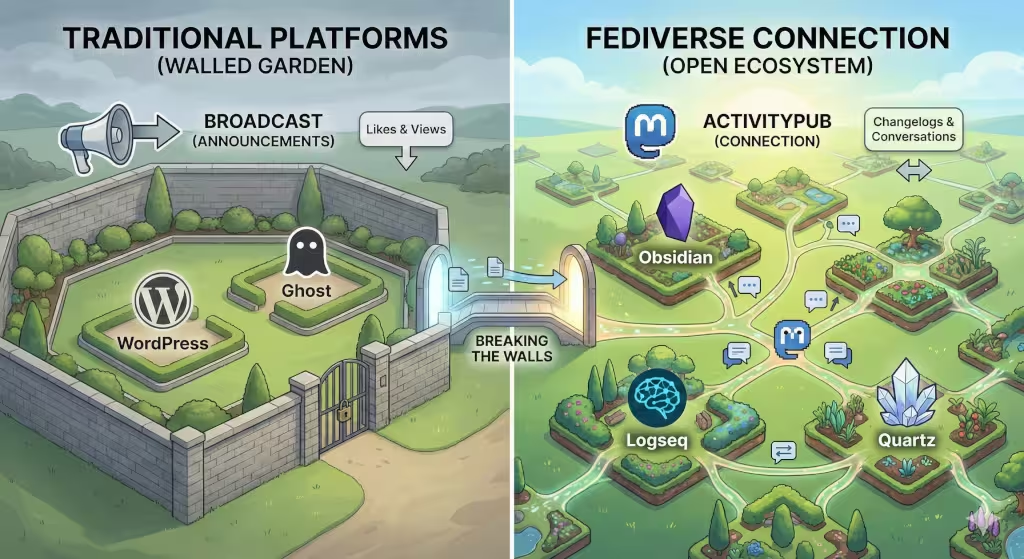
Choosing the right tool for a digital garden is not just about picking a website builder. It is about picking an environment where you can think clearly. Because a digital garden is meant to be a long term project, the tools need to be sturdy and flexible. You want something that will still work in ten years, even if a certain company goes out of business. This is why many people in the open source world prefer tools that use simple files on their own computer.
The Power of Obsidian and Markdown
The most popular tool in 2026 for building a digital garden is called Obsidian. It is a very simple but powerful app that sits on your computer. Instead of saving your notes in a “cloud” that you don’t own, it saves them as simple text files called Markdown.
Why does this matter? Because Markdown is the simplest way to write. It is just plain text with a few symbols for things like bold or links. If Obsidian ever goes away, you still have your files. You can open them in any other program. This gives you “digital sovereignty.” You own your garden, and no one can take it away from you.
Obsidian is great for a digital garden because it handles links so well. When you are writing a note about “sociology,” you can just type two brackets around a word like [[computer science]]. Immediately, Obsidian creates a link. If you click it, you go to a new note. If you look at the bottom of that note, you can see every other note that links back to it. This is how you build that topography we talked about earlier.
Moving from Private to Public with Quartz
Keeping notes on your computer is great for you, but a digital garden is meant to be shared. This is where a tool called Quartz comes in. Quartz is a free, open source tool that takes your private Obsidian notes and turns them into a beautiful website.
Quartz is very popular in the Fediverse because it is fast and respects the reader. It does not have ads. It does not track the person reading it. It just shows the information in a way that is easy to navigate. It even includes a “graph view” on the website. This lets your visitors see a visual map of how your notes are connected. They can see which topics are “seeds” and which ones have grown into big “evergreen” hubs of knowledge.
The Fediverse: A Social Layer for Your Garden
Now, let’s talk about the Fediverse. This is the collection of social networks like Mastodon that are not owned by one big company. In the old days of the web, if you had a blog, you had to share it on a place like Facebook or Twitter to get anyone to see it. But those places are like “walled gardens.” They want you to stay on their site so they can show you ads.
In the Fediverse, things are different. A digital garden fits perfectly here because Mastodon users value depth and helpfulness. Instead of trying to “go viral,” gardeners on Mastodon share their progress. They might post a short update saying, “I just added a new branch to my digital garden about open source ethics.”
This creates a very friendly and professional community. People don’t just “like” your post and move on. They often click the link, explore your notes, and then send you a message on Mastodon with a suggestion or a question. Because your garden is always growing, there is always something new for them to find. You aren’t just broadcasting a finished piece; you are inviting them to watch you think.
ActivityPub: The Language of Connection
The technology that makes the Fediverse work is called ActivityPub. It is a set of rules that lets different websites talk to each other. In 2026, some people are even making their digital garden talk directly to ActivityPub. This means that someone could “follow” your digital garden from their Mastodon account.
When you update a note in your digital garden, it shows up in their feed like a regular post. This is a huge change from the traditional blog model. In a blog, you usually have to sign up for an email list or check a feed. With ActivityPub, your garden becomes a part of the social web. It is a very competent way to stay connected with your friends and peers without relying on an algorithm.
Changelogs vs. Announcements
One of the most interesting digital garden vs. blog differences in a social setting is how we talk about our work.
A blog uses “announcements.” You write a post, and then you shout, “Look at this new thing I wrote!” It is a one-time event. If people miss it that day, they might never see it.
A digital garden uses a “changelog.” A changelog is just a list of what has changed. You might say, “Updated my notes on MIT research” or “Added three new links to the sociology section.” This feels much more casual and less pushy. It tells your followers that you are consistently tending to your ideas. It invites them to come back and see what is new, even if it is just a small change. On Mastodon, this kind of transparency is highly valued. It shows that you are a real person who is curious and helpful, not just someone trying to sell a personal brand.
Why This is Better for Your Brain
Too much social media can be distracting. The beauty of combining a digital garden with the Fediverse is that it protects your focus.
You spend most of your time in your private garden, thinking and writing. Then, when you are ready, you push a button to make it public. You share the link on Mastodon, have a few smart conversations, and then go back to your garden. You are in control of the “social” part. You aren’t constantly checking for notifications or “likes” because the value is in the garden itself, not in the reaction to it.
This way of working is very professional and direct. It shows that you have a “second brain” where you store your best ideas. When someone asks you a question at work or online, you don’t have to search your memory. You just go to your digital garden and find the answer. You can even send them a link so they can learn with you. This makes you a very competent member of any team or community.
Setting Up Your Own Plot
If you are sitting in Austin or Minneapolis today and want to start, don’t be scared by the technical side. You don’t need to be a computer scientist from MIT to do this.
- Start Small: Download Obsidian and just write one note about something you learned today.
- Link Often: Every time you mention a topic you like, put brackets around it.
- Choose Your Public Space: When you have ten or twenty notes, look into Quartz or a simple publishing service like Obsidian Publish.
- Connect to the Fediverse: Get a Mastodon account and start sharing your “seeds.”
Building a digital garden is a slow process, and that is okay. It is a long term investment in yourself. Unlike a blog that gets harder to manage as it gets older, a digital garden gets better. Every link you add makes the whole system stronger. In the world of 2026, where everything feels fast and temporary, having a quiet place to grow your thoughts is a true gift.
The Economics of Attention: Why Gardening Wins
When we look at the digital garden vs. blog differences from a business or sociology perspective, we have to talk about “the attention economy.” Traditional blogs are designed to capture attention quickly. They want you to click, stay for five minutes, and then maybe see an ad or sign up for a newsletter. This is a very “transactional” relationship.
A digital garden is different. It is built on “trust and authority.” Because you are showing your raw notes and your learning process, people trust you more. They see that you aren’t just copying and pasting “content.” They see that you are doing the hard work of thinking. This is why a digital garden is actually better for “personal branding” than a blog, even though it doesn’t try as hard. Your brand becomes “the person who knows a lot about X and is happy to share it.”
In the Fediverse, this is the best currency you can have. People follow you because they want to learn from you, not because you have a flashy headline. By tending your digital garden, you are building a library that works for you even when you are asleep. You aren’t just another voice in the stream; you are a landmark on the map.
Final Thoughts for the Modern Gardener
As you can see, the digital garden vs. blog differences are about much more than where you put the date. They are about how you value your own time and your own thoughts. Whether you use Obsidian, Quartz, or even just a simple set of text files, the act of gardening will change how you see the world.
It moves you away from the “perfection” of the blog and toward the “growth” of the garden. It connects you to the Fediverse in a way that is direct, professional, and friendly. And most importantly, it gives you a space to be curious and helpful without the pressure of a ticking clock.
SEO and Discoverability: A New Paradigm
You might wonder, “How will people find my digital garden if it isn’t a traditional blog?” This is a great question. In the past, SEO was all about high-volume keywords and long articles. Blogs are great at this because they target “trending” topics.
However, a digital garden is amazing for “Topical Authority.” Because you are linking so many notes together, search engines see that you really know your stuff. When you answer many small, specific questions naturally, you start to rank for “long-tail” searches. Instead of fighting for one big keyword, you become the go-to source for a whole network of ideas. This is a very competent and direct way to drive traffic to your website without feeling like a “marketer.”
Common Questions About Digital Gardens Vs. Blogs
Can you have both a blog and a digital garden?
Yes! Many experts use a hybrid model. They have a blog for “announcements” and big essays, but they keep a digital garden for their “raw notes” and research. It is like having a front porch (the blog) and a private backyard (the garden) that you sometimes let guests visit.
Is a digital garden better for learning?
Research in sociology and education shows that “networked thought” helps you remember things better. When you have to link a new idea to an old one, you are building a “second brain.” A digital garden forces you to do this, which makes you a better student and a more professional worker.
Does it require coding skills?
Not anymore! While some people like to build their own sites using static site generators like Hugo or Quartz, there are many “no-code” options. You can use Obsidian Publish or even a public Notion page. It is very easy to get started today.
Choosing Your Digital Plot
The digital garden vs. blog differences come down to what you want to achieve. If you want to build a “brand” and get a lot of quick attention, a blog is a great tool. But if you want to grow your mind, help others in a slow and steady way, and build a lasting library of knowledge, you should start a digital garden.
At Silphium Design, we believe the future of the web is more personal and less performative. Whether you are in Minneapolis or Austin, your ideas deserve a place to grow without the pressure of a ticking clock.