
At Silphium Design, we are dedicated to making the internet feel more like a garden and less like a machine.
Today, we are going to explore how we see the natural world through our screens. This is a big topic, but it is one that matters for our health, our happiness, and the future of design. Whether you are a web designer or just someone who spends a lot of time online, understanding cultural representations of nature will change how you look at your phone or computer forever.
Table of Contents
The Emergence of the Digital Wilderness
When we talk about cultural representations of nature, we are talking about how humans recreate the beauty of the outdoors inside the digital world. Think about the first time you turned on an old computer. You might remember a photo of a green hill and a blue sky. That was one of the first ways we tried to make technology feel more “human.”
In 2026, we are moving far beyond just simple photos. We are now building what I like to call the digital wilderness. This is a space where pixels and code are used to make you feel like you are standing in a forest or sitting by a stream. This happens because of something called the Biophilia Hypothesis. This idea suggests that humans have a deep, biological need to be connected to nature.
Even though we are looking at a screen, our brains still crave the patterns, colors, and movements of the earth. When we see cultural representations of nature in a website or an app, it sends a signal to our brains that we are safe and in a place where we can thrive. At Silphium Design, we don’t just put a picture of a tree on a homepage; we try to build an entire ecosystem that breathes and moves.
The Evolution of Nature Representations in Media
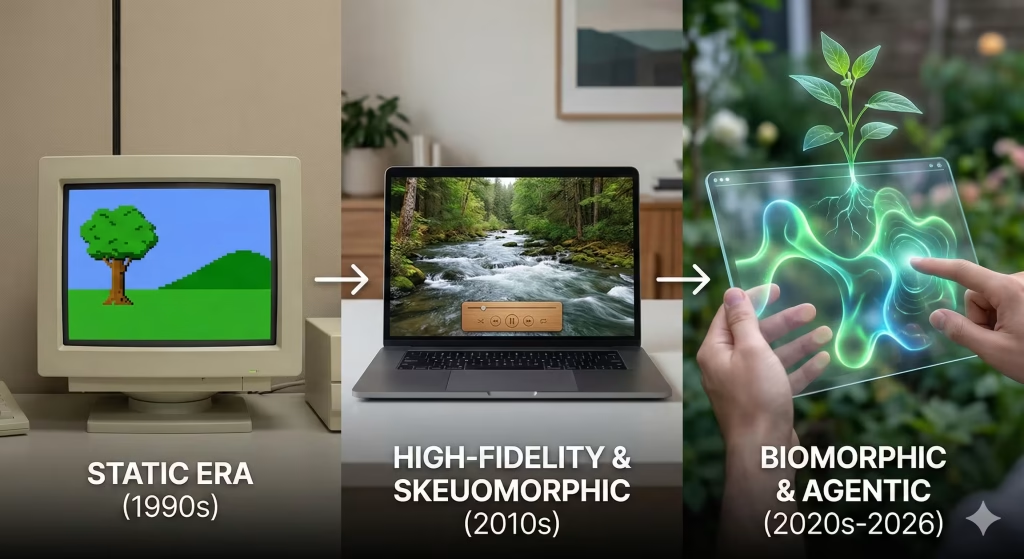
The evolution of how we depict the environment in our tools is a journey from the “imitation” of nature to the “integration” of nature. As a designer with a background in both biology and computer science, I find this progression fascinating because it mirrors our own changing relationship with the planet. We have moved from looking at nature as a background to treating it as a living part of our digital architecture.
Below, I have broken down the key stages of this evolution to show how cultural representations of nature have transformed over the decades.
The Era of the Static Backdrop
In the early days of personal computing, the screen was a sterile, gray place. To make it feel more welcoming, designers began to include “wallpapers.” These were the first widespread digital cultural representations of nature.
The most famous example is “Bliss,” the photograph of the rolling green hills in Sonoma County, California, used as the default background for Windows XP. For millions of people, this image was their primary visual connection to the outdoors while they worked in cubicles. However, these representations were “static.” They did not move, they did not react to the user, and they existed only as a thin layer of paint over a machine.
Skeuomorphism: Nature as a Texture
As we moved into the 2000s and early 2010s, design shifted toward “skeuomorphism.” This style tried to make digital icons look like their physical counterparts. In terms of cultural representations of nature, this meant adding textures like:
- Leather grains on digital calendars.
- Brushed metal on volume sliders.
- Polished wood on digital bookshelves.
The goal here was to use the “memory” of natural materials to make technology feel less intimidating. While these weren’t “living” nature, they used the patterns of the physical world to provide a sense of comfort and familiarity.
The Rise of High-Fidelity Simulation
With the arrival of 4K and 8K displays, our cultural representations of nature became incredibly sharp. We moved away from simple photos and toward high-definition video backgrounds.
Suddenly, a website wasn’t just showing you a picture of a forest; it was showing you the slow sway of a pine branch in the wind. This introduced “movement” into the design. At Silphium Design, we call this the “Living Hero” stage. It uses the visual beauty of the natural world to capture the user’s eye and lower their heart rate instantly upon landing on a page.
Biomorphy and Fluid Geometry (2020s–2026)
In the current era, we are seeing a shift toward “biomorphy.” This moves beyond just looking like nature and starts behaving like it. Instead of the sharp, 90-degree angles that defined the internet for thirty years, we now see:
- Organic shapes: Buttons that look like smoothed river stones.
- Fluid transitions: Pages that “flow” into one another like water rather than “snapping” into place.
- Asymmetry: Real nature is rarely a perfect grid. Modern cultural representations of nature in web design embrace a bit of “messiness” that feels more authentic to the human eye.
Agentic and Generative Nature
The most recent step in this evolution involves Artificial Intelligence and real-time data. In 2026, cultural representations of nature are often “agentic,” meaning they change based on the world around them.
For example, a website might use a generative background that grows “digital moss” over time, or the lighting on the site might shift to match the position of the sun in the user’s actual physical location. This creates a “bio-digital” link, where the screen is no longer a separate world, but a window that reflects the natural rhythms of the user’s life.
Comparison of Nature Representation Styles
| Era | Style | Primary Nature Element | Emotional Goal |
| 1990s | Static | Photographs (Wallpapers) | Familiarity |
| 2000s | Skeuomorphic | Textures (Wood, Leather) | Tactile Comfort |
| 2010s | High-Def | 4K Video Backgrounds | Awe & Beauty |
| 2020s | Biomorphic | Fluid Shapes & Gradients | Calm & Flow |
| 2026+ | Agentic | Generative, Adaptive Media | Biological Sync |
The Science of Digital Biophilia
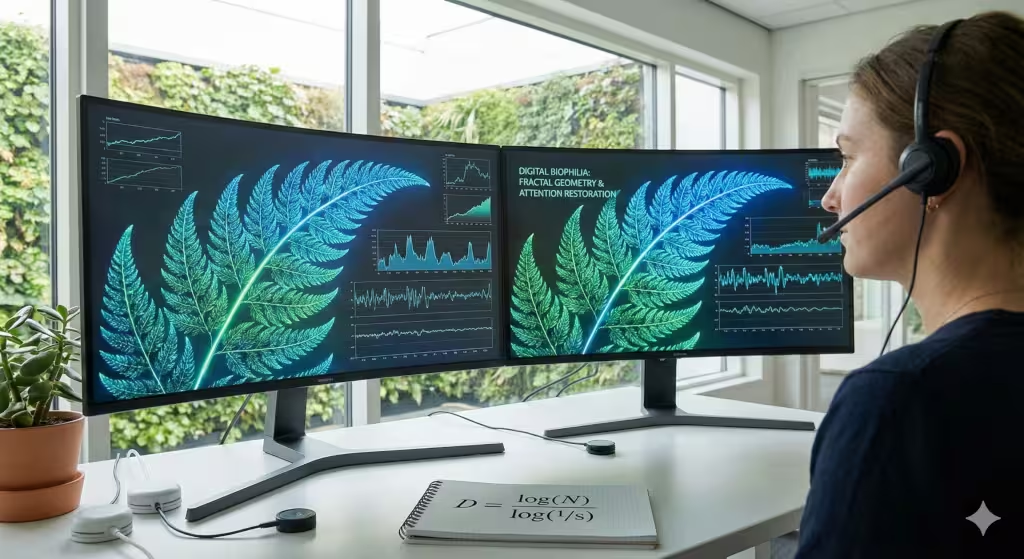
Why does looking at a screen filled with plants make us feel better? It comes down to something called Attention Restoration Theory. Most of the time, our phones demand “hard focus.” We have to read texts, check emails, and look at blinking alerts. This tires out our brains.
Nature provides “soft fascination.” This is a type of looking that does not require hard work. When you watch clouds move or see a digital leaf flutter on a screen, your brain gets a chance to rest. This is a key part of how we use cultural representations of nature to help people focus better.
We also use math to help. Have you ever noticed how a fern or a snowflake has a pattern that repeats itself? Those are called fractals. We use fractal patterns in web design to make the layout feel balanced. If a website is too messy, it causes stress. If it is too perfect and straight, it feels cold. By using the math of nature, we find a middle ground that feels just right.
Cultural Perspectives and the Nature Deficit
Today, many people live in big cities where they don’t see many trees. This is often called a “nature deficit.” Because we are stuck inside, we turn to our devices to fill the gap. This makes cultural representations of nature very important for our mental health.
However, different cultures see nature in different ways. In some Western cultures, people often think of nature as something “out there”—a place you visit on the weekend. In many Indigenous cultures, nature is something you are a part of every single day.
When we design digital media, we have to think about these different views. Is the nature in our design a “park” that is managed by humans? Or is it a “wild” place that feels powerful and a bit mysterious? Good design uses cultural representations of nature that respect these different feelings and traditions.
Effectiveness of Digital Substitutes
A common question people ask is: “Can a screen really replace a walk in the woods?” The honest answer is no, not entirely. But it can help a lot. Scientific studies have shown that looking at cultural representations of nature can lower your heart rate and reduce stress.
In hospitals, doctors sometimes use Virtual Reality (VR) to show patients beautiful landscapes. This helps the patients feel less pain and stay calm. While a digital forest doesn’t have the smell of pine needles or the feeling of dirt under your feet, it still provides the visual patterns our eyes love.
As we spend more time in digital spaces, these digital substitutes become a vital tool. We want to make sure that the time you spend online isn’t just productive, but also restorative. This is why cultural representations of nature are not just “decorations”—they are a form of digital medicine.
Modern Trends: Techno-Natural Fusion
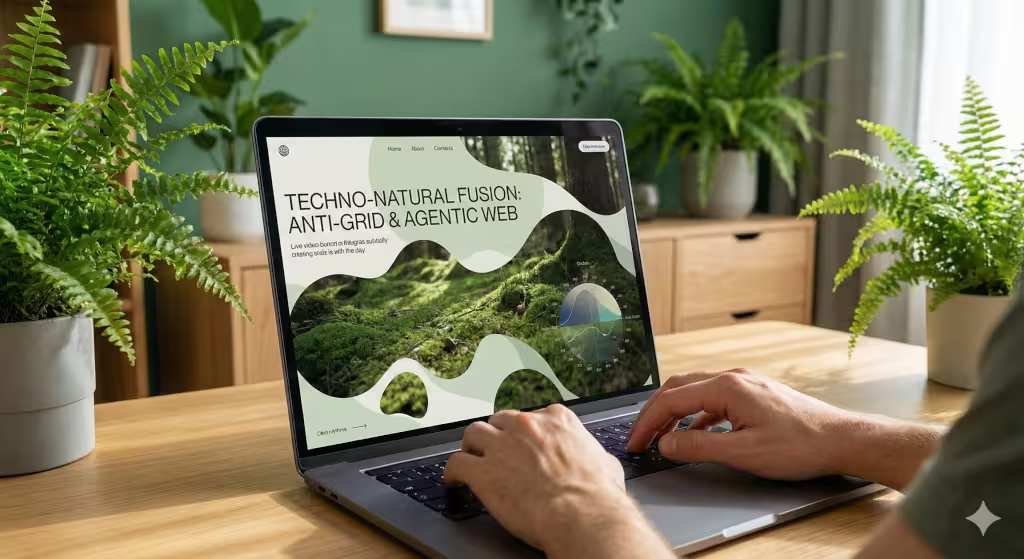
In 2026, the coolest websites don’t look like websites at all. They look like living things. We call this Techno-Natural Fusion. One big trend is “Anti-Grid Layouts.” Instead of putting everything in straight rows and columns, we let the content flow across the screen like a vine.
We also use “agentic” design. This means the website knows what time it is where you live. If you visit a site at night, the colors might turn dark and warm, like a campfire. If you visit in the morning, the site might be bright and fresh, like the morning sun. These cultural representations of nature help keep your body’s internal clock, or circadian rhythm, in sync.
Another big trend is being “green” with our code. High-quality videos of forests take up a lot of energy to load. At Silphium Design, we work hard to make sure our cultural representations of nature are “lean.” We want to show the beauty of the earth without using up too much electricity, which helps protect the real earth.
Practical Implementation for Designers
If you are a designer, how do you actually use these ideas? First, think about “non-rhythmic sensory stimuli.” This is just a fancy way of saying “subtle movement.” Think about how a blade of grass moves in a breeze. It’s not a perfect back-and-forth motion; it’s a bit random. Adding that kind of movement to a website button or an icon can make it feel alive.
Second, use organic textures. Instead of a flat gray background, use a texture that looks like recycled paper or soft sand. These cultural representations of nature give the user a sense of touch, even though they are just looking at glass.
Third, think about “prospect and refuge.” Humans feel safe when they can see far away (prospect) but also have a “nest” to hide in (refuge). You can do this in web design by having a big, open hero image at the top of the page, followed by cozy, enclosed sections of text.
Understanding the Bio-Digital Interface
We are now living at the “Bio-Digital Interface.” This is the place where our human bodies meet our digital tools. Everything we do online should be designed with our biology in mind. When we use cultural representations of nature, we are speaking a language that our bodies already know.
This is especially important for things like “Biomimetic UI.” This is when a user interface works like a biological system. For example, when you delete an item, it might “fade” away like a leaf decaying, rather than just disappearing instantly. These small details make the digital world feel less harsh.
By focusing on cultural representations of nature, we create spaces that are easier to use. People don’t get as tired when they use a biophilic website. They stay longer, they feel better, and they remember the experience more fondly.
The Role of Local SEO in Natural Design
You might wonder how search engines like Google feel about this. In 2026, search engines are getting smarter. They don’t just look for keywords; they look for “user experience.” If people enjoy being on your site because it feels natural and calm, Google notices.
Using cultural representations of nature can actually help your SEO. When people feel relaxed, they stay on your page longer. This tells search engines that your site is high quality. Also, by using specific terms related to nature and design, you can reach people who are looking for a more peaceful online experience.
At Silphium Design, we monitor the best keywords in this field. We look for ways to talk about “restorative environments” and “sustainable design.” By combining good writing with beautiful, natural visuals, we help our clients grow their digital presence in a healthy way.
Designing for the Biological Human
In the end, we have to remember that we are biological creatures. We were not made to stare at bright white screens in dark rooms. We were made for the sunlight, the trees, and the shifting patterns of the natural world.
Using cultural representations of nature is our way of bringing that world with us into the future. Technology does not have to be the opposite of nature. It can be a bridge that brings us closer to it. As we build the internet of tomorrow, we should look to the forest for inspiration.
The goal of any good design should be to make the user feel more human, not more like a machine. By embracing cultural representations of nature, we can build a digital world that is just as beautiful and refreshing as a walk in the woods.
Key Terms and Ideas about Cultural Representations of Nature
- Restorative Environments: Spaces that help you feel less stressed and more focused.
- Circadian Rhythm Design: Making screens change their light to match the sun.
- Organic Gradients: Colors that blend together in a way that looks like things in the real world.
- Sustainable Web Design: Building websites that use less energy and are better for the planet.
Questions Answered about Cultural Representations of Nature
Can digital representations of nature offer the same benefits as real nature?
While real nature is always better, digital versions do help. They can lower stress, help you focus, and make you feel happier. They are great for people who can’t get outside easily.
What is the potential for digital nature to serve as a substitute?
It works well as a “top-off” for your mental health. It’s like taking a vitamin. It doesn’t replace a full meal (real nature), but it helps keep you healthy when you are busy.
How can technology enhance biophilic design?
Technology allows us to bring nature into places where it normally can’t go. We can use screens to show beautiful views in basement offices or use sounds to hide noisy city traffic.
I hope this exploration of cultural representations of nature has been helpful for you. Our goal at Silpium Design is to always to provide a path toward a more balanced digital life.