
Here at Silphium Design, as an expert in biophilic design and web design, I see the internet as more than just code. I see it as a reflection of our physical world. For many years, we thought of factories and websites as separate from nature. We were wrong.
In 2026, the way a company shows itself online is just as important as how it makes its products. We are seeing a big shift in how people think. Sustainability is no longer just a nice goal. It is now a requirement. This shift means that sustainable manufacturing websites must do more than just talk about being green. They must be green in how they work and how they look.
At Silphium Design LLC, we use something called biophilic design. This means we bring the patterns of nature into digital spaces. We use things like fractals and organic flows. These help users feel calm. They also help the brand look like it belongs in the natural world. If a company makes eco friendly products but has a website that is messy and uses too much power, it creates a bad feeling for the user. We call this a brand value mismatch. A great website should be like a living thing. It should be efficient, beautiful, and helpful. In this article, we will look at how to build sustainable manufacturing websites that win in the modern world.
To understand where we are going, we must look at who is leading the way. Many companies are now using their digital presence to prove they care about the earth. These case studies show that good design is also good for business.
Table of Contents
Defining the Sustainable Manufacturing Website in 2026
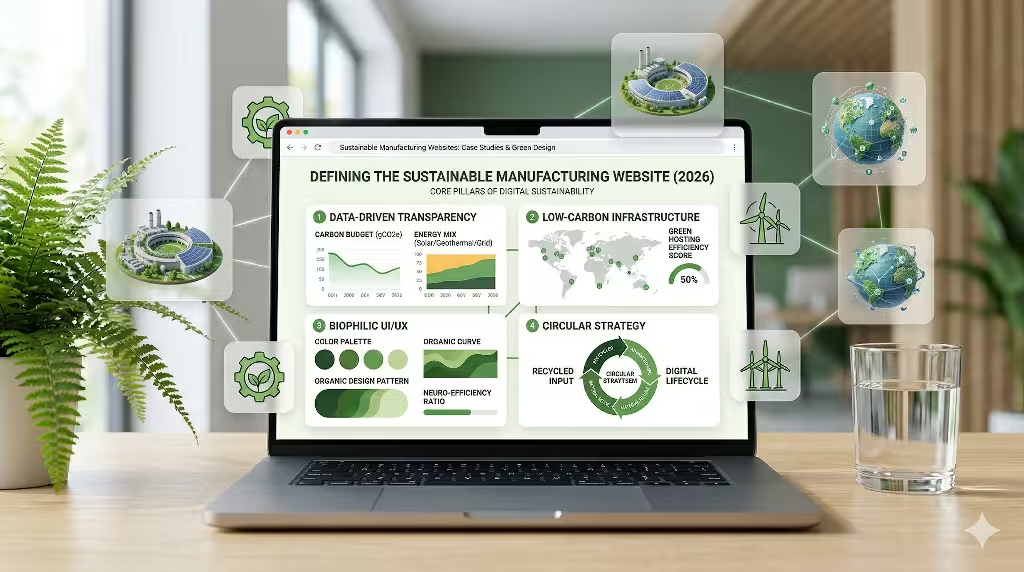
In the year 2026, we have reached a point where the digital world and the natural world are no longer separate. As a specialist in biology and web design, I have seen how the growth of the internet has put a strain on our planet. However, we are now entering an era where sustainable manufacturing websites are leading the charge for a cleaner future. When we define these sites today, we are not just talking about a page that loads fast. We are talking about a complete shift in how we think about the impact of data on the environment.
A website for a modern factory must act like a forest. It must be efficient, it must be useful, and it must not waste any energy. In the past, many industrial sites were heavy and slow. They were filled with large files and messy code that made servers work too hard.
Today, we define sustainable manufacturing websites by their ability to provide a high quality experience while leaving the smallest possible footprint. This involves a deep look at the code, the servers, and the visual design patterns that we use to guide the user.
The Foundation of Green Infrastructure
The first thing that defines sustainable manufacturing websites in 2026 is the infrastructure they sit on. We call this the green stack. It starts with where the data is stored. Every time a person clicks on a link, a computer in a big data center has to spin up and send information. If that data center runs on coal or gas, it hurts the air we breathe.
Now, we insist that sustainable manufacturing websites are hosted on servers powered by 100% renewable energy. This means wind, sun, or water power. But it goes deeper than just the power source. It also involves where the servers are located. We use something called edge computing to make sure the data is close to the user. If you are in Boston, you should not have to get your data from a server in London. Reducing the distance that data travels is a core part of how we build sustainable manufacturing websites.
Carbon Budgets for Digital Design
We also define these sites by their carbon budget. Just like a person has a budget for their money, a web designer in 2026 has a budget for how much carbon a page can produce. Every kilobyte of data has a cost. If a page is too heavy, it fails the audit. Sustainable manufacturing websites are built to be lean.
We look at every image and every video. We ask if it really needs to be there. If a video helps a customer understand a complex machine, we keep it, but we optimize it using the latest tools. This keeps the file size small. When we talk about sustainable manufacturing websites, we are talking about a design that respects the user’s time and the planet’s health. We aim for pages that weigh less than one megabyte. This is a big change from the bloated sites of the past.
The Biophilic Visual Philosophy
The visual part of sustainable manufacturing websites is where my love for biology comes in. We use biophilic design to create a connection between the human user and the natural world. This is not just for looks. It is functional. Nature has spent millions of years perfecting efficiency. A leaf is designed to catch the most sun with the least amount of material. We apply these same rules to the layout of sustainable manufacturing websites.
We use organic shapes instead of harsh, square boxes. We use colors that are found in the natural world, which are easier on the eyes and often require less screen brightness to see clearly. This saves battery life on phones and laptops. When a site feels like a natural environment, the person using it feels more at ease. This trust is vital for companies that make complex industrial goods. Sustainable manufacturing websites use these natural patterns to show that they are in harmony with the earth.
Clean Code as an Environmental Duty
The code is the hidden engine of any site. For sustainable manufacturing websites, the code must be as clean as a modern lab. We avoid using “heavy” frameworks that add thousands of lines of useless code. Instead, we write custom code that does exactly what is needed. This is like a lean manufacturing process where there is no waste.
When code is clean, the computer processor does not have to work as hard. This means it uses less electricity. It also means the site works better for people with older devices or slower internet connections. By making sustainable manufacturing websites accessible to everyone, we are practicing social sustainability too. We believe that information should be available to all without costing the earth.
User Experience and Energy Conservation
A major part of defining sustainable manufacturing websites is the user experience or UX. If a user has to click five times to find a product, they are using five times the energy. We design these sites to be intuitive. We want the user to find what they need in the fewest steps possible.
This means the search bar must be smart. The menus must be simple. Every second a user spends hunting for a button is energy wasted. We use data to see where people get stuck and we fix those areas. Sustainable manufacturing websites are always evolving. They are living systems that get better and more efficient over time.
Transparency and Real Time Data
In 2026, honesty is everything. People want to know that a company is actually doing what it says. That is why sustainable manufacturing websites often feature live dashboards. These dashboards show how much energy the factory is using or how much waste they have recycled.
This transparency is a key feature of sustainable manufacturing websites. It moves beyond marketing and into the realm of proof. When a site can show its impact in real time, it builds a level of authority that a simple brochure cannot match. We help our clients at Silphium Design LLC connect their factory sensors directly to their web interface. This creates a bridge between the physical and digital worlds.
The Role of Search Engines in Sustainability
Search engines have also changed how they view sustainable manufacturing websites. In the past, they mostly cared about keywords. Now, they care about performance and ethics. A site that is carbon neutral and fast will rank higher than a slow, heavy site.
This means that building sustainable manufacturing websites is not just good for the planet; it is also good for SEO. When a site is easy for a search engine to crawl, it uses less energy for the search engine’s robots too. This is a circular benefit. Every part of the system becomes more efficient when we prioritize sustainability.
The Impact of Mobile First Design
Most people now access the web through mobile devices. This is a challenge for sustainable manufacturing websites because phones have limited battery life. We design with a mobile first mindset. We make sure that the most important information is at the top of the page.
We avoid heavy animations that drain the battery. Instead, we use CSS animations which are very light. This ensures that sustainable manufacturing websites look great on any screen without causing the phone to heat up. A cool phone is a sign of a well designed, energy efficient website.
Choosing the Right Assets
We are very careful about the images and icons we use. For sustainable manufacturing websites, we prefer SVG files. These are small files that stay sharp at any size. They are much better than large photos that can slow everything down.
When we do use photos, we make sure they are in the best format for the year 2026. This allows for high detail with very low file sizes. This attention to detail is what makes sustainable manufacturing websites stand out. It shows a level of craft and care that reflects the quality of the manufacturing itself.
The Long Term Vision
A website should not be something you throw away and rebuild every two years. That is a waste of resources. We build sustainable manufacturing websites to be durable. We use technologies that will stay relevant for a long time.
By building a site that can grow and change, we reduce the total energy spent over the life of the brand. This is the same logic used in sustainable manufacturing. You build a machine to last twenty years, not two. We apply that same engineering mindset to the web.
When we define sustainable manufacturing websites today, we are looking at a blend of biology, math, and ethics. We are creating digital spaces that feel alive and healthy. At Silphium Design LLC, we are proud to be part of this movement. We believe that the internet can be a force for good, provided we design it with the planet in mind.
Case Study #1: Interface – The Pioneer of Digital Biomimicry
Interface is a company that makes carpet tiles. They are famous for their mission called Mission Zero. They want to have no negative impact on the earth. Their digital presence is one of the best examples of sustainable manufacturing websites. They don’t just sell carpet. They tell a story of how they mimic nature.
On their site, they use something called digital biomimicry. This is where the design mimics natural systems. For example, their carpet designs are often inspired by the floor of a forest. On their website, they use navigation that feels natural. It does not feel like a stiff grid. Instead, the images and text flow together. This makes the user feel like they are exploring a natural space.
Because they are leaders, their site is built to be light. They use modern image types that take up very little space. This is a key part of sustainable manufacturing websites. It keeps the page speed high and the energy use low. When you visit their site, you see how they turn old fishing nets into carpets. The visuals are crisp but small in file size. This shows that you can have a beautiful site without being a burden on the power grid. Interface proves that sustainable manufacturing websites can be both high tech and high nature.
Case Study #2: Wistron – Nature Themed Narrative and Transparency
Wistron is a big tech company. They manufacture electronics. In 2026, they have become a star for their work in sustainability. They realized that people want to see how things are made. Their site uses high quality videos of nature. They show how their factories work in harmony with the local environment.
They use a special kind of video tech. It is called AV1. This tech allows them to show beautiful nature videos while using very little data. This is very important for sustainable manufacturing websites. If a video is too big, it wastes energy. Wistron makes sure their videos are optimized.
Their website also features a lot of data. They show their carbon footprint in real time. This kind of transparency is a hallmark of top sustainable manufacturing websites. It builds trust. Users can see that the company is not just talking. They are doing the work. The site uses green hosting too. This means the servers that run the site are powered by wind or sun. By choosing green hosting, they make their site part of the solution.
Case Study #3: GE Vernova – Data as a Natural Pattern
GE Vernova was once known as GE Renewable Energy. They are a massive company. They build wind turbines and solar tech. Their website is a masterclass in how to handle complex data. Many sustainable manufacturing websites struggle with data. They make it look boring or hard to read. GE Vernova does it differently.
They use animations that look like moving water or wind. When you see how much power a wind farm is making, the graph moves like a breeze. This is a biophilic principle. It connects the digital data back to the physical force that created it. This makes the information easier for the human brain to process.
Their site is also built to be modular. This means they can update parts of it without rebuilding the whole thing. This saves a lot of time and energy over the years. Sustainable manufacturing websites that are built to last are much better for the earth. They don’t need to be replaced every two years. This is like a well built machine that stays in a factory for decades. It is a long term investment in the brand and the planet.
Common Questions about Sustainable Manufacturing Websites
When people search for information, they often ask the same questions. For sustainable manufacturing websites, we need to answer these clearly. One common question is: What makes a manufacturing website sustainable? The answer is simple. It is a mix of green hosting, efficient code, and honest design. It means the site does not use more resources than it needs.
Another common question is: How do I show sustainability on my website? You can do this by using third party badges. These are things like B Corp logos. You can also show live data of your energy use. But most of all, you show it through your design. If your site is easy to use and does not drain the battery of a phone, it shows you care.
People also ask: What are some sustainable manufacturing companies? We often point to names like Patagonia, Tesla, and Interface. These companies have aligned their digital world with their physical world. They use sustainable manufacturing websites to educate their customers. This education is a form of value. It helps the user make better choices for the planet.
The Mathematics of Nature: Fractals in Manufacturing UI
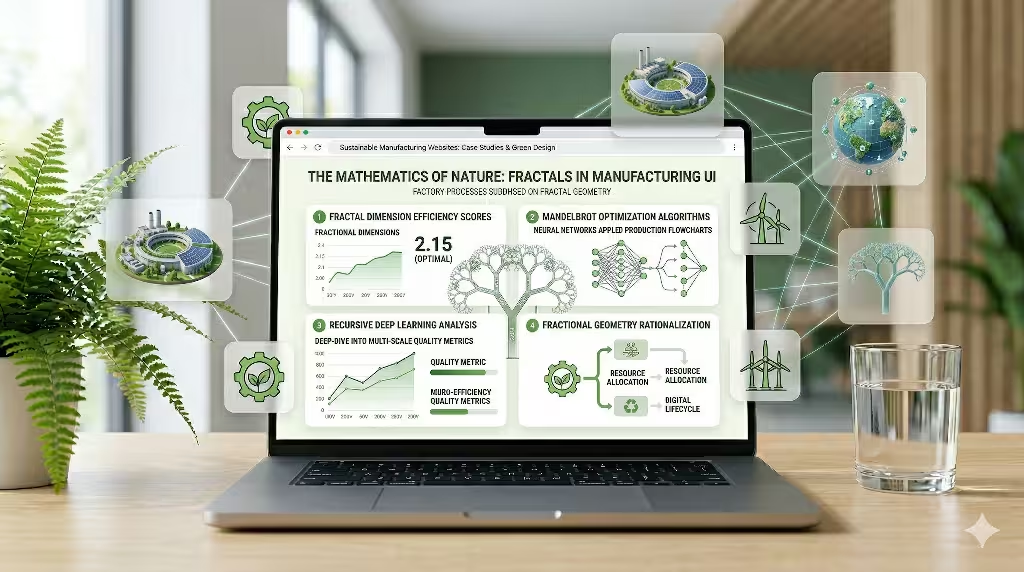
Nature uses patterns called fractals. A fractal is a shape that looks the same no matter how much you zoom in. Think of a fern leaf or a snowflake. These patterns are very efficient. They pack a lot of information into a small space.
When we build sustainable manufacturing websites, we use fractal math. This helps us create layouts that feel balanced. Our brains are tuned to recognize these patterns. When a website follows these rules, the user feels less stress. This is very important for industrial sites that have a lot of technical info.
D = log(N)/log(1/s)
This is the formula for fractal dimension. We use it to make sure our menus and grids aren’t too crowded. By using these natural ratios, we make the site more usable. Better usability means the user finds what they need faster. This means they spend less time on the site, which saves energy. It is a win for the user and the environment. This math is what separates basic sites from true sustainable manufacturing websites.
Sustainable SEO: Beyond the Keyword
SEO stands for search engine optimization. It is how people find you. In 2026, SEO has changed. It is no longer just about repeating words. It is about being a trusted authority. Search engines now look for sustainable manufacturing websites that provide real proof.
One part of this is called entity based search. This means the search engine knows that your company is a “Sustainable Manufacturer.” It looks for connections between your site and other green organizations. If you talk about your green supply chain, you build that connection.
Local SEO is also key. If you are a factory in Boston, you want people in Boston to find you. You can do this by talking about your local impact. Maybe you helped clean up a local park. Or maybe you use local solar power. Putting this on your site helps you rank for local searches. Sustainable manufacturing websites that focus on their community often see more loyal visitors.
The Green Stack for Manufacturers
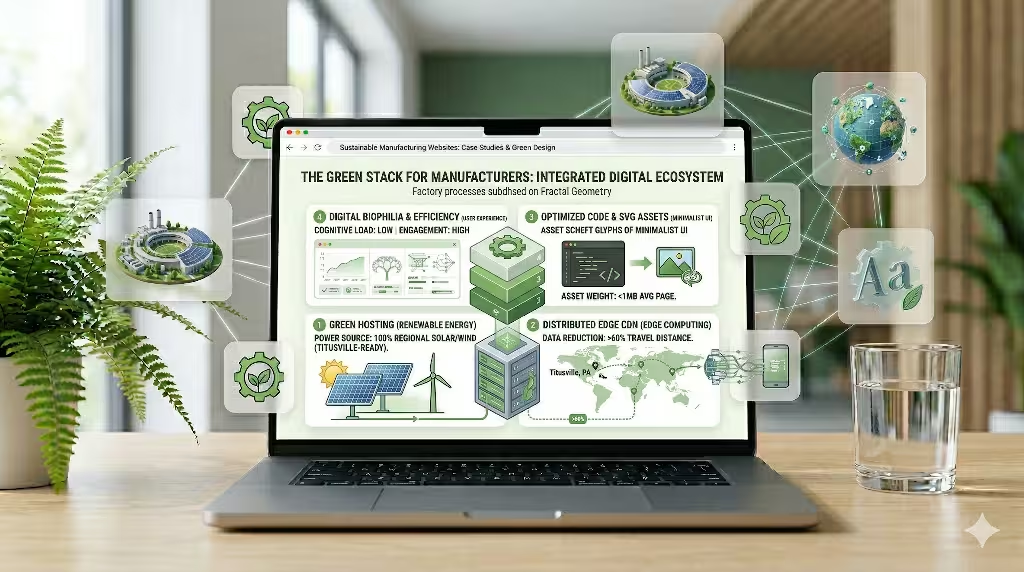
A green stack is the set of tools used to build a site. To have the best sustainable manufacturing websites, you need a solid stack. First, you need green hosting. This is a must. Second, you need a Content Delivery Network or CDN. This stores copies of your site in different places around the world. This way, the data doesn’t have to travel as far. Traveling data uses electricity.
You should also use system fonts. These are the fonts already on your computer or phone. When a site uses custom fonts, it has to download them. This takes time and power. By using system fonts, you make your site faster. This is a hallmark of efficient sustainable manufacturing websites.
Lastly, you must audit your images. Many sites have images that are way too big. You should use tools to make them smaller without losing quality. This is one of the easiest ways to improve sustainable manufacturing websites. It makes the site snap to life on a mobile phone.
| Feature | Sustainable Benefit | Biophilic Benefit |
| Edge Computing | Uses less power for data travel | Feels faster and more fluid |
| SVG Graphics | Very small file sizes | Perfect for natural, curved shapes |
| System Fonts | No extra downloads needed | Clean and easy to read |
The Future of Industrial Web Design
The world of manufacturing is changing fast. We can no longer ignore the digital footprint of our businesses. By building sustainable manufacturing websites, we show the world that we are ready for the future. These sites are more than just a place to see products. They are a tool for change.
We use biophilic design to bridge the gap between machines and nature. We use fractal math to make our interfaces feel like home. And we use the latest tech to keep our energy use low. This is the heart of what we do at Silphium Design LLC. We believe that every company can be a part of the green revolution.
If you want your brand to stand out in 2026, you must look at your website. Does it reflect your values? Does it respect the user? Does it protect the planet? Sustainable manufacturing websites are the answer to these questions. They are the new standard for excellence in the industrial world.
When we design with nature in mind, we all win. The planet gets a break. The user gets a better experience. And the company gets a stronger brand. This is the power of biophilic design. It is not just about looks. It is about how we live and work in a digital age. Let us build a web that is as vibrant and healthy as the world around us.
Sustainable manufacturing websites are not just a trend. They are the future of how we do business. By following the examples of Interface, Wistron, and GE, any manufacturer can lead the way. It starts with a single step. It starts with a choice to be better. Let’s make that choice today.
As we look toward the next few years, the tech will only get better. We will have even more ways to save energy. We will have even more ways to bring nature into our screens. But the core goal will stay the same. We want to create spaces that help people thrive. Sustainable manufacturing websites are the foundation of that goal.
Thank you for joining me on this journey. I hope these case studies and technical tips help you. Remember, a great website is like a well tended garden. It needs care, it needs balance, and it needs to grow. Let’s grow something beautiful together.