
Imagine walking through a dense forest. The light shifts as the wind moves the leaves. The temperature cools as you step near a stream. You feel alert yet calm. Now, imagine sitting at your computer. The screen is a flat, bright white square. The text does not move. The light never changes. It feels like standing in a concrete room with a fluorescent bulb buzzing overhead. This is the state of the modern internet. It is a “digital concrete jungle.” It disconnects us from the natural world, and this disconnection causes stress, eye strain, and mental fatigue.
For years, designers have tried to fix this by adding pictures of plants or using green color schemes. This is a good start, but it is not enough. A picture of a tree is not the same as a living tree. This is where the convergence of two powerful fields changes everything. These fields are Biophilic Design and Artificial Intelligence. Biophilic Design is the study of our innate love for nature and how we build spaces that respect that love. Artificial Intelligence, or AI, involves computer systems that can learn, predict, and create.
The problem with current web design is that it is static. It does not react to you. Nature is always reacting. It changes with the seasons, the time of day, and your presence. The main idea of this article is simple. AI is the catalyst that transforms biophilic design from a static picture into a dynamic, living system. The primary benefit of using AI in biophilic web UX is the creation of responsive environments. These are websites that adapt to your psychological and physiological state, just like a forest adapts to the seasons.
In this article, we will explore the deep benefits of this union. We will look at how code can mimic the way plants grow. We will discuss how your computer can help you sleep better by tracking the sun. We will also look at how “green” code can actually save energy and help the planet. This is the future of the internet. It is not just about looking like nature. It is about acting like nature.
Table of Contents
Dynamic Adaptation: AI as the Nervous System of Biophilic UX
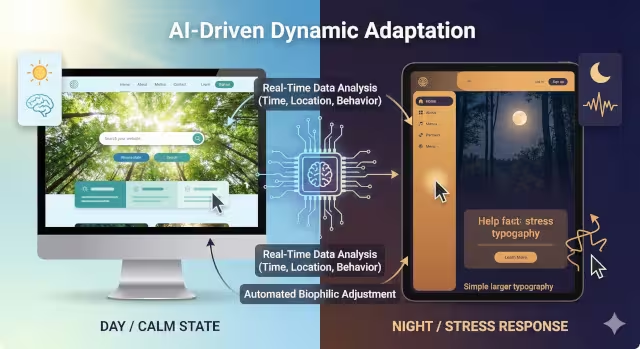
The most immediate benefit of using biophilic web UX is the ability to change based on the user’s needs. In the past, a website looked the same whether you visited it at high noon or midnight. This ignores the biology of the human body. We have internal clocks called circadian rhythms. These rhythms tell us when to be awake and when to sleep. Bright blue light signals “wake up,” while warm amber light signals “rest.”
AI acts as the nervous system for a website. It can connect to local time data and geolocation APIs. An API is just a way for two computer programs to talk to each other. By using this data, the AI knows exactly where the user is and what time it is. The biophilic web UX can then adjust the color temperature of the screen automatically.
If a user in Boston visits the site at 10 AM, the background might be a crisp, cool white to encourage focus. If that same user visits at 10 PM, the AI shifts the entire color palette to a soft, warm amber. This reduces the blue light entering the eye and helps preserve the user’s melatonin levels.
This goes beyond simple “dark mode.” It is a “nature mode” that mimics the setting sun. But AI can go deeper than just time. It can analyze behavior to create personalized digital habitats. Machine learning algorithms can detect signs of stress in a user. For example, if a user is clicking a mouse rapidly or moving the cursor in erratic, jagged lines, the computer can guess that the user is frustrated.
In response, the biophilic web UX can trigger a calming protocol. The interface might simplify itself, removing clutter and complex menus. The colors might shift to a deep, calming forest green. The contrast between text and background might lower slightly to reduce eye strain. This creates a responsive loop. The user feels stress, the digital environment changes to soothe them, and the user relaxes. This is a profound shift from the static pages of the past.
Generative Biomimicry: Infinite Nature Through Algorithms
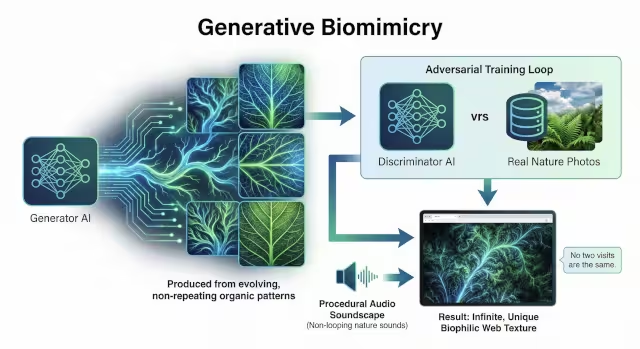
Nature never repeats itself exactly. If you look at a tree, every leaf is similar, but no two leaves are identical. This variety is pleasing to the human brain. It is stimulating without being overwhelming. Traditional web design is the opposite. It uses repeating grid patterns and identical icons. This repetition can become boring and tiring for the brain.
AI allows designers to use a technique called Generative Biomimicry. This involves using algorithms to grow designs rather than drawing them. One powerful tool for this is the Generative Adversarial Network, or GAN. You can think of a GAN as two AI artists having a contest. One artist tries to create a pattern that looks like a leaf. The other artist judges it. They do this millions of times until the computer can generate leaf patterns that are mathematically perfect but infinitely unique.
This unlocks massive potential for biophilic web UX. Instead of loading a heavy image file of a cloud, the website can use code to generate a new cloud formation every time the user visits. This keeps the experience fresh. It engages the brain’s desire for novelty. We call this “Fractal Dimension Analysis.” Fractals are repeating patterns found in nature, like the branching of a river or the veins in a leaf. Research shows that looking at fractals reduces stress by up to 60 percent. AI can generate these fractals in real time as background textures.
We can also apply this to sound. Many websites avoid sound because it is annoying. A looping clip of a bird chirping becomes repetitive and robotic after ten seconds. AI can fix this by using procedural audio. This means the computer has a library of thousands of tiny sound stems, a single chirp, a rustle of wind, a drop of water. The AI mixes these sounds in real time. It ensures that the soundscape never repeats exactly the same way twice. It creates a “cocktail party effect,” where the sound provides a pleasant background that masks distractions without demanding attention. This level of immersion is a key element of effective biophilic web UX.
Data-Driven Optimization: The Science of Feeling Good
How do we know if a design makes someone feel good? In the past, designers had to guess. They would use their intuition to place a picture of a plant or choose a shade of green. Today, we can use data to prove what works. This is where AI-driven optimization comes into play. It turns the art of design into a science of well-being.
One technique is biometric heatmapping. AI can simulate how a human eye will look at a web page. It predicts where the user will look first, second, and third. Designers can use this to arrange elements in organic, flowing layouts. Instead of a rigid square grid, they might use a Fibonacci spiral layout. This is a spiral pattern found in seashells and galaxies. It guides the eye naturally to the center of interest. When the layout matches the natural movement of the eye, the user feels less fatigue. They stay on the site longer. We call this “Dwell Time,” and it is a major factor in how search engines rank websites.
AI also allows for evolutionary testing. In standard web design, a team might test two versions of a page. This is called A/B testing. With AI, we can test thousands of variations at once. We call this “Evolutionary Algorithms.” The AI generates slightly different versions of the biophilic web UX. It might change the density of the leaf pattern, the speed of the animation, or the shade of green. It then measures how users react. Do they stay longer? Do they click more?
The designs that perform best “survive” and reproduce. The AI combines the best features of the winning designs to create an even better version. Over time, the website evolves on its own. It becomes perfectly improved for human comfort and engagement. This ensures that the biophilic web UX is not just a stylistic choice but a high-performance tool for business and user health.
Sustainable AI Architecture: The Green UX Advantage
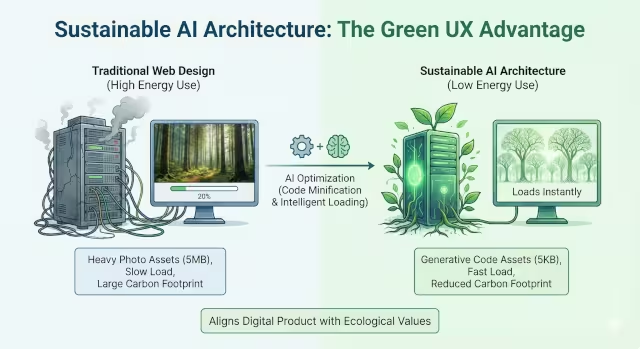
True biophilic design is not just about loving nature; it is about protecting it. The internet consumes a vast amount of electricity. Every time you load a large image or a video, servers in a data center burn coal or gas to send that data to you. A website that looks like nature but destroys the actual environment is a failure.
AI helps solve this through sustainable architecture. One of the hidden benefits of using AI in biophilic web UX is energy efficiency. AI tools can compress code and images far better than humans can. We call this “minification.” The AI scans the code and removes every unnecessary character and line. It makes the website lightweight.
Furthermore, generative assets are often smaller than photos. A high-resolution photograph of a forest might be 5 megabytes in size. That is a lot of data. A piece of code that instructs the browser to draw a fractal pattern might be only 5 kilobytes. That is one thousand times smaller. This means the website loads faster and uses less energy.
AI also enables intelligent asset loading. The system predicts what the user is about to look at. It only loads the images and scripts that are needed right now. If the user never scrolls to the bottom of the page, the AI never loads that data. This reduces the carbon footprint of the website. By aligning the digital product with ecological values, companies can show that they truly care about the environment. This authenticity appeals to modern users who value sustainability.
Leading Tools for AI-Enhanced Biophilic Design
For those ready to start building, several tools bridge the gap between AI and design. These tools allow designers to create organic textures and adaptive layouts without needing a PhD in computer science.
- Midjourney / DALL-E 3: These are image generation tools. A designer can type a prompt like “seamless texture of moss on oak bark, soft lighting, top-down view.” The AI will generate a unique, organic image that can be used as a background or texture in biophilic web UX.
- Figma (with AI Plugins): Figma is a popular design interface. New AI plugins allow designers to generate color palettes based on nature photos instantly. They can also create layout variations that break the grid and introduce organic asymmetry.
- Custom Python/TensorFlow Scripts: For the advanced developer, writing scripts in Python using libraries like TensorFlow allows for real-time adaptation. This is how you would build the system that changes the website color based on the local weather or time of day.
Common Questions about AI and Biophilic Design
Can AI replace human designers in biophilic design?
No, AI cannot replace the human designer. AI is a tool for “computational creativity.” It handles the heavy lifting of calculating complex patterns and analyzing data. However, it lacks the human capacity for empathy and intent. A human designer must set the goal of the project. The human decides the “mood” of the forest; the AI simply grows the trees. The best results come from a partnership between human intent and machine efficiency.
How does biophilic web design improve SEO?
Biophilic web UX improves SEO by improving user behavior. Search engines like Google look at metrics like “Time on Page” and “Bounce Rate.” If a user feels calm and happy on a site, they stay longer. They read more. They click more. These signals tell the search engine that the website provides value. This leads to higher rankings. Additionally, the technical optimization provided by AI (faster load times) is a direct ranking factor.
What are the 14 patterns of biophilic design in digital spaces?
The 14 patterns are a framework for bringing nature into the built environment. In digital spaces, we focus on patterns like “Visual Connection with Nature” (images/video), “Non-Rhythmic Sensory Stimuli” (gentle animations like swaying grass), “Biomorphic Forms” (curved lines instead of sharp corners), and “Mystery” (partially obscured views that make the user want to scroll). AI amplifies these by making them responsive and infinite.
Conclusion
The benefits of using AI in biophilic web UX are vast and transformative. We are moving away from the era of the “digital concrete jungle.” We are entering an era of living digital ecosystems. By combining the soothing, restorative power of nature with the predictive, generative power of AI, we can create websites that heal rather than harm.
These new digital spaces respect our circadian rhythms. They engage our brains with infinite fractal variety. They evolve to meet our needs using data. And they do all of this while minimizing the energy impact on the planet. The future of web design is not about building more pages; it is about growing them.
We are moving toward a concept called “Neuroarchitecture.” This is the idea that our buildings—and our websites—should be designed to positively affect our brains and nervous systems. As we spend more of our lives online, this becomes a health imperative.
I encourage every designer and developer to take a small step today. You do not need to rebuild your entire site. Start by using an AI tool to generate a single organic texture. Replace a sharp gray background with a soft, generative fractal. Observe how it changes the feel of the page. The technology is here. The biology is ancient. It is time to bring them together.