
Table of Contents
Defining Biometric Soundscape Adaptation
The Definition
A biometric soundscape is an intelligent audio environment that listens to your body and changes its sound in real time. The process is called biometric soundscape adaptation. To understand how it works, imagine putting on a pair of headphones or walking into an office room. A small sensor on your wrist, your ring, or your webcam measures physical signals from your body. These physical measurements are called biometrics. They include your heart rate, the rhythm between your heartbeats, your breathing speed, and how much sweat your skin produces.
When you get stressed, your body shifts into high gear. A biometric soundscape detects that shift right away. Instead of playing a pre-recorded song or a repeating loop of ocean waves, the biometric soundscape software generates original sound on the spot. It uses computer code to alter the acoustic layers. If your heart speeds up and your skin indicates tension, the biometric soundscape might soften harsh high-frequency sounds, slow down the musical tempo, or bring in the gentle rumble of distant thunder and rain.
When your body relaxes, the sound gently shifts again to keep you engaged or help you sleep. In simple terms, a biometric soundscape acts like an acoustic mirror for your autonomic nervous system. It creates a closed loop where your body guides the sound, and the sound guides your body back to a state of balance.
The Paradigm Shift
For decades, people used background sound to drown out annoying noises or help them concentrate. In the past, this meant buying a white noise machine or playing a long video of nature sounds. Later, people began using streaming apps with focus playlists.
While static recordings can be helpful, they have major weaknesses. First, a static recording does not care how you feel. If you are having a panic attack, a standard focus playlist continues playing at the same speed. Second, the human brain is an expert pattern detector. When a recorded stream of rain loops every three minutes, your subconscious brain notices the pattern. Once your brain notices the loop, the calming effect drops off, and the sound can even become annoying.
The arrival of the biometric soundscape represents a fundamental change in how we think about sound design. We are moving from static audio to responsive audio. A modern biometric soundscape does not use static sound files. It uses live code, mathematical algorithms, and digital signal synthesis to generate acoustic textures that never repeat.
Because the biometric soundscape reacts to your personal body data, it is customized for you at that exact second. It treats audio as an interactive health tool rather than static wallpaper. This shift changes our relationship with digital media, shifting audio from passive entertainment into a dynamic system that actively protects our mental energy.
The Biophilic Interface
Human beings spent hundreds of thousands of years living outside among plants, wind, water, and wildlife. Our ears and nervous systems evolved to listen to natural environments. When our ancestors heard the gentle rustle of leaves, running water, and the steady singing of songbirds, their brains knew an important fact: there are no predators nearby, and the environment is safe.
This evolutionary biological connection to nature is known as biophilia. Biophilic design brings natural elements like sunlight, plants, natural wood, and fresh air into buildings and websites. However, design often ignores what our ears hear. Many offices and websites look visually pleasant, but they sound cold, sterile, or chaotic.
A biophilic biometric soundscape solves this sensory gap. It uses the biological lessons of nature to build digital soundscapes. When a biometric soundscape detects that your stress levels are climbing, it does not just play random notes. It introduces acoustic elements from natural habitats. It might introduce the acoustic resonance of a rushing mountain creek or the soft calls of morning birds.
Because these sounds are delivered through a responsive biometric soundscape, the audio feels alive. It breathes when you breathe. It quiets down when you need deep focus, and it warms up when you need restoration. The biometric soundscape serves as a bridge between ancient human biology and modern digital technology.
The Physiology of Auditory Feedback: How the Closed-Loop Functions
Biometric Ingestion (Input Layer)
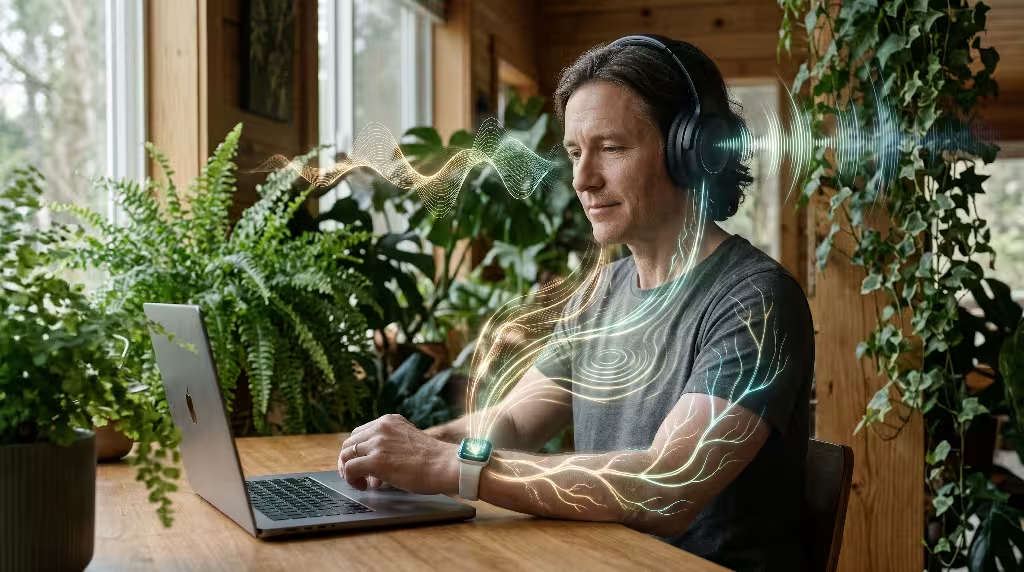
To create an effective biometric soundscape, the system needs accurate, continuous information about your internal physical state. This happens at the input layer through biometric sensors. Today, these sensors are small, comfortable, and often already built into devices people use every day, such as smartwatches, fitness rings, and webcams.
The first and most important measurement used by a biometric soundscape is Heart Rate Variability, or HRV. Many people think a healthy heart beats like a mechanical metronome, tick-tock-tick-tock at exact intervals. In reality, a healthy heart is flexible. If your heart rate is sixty beats per minute, the time between beats varies constantly. One gap might be 0.9 seconds, the next might be 1.1 seconds, and the one after that might be 0.95 seconds.
This variation is controlled by your autonomic nervous system. Your sympathetic nervous system acts like a car gas pedal, preparing you to run or fight. Your parasympathetic nervous system acts like a car brake, helping you rest, digest, and recover. When your brake is working well, your heart rate variability is high, meaning your body is resilient and relaxed. When you are stressed, your gas pedal takes over, and your heart rate variability drops. A biometric soundscape uses optical sensors called photoplethysmography, or PPG, to measure these tiny shifts in blood flow through your skin.
The second measurement is Electrodermal Activity, also known as Galvanic Skin Response. When your sympathetic nervous system fires up, microscopic sweat glands on your fingers and palms open up slightly. This changes how easily a tiny electrical current passes across your skin. It happens within milliseconds of an emotional thought or stress trigger. A biometric soundscape uses this skin conductance data to spot stress spikes before you even notice them consciously.
The third measurement is Electroencephalography, or EEG. Some modern audio headsets have soft dry sensors built into the headband that read the electrical waves of your brain. Fast beta and gamma waves show intense thinking or anxiety. Slower alpha and theta waves show calm alertness, meditation, and creative flow. When an EEG sensor feeds data into a biometric soundscape, the system can see whether your brain is overwhelmed or resting.
Algorithmic Interpretation and DSP Modulation (Processing Layer)
Once the sensors collect raw biometric data, that information enters the processing layer. Raw body data is noisy. Your wrist moves, your fingers twitch, and your breathing changes while you speak. The biometric soundscape software must clean this data before using it.
The software uses mathematical filters to remove movement errors. It calculates rolling averages for your heart rate variability and skin conductance. For example, the software looks at a metric called RMSSD, which stands for the root mean square of successive differences between heartbeats. This number gives an accurate picture of your parasympathetic vagal tone.
Next, the biometric soundscape engine maps your physiological metrics to acoustic variables. This is where computer science meets digital signal processing, or DSP. Digital signal processing is the method computers use to shape sound waves. The biometric soundscape does not pick from a list of fixed audio files. Instead, it adjusts parameters inside a software synthesizer.
If your stress index rises, the biometric soundscape algorithm can lower the cutoff frequency of a low-pass filter. This filter cuts out harsh, sharp frequencies and leaves only warm, muted tones. The algorithm can also alter the density of sound grains in a granular synthesizer. In granular synthesis, the computer splits tiny slices of natural audio and scatters them across the room. If your body needs calming, the biometric soundscape spreads those sound grains out, creating a smooth, soft acoustic blanket.
Auditory Delivery (Actuation Layer)
The final stage of the loop is the actuation layer, which is the sound that actually reaches your ears. This sound must be delivered with care. If a biometric soundscape changed abruptly whenever your heart beat faster, the sudden shift in sound would startle you. That would cause more stress, creating a bad feedback loop.
To prevent this, an effective biometric soundscape uses smooth, slow transitions. The acoustic parameters change gradually over ten, twenty, or sixty seconds. You do not consciously hear the sound shifting. Instead, you simply notice that your shoulders have relaxed, your jaw is unclenched, and your breathing has slowed down.
The delivery system also relies on spatial audio and ambisonics. Spatial audio makes sound feel like it is coming from specific locations in three-dimensional space around your head. In a high-quality biometric soundscape, natural sounds are placed around you in a realistic sphere. The sound of wind might pass high above you, while the sound of falling water stays low and to your right.
This 3D spatial layout makes the brain feel like it is sitting in an open, natural landscape rather than staring at a computer screen. When the delivery layer works smoothly, the biometric soundscape becomes an extension of your own body, quietly steering you toward calm and focus.
Biophilic Acoustic Design: Why Nature Sounds Matter Mechanistically

Attention Restoration Theory (ART) and Auditory Soft Fascination
Modern life places huge demands on our minds. When you read emails, write code, balance spreadsheets, or drive in traffic, you use a cognitive process called directed attention. Directed attention requires effort. You must force your brain to focus on one thing while ignoring dozens of distractions, such as notifications, background conversations, and street traffic.
Over the course of a day, your directed attention runs out of energy. Psychologists call this directed attention fatigue. When you reach this point, you become irritable, make more mistakes, and struggle to think clearly.
In the 1980s, environmental psychologists Rachel and Stephen Kaplan developed Attention Restoration Theory, or ART. They discovered that spending time in nature restores our directed attention. Nature accomplishes this through a state called soft fascination.
Soft fascination occurs when your attention is held effortlessly by gentle, interesting sensory inputs that do not demand hard analysis. Examples include watching clouds drift across the sky, seeing sunlight filter through leaves, or listening to water trickle over river stones.
A biometric soundscape uses auditory soft fascination to heal mental fatigue. It provides your ears with rich, gentle acoustic information that holds your interest without demanding focused thought. When your mind enters this state, your directed attention system can rest and rebuild its strength.
By tying soft fascination to your body signals, a biometric soundscape knows exactly when your attention is exhausted. It steps in with restorative natural textures precisely when your brain needs them most.
Evolutionary Psychoacoustics
Psychoacoustics is the study of how human brains perceive and interpret sound. Our hearing system did not develop in carpeted offices or concrete cities. It developed in wild savannas, dense forests, and coastal margins. As a result, our auditory cortex has built-in preferences for certain sound structures.
One of the most important patterns found in nature is pink noise, which follows a mathematical distribution known as one-over-f noise. In pink noise, every octave contains an equal amount of acoustic energy. The power of the sound drops off smoothly as the frequency gets higher.
Pink noise is found everywhere in natural physics, including ocean waves, rainfall, waterfalls, and wind blowing through trees. Because this sound pattern is so common in nature, human ears find it deeply soothing. It provides enough sound energy to mask unexpected noises without overloading our sensory processing.
A biometric soundscape takes advantage of evolutionary psychoacoustics. It generates nature-like noise profiles that match natural physical laws. Furthermore, it understands the emotional meaning of silence in nature. To a primitive human, total silence in a forest was terrifying. It meant birds and insects had stopped making noise because a predator was prowling nearby.
Complete silence in an office or a pair of noise-canceling headphones can actually make people feel anxious and hyper-alert. A biometric soundscape maintains a comforting baseline of healthy natural sound. It tells your primitive brain that the surrounding environment is calm, stable, and completely safe.
Algorithmic Nature Synthesis vs. Static Recordings
To understand the power of a biometric soundscape, you must understand the difference between playing a sound file and synthesizing an acoustic world. A traditional sound app plays an MP3 file recorded in a national park. While the original recording may be beautiful, it is fixed in stone. If you listen to that file for eight hours while working, you will hear the exact same bird chirp at minute 3, minute 18, and minute 33.
Your auditory cortex is built to detect repetitions and anomalies. When your subconscious mind hears the exact same bird chirp repeat, it realizes the sound is artificial. The illusion of nature breaks down, and your brain stops experiencing deep restoration.
A modern biometric soundscape takes a different path. It uses algorithmic nature synthesis. The software contains mathematical rules that model how natural sounds behave physically. For example, instead of playing a recording of rain, the biometric soundscape calculates the sound of thousands of individual virtual raindrops hitting different virtual surfaces like leaves, soil, or water. Each drop has a slightly different mass, velocity, and pitch.
The software can change the virtual wind speed, the humidity, and the size of the raindrops based on your biometric data. If your heart rate goes up, the virtual rain can soften into a gentle mist. If you need a burst of morning energy, the biometric soundscape can introduce the calls of various virtual birds, each following natural biological rules for timing and pitch.
The resulting audio is infinite, completely organic, and never repeats a single phrase. This keeps your brain engaged and allows the restorative effects of biophilia to last all day long.
Implementation Verticals and Emerging Use Cases
Next-Gen Biophilic Web and Digital Interfaces
As a designer at Silphium Design LLC, my primary focus is bringing natural design principles into the digital world. For many years, web design has been almost entirely visual. Designers add green plant photos, earthy color palettes, and organic curved layouts to websites. While these visual touches help, they only engage one human sense.
The modern internet is often an exhausting place to visit. Websites are packed with flashing banners, auto-playing videos, pop-up ads, and harsh alert chimes. This creates an environment of sensory overload. By integrating a biometric soundscape directly into web applications, we can make digital spaces calmer and more human.
Imagine opening a web application for project management, writing, or online learning. With your permission, the website reads basic biometric signals. It can do this through a connected smartwatch or by using remote photoplethysmography via your webcam. Remote photoplethysmography tracks tiny, invisible changes in the color of your facial skin each time your heart beats, calculating your heart rate without any wearable device.
As you work on the website, a subtle biometric soundscape runs in the background through the browser Web Audio API. When you are writing calmly, the sound stays quiet and transparent, sitting just below your conscious awareness. If you encounter a frustrating problem and your heart rate spikes, the website biometric soundscape notices the tension.
It slowly introduces soft, low-frequency water sounds that help regulate your breathing. The website ceases to be a static page of text and becomes a responsive environment that protects your mental health while you work.
Architectural and Workspace Optimization
Modern office buildings are filled with acoustic problems. Open-plan offices were created to encourage teamwork, but they often make it impossible to concentrate. In an open office, you constantly overhear half of a phone conversation, the clatter of keyboards, the hum of air conditioning units, and people walking down hallways.
Human speech is especially distracting. Because our brains are wired to decode language, you cannot simply choose to ignore someone talking five feet away from you. Your brain works hard to decipher the words, which destroys your ability to write, analyze data, or read complex documents.
Many companies try to solve this by installing sound masking systems. These systems usually pump constant pink or white noise through ceiling speakers to cover up speech sounds. While this makes speech less intelligible, constant white noise can cause fatigue, headaches, and elevated stress over an eight-hour shift.
An architectural biometric soundscape provides a much smarter solution. Instead of pumping unchanging static noise into the room, an architectural biometric soundscape uses anonymous environmental sensors and wearable data from team members. It tracks the ambient noise level, room occupancy, and collective stress patterns of the workspace.
The biometric soundscape then generates layered nature sounds, such as flowing streams or forest breezes, that adjust their frequencies to mask speech without sounding harsh. When the office is quiet, the biometric soundscape softens to a barely audible breeze. When meeting rooms empty and people start talking in the open area, the biometric soundscape gently raises its masking layers to protect focus. The office sounds like an open woodland glade rather than a noisy factory floor.
Clinical and Therapeutic Environments
Healthcare settings are some of the most stressful environments on earth. Hospitals, dental clinics, and emergency rooms are loud and chaotic. Patients are forced to listen to beeping medical monitors, rolling carts, closing doors, and the distress of other patients.
This acoustic chaos increases patient blood pressure, elevates stress hormones, and makes it harder for people to rest and heal. Hospital staff also suffer from alarm fatigue, where their brains become overwhelmed by constant warning sounds, increasing the risk of medical errors.
A biometric soundscape can transform clinical spaces into healing sanctuaries. In an infusion suite or dental chair, a patient can wear simple biosensors and noise-isolating headphones running a customized biometric soundscape.
If the patient feels anxious before a procedure, their heart rate rises and their skin conductance increases. The biometric soundscape detects this surge in anxiety and adapts immediately. It introduces comforting, harmonic acoustic layers and rhythmic natural sounds that coax the patient into taking deeper, slower breaths.
In mental health therapy rooms, a biometric soundscape can help patients processing deep trauma. When a patient talks about painful memories, their nervous system can easily become overwhelmed. A therapist can monitor the biometric soundscape feedback on a screen or let the ambient audio adjust automatically to help the patient stay within a safe emotional zone.
By providing immediate acoustic grounding, the biometric soundscape helps patients feel safe and anchored during difficult psychological work.
Frequently Asked Questions about Biometric Soundscapes
What is the difference between adaptive soundscapes and binaural beats?
Many people searching for focus and relaxation audio come across binaural beats. While both technologies aim to change your mental state, they operate on completely different principles.
A binaural beat is a rigid acoustic illusion. To create a binaural beat, a system plays one pure frequency into your left ear (for example, 400 Hertz) and a slightly different frequency into your right ear (for example, 410 Hertz). Your brain processes the difference between these two tones and perceives a phantom third tone that pulses at the difference frequency (in this case, 10 Hertz).
Binaural beats attempt to force your brain into matching that pulse through a process called brainwave entrainment. However, binaural beats are one-way tools. They do not know if your brain is actually responding, they require stereo headphones to work at all, and many people find listening to pure buzzing sine waves unpleasant or irritating.
A biometric soundscape, on the other hand, is a responsive, closed-loop system. It does not try to force your brain into a specific frequency through a rigid tone. Instead, a biometric soundscape reads your actual physical state and creates a multi-layered, organic audio environment. It uses rich natural sounds, spatial balance, and dynamic filtering to encourage relaxation naturally.
A biometric soundscape can play through headphones or through open room speakers. Most importantly, a biometric soundscape listens to you. If a sound approach is not helping your body settle down, the biometric soundscape recognizes that failure and changes its acoustic strategy in real time.
How do wearables feed biometric data to an acoustic sound generator?
To make a biometric soundscape work, data must travel smoothly from your body to the audio generation software. This happens through a simple, four-step pipeline:
[Body Sensors: PPG / GSR]
         │
         ▼ (Bluetooth Low Energy)
[Device Interface: Web Bluetooth / Native App]
         │
         ▼ (Data Cleaning & Normalization)
[Algorithmic Engine: Parameter Mapping]
         │
         ▼ (Audio DSP & Synthesis)
[Biometric Soundscape Output: Speakers / Headphones]
- Sensor Measurement: Your wearable device uses optical light sensors or metal contacts to measure physiological changes, such as pulse waves and skin sweat.
- Wireless Transmission: The wearable packages these readings into lightweight data packets and sends them via Bluetooth Low Energy (BLE) to your phone, computer, or tablet. Modern web browsers can receive this data directly through the Web Bluetooth API, meaning you do not even need to install separate software.
- Data Ingestion and Scaling: The receiving app runs a script that cleans the incoming numbers. It checks your baseline and scales the numbers between 0.0 and 1.0 to represent your current stress or recovery level.
- Parameter Injection: The software passes these scaled values into the audio engine. In the engine, these numbers are connected directly to sound parameters. For example, as your recovery score rises, a volume knob for bird song turns up, and the master low-pass filter opens to let in brighter, clearer sounds. The entire trip from your heartbeat to a sound update takes less than a tenth of a second.
Can biometric soundscape adaptation reduce cortisol and stress?
Yes, scientific research shows that responsive sound environments can measurably reduce physiological stress and lower cortisol levels. Cortisol is the primary stress hormone produced by your adrenal glands. When you face acute mental strain or long periods of noise pollution, your body releases cortisol into your bloodstream. Prolonged high cortisol impairs memory, disrupts sleep, weakens the immune system, and increases inflammation.
When you listen to an adaptive biometric soundscape, several therapeutic mechanisms work together. First, the introduction of natural water and wind sounds triggers an immediate parasympathetic response. Clinical studies have shown that listening to natural soundscapes speeds up autonomic recovery after a stressful event compared to sitting in silence or listening to urban noise.
Second, because the biometric soundscape adapts in real time, it acts as a form of biofeedback. When the sound softens as you take deep breaths, your brain recognizes the connection. You learn to relax faster because the audio gives you instant auditory rewards for letting go of tension.
Medical tests measuring salivary cortisol and heart rate variability have confirmed that participants working inside a responsive biometric soundscape show lower stress markers and recover from mental fatigue faster than those in standard environments.
Is biometric soundscape adaptation safe for neurodivergent individuals?
For neurodivergent individuals, including people with Autism Spectrum Disorder (ASD), Attention Deficit Hyperactivity Disorder (ADHD), and sensory processing differences, traditional acoustic environments are often painful. Fluorescent light hums, sudden elevator chimes, echoing hallways, and chaotic cafeteria chatter can trigger intense sensory overload.
A biometric soundscape can serve as an invaluable safety tool for neurodivergent individuals, provided it is designed with careful safeguards. Because a biometric soundscape monitors physical arousal via skin conductance and heart rate, it can detect the earliest physiological signs of sensory overwhelm before a person experiences a full meltdown or shutdown.
When early distress signals appear, the biometric soundscape can automatically intervene. It can dial back complex high frequencies, increase soothing low-frequency pink noise, and create an acoustic bubble that shields the individual from chaotic room sounds.
However, system safety requires giving the user full agency. Neurodivergent individuals must always have the ability to pause the system, adjust volume limits, or choose which sound elements they feel comfortable hearing. When built with these respectful limits, a personalized biometric soundscape provides a predictable, calming shelter in a loud world.
Technical Architecture and Engineering Considerations (Web and Systems Perspective)

Client-Side Latency and Computational Overhead
Building a high-performance biometric soundscape requires careful software engineering. If an audio system lags, stutters, or uses up all of a computer’s central processor, it causes frustration rather than relaxation. When building these systems for websites, engineers must run the entire pipeline directly on the user’s computer inside the browser.
To achieve this, developers rely on the Web Audio API. The Web Audio API allows a browser to process and synthesize audio using background hardware threads rather than blocking the main user interface. Engineers construct an audio graph, which is a collection of connected audio nodes:
[Audio Context]
       │
       ├──> [Stochastic Noise Generator] ──> [Biquad Low-Pass Filter] ──┐
       │                                                                │
       ├──> [Granular Water Synthesizer] ──> [Stereo Panner Node] ──────┼──> [Gain Node] ──> [Destination: Speakers]
       │                                                                │
       └──> [Procedural Birdsong Engine] ──> [Convolver Reverb Node] ───┘
In this audio graph, the biometric data feeds directly into the parameters of these nodes. For example, the cutoff frequency of the Biquad Filter is tied to a smoothed heart rate calculation.
To prevent sudden clicks or pops in the audio, engineers use a method called linear parameter automation. Instead of jumping from 500 Hertz to 200 Hertz instantly, the code tells the browser to glide between the two values smoothly over a few seconds.
By writing clean, modular code using modern WebAssembly, a web-based biometric soundscape can run smoothly in the background while using less than two percent of a standard laptop processor.
Data Privacy, Anonymization, and Local Execution
Biometric data is among the most sensitive personal information a person has. Your heart rate, breathing patterns, and stress responses can reveal private details about your physical health, emotional state, and medical conditions. If users suspect that a website is collecting their heart data and sending it to corporate marketing servers, they will rightfully reject the technology.
To earn user trust, every biometric soundscape must follow strict privacy engineering practices. The most important rule is local execution, often called edge computing.
All data processing, from raw sensor reading to audio synthesis, should happen exclusively on the user’s local machine. The raw biometric data should never be saved to a database, sent to a cloud server, or shared with third-party advertisers.
When a user closes their browser tab, the biometric session data should disappear from computer memory completely. If an office building uses an architectural biometric soundscape, the sensors must aggregate and anonymize the data at the hardware level.
The system should never track individual workers. Instead, it should only read a single blended room average to adjust the background sound. By designing the biometric soundscape with zero-knowledge architecture, we protect personal dignity while delivering genuine biological benefits.
The Future of Responsive Environmental Computing
Bringing Biology, Computation, and Ecological Design Together
We stand at an exciting crossroads in the history of human design. For over a century, technological progress has pulled humans away from the natural world. We moved from outdoor fields into enclosed offices, trading sunlight and living soundscapes for fluorescent lamps and noisy ventilation ducts. In recent decades, our work migrated into glowing glass screens, filling our days with digital noise and chronic attention fatigue.
The biometric soundscape proves that technology does not have to alienate us from our biological roots. By uniting biology, computer science, and ecological architecture, we can build tools that support our evolutionary needs.
Instead of demanding that humans adapt to rigid machines, the biometric soundscape makes machines adapt to living humans. It transforms sound from an accidental side effect of modern life into an intentional, supportive, and restorative partner.
As wearable sensors become smaller and browser audio engines become more sophisticated, the biometric soundscape will become a standard component of healthy buildings, caring websites, and balanced digital workspaces.
By listening closely to our bodies and answering with the ancient wisdom of nature, a biometric soundscape helps us find focus, calm, and health in an increasingly complex world. It points toward a future where our digital spaces feel just as restorative, organic, and welcoming as a walk through an untouched forest.