The intersection of digital technology and environmental protection requires a new way of thinking about user design. As digital platforms expand, creators often use game elements to keep people interested. However, when we build systems for users who care deeply about the planet, traditional point tracking is not enough. These users want truth, depth, and clear utility.
This article looks at how web designers can build digital systems that change how people act. By using nature-focused gamification strategies for eco-conscious users, we can design websites and apps that do more than just capture attention. We can create digital systems that support real world conservation and build healthy online spaces.
To understand these nature-focused gamification strategies for eco-conscious users, we must look at how human psychology connects with the natural world. This approach uses biophilic web design, which means bringing elements of nature into our digital interfaces. When we combine biophilic design with human behavior science, we create tools that feel natural and meaningful. These gamification strategies do not treat the environment like a casino game. Instead, they use the rules of living ecosystems to guide human choices. By end of the article, you will know how to build, program, and launch digital systems that turn environmental awareness into daily habits.
Table of Contents
The Behavioral Mechanics of Green Design
Shifting from Extrinsic to Intrinsic Motivators
When digital platforms try to change user habits, they often make the mistake of using external rewards. These are called extrinsic motivators. They include things like virtual coins, digital medals, or corporate shopping coupons. For everyday web users, these tools might work for a short time. But when you are building gamification strategies for people who care about ecology, these external rewards can actually backfire. Eco-conscious users are motivated by internal values. This is called intrinsic motivation. They act because they care about the health of the planet, not because they want to win a digital plastic trophy.
If a web platform uses cheap gamification strategies that feel like a slot machine, eco-conscious users will experience cognitive dissonance. This is a psychological term for the mental discomfort you feel when your actions or the tools you use do not match your deep beliefs.
For example, if a user cuts their home energy use, they do not want a pop-up ad offering a discount on a fast-fashion t-shirt. That reward harms the environment, which defeats the whole purpose of their effort.
Therefore, advanced gamification strategies must use what design experts call Self-Determination Theory. This theory states that humans are happiest and most active when they feel three things: autonomy, competence, and relatedness. Autonomy means the user feels in control of their own choices. Competence means they feel they are getting better at a skill. Relatedness means they feel connected to a larger community or cause.
[Autonomy: User Choice] + [Competence: Real Skill] + [Relatedness: Big Cause]
                                   │
                                   ▼
             [Long-Term Intrinsic Habit Formation]
When you build web systems based on these three pillars, your gamification strategies become much more powerful. Instead of using a simple numbers countdown to show progress, you can use organic visuals. For instance, you can design a user dashboard where a digital forest canopy grows thicker as the user lowers their home carbon footprint. The reward is the visual health of the digital ecosystem, which mirrors the health of the real world. This connects directly to the user’s intrinsic desire to see nature thrive.
How does gamification encourage sustainable behavior?
To answer this question, we have to look at a major problem in environmental psychology known as the value-action gap. This gap is the distance between what people care about and what they actually do. Many people say they want to protect the earth, but they find it hard to change their daily habits. This happens because environmental damage is often invisible, slow, and far away. If you throw away a plastic cup, you do not see the ocean ecosystem suffer right that second. The feedback loop is broken.
This is exactly where well-designed gamification strategies can help. Game mechanics can shorten the feedback loop. They bring the distant consequences of human actions right onto the user’s screen in real time. By using smart data and clear visuals, gamification strategies make the invisible visible.
When a user logs a sustainable action, like riding a bicycle to work instead of driving a car, the web platform updates instantly. The system can show how much carbon gas was kept out of the air. It can translate that raw data into a clear visual, like showing how many leaves on a virtual tree stay healthy because of that bike ride. This immediate response satisfies the human need for feedback. It rewards the user right away, which helps them turn a one-time choice into a lifelong habit and encourages them to continue the activity.
Furthermore, these gamification strategies break huge global problems into small, easy steps. Saving the entire planet feels impossible for a single person. But keeping a single virtual plant alive by turning off your home lights is a goal anyone can handle. By shrinking the scale of the challenge, gamification strategies remove the feeling of overwhelm. They replace panic with a sense of control, which encourages people to take consistent, sustainable action every single day.
Nature-Focused Gamification Strategies for Eco-Conscious Users

Micro-Quests and Actionable Eco-Challenges
One of the most effective nature-focused gamification strategies for eco-conscious users is the use of micro-quests. A micro-quest is a tiny, low-friction task that a user can complete in a short amount of time. In traditional web design, interfaces often bombard users with long lists of chores. If an app tells a user to overhaul their entire lifestyle in one day, the user will get tired and close the app. Smart gamification strategies take those massive goals and chop them into bite-sized actions.
For example, a sustainable cooking website can use these gamification strategies to change how people buy food. Instead of asking a user to become a strict vegan overnight, the site can offer a simple daily challenge, such as eating one plant-based meal today. Another challenge could be checking the refrigerator for leftovers before going to the grocery store to cut down on food waste.
[Massive Environmental Goal] ──(Split into)──> [Daily Micro-Quests] ──> [Low Friction Action]
To make these gamification strategies work well, the website architecture must make tracking these quests completely seamless. Users should be able to log their actions with a single tap on their screen. Every time they complete a micro-quest, the system records it without interrupting their digital experience. Over time, these small actions add up. The web platform can then show the user a summary of their history. This summary shows how dozens of tiny choices have created a massive wave of positive environmental change. This builds a strong sense of personal capability and keeps the user coming back to the platform.
Dynamic Biomimetic Feedback Loops
Another vital part of nature-focused gamification strategies for eco-conscious users is the use of biomimetic feedback loops. Biomimetic means mimicking living systems. In the physical world, nature operates through constant balance and feedback. When a forest receives rain, the plants grow. When there is a drought, the leaves turn brown. Web designers can study these natural rules to build better gamification strategies.
When you design a user dashboard, you can connect the layout directly to live data inputs. These inputs can come from smart home devices, public environmental databases, or user input logs. As this data changes, the interface changes too. If a user reduces their daily water use, the background of the website might become a vibrant, deep blue, and digital plants might start to bloom across the screen. If their water use goes up, the digital landscape dries out.
These types of gamification strategies work because humans are hardwired to understand natural patterns. We instantly know that a brown, dry leaf means a system needs care, while a bright green shoot means a system is healthy. By using these natural indicators instead of standard pie charts or red progress bars, you make the data intuitive. Users do not have to study complex math spreadsheets to see how they are doing. They can look at the digital biome and instantly feel the impact of their choices. This makes the platform feel alive and deeply connected to the natural world.
Cooperative Environmentalism vs. Hyper-Competition
When thinking about gamification strategies, many developers default to creating fierce competition. They build leaderboards where users fight for the number one spot. While this style of play works well in video games or sales departments, it often fails when applied to environmental work. Eco-conscious users usually care about community and sharing. They do not want to beat their neighbors; they want to cooperate with them to solve planetary issues.
Therefore, your gamification strategies should focus on cooperative environmentalism. Instead of pitting users against each other, design systems where people work together to achieve a shared goal. For example, a city-wide energy website can set a community goal to lower power use by ten percent during a hot summer week. Every single resident who turns down their air conditioner adds data to a single communal progress meter.
[User 1 Data] ──┐
[User 2 Data] ──┼─> [Communal Progress Meter] ──> [Massive Collective Conservation Goal]
[User 3 Data] ──┘
When communities use these collaborative gamification strategies, they build strong social bonds. The platform can show the collective power of the group, like displaying a large virtual park that grows bigger as more citizens join the effort. This rewards everyone together. It also creates a supportive social environment where people encourage one another to keep going. By replacing isolated competition with team-focused victories, these gamification strategies create a welcoming space that keeps users engaged for months or years.
UI/UX Architecture: Merging Biophilic Design with Game Elements

Organic Visual Progressions
To make sure your gamification strategies connect with eco-conscious users, you must think about the visual architecture of your website. Most modern websites are built using sharp grids, hard squares, and bright neon colors. This style of design is often called mechanical or industrial. While it is clean, it can feel cold and unnatural. Biophilic web design replaces these rigid layouts with organic visual progressions.
When you design screens for gamification strategies, you should use soft curves, flowing lines, and patterns found in nature, such as fractals. Fractals are repeating shapes that look similar whether you zoom in or zoom out, like the patterns on a fern leaf or a snowflake. Using these shapes in your user interface lowers stress and makes the digital space feel comfortable.
Standard Industrial UI:  [ [Box]   [Box]   [Box] ]  <-- High cognitive load
Biophilic UI Layout:     ( (Curve) (Fractal) (Flow) ) <-- Restorative, natural feel
Organic visual progressions also change how we display user growth. Instead of a standard loading bar that fills up from left to right, your gamification strategies can use the growth rings of a tree. As the user completes tasks, a new ring appears on a digital tree cross-section on their profile. This shows time, effort, and resilience in a way that feels deeply rooted in earth sciences. The colors on the screen should also be inspired by nature. Use muted earth tones, soft forest greens, deep sky blues, and warm soil browns. These colors calm the eyes and reinforce the eco-focused message of the platform.
Audiovisual Reward Systems
The way a website sounds and moves when a user wins a reward is another area where gamification strategies must be refined. Traditional games often use loud, high-pitched arcade sounds and flashing neon lights to celebrate a win. These triggers stimulate dopamine, but they can feel chaotic and cheap. For an eco-conscious user, these hyper-active reward styles break the feeling of being connected to nature.
Instead, biophilic gamification strategies use peaceful audiovisual reward systems. When a user completes a major environmental milestone, the website can celebrate with low-frequency sounds from nature. You might play the soft sound of wind moving through grass, the gentle chirp of a morning bird, or the sound of raindrops falling on water.
The animations should also feel natural and smooth. Instead of a sudden explosion of digital confetti, you can design a screen where digital leaves gently float down from the top of the browser window, or where a flower bud slowly opens its petals. These soft micro-interactions give feedback without causing digital fatigue. They make the act of using the website a relaxing, restorative experience. This encourages users to return to the site when they want a moment of peace, building a positive loop between healthy habits and digital wellness.
Real-World Applications and Benchmarks
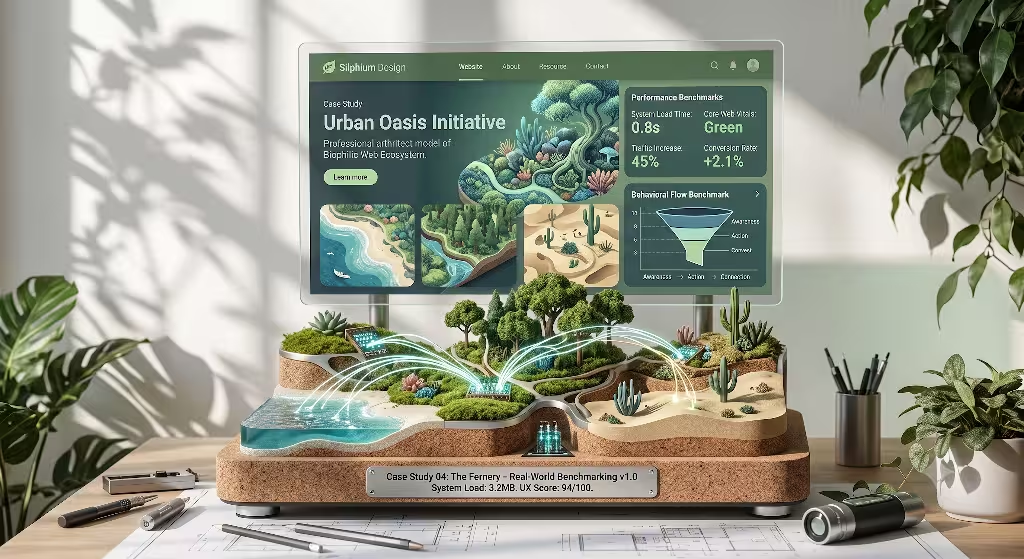
What are some successful examples of eco-friendly gamified apps?
To build incredible gamification strategies, we must study the platforms that are already succeeding in the real world. There are several incredible examples across different industries that show how these ideas can be put into practice. By looking at these real-world benchmarks, we can learn how to balance fun mechanics with true environmental impact.
One of the most famous examples is Ecosia, a web search engine. Ecosia uses very simple yet powerful gamification strategies. Every time a user searches the web, a small counter in the top corner of the screen goes up. This counter shows exactly how many searches the user has made, which tells them how many real-world trees they have helped plant. Ecosia takes its ad revenue and uses it to fund reforestation projects around the globe. The user interface is clean, direct, and completely transparent. It works because it connects a daily digital habit to an active, physical solution on the ground.
Another excellent benchmark is the Forest app. This mobile application uses clever gamification strategies to help users stay focused and put down their phones. When a user needs to concentrate on work or study, they open the app and plant a virtual seed. As long as the user stays focused and does not leave the app, their virtual tree grows over a set amount of time, such as thirty minutes. If they exit the app to check social media, the tree dies.
[Open App & Plant Seed] ──(Stay Focused)──> [Virtual Tree Grows Fully] ──> [Earn Virtual Coins]
                                                                                   │
                                                                                   ▼
                                                                     [Fund Real Trees in Africa]
As users grow more virtual trees, they earn coins. The brilliance of Forest’s gamification strategies is that users can save these coins and spend them to plant a real, living tree in Africa through a charity partner named Trees for the Future. This bridges the gap between digital success and real planetary restoration. The interface relies on beautiful, simple illustrations of plants, which makes building a personal virtual forest incredibly satisfying.
We also have apps like JouleBug and AWorld, which is the official platform for the United Nations ActNow campaign. These platforms use gamification strategies centered around social connections and localized challenges. They allow users to log daily actions, such as line-drying clothes or taking shorter showers. Users can see their friends’ actions on a live feed, join local teams, and compete in group challenges to save resources. These platforms prove that when you combine simple tracking with community support, you can inspire thousands of people to make sustainable choices every day.
Systemic Risks: Designing for Authenticity
What are the pitfalls of green gamification?
While using gamification strategies can lead to amazing results, there are serious risks that developers must understand. If these systems are built poorly, they can cause more harm than good. The biggest pitfall in this field is greenwashing through play. Greenwashing happens when a company tries to look eco-friendly on the surface without changing its harmful core practices. If a web platform uses flash gamification strategies to make a destructive corporate habit look green, users will quickly spot the deception.
Eco-conscious users are highly educated about environmental issues. They have a strong sensor for marketing tricks. If a website uses game mechanics to celebrate small green acts while ignoring giant systemic problems, it loses all credibility. For example, if a large oil company launches a game where users can grow a virtual garden, but the company continues to pollute local waterways, the gamification strategies will be seen as an offensive distraction.
Another major pitfall is user fatigue. When a web platform relies too heavily on constant push notifications, artificial deadlines, and stressful check-ins, users get burned out. Environmental action should feel life-giving, not like a second job. If your gamification strategies make users feel guilty or stressed every time they log on, they will eventually delete their accounts. Designers must make sure that their game mechanics are optional, gentle, and always focused on positive encouragement rather than shame.
The Consumption-Tracking Trap
Another hidden danger within environmental gamification strategies is something we call the consumption-tracking trap. This happens when an eco-app or website tries to help the planet by encouraging users to buy new products. For instance, an app might give users bonus points for purchasing a brand-new, expensive reusable water bottle, or for buying clothes from a sustainable fashion line.
While buying green products can sometimes help, the core rule of ecology is always to reduce, reuse, and recycle. The most sustainable product is the one you already own. When gamification strategies reward people for buying their way to sustainability, they are still promoting the old consumer mindset that drives climate change. This creates a loop where users consume more goods just to watch their digital green points go up.
The Trap:   [Buy Sustainable Brand] ──> [Gain Digital Points] ──> [Increases Resource Consumption]
The Remedy: [Maintain Existing Item] ──> [Log Reuse Action]    ──> [Protects Natural Resources]
To avoid this trap, advanced gamification strategies must reward circular economy habits instead. The circular economy is an economic model that focuses on eliminating waste through the continual reuse and repair of resources. Your web platform should give points when users repair an old item, share tools with a neighbor, or choose to walk instead of buying an electric vehicle. By designing your gamification strategies to honor conservation over consumption, you stay true to real ecological principles. This builds deep trust with your users and ensures your platform creates actual, measurable benefits for the natural world.
Engineering for Local SEO and Future Trends
Integrating Geo-Location and Community Mapping
As we look to the future of web development, the best gamification strategies will connect closely with local communities. This is where local Search Engine Optimization, or local SEO, joins forces with user experience design. When eco-conscious users search the internet, they often look for ways to make a difference in their own neighborhoods. They want to know where to recycle old electronics, where to buy food from local farms, or how to join a neighborhood clean-up.
Web engineers can build gamification strategies that utilize geo-location data to power community maps. When a user logs into a website, the platform can check their general location and show them a custom digital map of their physical town. This map can feature local environmental quests. For example, a user could get points for visiting a nearby community garden, or for dropping off compost at a local collection site.
[User Location Data] ──> [Hyper-Local Map Quests] ──> [Physical Neighborhood Action]
                                                                 │
                                                                 ▼
                                                  [Boosts Local SEO & Community Health]
These hyper-local gamification strategies help websites rank higher in local search results. When a website features real-time, location-specific data about environmental projects, search engines see that site as a highly valuable authority for that area. This drives more organic web traffic to the platform. More importantly, it helps users connect with real people and real places right outside their doors. It turns the digital experience into a bridge that leads straight to community action, making the platform an essential tool for local environmental care.
Predictive AI and Smart Data Inputs
Another major trend shaping modern gamification strategies is the rise of artificial intelligence, or AI. In the past, eco-apps required users to type in every single detail of their daily life by hand. This manual data entry creates a lot of friction, and when people get busy, they stop updating their profiles. AI can solve this problem by introducing smart, automatic data inputs.
For instance, a website can connect with a user’s smart home power meter through a secure connection. The AI can then study the home’s normal energy habits and automatically spot when the user saves electricity. It can instantly reward them within the platform without requiring them to type a single word. AI can also help customize the experience for each individual user. If the system notices that a user struggles to complete cooking quests but loves outdoor gardening tasks, it can adjust its gamification strategies to offer more plant-based challenges in their backyard.
By using predictive AI, the platform can anticipate user fatigue. If the system sees that a user has not logged in for a few days, instead of sending an annoying alert, it can wait until the local weather is beautiful. Then, it can suggest a gentle outdoor quest, like taking a walk in a nearby park to clear their mind. These smart, intuitive gamification strategies feel supportive rather than demanding. They adapt to human life, reduce digital friction, and create a smooth, long-lasting relationship between the user and the platform.
Technical Mapping Matrix
To help developers build these systems, the following table shows how specific game choices connect with human needs and biophilic web elements.
| Core Game Mechanic | Psychological Drive (SDT) | Biophilic Visual/Functional Indicator | Technical Implementation Metric |
| Collaborative Raids | Relatedness (Social Connection) | Expanding digital community forest canopy | Active community participation rate |
| Biomimetic Progress Bars | Competence (Growth/Mastery) | Growth rings of a tree or seasonal color changes | Daily Active Users (DAU) retention |
| Environmental Role-Play | Autonomy (Self-Expression) | Customizable nature preserves or animal sanctuaries | Session duration and interface interactions |
| Real-World Impact Badges | Epic Meaning (Purpose) | Verifiable data tokens mapped to actual carbon offsets | Conversion rate of in-game actions to real impact |
System Architecture for Sustainable Gamification
Building these interactive tools requires a clear data pipeline. The framework below shows how a web platform can process real-world data and turn it into biophilic user rewards.
[Real-World Action Logged]
          │
          ▼
[API Processing / Verification]
          │
          ▼
[Data Sent to Biomimetic Engine] ──> Updates fractal metrics & tree rings
          │
          ▼
[Biophilic UI Rendered]          ──> Soft leaf animations & audio wind sounds
          │
          ▼
[Real Impact Triggered]         ──> Funds actual tree planting or local garden
Maximizing Digital Sustainability
When we build gamification strategies for people who care about the environment, we must also look at the environmental cost of the website itself. This is an area that many design agencies completely overlook. Every single website runs on data servers located in massive data centers around the world. These servers use a large amount of electricity, which often comes from burning fossil fuels. If a website uses messy code, giant uncompressed images, and heavy video scripts, it creates a lot of carbon emissions every time someone loads a page.
Therefore, true nature-focused gamification strategies must include clean, efficient web development. We need to optimize our code so pages load incredibly fast and use as little data as possible. This practice is called green hosting and low-carbon web development. It matches the values of your user base and improves your search engine rankings, because search engines favor fast, efficient sites.
[Messy Code, Heavy Images]   ──> [High Server Power Use] ──> [More Carbon Emissions]
[Optimized Code, Clean UI]   ──> [Low Server Power Use]  ──> [Less Carbon Emissions]
To make your gamification strategies digitally sustainable, you can use modern image formats like WebP or AVIF instead of old, heavy PNG files. You can also write clean, native JavaScript instead of loading massive external code libraries that slow down the browser. Furthermore, you should choose a web hosting company that powers its data centers with one hundred percent renewable energy, like solar or wind power. When you build your platform this way, your digital infrastructure matches your ecological message. You create a system that is truly green from the inside out.
Nurturing Long-Term User Retention
The ultimate test for any platform using gamification strategies is whether users stay active over long periods of time. Many apps experience a massive burst of sign-ups when they first launch, but see their user numbers drop off after a few weeks. To keep people interested for months or years, your game mechanics must grow and evolve alongside the user.
In standard game design, developers keep people hooked by constantly increasing the difficulty or adding rarer loot. In environmental design, your gamification strategies should focus on shifting roles. When a user first joins your platform, they are an observer. They learn the basic habits and complete simple micro-quests. As they gain competence, the system can offer them mentorship roles within the community.
For instance, an advanced user can get points for hosting a local neighborhood cleanup challenge or for writing helpful guides for beginners inside the app. This satisfies their deep need for social connection and purpose. It turns them from passive users into active community leaders. By designing your gamification strategies to support this personal growth journey, you build an active, self-sustaining community that keeps your digital ecosystem thriving for years to same.
Designing for Accessibility and Inclusivity
When implementing gamification strategies, it is essential to ensure that your platform is accessible to every single person who wants to help the earth. Environmental protection is a global mission that requires everyone’s help. If your interactive features are hard to use for people with visual, auditory, or motor differences, you are leaving out a huge part of your community.
Therefore, your biophilic gamification strategies must follow Web Content Accessibility Guidelines, which are often called WCAG rules. For example, when you use biomimetic progress bars, like a tree leaf that changes color from brown to green, you should also include clear text labels or patterns. This ensures that users who are colorblind can still easily understand their progress.
Visual Change Only:  [Brown Leaf] ──> [Green Leaf]  (Confusing for colorblind users)
Accessible Design:   [Brown Leaf + "Needs Care"] ──> [Green Leaf + "Healthy System"]
All audio rewards, like the sound of soft rainfall, should have visual matches on the screen, such as a gentle ripple animation, so that deaf or hard of hearing users receive the same positive feedback. The interface should also be fully usable with a keyboard alone, allowing people who cannot use a mouse to navigate the challenges easily. When you build inclusive gamification strategies, you show that your platform values every human being. This builds a kind, welcoming community where everyone can work together to protect our shared home.
Future Horizons of Ecological Interface Design
As technology continues to march forward, the tools we use to build gamification strategies will become even more immersive. We are starting to see the rise of spatial computing and advanced environmental sensors that can track our world with incredible accuracy. In the coming years, web designers will be able to connect digital interfaces directly with regional environmental monitors, allowing users to interact with live planetary data like never before.
Imagine a website where the background design reacts to the actual health of the air in your local city. If the air quality improves because more people are riding bikes, the digital sky on the website becomes perfectly clear. If pollution rises, the site guides users toward regional action quests. These advanced gamification strategies will blur the line between our online spaces and our physical environments.
By preparing for these future trends today, web creators can build systems that remain helpful and relevant for decades. The key is to always keep human nature and planet health at the center of your design choices. When we use technology to connect people with the earth rather than distract them from it, we unlock the true potential of web design. These nature-focused gamification strategies for eco-conscious users are not just about making websites fun. They are about using our digital tools to help heal the planet, one small choice at a time.
Design Axiom: A nature-focused interface should never mimic a casino. If the gamification strategy relies on artificial urgency, such as countdown timers causing panic, it violates basic biophilic design principles and will ultimately alienate the eco-conscious user base. Keep the interface grounded, deliberate, and naturally restorative.