
Table of Contents
The Death of the Distance-Radius Paradigm
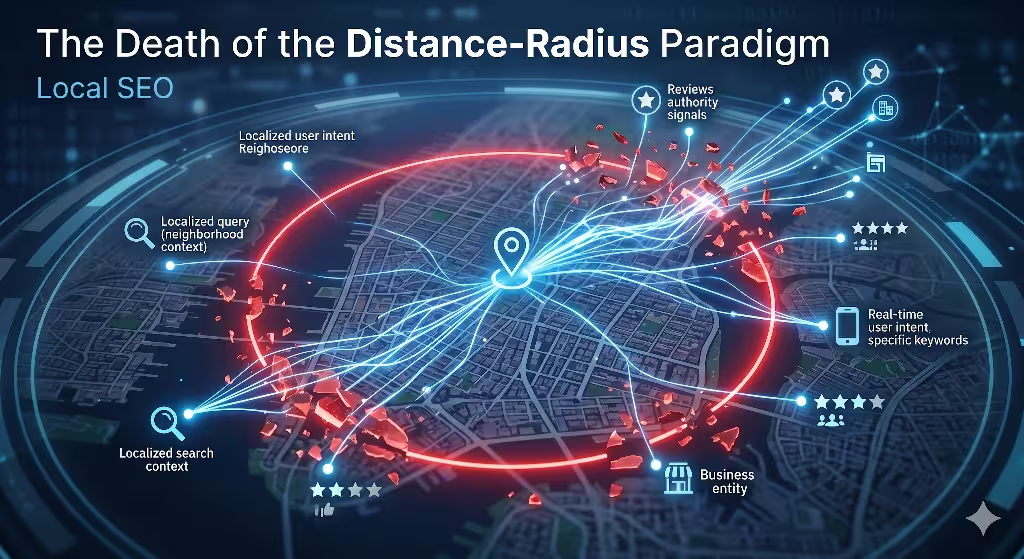
When we look at how search engines work today, we see an amazing shift that mirrors the natural world. In the past, local search was very simple. A person would type a business type and a city name. The search engine would look at a strict map radius. It would draw a circle around the user. It would then show the businesses inside that circle based on basic text keywords. That old way is now completely dead. The modern ecosystem is shifting toward entity-based spatial data models. This shift alters how we approach trends in local seo.
We can understand this shift better by looking at nature. In an ecosystem, a tree does not exist as an isolated point on a map. The tree connects to the soil, to fungal networks, to water sources, and to the surrounding wildlife. It is part of a complex, living web. Search engines now view local businesses the same way. They view them as entities within a digital ecosystem. Because of this, trends in local seo now focus on how well your business connects to other digital entities. The modern search engine does not just look at your physical address. It looks at your relationships, your reviews, your digital structure, and your real-world relevance.
Here at Silphium Design, we track these trends in local seo very closely. We are moving away from simple text matching. We are moving into a world of hyper-granular entity mapping. This means search engines want to know exactly what your business is, what it does, and how it interacts with its specific neighborhood. This shift changes everything for location-based marketing. If you want your business to be discovered, you must adapt to these new trends in local seo. You cannot just repeat your city name fifty times on your homepage. You must build a rich digital footprint that proves your local authority.
This evolution connects deeply with biophilic design. Biophilic design means bringing natural patterns and human-centered design into our spaces. When we apply this to websites, we create digital environments that match how humans naturally think, move, and seek out information. Human beings did not evolve to read flat spreadsheets or dense walls of unorganized text. We evolved to navigate complex, layered environments by using visual signs, spatial awareness, and contextual clues. The latest trends in local seo reflect this truth. Search engines are getting better at scoring websites based on how naturally a human can interact with them.
If your website layout feels chaotic or unnatural, users will leave quickly. Search engines track this behavior. They see that users are frustrated, and they will lower your rankings. Therefore, studying trends in local seo requires us to look at human behavior through a natural lens. We must design digital experiences that feel as intuitive as walking through a well-planned garden or a forest path. When we align our website architecture with human biology and smart spatial data, we win. We satisfy both the human reader and the search algorithm.
To stay ahead of the curve, you must understand that these trends in local seo are not temporary fads. They represent a permanent change in how computers process human geography. Location-based marketing is no longer about winning a race based on who is physically closest to the searcher. It is about who has the strongest digital presence and the clearest local authority. As we explore the deeper details of these trends in local seo, we will look at technical data structures, machine learning models, and advanced design practices. Let us dive into the algorithmic frameworks that are shaping the future of our local digital world.
Algorithmic Entity Matching and Spatial Data Infrastructures
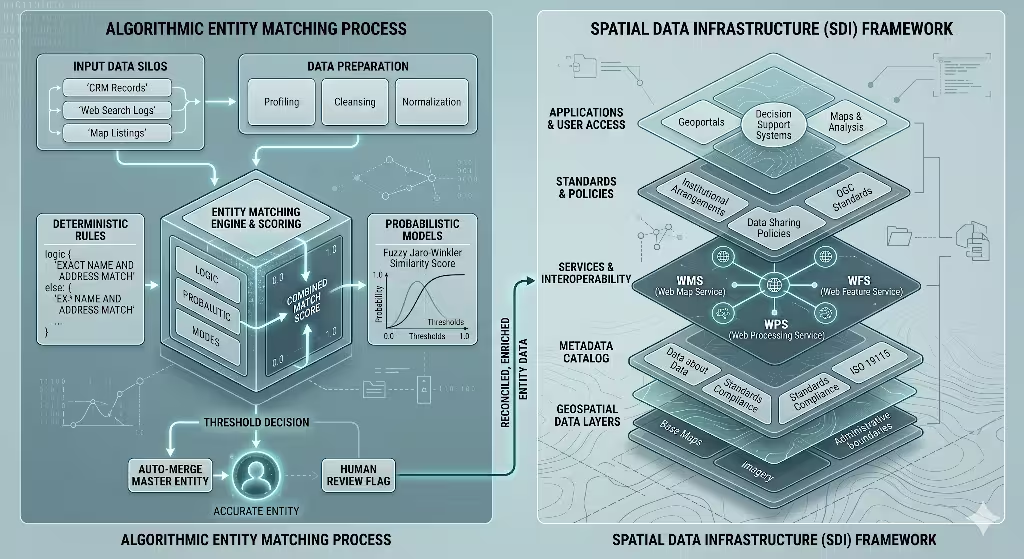
To truly master the current trends in local seo, we have to look at how modern search engines work. We must move beyond simple string matching. String matching means the computer looks for the exact letters of a keyword in your text. That is an old, weak way to rank websites. Today, search engines use entity matching. An entity is a distinct, well-defined thing or concept. It could be a person, a place, a specific business, or an object. When search engines use entity matching, they try to understand the actual meaning behind the words. This shift toward meaning is one of the most important trends in local seo today.
Search engines build huge systems called knowledge graphs to store these entities. A knowledge graph is like a giant map of ideas. It connects different entities together using lines called relationships. For example, your business might be an entity. The city you are in is another entity. The products you sell are entities too. The knowledge graph draws lines between them. It creates a web of verified facts.
Search engines build meaning by connecting nodes together through specific properties. When you align your content with these structures, you are following the best trends in local seo. The algorithm looks at how these nodes connect to determine if your business is trustworthy and relevant to a user’s location.
To feed these knowledge graphs, search engines look at spatial data infrastructures. This is a fancy term for information about physical locations. This includes 3D spatial data, Geographic Information Systems (GIS), and micro-signals from mobile phones. Search engines gather this data to understand the real world in real time. They know how people move through a city. They know which areas are busy at noon and which are quiet at night. These real-world movements create micro-signals. These signals are now major factors in the top trends in local seo. Your website must reflect this physical reality by providing clear, accurate information that matches real-world data.
One of the best tools we have to communicate with these knowledge graphs is structured data, also known as schema markup. Schema is a special code you add to your website. It does not show up for human visitors, but it speaks directly to search engine crawlers. Advanced schema is a vital part of modern trends in local seo. You cannot just use a basic LocalBusiness schema anymore and hope for the best. You need to use highly specific schemas like Place schema, GeoCircle schema, and serviceArea properties. These codes allow you to explicitly define your exact service boundaries, your micro-locations, and your real-time operational states.
Let us look at how you can structure this data. When you write code for your website, you can use these advanced tags to tell the search engine exactly where you operate. You can define the latitude and longitude of your front door. You can define the specific radius of your delivery truck. You can even list the neighborhoods you serve by linking directly to their official Wikidata pages. This removes all guesswork for the algorithm. It is a perfect example of how technical accuracy fits into the latest trends in local seo. You are taking your physical entity and mapping it perfectly into the search engine’s digital brain.
Furthermore, these trends in local seo show us that real-time data is becoming critical. If your hours change because of a holiday or bad weather, your website code and your local profiles must update instantly. If a search engine sees a mismatch between your website text, your schema code, and your Google Business Profile, it loses trust in your entity. When trust drops, your rankings drop too. That is why keeping your spatial data completely synchronized across the entire internet is one of the foundational trends in local seo for location-based marketing.
Frequently Asked Questions about Trends in Local SEO
To create an in-depth article that ranks well, we must address the exact questions that users are typing into search engines. Google has a feature called “People Also Ask.” This box shows related questions that real people frequently search for that are related to your topic or area. By analyzing these questions, we can discover the exact intent of our audience. This helps us understand the practical side of trends in local seo. Let us break down three major questions from the search engine results pages and look at the technical strategies needed to answer them.
How will AI and machine learning change local SEO?
Artificial intelligence and machine learning are completely rewriting the rules of search. In the past, search engines used rigid formulas to rank pages. Today, they use large language models and neural matching systems. These systems do not just look for keywords. They read entire paragraphs and understand the context, just like a human would. This rise of AI-driven search overviews is one of the most transformative trends in local seo. These AI overviews look at the entire web, find the absolute best answer, and present it as a short summary at the very top of the page.
To win in this AI-driven environment, your content cannot be thin or generic. AI models look for deep context and structured entity data. They want to see comprehensive answers to specific local problems. For example, if you run a plumbing business, your website should not just say you fix pipes. It should explain how the local soil chemistry affects copper pipes in your specific county. It should talk about common winter freezing patterns in your city. This deep, localized knowledge helps AI systems recognize you as an authority. Creating this rich, multi-layered regional content is one of the essential trends in local seo today.
What are the future trends in location-based marketing?
When we look ahead, the future of location-based marketing is all about the blending of our physical and digital worlds. We are seeing the rapid rise of Augmented Reality (AR) navigation, smart wearable tech, and predictive intent engines. Imagine a person walking down a historic street wearing smart glasses. They do not type a query into a search box. Instead, their glasses look at the shops. The predictive engine uses their past behavior to suggest a local coffee shop before they even ask for it. This predictive, hands-free discovery is where the future trends in local seo are heading.
To optimize for these future trends in local seo, you must build asset libraries that are ready for visual search and spatial anchors. This means every image on your website must have clean metadata, accurate geo-tags, and clear descriptive text. If an AR camera looks at your building facade, the search engine needs to connect that physical image with your digital website instantly. Location-based marketing will rely heavily on these visual connections. If your digital assets are messy or unoptimized, these new wearable devices will simply skip over your business.
How do I optimize for voice search and conversational local search?
Voice search has changed how people phrase their questions. When people type, they use short, broken phrases like “best bakery Boston.” But when they talk to a smart speaker or a phone assistant, they use full, natural sentences. They might say, “Hey Siri, where can I find a gluten-free bakery that is open right now near me?” This shift toward natural language processing is one of the most prominent trends in local seo. Your website content must adapt to mirror this conversational style.
To optimize for these conversational trends in local seo, you should use a Q&A format natively within your website layout. Create clear FAQ sections that use the exact long-tail, conversational questions your customers ask out loud. Write your answers in a direct, clear way. Use simple sentence structures that a voice assistant can easily read back to a user. By engineering your text to match natural human dialogue, you make it easy for conversational search engines to select your content as the single best answer. This strategy perfectly combines technical optimization with human-centered communication, keeping you aligned with the best trends in local seo.
Next-Generation Mobile UX and Performance Architecture
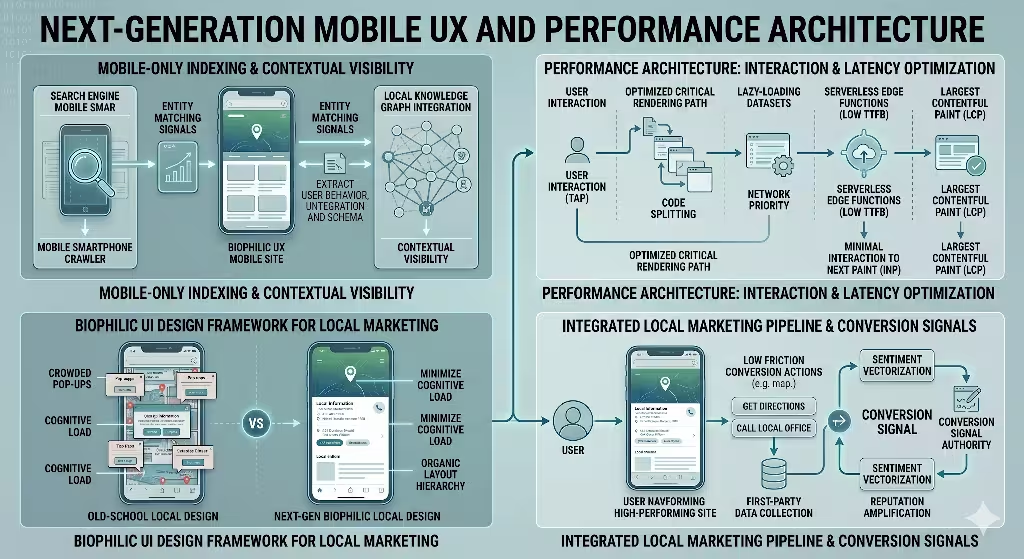
A website is a digital space. Just like a physical building, it must be easy to navigate, structurally sound, and pleasant to experience. As we study the latest trends in local seo, we see that search engines are putting a massive focus on mobile user experience (UX) and site performance. Most local searches happen on mobile phones while people are on the move. If your mobile website is slow, confusing, or hard to use, you are failing to meet the standards of modern trends in local seo. Let us look at the technical layout and performance rules that matter most.
First, let us talk about mobile-first and mobile-only indexing. Search engines do not look at the desktop version of your website to determine your rank anymore. They use a mobile smartphone crawler to judge your site. This means if a piece of local content or an important schema tag is missing from your mobile layout, it basically does not exist in the eyes of the algorithm. Ensuring absolute parity between your desktop and mobile sites is one of the mandatory trends in local seo. Every button, every paragraph, and every structural code must be fully optimized for small screens.
Second, we must look at a technical performance metric called Interaction to Next Paint (INP). This metric measures how fast your website reacts when a user clicks a button, taps a link, or interacts with a menu. If a user is standing on a busy street corner trying to click your phone number, and your site freezes for two seconds before making the call, that is a bad INP score. Search engines track these rendering latencies. High latencies lead directly to algorithmic rank drops. Minimizing code clutter and optimizing your site speed are vital trends in local seo. Your pages must load and react instantly, even on weak cellular networks.
We can solve these user interface issues by applying biophilic UI design principles. Biophilic design means creating layouts that mimic the balance, flow, and visual hierarchies found in the natural world. In nature, everything has an organic order. Our eyes are trained to find pathways, recognize open spaces, and notice natural focal points. When we bring these concepts to a mobile screen, we build a low-friction interface that reduces cognitive load (the mental effort needed to understand a page).
+-------------------------------------------------------------+
|                     Silphium Design LLC                     |
|                   [Header / Clean Menu]                     |
+-------------------------------------------------------------+
|                                                             |
|   [Natural Earthy Imagery / Local Hero Section]             |
|                                                             |
|   "Biophilic Web Experiences Rooted in Local Ecosystems"    |
|                                                             |
+-------------------------------------------------------------+
|                                                             |
|   [Quick-Action Container]                                  |
|   ( ) Call Local Office       ( ) Get Driving Directions     |
|                                                             |
+-------------------------------------------------------------+
|                                                             |
|   [Structured Local Entity Info]                            |
|   - Verified Address: 123 Forest St, Boston, MA             |
|   - Current Status: Open until 5:00 PM                      |
|                                                             |
+-------------------------------------------------------------+
By using a clean, biological layout like the above, we guide the user’s eye naturally down the page. We use ample white space, which acts like open clearings in a forest. We avoid flashing pop-ups or chaotic layouts that cause digital claustrophobia. This clean structure keeps users on your site longer. This increase in on-site dwell time acts as a powerful quality signal to search algorithms. Designing these calm, efficient mobile environments is one of the most rewarding trends in local seo for modern marketers.
To help you compare the differences between old-school design habits and next-generation biophilic local design, I have created a comprehensive comparison table below. This table outlines the specific technical shift happening across the industry right now.
| Design Element | Old-School Local Web Design | Next-Gen Biophilic Local Design |
| Mobile Layout | Cramped text with small, hard-to-click buttons | Spacious grids with natural visual pathways |
| Performance Focus | Large, unoptimized images causing slow loads | Instant rendering with optimized INP metrics |
| Content Structure | Keyword stuffing for specific city names | Rich entity data with conversational answers |
| User Interaction | Intrusive pop-ups and high cognitive load | Calm, intuitive paths that mirror natural spaces |
As this table shows, the modern trends in local seo require a complete rethink of how we build digital spaces. We are moving away from manipulative, robotic tactics. We are moving toward clean, fast, organic designs that respect both the user’s time and the search engine’s technical standards. By embracing these changes, you ensure your website remains highly visible and deeply effective in a competitive local market.
First-Party Data, Reviews, and Sentiment Vectorization
Another major shift changing the landscape of location-based marketing involves how search engines read and understand user feedback. In the early days of the web, search systems simply counted the number of reviews you had. If you had fifty reviews and your competitor had forty, you won. Today, things are vastly more complex. Search engines use advanced Natural Language Processing (NLP) to perform sentiment vectorization. This means they convert the words in your reviews into mathematical numbers to understand the deep emotional tone and specific facts hidden inside customer feedback. This advanced analysis is one of the quietest but most powerful trends in local seo.
When an algorithm reads a review, it does not just look at the star rating. It analyzes specific noun-adjective pairs. It looks for localized vocabulary. For example, if a review says, “This Boston web agency designed a beautiful website that doubled our local foot traffic,” the algorithm extracts key pieces of data. It notes the location (Boston), the service (web agency), the quality (beautiful website), and the real-world outcome (doubled foot traffic). These extracted details reinforce your business entity in the knowledge graph. This is why encouraging detailed, honest, and word-rich reviews from your clients is one of the most effective trends in local seo.
To show how algorithms process this sentiment, let us look at the differences in how positive, neutral, and negative language impact your digital entity.
[Customer Review Text]
        │
        ▼
[NLP Sentiment Engine]
        │
        ├─► Noun-Adjective Extraction ("beautiful website", "local traffic")
        ├─► Geographic Verification (Checks if reviewer is locally active)
        └─► Vector Score Calculation
                    │
                    ▼
[Knowledge Graph Update] (Boosts or lowers local entity authority)
As this process shows, every word your customers write online acts as a direct ranking signal. If your reviews are filled with generic phrases like “good job” or “nice service,” they do not provide much data for the algorithm. But if they contain rich, specific local descriptions, they feed the machine learning models perfectly. Navigating these linguistic patterns is a core part of mastering modern trends in local seo.
At the same time, the broader internet is going through a massive privacy revolution. We are witnessing the steady decline of third-party cookies (the tracking codes that follow users across different websites). Because these old tracking tools are disappearing, location-based marketing must find new ways to connect with audiences. The solution lies in first-party data. First-party data is information you collect directly from your own audience with their clear permission. Building a clean strategy around this data is one of the most critical trends in local seo for long-term business survival.
You can collect first-party data by inviting users to interact directly with your biophilic website. For instance, you can offer a localized newsletter, a digital guide to local plants, or a geographic permission token that lets your site customize its layout based on their neighborhood. When a user gives you direct permission to see their general location, you can serve them highly relevant, low-latency content without relying on creepy background tracking. This ethical, privacy-first approach keeps you completely compliant with modern laws while aligning perfectly with the latest trends in local seo. You are building a sustainable digital ecosystem that respects the user and secures your local visibility.
Technical Implementation Roadmap
We have covered a massive amount of ground in this technical blueprint. As we wrap up, it is important to realize that local search is no longer an isolated marketing tactic. It is a core infrastructure layer that connects your physical business to the global digital mind. The latest trends in local seo show us that success requires a beautiful harmony between clean computer code, deep semantic text, and flawless user experiences that respect human biology. By looking at search through this natural, integrated lens, we can build online spaces that truly thrive.
To help you take immediate action on these trends in local seo, let us map out a direct, step-by-step technical implementation roadmap. This sequence must be followed carefully. Each step builds the foundation for the next, ensuring your local business entity gains maximum visibility in modern search engines.
1. Audit Entity Health and Core NAP Consistency: Week 1.
Begin by verifying your Name, Address, and Phone number (NAP) across the entire web. Use automated tools to search for duplicate or conflicting listings. Remove old addresses, incorrect phone numbers, and outdated business names from every local directory and map service. This ensures search engines have a clean, single set of facts for your business entity.
2. Implement Advanced Spatial Schema Markup: Week 2.
Open your website’s code editor and write advanced JSON-LD structured data. Do not just use a basic template. Explicitly define your Place schema, include your exact latitude and longitude coordinates, and use the GeoCircle property to map your precise service boundaries. Link your schema directly to official Wikidata entries for your city and surrounding neighborhoods.
3. Optimize Mobile Performance and INP Metrics: Week 3.
Test your mobile website using real-world cellular speed tests. Clean up messy JavaScript code, compress all images to modern formats, and eliminate any layout elements that slow down user interaction. Focus heavily on your Interaction to Next Paint (INP) score, ensuring that every tap on a mobile screen triggers an instant visual reaction from the page.
4. Deploy Biophilic UI and Conversational Q&A Content: Week 4.
Redesign your mobile user interface using clean, natural layouts that minimize visual stress. Replace dense blocks of text with clear visual pathways and open spacing. Inside this layout, add a dedicated local FAQ section. Write out the exact conversational questions your local customers ask out loud, and provide direct, clear answers that voice search engines can easily scrape.
By completing this sequential roadmap, you will position your business to dominate the changing market. You will move past old, broken tricks like keyword stuffing. Instead, you will build a fast, beautiful, and deeply intelligent website that respects human nature and speaks perfectly to modern machine learning models.
The future trends in local seo are clear. The businesses that treat their digital presence as a living, connected ecosystem will grow and endure. The businesses that cling to old, flat methods will simply fade away. Take control of your spatial data, invest in premium biophilic web experiences, and watch your local community connect with your brand like never before.