As the lead designer at Silphium Design LLC, I look at the digital world differently than most people. I see websites and social networks as habitats. Just like a forest or a garden, a digital space can either help you feel calm or make you feel stressed. In 2026, we call this digital biophilia. This is the practice of making our online spaces feel like the natural world.
When we look at mastodon vs facebook, we are really looking at two very different kinds of nature. Facebook is like a paved parking lot with a few potted plants. It is neat and organized, but it feels stiff. Mastodon is like a wild forest floor. It is complex and messy, but it is full of life and health. For brands today, choosing between them is about more than just numbers. It is about what kind of environment you want your customers to live in.
In this guide, I will show you why the user experience (UX) of mastodon vs facebook is the most important choice your business will make this year.
Table of Contents
Structural Architecture: Centralized Silos vs. Federated Rhizomes
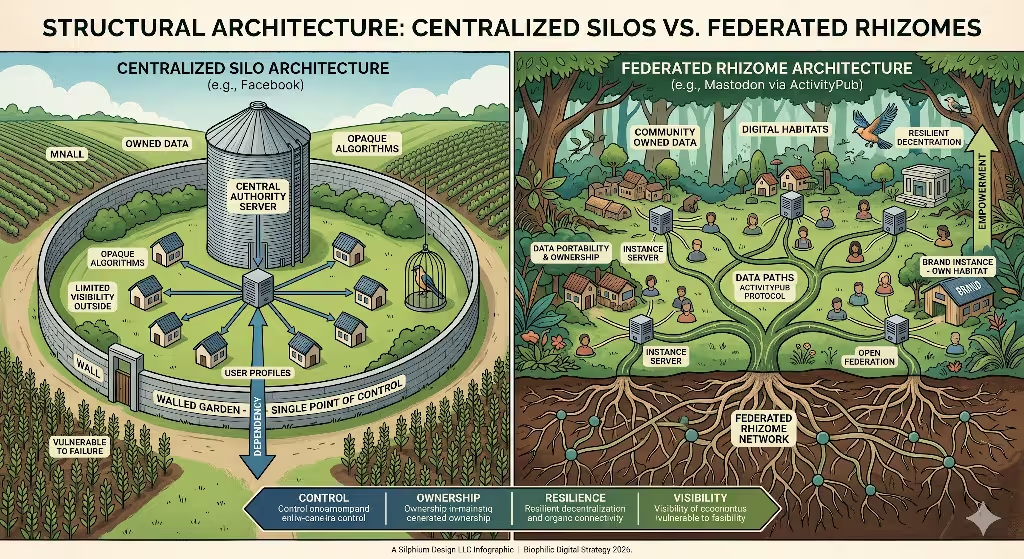
To understand the mastodon vs facebook debate, we have to look at how they are built. Facebook is what we call a centralized silo. This means one big company owns the whole thing. They own the servers, the data, and the rules. If they want to change how the site looks or works, they just do it. You have no say in the matter. In design, we call this a “walled garden.” It looks pretty from the outside, but you are trapped within its walls. The user experience here is very predictable. You know where the buttons are. You know how to post a photo. But you are also at the mercy of the owner.
Mastodon is built on a very different idea called federation. Instead of one big server, it is made of thousands of small servers called instances. This is a lot like a rhizome in nature. A rhizome is a root system where every part is connected, but there is no single main root. If you cut one part, the rest of the plant keeps growing.
This makes the mastodon vs facebook choice very interesting for brands. On Mastodon, you can even start your own server. This gives you total control over your data. You are not just a guest in someone else’s garden. You are the owner of your own digital habitat. This is a huge shift in how we think about the internet in 2026.
When a brand chooses mastodon vs facebook, they are choosing between a cage and a forest. Facebook offers a simple experience, but it lacks freedom. Mastodon offers freedom, but it takes more work to understand. For a biophilic design expert, the freedom of the forest is always better for long-term health.
A brand that owns its own “instance” on Mastodon can design the rules to fit its community perfectly. They can decide how moderation works. They can decide how the interface looks. They are not forced to follow the changing moods of a giant corporation. This is why the structural architecture of mastodon vs facebook matters so much for your brand’s future.
The Cognitive Load of Discovery: Algorithmic Manipulation vs. Natural Flow
One of the biggest differences in the mastodon vs facebook experience is how you find new things. Facebook uses a complex computer program called an algorithm. This program decides what you see and when you see it. It is designed to keep you looking at the screen for as long as possible.
We call this “artificial light” in digital design. Just like a bright neon sign, it grabs your attention, but it also makes you feel tired. The constant notifications and “suggested posts” create a high cognitive load. This means your brain has to work very hard just to filter out the noise. When brands use facebook, they are often fighting against this noise just to be seen by their own followers.
Mastodon works in a much more natural way. It uses a chronological feed. This means you see posts in the order they were written. There is no secret program trying to trick you into staying online. This creates a “natural flow” that feels much more like a real conversation. When you think about mastodon vs facebook, you have to think about how your customers feel. Do they feel stressed when they see your brand, or do they feel calm? A chronological feed reduces stress because the user knows exactly what they are looking at. They do not have to wonder why a post from three days ago is suddenly at the top of their feed.
In the mastodon vs facebook comparison, the chronological feed is like a quiet walk in the woods. You see what is there, and then you move on. The facebook algorithm is like being in a crowded mall with people shouting at you. For brands that want to build trust, being the “quiet voice” in a calm forest is often much more effective than being the “loudest voice” in a noisy mall. In 2026, users are very tired of being manipulated. They crave the honesty of a natural timeline. This is a key reason why the mastodon vs facebook battle is shifting toward decentralized platforms.
Engagement Mechanics: Pay-to-Play vs. Organic Symbiosis
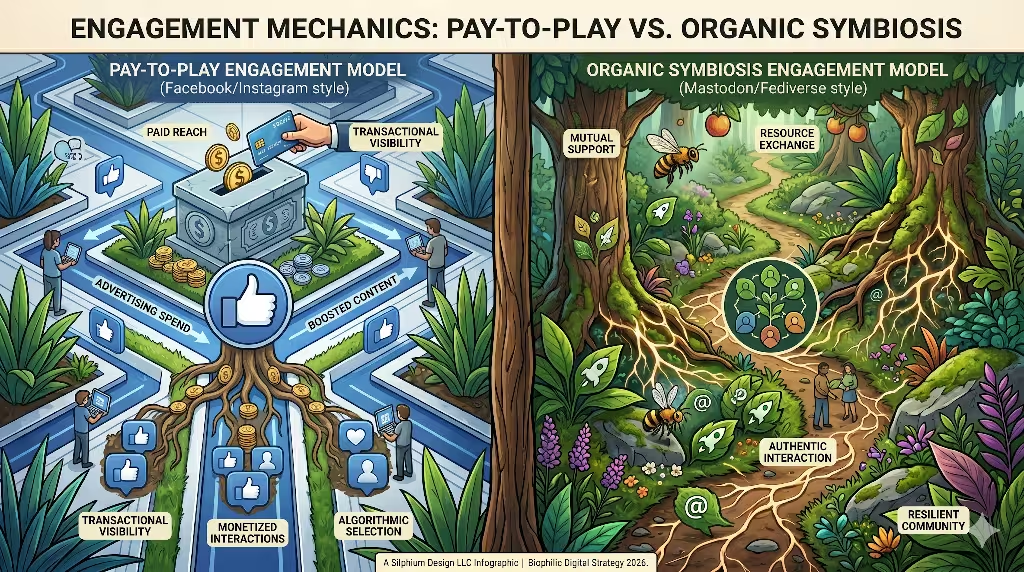
How a brand talks to its audience is another major part of the mastodon vs facebook debate. On Facebook, the system is mostly “pay-to-play.” This means that even if someone follows your page, they might not see your posts unless you pay for an ad. Facebook hides your content to make you spend money. This creates a very transactional relationship. It is not about how good your content is; it is about how much money you have. This is why many brands feel frustrated with the facebook user experience. They feel like they are being taxed just to talk to their own fans.
Mastodon operates on a principle of organic symbiosis. In nature, symbiosis is when two different living things help each other grow. On Mastodon, if someone follows you, they see everything you post. There are no ads to get in the way. This means you have to earn your audience’s attention by being helpful and interesting. You cannot just buy your way to the top. When we look at mastodon vs facebook for brands, Mastodon requires more effort but gives better results. You build a real community based on shared values. This is much healthier than a community built on paid impressions.
The UX of mastodon vs facebook also changes how we measure success. On Facebook, brands often look at “reach” and “likes.” But these numbers can be fake. They are often inflated by the algorithm. On Mastodon, brands look at “boosts” and “replies.” Because there is no algorithm, a boost means someone truly liked your post enough to share it with their own followers. It is a much more honest metric. In the mastodon vs facebook world of 2026, honesty is the most valuable currency a brand can have. Users can smell a fake ad from a mile away, but they will follow a brand that acts like a real person in a real community.
Is Mastodon Better for Brands than Facebook?
This is a question I hear every day at Silphium Design LLC. The answer depends on what you want to achieve. If you want to reach a huge number of people very quickly and you have a large budget, Facebook is still a powerful tool. It has billions of users and very specific ad targeting. You can pick exactly who sees your ad based on their age, location, and hobbies. For many local businesses, this is a very easy way to get customers. However, the trust in Facebook is very low in 2026. People know they are being tracked, and many are leaving the platform because they are tired of the privacy issues.
If you want to build a long-term, loyal community that trusts you, then Mastodon is much better. In the mastodon vs facebook choice, Mastodon wins on trust every time. Because it is decentralized, no one is selling your data. People feel safe there. For a brand, this means your followers are more likely to listen to what you say. They are not just scrolling past you; they are engaging with you. Mastodon is also better for niche brands. If you sell a very specific product, like handmade gardening tools, you can find a Mastodon instance full of people who love gardening. You don’t need a billion people; you just need the right people.
So, in the mastodon vs facebook debate, Facebook is the giant city and Mastodon is the specialized village. Most successful brands in 2026 use a mix of both. They use Facebook for broad awareness and Mastodon for deep community building. But if you only have time for one, I always suggest starting where the trust is. A brand that is a “first mover” on Mastodon can establish itself as a leader in its field while others are still fighting for attention on Facebook.
How Do You Use Mastodon for Business Without Ads?
Many business owners are confused when they first see Mastodon because there is no “Ads Manager” button. They wonder how they will ever get found. In the mastodon vs facebook comparison, this is the biggest hurdle. But it is also the biggest opportunity. To use Mastodon for business, you have to stop thinking like a marketer and start thinking like a community member. You gain followers by being useful. You answer questions, share interesting news, and help others. In biophilic design, we call this “adding to the ecosystem.” You are not just taking space; you are providing value.
One great way to grow on Mastodon is by using hashtags. Because there is no algorithm, people use hashtags to find topics they care about. If you use the right hashtags, people who are interested in your field will find your posts naturally. This is much more organic than a paid ad. Another way is to join the right instance. There are instances for artists, scientists, gamers, and more. By being in the right “habitat,” you are already close to your target audience. In the mastodon vs facebook struggle, Mastodon rewards those who are helpful, while Facebook rewards those who have the most money.
You can also run your own instance. This is like building your own clubhouse. You can invite your best customers to join your server. This gives them a safe space to talk about your products and help each other. It also gives you a direct line of communication that can never be shut down by another company. When you compare mastodon vs facebook, the ability to own your own platform is a game-changer for brand security. You don’t have to worry about a “policy change” destroying your business overnight.
What are the UX Differences Between Mastodon and Facebook for Community Management?
Managing a community feels very different on these two platforms. On Facebook, you have “Pages” and “Groups.” These tools are very polished and easy to use. You can schedule posts, look at detailed charts of your traffic, and use automated tools to filter out bad comments. However, you are always working inside Facebook’s rules. If they decide your group violates a rule, they can delete years of work in an instant. This makes the community feel “rented” rather than “owned.” This is a major factor when weighing mastodon vs facebook for your community strategy.
On Mastodon, community management is more about relationships. Because you are often on a smaller instance, you get to know the moderators and the other users. Moderation is done by real people, not just bots. This makes the community feel much safer and more human. In the mastodon vs facebook world, Mastodon communities tend to be much more polite and helpful. There is a sense of “common ground” because everyone chose to be on that specific server. This makes the job of a community manager much easier because the community often self-regulates.
From a design perspective, the Mastodon interface is also much cleaner. There are no sidebars full of ads or “people you may know” distractions. This allows the community to focus on the conversation. When brands choose mastodon vs facebook, they are choosing the quality of the interaction. Facebook gives you more tools, but Mastodon gives you a better environment for real human connection. As a biophilic designer, I always prefer the cleaner, focused space of Mastodon for building healthy digital relationships.
Is it Safe for a Brand to Join a Decentralized Network?
Safety is a huge concern for brands in 2026. On Facebook, there is a central team that handles security and bad content. You feel like there is a “police force” watching over the site. However, as we have seen many times, this system often fails. Fake accounts and hate speech are still big problems on centralized sites. In the mastodon vs facebook safety debate, many people think decentralized means “uncontrolled.” But that is not true. In fact, Mastodon can be even safer because moderation is decentralized.
Each Mastodon instance has its own moderators who care about their specific community. If an instance starts allowing bad behavior, other instances can “block” it. This is like a neighborhood coming together to keep out trouble. For a brand, this means you can choose an instance with very strict rules that match your values. You are not stuck with whatever Facebook decides is okay today. In the mastodon vs facebook comparison, Mastodon offers a more customized approach to safety. You can even set up your own server with your own security protocols to ensure your brand is perfectly protected.
Another safety benefit of Mastodon is the lack of “data scraping.” Because there is no central database, it is much harder for bad actors to steal large amounts of user data. This protects your customers and your brand’s reputation. In 2026, a data breach can ruin a company. By moving to a decentralized platform, you are reducing the “attack surface” of your digital presence. When looking at mastodon vs facebook from a technical side, the decentralized nature of the Fediverse is a much more robust and healthy architecture for the modern world.
Biophilic UX Checklist: Optimizing Your Presence
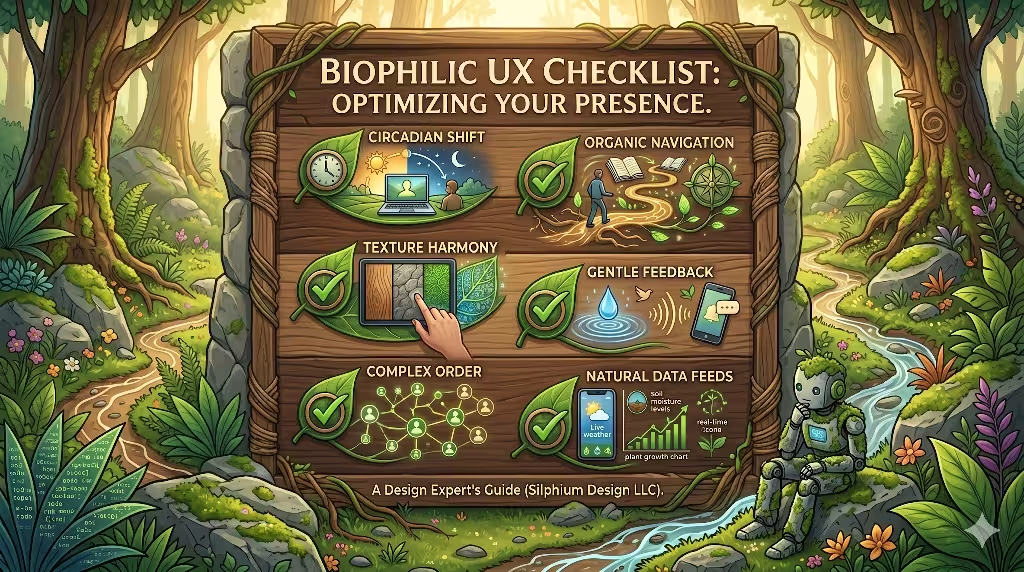
If you are ready to move your brand toward a more natural digital presence, here is a checklist to help you. These principles apply whether you are looking at mastodon vs facebook or any other platform.
- Reduce Visual Noise: Choose an environment that is clean and focused. Avoid platforms that clutter the screen with ads and distractions. This is a big win for Mastodon in the mastodon vs facebook debate.
- Use Natural Rhythms: Don’t try to post 20 times a day to “beat the algorithm.” Post when you have something meaningful to say. Let your brand’s voice follow a natural pace.
- Prioritize Accessibility: Ensure your content can be read by everyone. Mastodon makes it very easy to add “alt-text” to images, which is a key part of good UX.
- Foster Organic Connections: Focus on building real relationships rather than just collecting followers. In the mastodon vs facebook world, quality always beats quantity.
- Be Transparent: Share how you use data and who you are. In 2026, users trust brands that are open and honest about their work.
- Embrace Minimalist Design: Use simple layouts and clear fonts. The more “human” and “organic” your design feels, the more people will want to interact with it.
Following these steps will help your brand feel like a living, breathing part of the digital world. Whether you choose mastodon vs facebook, these biophilic principles will make your user experience much more pleasant for your audience. At Silphium Design LLC, we believe that a healthy digital habitat is the foundation of a successful brand.
The Technical Side of Decentralization
I want to explain a bit more about the technical parts of Mastodon because it is so different from what we are used to. Mastodon uses a protocol called ActivityPub. A protocol is just a set of rules that lets different computers talk to each other. Think of it like email. You can have a Gmail account and send an email to someone with an Outlook account. They are different “instances,” but they can talk to each other because they use the same protocol. This is how the Fediverse works. This is the biggest technical difference in the mastodon vs facebook comparison.
On Facebook, everything is proprietary. This means Facebook owns the code and the data. You cannot take your followers from Facebook and move them to another site. You are “locked in.” This is very dangerous for a brand. If Facebook goes away or changes its rules, you lose everything. On Mastodon, because it uses the open ActivityPub protocol, you can move your account from one server to another and take your followers with you. This is called “data portability.” In 2026, this is a basic human right in the digital world.
This technical freedom is why I often recommend Mastodon to my clients at Silphium Design LLC. It is a more sustainable way to build a business. You are building on open ground rather than on a rented lot. When we talk about mastodon vs facebook, we are talking about the difference between being a tenant and being a landowner. For any brand that plans to be around for the next ten or twenty years, owning your digital “land” is the only smart move. The technical architecture of the Fediverse is built for the long term, while centralized silos are built for short-term profit.
The Emotional Impact of Digital Environments
As a biophilic design expert, I am very interested in how these platforms make us feel. Studies in 2026 show that spending too much time on algorithmic social media can lead to higher levels of stress and anxiety. The constant “pull” of the facebook feed mimics the feeling of gambling. It is designed to trigger dopamine hits that keep you coming back, but it leaves you feeling empty. This is not a healthy environment for a brand to live in. If your customers associate your brand with the stress of Facebook, that is bad for business.
Mastodon, on the other hand, feels much more like a community garden. Because it is slower and more intentional, it creates a sense of “fascination” and “hominess.” These are terms we use in biophilic design to describe spaces that make people feel at peace. When you post on Mastodon, you are part of a calm conversation. This creates a positive emotional connection with your brand. In the mastodon vs facebook comparison, the emotional health of the platform is a huge competitive advantage for Mastodon. Brands that care about the mental well-being of their customers are moving to these “quieter” spaces.
Think about the last time you walked through a beautiful park. You felt refreshed and happy. Now think about the last time you were in a crowded, noisy airport. You felt tired and annoyed. This is the difference in UX between mastodon vs facebook. Facebook is the airport, and Mastodon is the park. As a brand, you want to be the “refreshing” part of your customer’s day. You want to be the place they go to feel good, not the place that drains their energy.
SEO and Discoverability in the New Internet
You might be wondering how people will find your website if you move away from big platforms. This is where SEO (Search Engine Optimization) comes in. In 2026, SEO is not just about Google anymore. It is about being visible across the entire web. When you post on Mastodon, your posts are public and can be indexed by search engines. Because Mastodon is a high-authority domain, your posts often rank very well. This means that the mastodon vs facebook choice actually helps your SEO.
Facebook is a “dark” social network. This means much of what happens inside Facebook is hidden from search engines. If you post a great article on Facebook, it might never show up in a Google search. But if you post it on Mastodon, it is part of the open web. This makes it much easier for new people to find your brand. At Silphium Design LLC, we focus on making sure our biophilic designs are seen by the right people. Using decentralized platforms is a great way to boost your “organic” reach across the whole internet.
Also, because Mastodon users love to share and “boost” high-quality content, you can get a lot of “backlinks” to your website. Backlinks are like votes of confidence from other websites. The more backlinks you have, the higher you will rank on search engines. In the mastodon vs facebook world, the open nature of Mastodon is much better for your overall SEO strategy. It helps you build a “web” of connections that points back to your main site. This is like a healthy forest where all the trees are connected by their roots, helping each other grow strong.
Choosing Your Digital Habitat
We have covered a lot of ground in this guide. We have looked at the structural architecture, the emotional impact, and the business benefits of mastodon vs facebook. In the end, the choice comes down to your brand’s values. Do you value fast, paid reach in a noisy environment? Or do you value slow, organic growth in a calm and trusted space? For me, as a biophilic design expert at Silphium Design LLC, the choice is clear. The future of the internet is decentralized, human, and natural.
Facebook will likely be around for a long time, and it still has its uses for broad marketing. But if you want to be a brand that people truly love and trust in 2026, you need to find a home in the Fediverse. The mastodon vs facebook debate is not just about which app is better. It is about what kind of world we want to build. By choosing a platform that respects privacy, avoids manipulation, and fosters real community, you are helping to create a healthier digital ecosystem for everyone.
Thank you for joining me on this journey through the digital woods. I hope this guide has helped you understand the complex world of mastodon vs facebook and given you the tools to make the right choice for your brand. Remember, a great user experience is not just about where the buttons are. It is about how you make people feel. Let’s build a web that feels more like home.
Final Thoughts on Biophilic UX
As we move forward, we must continue to ask ourselves how we can make our technology more like nature. We need more “fractals” and “natural light” in our software. We need more “rhizomes” and “symbiosis” in our business models. The mastodon vs facebook comparison is just the beginning. The shift toward biophilic design in our digital lives is a long-term trend that will change everything about how we interact with the world.
Whether you are a small local business or a global brand, your digital habitat matters. Choose a space that allows you to grow naturally. Choose a space that treats your customers with respect. Choose the forest over the parking lot. In the 2026 landscape of mastodon vs facebook, the brands that choose the path of nature are the ones that will truly thrive. At Silphium Design LLC, we are here to help you plant those seeds and watch them grow.