
At Silphium Design LLC, we believe that a website is more than just code and pixels. It is a digital ecosystem. Just as a forest relies on the complex relationship between soil, roots, and sunlight, a successful digital presence relies on the relationship between design, technology, and human psychology. My background in biology and computer science has taught me that humans are not machines. We are biological organisms. We crave connection with the natural world. This is the core of biophilic design.
However, simply putting a picture of a tree on a homepage is not enough. To truly move people, we must engage their brains. We must use the oldest tool in human history. That tool is storytelling. When we look at the challenges facing our planet, data alone rarely changes minds. Charts and graphs are important, but they do not make us cry, and they do not make us act. Stories do.
This article serves as a comprehensive guide on using storytelling to highlight nature conservation efforts. We will look at how the human brain processes stories. We will explore how to build websites that mimic the natural world. We will discuss the technical side of search engine optimization. We will look at how to turn passive website visitors into active guardians of the earth. By combining the science of biology with the art of narrative, we can create digital experiences that help save the physical world.
Table of Contents
The Neurobiology of Narrative: Why Conservation Needs Story
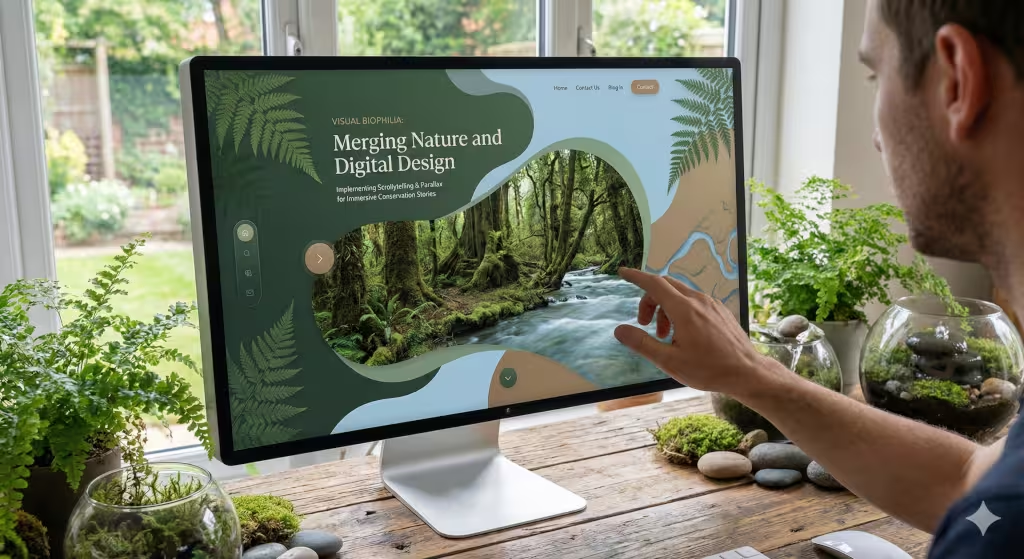
To understand why storytelling works for nature conservation, we must first look inside the human brain. We have evolved over millions of years to pay attention to stories. In the past, a story about a predator or a food source could mean the difference between life and death. Today, our brains still react the same way.
The Chemistry of Empathy
When you read a list of facts about climate change, two small parts of your brain light up. These are the parts responsible for processing language. That is it. However, when you read a story about a polar bear struggling to find ice, your brain activity changes completely.
A compelling story releases chemicals in your brain. One of these chemicals is cortisol. This is the stress chemical. It focuses your attention. It tells you that something important is happening. Another chemical is oxytocin. This is often called the “love hormone.” It creates feelings of trust and empathy. When a story creates tension and then offers a solution, it mimics real-life social bonding. This chemical reaction is vital for nature conservation because it makes the reader care about the subject on a biological level.
Mirror Neurons in Action
There is a fascinating mechanism in our heads called the mirror neuron system. These neurons fire when we act, but they also fire when we observe someone else acting. If you read a detailed description of someone walking through a wet rainforest, the sensory cortex in your brain lights up as if you were walking through the rain yourself.
This is powerful for nature conservation. We cannot bring every person to the Amazon rainforest or the Great Barrier Reef. But through rich, descriptive storytelling, we can trick their brains into feeling like they are there. This is called “neural coupling.” It allows the reader to take the story and make it their own experience. When a person feels like they have experienced the beauty of a place, they are much more likely to support nature conservation efforts to protect it.
Adapting the Hero’s Journey for Environmental Advocacy
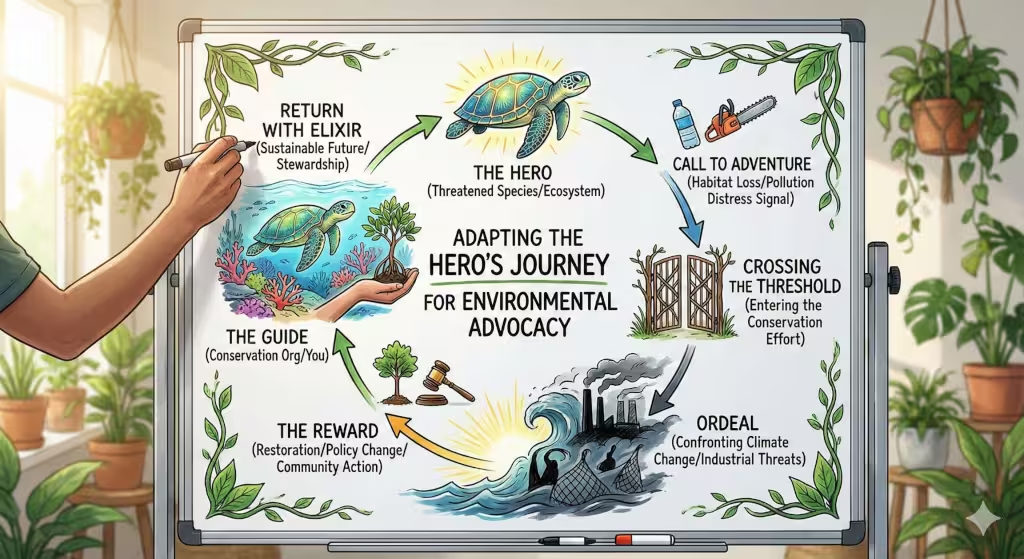
For thousands of years, humans have told stories using a specific structure. The scholar Joseph Campbell called this the “Hero’s Journey.” You see it in movies, books, and myths. A hero leaves home, faces a challenge, wins a victory, and returns changed. To succeed in nature conservation, we need to adapt this framework.
Changing the Hero
In traditional marketing, the customer is the hero. In standard corporate storytelling, the business is the hero. In biophilic storytelling, we must shift the focus. The hero should be the ecosystem, the endangered species, or the local community fighting for survival.
When the hero is a specific animal, like a sea turtle, the audience can root for it. We call this the protagonist. The audience follows the turtle as it faces obstacles. These obstacles might be plastic pollution or fishing nets. This creates an emotional hook. If we frame nature conservation as a battle for the survival of a beloved hero, people pay attention.
The Villain and the Guide
Every story needs conflict. In our case, the “villain” is not necessarily a person. The villain is the threat. It is deforestation, pollution, or climate change. However, we must be careful. If the villain is too strong, the audience feels hopeless. This leads to apathy.
This is where your organization comes in. You are not the hero. You are the guide. You are the wise mentor who gives the hero the tools to win. In Star Wars, the guide is Yoda. in your story, your nature conservation organization acts as Yoda. You provide the science, the plan, and the tools to help the hero survive. This structure makes the donor or volunteer feel like they are helping the hero win the war.
Visual Biophilia: Implementing Scrollytelling and Parallax
As a designer, I know that words are only half the story. The way a story looks on a screen matters just as much. We use a technique called “scrollytelling.” This is a mix of scrolling and storytelling. As the user scrolls down the page, the story unfolds.
The Magic of Parallax
One of the best ways to create a feeling of depth is through parallax scrolling. This is a technical term for a simple visual trick. In parallax, the background image moves slower than the foreground content.
Imagine looking out the window of a moving train. The trees nearby move fast, but the mountains in the back move slowly. This creates a 3D effect. We can do this on a website using code. When we apply this to nature conservation websites, it immerses the user. It makes the digital world feel deep and alive, just like the real world.
Fractals and Natural Patterns
Nature is full of patterns. We call these fractals. You see them in the branching of trees, the veins of leaves, and the flow of rivers. These patterns are mathematically complex but visually soothing.
Studies in biophilic design show that looking at fractal patterns reduces stress. It lowers cognitive load, which is the amount of mental effort being used. When we design a page for nature conservation, we should use these natural patterns in the background and layout. By using organic shapes instead of rigid squares, we put the user in a relaxed state. A relaxed user is more willing to read a long article and more likely to donate to nature conservation.
Fluid User Experience
Water does not move in jumpy, jagged lines. It flows. Your website should do the same. We use CSS (Cascading Style Sheets) to smooth out the scrolling. We want the transition between sections to feel like a river flowing downstream. This keeps the user moving through the story without friction. The goal is to make learning about nature conservation feel as natural as taking a walk in the woods.
Anthropomorphism and Empathy Mapping
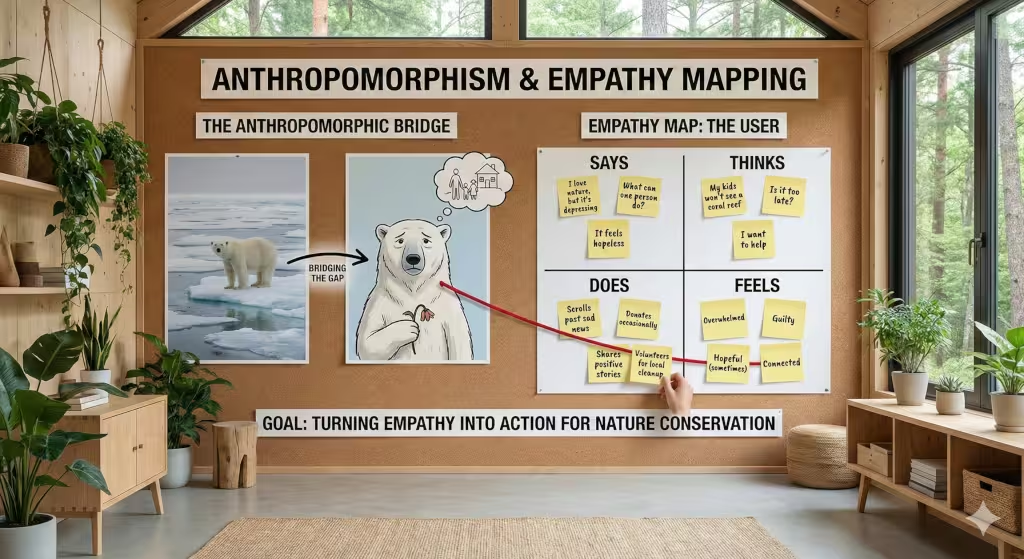
Anthropomorphism is a big word that means giving human traits to non-human things. Scientists used to frown on this. They thought it was not scientific to say an animal was “sad” or “happy.” However, in the world of communication and nature conservation, it is a necessary tool.
Bridging the Empathy Gap
It is hard for a human to empathize with a plankton or a coral reef. They are too different from us. It is much easier to empathize with something that has a face and feelings. When we tell a story about a mother elephant mourning her calf, we are using anthropomorphism. We are framing animal behavior in a way that humans understand.
This bridges the empathy gap. It allows the user to say, “I know what sadness feels like. That elephant is sad. I want to help.” This emotional connection is the fuel for nature conservation. Without it, animals are just biological machines. With it, they are fellow beings worthy of protection.
Creating an Empathy Map
Before writing content for nature conservation, we create an empathy map. This is a diagram that helps us understand our audience. We ask questions like:
- What is the user seeing?
- What is the user feeling?
- What are their fears regarding the environment?
If we know that our audience is afraid of the future for their children, we can tailor the nature conservation story to address that fear. We can show how preserving nature today ensures a better world for their kids tomorrow. This makes the story personal. It moves the issue from the abstract to the immediate.
The Jane Goodall Effect
Jane Goodall is a prime example of this. She gave the chimpanzees names, not numbers. She described their personalities. She told their stories. This changed the way the world looked at primates. It revolutionized nature conservation. We should follow her lead in our digital storytelling. By naming the animals and describing their struggles in human terms, we build a bridge of understanding.
Data Visualization as Narrative Arc
Raw numbers can be boring to the average person. Saying that “biomass has decreased by 50%” is a fact. Showing that decline visually is a story.
Humanizing the Data
Big numbers are hard to understand. The human brain cannot truly grasp what “one million tons” looks like. To help nature conservation, we need to translate these numbers.
Instead of saying a forest lost 10,000 hectares, we say it lost an area the size of 15,000 soccer fields. We use visuals to show the shrinkage over time. We can use coding libraries like D3.js to create interactive charts. These charts allow the user to hover over the data and see the details.
The Narrative Arc of a Graph
A good graph tells a story. It has a beginning, a middle, and an end. The beginning might show a healthy population of wolves. The middle shows the decline due to hunting. The end can show two paths: one where the line goes to zero (extinction) and one where it goes back up (recovery).
This visual choice puts the user in the driver’s seat. It shows them that the end of the story is not written yet. It shows that nature conservation can change the direction of the line. This turns a static image into a call to action.
Interactive Infographics
Static images are okay, but moving images are better. We can create infographics where trees grow as you scroll, or where a coral reef changes color based on the water temperature data you input. This interactivity keeps the user’s brain engaged. It forces them to process the data to move forward. The more time they spend interacting with the data, the more they understand the urgency of nature conservation.
User Agency: Gamification of the Conservation Effort
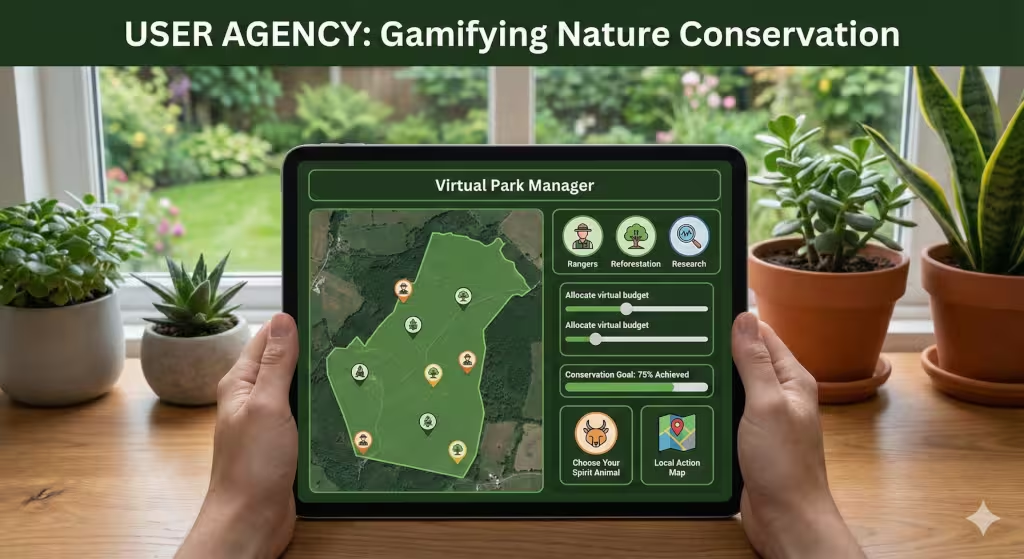
Nobody likes to feel helpless. One of the biggest problems in environmental communication is “doom and gloom.” If we only tell people the world is ending, they shut down. They feel like they cannot make a difference. To fix this, we need to give them agency. We need to make them players in the game of nature conservation.
The IKEA Effect
There is a psychological concept called the IKEA effect. It says that people value things more if they helped build them. We can apply this to websites. If we let users “build” a solution, they will care more about it.
For example, we can design a page where the user manages a virtual budget for a park. They have to decide how much money goes to rangers, how much to planting trees, and how much to science. When they see how hard it is to balance the budget, they understand the challenges of nature conservation. They feel invested in the outcome.
Interactive Quizzes and Maps
Simple tools like quizzes can be very effective. “Which endangered animal are you?” sounds silly, but it works. It creates a personal identity link between the user and the species. Once a user identifies as a “Snow Leopard,” they are more likely to click on a link about snow leopard nature conservation.
Interactive maps are another great tool. We can show a map of the user’s local area. We can highlight the nature conservation projects happening in their own backyard. This brings the story home. It shows that conservation isn’t just something that happens in Africa or the Amazon. It happens in Boston, in Burlington, and in their own town.
Turning Clicks into Action
Gamification creates a reward loop in the brain. When a user signs a petition or makes a small donation, the website should celebrate. We can use animations of confetti made of leaves or a “level up” notification. This gives the user a hit of dopamine. It makes them feel good about helping. This positive reinforcement encourages them to return and do more for nature conservation in the future.
Semantic SEO and Schema Markup for Visual Stories
We can write the most beautiful story in the world, but if nobody finds it, it does not help the planet. This is where my expertise in Search Engine Optimization (SEO) comes in. Search engines like Google are robots. They cannot “read” a story like a human does. We have to speak their language.
Speaking to the Algorithms
To rank for terms related to nature conservation, we need to use the right words. But it is not just about repeating keywords. It is about “semantics,” or meaning. Google looks for words that are related to each other.
If we are writing about bees, Google expects to see words like “pollination,” “hive,” “colony collapse,” and “biodiversity.” These are called LSI keywords (Latent Semantic Indexing). By including these related terms naturally in our story, we tell the search engine that our article is comprehensive and authoritative. This helps us rank higher, which brings more eyes to our nature conservation message.
Schema Markup
Schema markup is code that we put in the background of a website. It is like a label on a file folder. It tells Google exactly what the content is.
For a story, we use the Article schema. If we have a video, we use VideoObject schema. For nature conservation groups, we use Organization schema. This helps Google display our content in special ways, like in the “Rich Snippets” at the top of the search results. If we want our conservation story to appear as a top news item or a featured snippet, we must use this code.
Accessibility and Alt Text
Every image on a website needs “Alt Text.” This is a description of the image for people who are blind or visually impaired. It is also what Google reads to understand the image.
Instead of writing “image of tree,” we should write “A towering ancient oak tree providing shade and habitat, symbolizing the goals of nature conservation.” This is better for accessibility, and it is better for SEO. It weaves our keywords into the hidden fabric of the website. It ensures that our nature conservation message reaches everyone, regardless of their ability.
The “Biophilia Effect” on Conversion Rates (ROI)
Some people think that storytelling and design are “fluff.” They think they are nice to have, but not essential. They are wrong. There is a strong business case for using high-quality biophilic design and storytelling. We call this the Return on Investment (ROI).
Building Trust with E-E-A-T
Google uses a metric called E-E-A-T. It stands for Experience, Expertise, Authoritativeness, and Trustworthiness. High-quality storytelling builds E-E-A-T.
When a nature conservation site features deep, well-researched stories written by experts, it builds authority. When it features photos of real people working in the field, it shows experience. This builds trust with the user. People do not donate money to websites they do not trust. By investing in quality content, an organization proves it is serious. This leads to more donations.
Emotional Peaks and Calls to Action
In a standard website, the “Donate” button is just sitting in the corner. In a narrative website, we place the button strategically. We want to ask for help right when the user is feeling the most emotion.
We map the story’s emotional arc. When the story reveals the tragic loss of habitat, we might ask for a signature on a petition. When the story shows the hope of a new baby animal being born, we ask for a donation to support the breeding program. By aligning the “ask” with the story’s emotional peak, we drastically increase the conversion rate for nature conservation funding.
Retention and Loyalty
Biophilic design makes people feel good. It reduces stress. If a user feels good while visiting your website, they will come back. They will share the site with friends. This organic sharing is free advertising. It builds a community of loyal supporters who are invested in nature conservation for the long haul.
Case Studies: Who is Doing it Right?
To learn how to do this well, we should look at the masters. There are organizations and individuals who have perfected the art of storytelling for nature conservation.
The Attenborough Effect
David Attenborough is perhaps the greatest storyteller of our time. For decades, he showed us the beauty of nature. But in recent years, his tone changed. He started telling stories about the loss of nature.
He used his established trust to deliver a hard message. This is often called the “Attenborough Effect.” After his documentary regarding plastic pollution aired, searches for “plastic recycling” and donations to marine nature conservation groups skyrocketed. He didn’t just show a dirty ocean; he told the story of the albatross feeding plastic to its chick. That specific, heartbreaking story drove global action.
Patagonia’s Brand Storytelling
Patagonia is a clothing company, but they act like a nature conservation group. Their website is full of stories. They produce films about dam removal and organic farming.
They do not push products in these stories. They push values. They tell stories about people fighting to save their local rivers. By doing this, they build a tribe. Customers buy their jackets not just because they are warm, but because wearing the jacket signals that they support nature conservation. This proves that storytelling can drive both profit and planet-protection.
The Ugly Animal Preservation Society
Most nature conservation focuses on cute animals like pandas. The Ugly Animal Preservation Society tells stories about the blobfish and the naked mole rat. They use humor. They tell the story of why these ugly animals are essential for the ecosystem.
This is a brilliant strategy. It stands out. It uses comedy to engage an audience that might be bored by traditional nature stories. It shows that there are many ways to tell a story. You can be serious, you can be sad, or you can be funny. As long as the story serves the goal of nature conservation, it is a good story.
Conclusion: From Story to Stewardship
We have covered a lot of ground. We started with the neurons in our brains and traveled through the code of a website, all the way to the strategy of global brands. The thread connecting it all is simple: connection.
We live in a world that is increasingly disconnected from nature. We spend our days in boxes, looking at glowing screens. This is not how we were meant to live. It makes us stressed, and it makes us forget the physical world that sustains us. Biophilic design and storytelling are the antidotes.
By weaving nature into the digital experience, we remind the user of what matters. By using storytelling to highlight nature conservation efforts, we do more than just inform. We inspire. We turn passive readers into active stewards.
The Future of Conservation Storytelling
The technology is only getting better. Soon, we will not just scroll through a story; we will step inside it. Virtual Reality (VR) and Augmented Reality (AR) will allow us to transport a user from their living room to the middle of the Serengeti.
Imagine putting on a headset and standing in the middle of a herd of elephants. Imagine seeing the world through their eyes. The potential for empathy is limitless. But the core principles will remain the same. We will still need a hero. We will still need a structure. We will still need to understand the biology of the human brain.
As we move forward, we must remember that every website we build is a chance to plant a seed. A seed of knowledge, a seed of empathy, and a seed of action. It is our responsibility to water those seeds with great stories. If we do our job right, those seeds will grow into a future where nature conservation is not just a niche interest, but a global priority.
I hope this guide helps you in your journey to connect the digital and the natural. It is a challenge, but it is the most important design project of our lives.