You only have a few seconds to make a good first impression. When a customer visits your website or looks at your logo, their brain makes a fast decision. It decides if your brand is safe, friendly, and honest. This happens before they even read a single word of your text. This quick decision is based on the shapes they see.
For most of human history, people lived outside. We evolved in the wild. We are used to looking at trees, rivers, clouds, and leaves. These things are filled with natural shapes. Our brains are hardwired to understand these forms instantly. We know that a soft, round fruit is usually good to eat. We know that a sharp, jagged rock or a thorn might hurt us.
Today, we live in a world built by machines. We see squares, hard corners, and straight lines everywhere. These are not natural shapes. While they look neat and organized, they can sometimes make our brains feel tired or stressed without us knowing it. This is where the power of design comes in.
When a brand uses natural shapes in its design, it sends a secret signal to the human brain. It tells the customer that this company is approachable. It signals that the product is authentic. By using curves, waves, and irregular lines, you lower the mental effort it takes for a person to process what they are seeing. This is called “cognitive fluency.”
At Silphium Design, we study this connection. We know that incorporating natural shapes into a logo or a website does more than look pretty. It builds trust. It makes a user feel calm. In this article, we will look at exactly how this works and how you can use natural shapes to make your brand stronger.
Table of Contents
The Psychology of Shape: Why Our Brains Love Curves
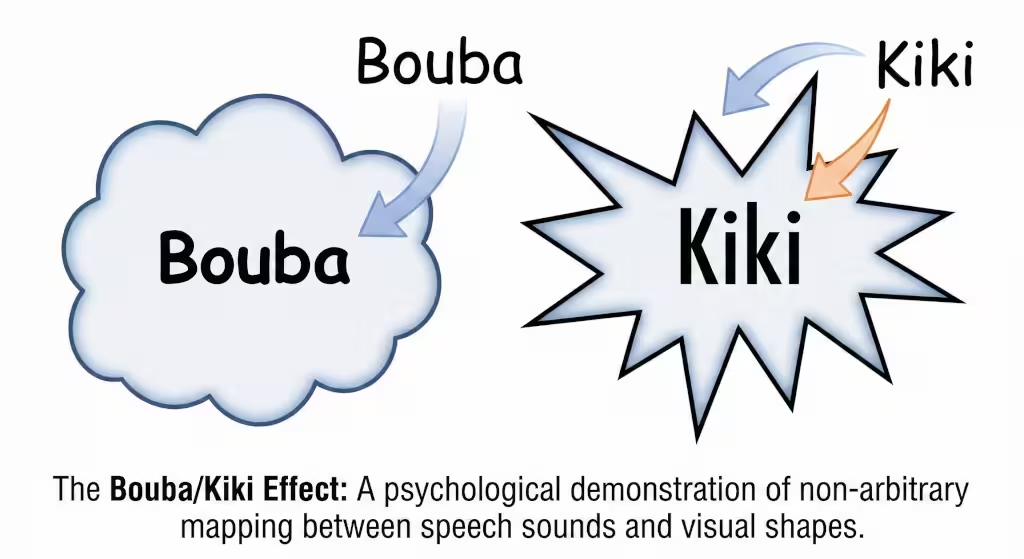
To understand why natural shapes work, we have to look at psychology. There is a famous experiment called the “Bouba/Kiki” effect. In this test, people are shown two shapes. One shape is a blob with round, curvy edges. The other shape is jagged with sharp spikes. People are told one is named “Bouba” and one is named “Kiki.”
Almost everyone, no matter what language they speak, says the round shape is Bouba and the sharp shape is Kiki. This proves that our brains give meaning to shapes automatically. We associate soft sounds and friendly feelings with round, natural shapes. We associate sharp sounds and danger with jagged shapes.
When you use natural shapes in your branding, you are being a “Bouba.” You are telling the customer that you are soft, flexible, and safe. If you use perfectly square boxes and sharp triangles, you might look strong, but you also might look strict or aggressive.
Natural shapes are rarely perfect. A leaf is never a perfect oval. A river never flows in a straight line. These imperfections are actually good for us. They tell our brain that what we are seeing is real. When a shape is too perfect, like a strict grid, it can feel cold or fake. By using natural shapes that are slightly uneven or flowing, you create a feeling of warmth. This makes your brand feel more human.
The Biophilic Framework in Branding

Biophilia is a scientific term that means “love of life.” It is the idea that humans have an innate need to connect with nature. When we are cut off from nature, we feel stress. When we see nature, we feel better. Biophilic design is the practice of bringing nature into our buildings and our screens.
A major part of this design philosophy is the use of natural shapes. Experts like Stephen Kellert have studied how these patterns affect us. They found that just looking at an image of a natural form can lower your heart rate. It can lower your blood pressure.
One of the most powerful types of natural shapes is the fractal. A fractal is a pattern that repeats itself at different sizes. Think of a fern leaf. The whole leaf looks like the little branch, and the little branch looks like the tiny leaflets. Clouds, coastlines, and lightning bolts are also fractals.
Our eyes are made to look for these repeating natural shapes. When we see them in a brand pattern or a website background, our eyes lock onto them easily. It feels satisfying to look at them. This increases the time a person spends looking at your brand.
Using natural shapes is not just about putting a picture of a tree on your logo. It is about using the lines of nature. It is about using the geometry of life. When you do this, you align your brand with the history of human evolution. You make your brand feel like it belongs in the world.
Brand Perception and the Halo Effect
There is a concept in marketing called the “Health Halo.” This happens when people think a food is healthy just because of one small clue, like a green label. Natural shapes create a similar halo effect for brands.
When a company uses organic, flowing lines, consumers assume other good things about the company. They might assume the company cares about the environment. They might assume the products are made of better ingredients. They might even assume the customer service will be friendlier.
This happens because natural shapes are linked to life and growth. A square block does not grow. It sits there. A curving vine grows and adapts. When your brand uses these flowing forms, you look like a company that is growing and adapting. You look alive.
Think about the difference between a bank and a spa. A bank usually uses squares, pillars, and rigid lines. They want to look like a fortress. They want to say, “We are solid.” But a spa uses waves, circles, and leaves. They use natural shapes to say, “Relax.”
However, even tech companies are starting to use natural shapes. They realized that technology can feel cold and scary. By making their phones with rounded corners and their logos with soft curves, they make the tech feel like a natural part of your life. They use natural shapes to bridge the gap between machine and human.
Implementing Natural Shapes in Digital Design
At Silphium Design, we specialize in putting these ideas onto the internet. Web design has been very blocky for a long time. Websites are usually made of rectangles inside of rectangles. This is because computers find it easy to draw rectangles. But humans do not find it easy to look at them all day.
We can break this rigid grid by using natural shapes. We can use buttons that are rounded instead of sharp. We can use section dividers that look like waves or hills instead of straight lines.
Using natural shapes helps guide the user’s eye. On a standard website, the user scans in a strict “F” pattern. They look left to right, then down. It is very mechanical. When we use organic curves, we can lead the eye down the page more gently. A curving line can point towards a “Buy Now” button in a way that feels helpful, not pushy.
This also helps with Search Engine Optimization (SEO). Search engines like Google want to see that users enjoy your website. If a user feels calm and happy because of the natural shapes on your page, they will stay longer. They will click more pages. This “dwell time” tells Google that your site is good.
Background textures are another great place for natural shapes. Instead of a flat color, we can use a subtle pattern of leaves, ripples, or wood grain. These textures add depth. They make the screen look less like a flat piece of glass and more like a window into a real space.
The Importance of Asymmetry
Nature is rarely perfectly symmetrical. If you slice a tree in half, the two sides are not exactly the same. One side might have a bigger branch. This is called asymmetry. In the past, brands loved perfect symmetry because it felt stable. But today, perfect symmetry can feel boring.
Using asymmetry is a key part of using natural shapes. An asymmetrical logo looks dynamic. It looks like it is in motion. Think of a running horse or a wave crashing. These are not symmetrical. They are full of energy.
When we design a website using natural shapes, we often balance things asymmetrically. We might have a large image on the left and a smaller block of text on the right, but balanced by a flowing background shape. This keeps the user’s brain active. It makes the design feel fresh.
Asymmetry mimics the randomness of the natural world. It feels freer. Brands that use asymmetrical natural shapes are often seen as more creative and innovative. They are seen as rule-breakers in a good way. They are not stuck in a box.
Consumer Trust and Emotional Durability
Getting a customer to buy something once is easy. Getting them to stay loyal for years is hard. This is called emotional durability. You want your brand to feel like a friend.
Natural shapes help build this friendship. Because these shapes are easy for the brain to process, looking at them feels like a relief. In a chaotic world full of flashing lights and loud noises, a brand that uses calm, natural shapes is a sanctuary.
This creates a positive emotional memory. Every time the customer sees your logo or visits your site, they get a tiny hit of dopamine. They feel a little bit better. Over time, this builds a deep loyalty. They might not even know why they like your brand so much. They just know it “feels right.”
This is very important for local SEO as well. If you are a local business, you want to be part of the community. The community is a living ecosystem. By using natural shapes, you show that you are part of that ecosystem. You are not a faceless corporation. You are a living part of the neighborhood.
Color and Natural Shapes Working Together
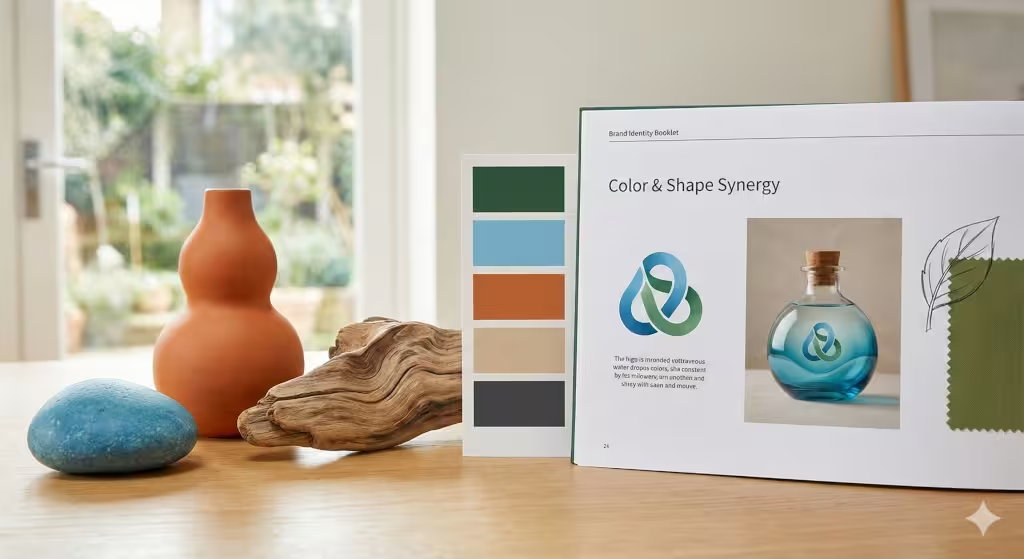
While this article is about shape, we cannot ignore color. Natural shapes work best when they are paired with natural colors. This does not just mean green. Nature is full of color. The blue of the ocean, the orange of a sunset, the brown of the soil, and the gray of a stone.
When you combine a natural shape, like a water droplet, with a natural color, like a soft blue, you double the effect. You create a very strong signal to the brain.
However, you can also create contrast. You can use a natural shape with a bright, modern color. This creates a feeling of “modern nature.” It says that you are high-tech, but you still have human values.
If you use a natural shape but fill it with a neon, artificial color, it can be confusing. It might look like plastic. For the best biophilic effect, the shape and the color should work together. They should both feel organic.
Typography and Natural Shapes
Letters are shapes too. The font you choose for your brand is a collection of shapes. Some fonts are very geometric. They have perfect circles and straight lines. These are often used by tech companies or banks.
Other fonts have more natural shapes. They might look like handwriting. They might have serifs (the little feet on the letters) that curve like a leaf stem. These fonts feel more human.
When we design a brand, we try to match the font to the other natural shapes in the visual identity. If the logo is soft and round, we might use a font that has soft edges. We avoid fonts that look like they were stamped by a machine.
Even the way the text is arranged can use natural shapes. We can wrap text around a curve. We can arrange a paragraph so it looks like a silhouette of a hill. This makes the reading experience more interesting. It breaks the monotony of the block.
Case Studies: Success with Natural Shapes
Let’s look at some examples. Think of the logo for Twitter (now X). The original bird was a collection of natural shapes. It was made of overlapping circles. It felt friendly, light, and chatty. It was a great example of biophilic design. When it changed to “X,” it became two sharp lines. It became aggressive and stark. The feeling of the brand changed instantly from a garden to a factory.
Think about the logo for Whole Foods. It is green and uses a stylized leaf. The leaf is a classic natural shape. It tells you immediately that the food is fresh. If Whole Foods used a red square as a logo, you would not trust the food as much. The shape does the selling.
We also see this in car design. In the 1980s, cars were very boxy. They were rectangles on wheels. Today, cars use fluid, aerodynamic lines. They use natural shapes that look like muscles or flowing water. These cars sell better because they look faster and more advanced. They look like living creatures.
For local businesses, this is huge. A local coffee shop that uses a steaming cup icon with swirling steam (natural shapes) looks warmer than a shop with a plain text sign. The steam curves invite you in. They promise comfort.
The Fear of Sharp Angles
We have talked a lot about why we like curves. But why do we dislike sharp angles? This goes back to the amygdala. This is the part of the brain that senses fear.
When we see a sharp object pointing at us, our brain sends a warning signal. It says, “Be careful!” This takes energy. Even if it is just a sharp triangle on a piece of paper, a tiny part of our brain is on alert.
If your website is full of sharp corners and jagged boxes, you are keeping your users in a state of low-level alert. They might not feel scared, but they will feel “on edge.” They will get tired faster. They will want to leave the page.
By smoothing out those corners and using natural shapes, you turn off that alarm. You let the user relax. A relaxed user is more likely to buy. A relaxed user is more likely to trust you.
Natural Shapes in Product Packaging
This influence extends to the physical world too. If you sell a product, the shape of the bottle or box matters. A bottle with a waist that curves like a human body or a plant stem is more attractive to pick up. It fits the hand better. The hand is a biological tool, and it prefers to hold natural shapes.
When a customer picks up a product that fits their hand, they feel a sense of ownership. They bond with the product. If the package is sharp and awkward, they will put it back.
The label on the package should also use natural shapes. A label with a scalloped edge or a rounded top looks more premium than a standard rectangle sticker. It shows that thought went into the design. It implies quality.
Questions Answered about Natural Shapes
Why do natural shapes calm us?
Natural shapes calm us because of evolution. For millions of years, natural environments were our home. Our brains adapted to process these complex, flowing patterns easily. When we see them, our brain recognizes them as “safe” and “normal,” which lowers our stress levels.
What are organic shapes in graphic design?
Organic shapes are forms that look like they were made by nature, not a machine. They are often irregular, uneven, and asymmetrical. Examples include shapes that look like leaves, rocks, clouds, water ripples, or animals. They are the opposite of geometric shapes like perfect squares or cubes.
Can shape psychology improve conversion rates?
Yes, it can. Because natural shapes are easier for the brain to process, they reduce the mental work a user has to do. This makes the user feel good. When a user feels good and trusts the design, they are more likely to click a button, sign up for a newsletter, or buy a product.
The Future of Design is Organic
We are moving into a new era of design. For a long time, we wanted everything to look futuristic and robotic. But now, people are tired of screens. They are tired of the digital world. They want to feel connected to reality again.
This is why natural shapes are the future. We will see more websites that break the grid. We will see more logos that look like hand-drawn sketches. We will see interfaces that move and flow like liquid.
This is not just a trend that will go away next year. This is a correction. We are realizing that we are biological creatures, not digital ones. Our technology needs to adapt to us, not the other way around.
By embracing natural shapes, you are future-proofing your brand. You are making sure that as technology gets more complex, your brand remains human. You are ensuring that you will always connect with your customers on a deep, biological level.
Conclusion
Shape is a silent language. It speaks to your customers before you even say hello. It tells them if you are friendly or cold. It tells them if you are safe or dangerous.
We have learned that natural shapes are the key to unlocking trust. They tap into ancient parts of the human brain. They lower stress and increase focus. They make a brand feel authentic and durable. From the curves of a logo to the layout of a website, these organic forms change how people perceive value.
Whether you are a global tech giant or a local bakery, you can use this power. Look at your brand today. Are you a box, or are you a living thing? Are you sharp, or are you smooth?
At Silphium Design, we believe the internet should be a garden, not a parking lot. We can help you cultivate that garden.