
Is Mastodon worth it for small business marketing in 2025? If you look at the headlines, you might think social media is a dying art. But if you look closer at the Fediverse, you will see a world that is growing fast. Here at Silphium Design LLC, I have watched this platform turn from a niche hobby for tech fans into a real power for brands.
I see a big change coming. People are tired of big companies owning their data. They want real talk, not ads. In this guide, I will show you why 2025 is the year to jump in. We will talk about how this decentralized world works. We will look at why Mastodon is worth it is the question every smart shop owner should be asking. If you want to reach people who actually care about what you do, you are in the right place.
Table of Contents
Is Mastodon Worth It for Small Business Marketing?
When we talk about whether Mastodon worth it, we have to look at how we measure success. On old sites like X or Facebook, success means “going viral.” You want thousands of likes from people who will forget you in five minutes. On Mastodon, success is different. It is about building a local group of fans who trust you.
Small businesses often fail on big sites because they cannot pay for ads. Big brands spend millions to stay at the top of the feed. On Mastodon, there are no ads. There is no secret math or “algorithm” that hides your posts unless you pay up. Every single person who follows you sees what you post in the order you post it. This is called a chronological feed. For a small business, this means your work does not get buried.
Is Mastodon worth it for your budget? Yes, because the cost is mostly your time, not your money. You are not fighting a computer program; you are talking to people. In 2025, customers are looking for “brand honesty.” They want to know the person behind the product. Because Mastodon is a “social community” and not just a “social network,” you can build deep roots. You might have fewer followers, but those followers are much more likely to buy from you and be passionate about your brand. This is especially true for those users who are in a unique niche.
Understanding the Fediverse Ecosystem
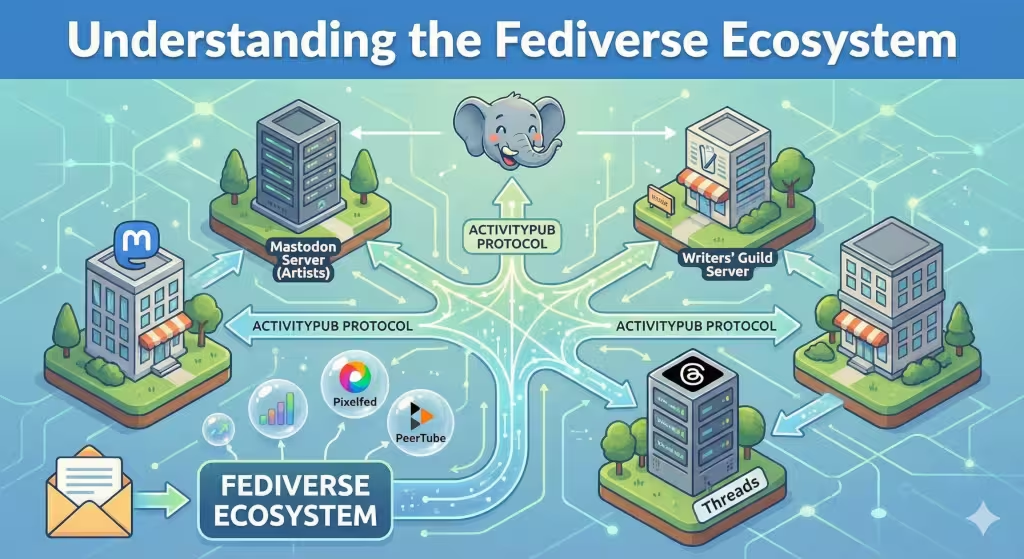
To understand if Mastodon worth it, you need to know what the Fediverse is. Think of the Fediverse like email. You might use Gmail, and your friend might use Outlook. You can still send each other messages. Mastodon works the same way. It is made up of thousands of small servers called “instances.”
Each instance is like a small town. Some towns are for artists. Some are for tech workers. Some are for people in a specific city like Minneapolis. When you join, you pick a home town, but you can still talk to everyone in every other town. This is possible because of a set of rules called the ActivityPub protocol.
In 2025, the Fediverse has become even bigger. Even big apps like Instagram Threads now let people share posts to Mastodon. This means your small business can stay on a small, safe server but still reach people all over the world. This interoperability is a huge reason why many think Mastodon is worth using. You are not trapped in one “walled garden.” You own your account. If you don’t like the rules of one server, you can move to another and take your followers with you. You cannot do that on Instagram.
Strategic Benefits for Small Brands
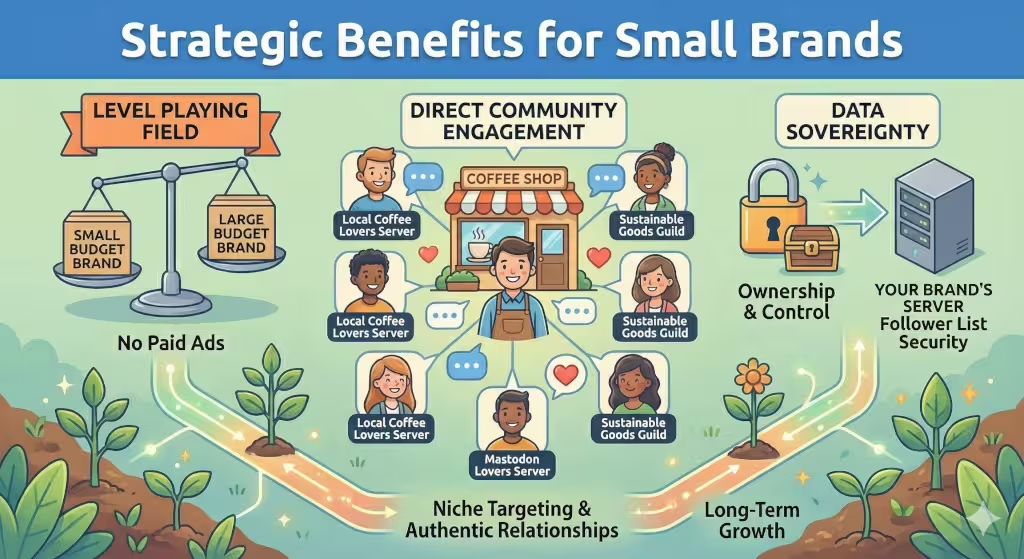
One of the biggest reasons Mastodon is worth it for small brands is the lack of “pay-to-play” barriers. On most sites, you have to “boost” a post to get seen. On Mastodon, if your content is good, people will “boost” it for you. A boost is like a retweet. It puts your post in front of their friends. Because there is no noise from paid ads, a boost from a real person carries a lot of weight.
Another benefit is niche targeting. Most small businesses serve a specific group. If you sell hand-made pens, you can join a server for writers. If you fix bikes, you can join a server for your local city. You are not yelling into a void of billions of people. You are sitting at a table with your exact customers.
Data sovereignty is also a key factor. In the past, if a big social media site closed or changed its rules, businesses lost everything. On Mastodon, you have more control. You can even start your own server for your company. This makes your brand look very professional. It also keeps your data safe. When you look at long-term safety, Mastodon is worth it because it is built on open-source code that no one person can destroy.
The Challenges: Technical and Social
I have to be direct with you. While Mastodon is worth using, it is not always easy. The biggest hurdle is the learning curve. It feels a bit like the early days of the internet. You have to pick a server, which can be confusing. There is no one “Mastodon” sign-up page. You have to find a “home” first.
There is also a social rulebook you must follow. Mastodon users hate traditional marketing. If you just post links to your shop all day, people will block you. They want to see “behind the scenes” photos. They want to hear your thoughts on industry news. They want you to help other people. If you are an expert in your area of business or a blogger, then Mastodon could be the place for you to shine, unfettered by an algorithm.
Moderation is also different. Each server has its own rules and its own human moderators. You have to be a good neighbor. If you are rude or spammy, you might get kicked off a server. This sounds scary, but it actually keeps the platform much cleaner and friendlier than other sites. For businesses that want a safe space for their brand, these rules make Mastodon worth it and valuable.
Common Questions about Mastodon
Many people wonder: “How do I use Mastodon for business without ads?” The answer is content pillars. You should follow a rule of thirds. One-third of your posts should be helpful or educational. One-third should be sharing other people’s cool work. Only the last third should be about your products.
Another common question is: “Can you promote products on Mastodon?” Yes, but you have to be clever. Instead of a “Buy Now” graphic, show a video of how you make the product. Ask for feedback. Use “Content Warnings” if you are posting a long thread about a sale so people can choose to read it or not.
People also ask: “Is Mastodon still growing in 2025?” Yes, it grew by 30% this year alone. More people are moving there because they want privacy. They are tired of their personal info being sold. As a business, being where the people are moving gives you a “first-mover” advantage. This growth proves that Mastodon is poised for those who plan for the future.
Strategic Implementation: Your 2025 Playbook
If you decide that Mastodon is worth it, you need a plan. First, pick the right server. Don’t just join the biggest one. Look for one that fits your industry. If you are a tech startup, look at fosstodon.org. If you are a general business, mastodon.social is a good safe bet. Remember, you can always change the server later. Just pick something and learn how it works.
Second, fix your profile. Since there is no blue checkmark you can buy, you verify yourself by linking your website. You put a special link on your site, and Mastodon turns your website link green on your profile. This proves you are who you say you are for free.
Third, use hashtags. Since there is no algorithm to “guess” what people want to see, hashtags are the only way people find new things. Use three to five tags per post. Don’t use too many, or it looks like spam. When you follow this simple path, you will see why Mastodon is worth it. It brings you back to the basics of good business: talking to people and helping them solve problems.
SEO, GEO, and AEO: Staying Visible

In 2025, search has changed. We don’t just use Google. We use AI like ChatGPT or Perplexity to find answers. This is called AEO (Answer Engine Optimization) and GEO (Generative Engine Optimization). To make sure AI mentions your business, you need to be active on high-quality sites like Mastodon.
AI models look for “signals of trust.” When real people talk about your brand on a decentralized server, it creates a strong signal. Since Mastodon is public and open, search engines can see that people like you. By having a clear, helpful presence, you help AI systems understand that your business is a leader in your field.
We also have to think about GEO. This is how AI suggests local businesses. If you are active on a local Mastodon server for your city, you are more likely to show up when someone asks an AI, “Who is the best web designer in Minneapolis?” For these reasons, Mastodon is worth it even if you don’t care about social media. It helps you get found everywhere else.
The Verdict: The Future of Your Brand
So, is Mastodon worth it? For a small business that wants to survive the next ten years, the answer is a clear yes. You get to own your audience. You get a feed that doesn’t hide your hard work. You get to join a community that values honesty over hype.
The internet is changing. The days of giant, central social media sites are starting to fade. The future is “federated.” It is made of many small parts working together. By joining now, you are building a home on a foundation that won’t wash away. You are not just a user on a platform; you are a member of a global community.
When you look back in a few years, you will be glad you didn’t wait. You will have a loyal group of followers who know you, trust you, and support your business. That kind of loyalty is priceless. That is what makes Mastodon worth it.
Interested In Mastodon
I am so glad you are ready to take the next step. Setting up your own space on the Fediverse is a big move. It shows your customers that you care about owning your brand and protecting their privacy. Below is a technical and social checklist, followed by a full week of posts you can use to get started. If you are joining an established server, then skip to the content calendar. However, by looking at the business server checklist, you can get an idea of how the servers work.
The Business Server Setup Checklist
Setting up a server might sound like a lot of work, but it is much easier if you take it one step at a time. This path is what makes a professional presence on Mastodon worth it for a growing brand.
Phase 1: Preparation (The Basics)
- [ ] Buy Your Domain: Pick a name that matches your brand (like
social.yourbrand.comorcommunity.yourbrand.com). - [ ] Pick a Hosting Provider: You need a Virtual Private Server (VPS). I recommend providers like DigitalOcean or Hetzner. For a small business, a server with 4GB of RAM is plenty to start.
- [ ] Get an Email Service: Mastodon needs to send sign-up emails. Services like Mailgun or SendGrid work great and usually have free levels for small users.
- [ ] Choose Storage: If you plan to post a lot of videos and photos, sign up for “Object Storage” (like Amazon S3 or Wasabi). This keeps your server from running out of room.
Phase 2: Technical Installation
- [ ] Install Docker: This is a tool that lets Mastodon run in a “container,” making it much easier to manage and update.
- [ ] Setup Nginx and SSL: This is the security layer. It makes sure the “lock” icon shows up in the browser so your users know their data is safe.
- [ ] Run the Setup Wizard: Mastodon has a built-in helper. You will type a simple command, and it will ask you for your domain name and email settings.
- [ ] Verify Your Site: Link your main business website to your Mastodon profile. This turns your link green and proves you are a real business.
Phase 3: Governance and Rules
- [ ] Write Your Rules: Every server needs a “Code of Conduct.” Keep it simple: No hate speech, no spam, and be kind.
- [ ] Set Up Moderation: Decide who will check for bad posts. For a small business, you can usually do this yourself in five minutes a day.
- [ ] Connect to the Relay: Join a “relay” to help your server find other people to talk to. This makes your “Federated Timeline” active right away.
Your First Week: A “Fediverse-Friendly” Content Calendar
Most people fail because they post like they are on a billboard. To make the most of Mastodon, you have to post like you are at a neighborhood BBQ. Use these templates for your first seven days.
Day 1: The “Hello World” Introduction
- Goal: Tell the community who you are and why you are here.
- Post Template: “Hello #Fediverse! We are [Business Name] from [City]. We joined because we believe in open social media and privacy. We make [Product/Service] and love [Industry Topic]. Looking forward to meeting you all! #Introduction #NewHere #[IndustryTag]”
- Pro-Tip: Pin this post to your profile so it is the first thing people see.
Day 2: The “Behind the Scenes” Photo
- Goal: Show the human side of your work.
- Post Template: “Here is a messy look at our desk today! We are working on a new [Project Name]. It is hard work, but we love the process. What are you working on today? #WorkLife #SmallBiz”
- Pro-Tip: Always add “Alt-text” to your images for people who are blind. It is a big deal on Mastodon.
Day 3: The “Helpful Teacher” Post
- Goal: Give away a free tip.
- Post Template: “Did you know that [Common Problem] can be fixed by [Simple Solution]? We see this a lot in our shop. Hope this helps someone today! #Tips #Education”
- Pro-Tip: Don’t link to your store yet. Just give the tip for free.
Day 4: The “Community Boost”
- Goal: Support someone else.
- Action: Find an interesting post from a customer or a peer and “Boost” it. Add a comment if you can.
- Why: This shows you are a good neighbor, which is why many join Mastodon.
Day 5: The “Question of the Week”
- Goal: Start a conversation.
- Post Template: “We are curious: do you prefer [Option A] or [Option B] when it comes to [Product Category]? Let us know in the replies! #Question #Poll”
- Pro-Tip: Use the built-in “Poll” feature to make it easy for people to vote.
Day 6: The “Soft Feature” (Gentle Marketing)
- Goal: Show your product in a helpful way.
- Post Template: “We just finished this [Product] for a client. They needed it to [Solve Problem], and we are so happy with how the colors turned out. Check it out! [Link to website]”
- Pro-Tip: Keep the link at the very end of the post.
Day 7: The “Weekly Wrap-up”
- Goal: Review the week and say thanks.
- Post Template: “What a great first week on the Fediverse. We met [Mention 1-2 people you talked to] and learned so much about [Topic]. Have a great weekend everyone! #Weekend #Community”
Why This Approach Works
If you follow this plan, you will see that the time you spend makes Mastodon worthwhile. You aren’t just a logo; you are a neighbor. People buy from neighbors they like.