
We stand at a precipice in human history, marking a profound and troubling divergence in our species’ trajectory. Recent studies quantify what many of us intuitively feel: over the last two centuries, humanity’s quantifiable connection to the natural world has plummeted by a staggering 60 percent.
This phenomenon, often termed the “extinction of experience,” is not merely a nostalgic loss of pastoral sentiment. It represents a fundamental severing of the biological ties that have sustained our psychological and physiological equilibrium for millennia. We have transitioned from a species that lived symbiotically within nature to one that observes it almost exclusively through glass, first through the windows of rapidly densifying urban centers, and now, overwhelmingly, through the backlit screens of digital devices.
However, to view this 21st-century shift solely as a tragedy of loss is a failure of imagination. It is, rather, a critical inflection point demanding adaptation. We cannot turn back the clock on urbanization or technological integration. Therefore, the challenge facing designers, architects, and technologists today is not to reject the digital realm in favor of the analog wild. Instead, we must forge a new, “cyber-biophilic” relationship. We must master the translation of organic principles into our digital interfaces. We must build websites and applications that do not act as barriers to the living world, but rather as conduits, mimicking nature’s restorative patterns to heal the very deficits our modern lifestyle has created.
Table of Contents
The Biological Imperative: Why We Still Need the Wild
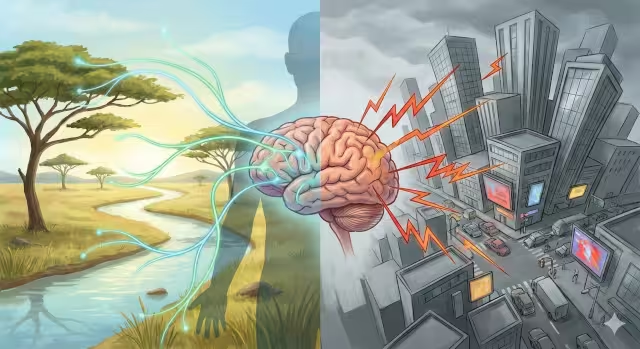
To understand why our current separation from nature is so damaging, we have to look at how human beings are built. It is easy to forget, sitting in climate-controlled offices and looking at smartphones, that we are biological creatures. For almost all of human history, we lived outside. Our brains, our eyes, and our nervous systems evolved in direct response to the sights, sounds, and rhythms of nature.
Biologist E.O. Wilson coined a term for this: the “Biophilia Hypothesis.” Put simply, this hypothesis states that humans have an innate, hard-wired desire to connect with other living things. We are genetically programmed to find comfort in environments that offer the resources for life. Think about what relaxes you. It is likely the sound of ocean waves, the view of a green valley, or the dappled light coming through a forest canopy. These things signal safety and abundance to our ancient brains.
The conflict arises because our modern world looks nothing like the world we were built for. We have largely replaced the soft, complex geometry of nature with the hard, straight lines of concrete buildings and grid layouts. We have traded the gentle sounds of wind and birds for the harsh noise of traffic and machinery.
Researchers have found that this constantly triggers our body’s stress response. When we are surrounded by urban noise and sharp, artificial structures, our “fight or flight” system stays slightly activated. Over time, this low-level stress leads to anxiety, mental fatigue, and difficulty focusing. We become depleted because our environments are demanding too much attention without giving any restorative energy back. We are trying to run software designed for the savanna on the hardware of a concrete jungle.
Digital Biophilia: The New Human-Nature Interface
Since we spend so much of our lives looking at screens, we must ask: can we bring the benefits of nature into the digital world? This is the core of “Digital Biophilia.” It is not about just slapping a picture of a leaf on a webpage. It is a deeper design philosophy that tries to translate the rules of the organic world into human-computer interactions.
We can break digital biophilia down into three main pillars that guide how we build websites and apps.
Direct Experience of Nature
This is the most obvious pillar. It involves using technology to provide a sensory experience of nature that is as close to the real thing as possible. In the past, web designers avoided large images or video because internet speeds were slow. Today, we have high-speed connections and high-definition screens.
A website using this principle might feature a high-quality “hero video” at the top of the homepage showing a slow-moving mist over a mountain range. It might include an optional audio track of rain falling or a babbling brook. Apps like “Calm” or various focus timers use this perfectly. They transport the user, even momentarily, out of their digital task and into a simulated natural environment. Seeing real-time footage of nature, even on a screen, has been shown to lower heart rates.
Indirect or “Natural Analogues”
This pillar is where design expertise really matters. It is about using elements that are not literally nature, but mimic the rules and shapes found in nature. Our brains are excellent pattern-matching machines. They recognize organic structures even when they are abstract.
One major aspect of this is using “biomorphic forms.” If you look around nature, you rarely see a perfect square with sharp 90-degree corners. Nature is full of curves, soft edges, and irregular shapes think of a river rock, a cell under a microscope, or the petals of a flower. In web design, this means moving away from rigid grid boxes. We use rounded corners on buttons and image frames. We use background shapes that are fluid and wavy rather than straight divisions. These organic shapes feel friendlier and less threatening to our subconscious brain than sharp points.
Another crucial concept here is “fractals.” A fractal is a pattern that repeats itself at different scales. A fern leaf is a perfect example; the whole frond looks like the smaller branches, which look like the tiny leaves. Trees are fractals, too. The big branches mimic the trunk, and the twigs mimic the branches. Our brains are incredibly efficient at processing fractals. Looking at these repeating patterns is almost like a mental massage; it becomes easier for us to understand what we are seeing. We can use fractal-like structures in how we organize website menus, allowing users to “branch off” into deeper content in a way that feels intuitive rather than overwhelming.
Nature of the Space
The third pillar deals with how the digital space itself feels. In the physical world, humans love spaces that offer “prospect and refuge.” This goes back to our survival instincts. We like to be in a safe, sheltered spot (refuge) where we can also see what is going on around us and see into the distance (prospect).
On a website, a cluttered page packed with text and flashing ads feels unsafe. There is no refuge for the eye. Biophilic design uses “white space” (empty space around elements) to create that sense of refuge. It gives the user’s brain a break. We then provide “prospect” through clear navigation and layouts that let the user understand where they can go next. It creates a digital landscape that feels open and explorable, rather than cramped and confusing.
Technical Implementation: Coding the Organic
How do we actually build these things with code? We have to move beyond just thinking about layout and consider light, color, and motion, just as nature does.
Color and Body Clocks
Nature is never just one flat color. The colors of the outdoors change constantly based on the time of day and the season. Our bodies have internal clocks, called circadian rhythms, that are set by the color of natural light. Bright, blue-toned light in the morning wakes us up. Warm, amber, reddish light in the evening tells our brains it is time to rest.
Our screens, however, usually blast bright blue light all day and night. This confuses our body clocks and ruins sleep. A biophilic approach to web design considers this. We can use code to subtly shift a website’s color palette based on the user’s time of day. A site might have a crisp, bright look at noon, but transition to warmer, softer earth tones in the evening. This respects the user’s biology instead of fighting against it.
Non-Rhythmic Motion
Nothing in nature is perfectly still, but nothing moves like a machine, either. A flickering neon sign or a flashing banner ad is stressful because it is repetitive and demanding. Nature has what we call “non-rhythmic sensory stimuli.” Think of leaves gently rustling in a breeze, or clouds drifting across the sky, or ripples on a lake. The motion is unpredictable, gentle, and does not repeat in a perfect loop.
We can use modern web technologies like CSS and JavaScript to create these effects. Instead of a boring, static background, we can have subtle, slow-moving shapes that drift like smoke. We can make elements react gently when a mouse hovers over them, like pushing water. This type of motion grabs our attention without causing fatigue, a state known as “soft fascination,” which is very restorative for the brain.
Texture and Depth
Screens are naturally flat and smooth, which is very unlike the real world. Nature is full of rich textures, rough bark, soft moss, slick water. We can try to bring some of that depth back into digital design. A recent trend called “glassmorphism” is a good example. It uses translucent, blurry layers that look like frosted glass. This gives a sense of depth and layering, making the interface feel more like a physical object and less like a flat plane of pixels. By using subtle textures in backgrounds instead of solid colors, we add a level of richness that mimics the complexity of a natural surface.
Case Studies: The Shift in Action
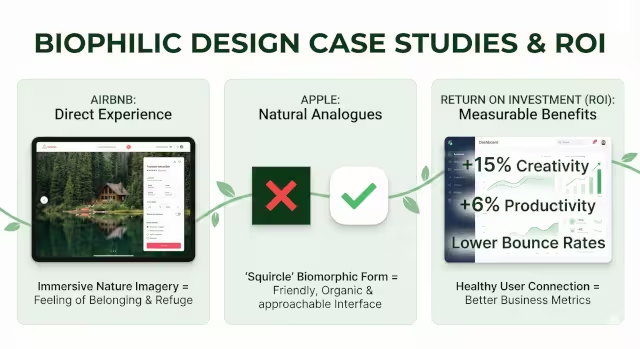
This is not just theory. Some of the biggest and most successful companies in the world are already using these principles to make their digital products better and more appealing. They understand that connecting with our nature-loving brains is good for business.
Airbnb and the Feeling of Belonging
Airbnb’s entire brand is built around the idea of “belonging anywhere.” They do not just list houses; they sell the experience of being in a location. Their website and app rely heavily on the “Direct Experience of Nature” pillar. They use incredibly high-quality, large photographs of beautiful destinations—cabins in forests, homes by the ocean, villas with mountain views.
When you land on their site, you are immediately hit with these immersive images of nature. It creates an emotional reaction. It taps into that desire for refuge and prospect. You feel relaxed and excited to explore just by looking at the pictures. They use a very clean layout with lots of white space, making the beautiful photography the star of the show.
Apple and the Friendly Shape
Apple is famous for its obsessive attention to design detail. Years ago, they made a shift in their operating system that seems small but is actually very biophilic. They changed their app icons from squares with standard rounded corners to a shape called a “squircle” or a super-ellipse.
A standard rounded corner is just a straight line that suddenly turns into a perfect quarter-circle arc. It is geometric. A squircle is different; the curve starts gradually, gets deeper, and then gradually flattens out again. It is a continuously changing curve. Why does this matter? Because that is how curves work in nature. A pebble worn smooth by a river doesn’t have geometric arcs; it has continuous, complex curves.
By using this shape, Apple’s interface feels softer, more organic, and friendlier to the human eye. It is a subtle application of biomorphic form that makes a high-tech device feel a little more natural.
The Return on Investment
Using biophilic design isn’t just about making things look pretty. It has real, measurable benefits. Studies in workplaces have shown that incorporating elements of nature, whether real plants or biophilic design patterns, can boost creativity by up to 15% and increase productivity by 6%.
In the world of websites, this translates to better user metrics. If a website feels calming and restorative because it uses natural colors and organic layouts, people are less likely to immediately leave (a lower “bounce rate”). They are likely to stay longer and browse more pages. If they feel psychologically safe and comfortable, they are more likely to trust the brand and eventually make a purchase or sign up for a service. Investing in the human connection to nature is a smart financial decision.
Frequently Asked Questions About the Human-Nature Shift

As this shift in our relationship with nature continues, many people have questions about what it means for our future. Here are some common queries regarding this topic.
How has the human-nature relationship changed significantly in the 21st century?
The biggest change is the shift from a direct, physical dependence on nature to a psychological disconnection from it. For most of history, our daily survival depended on interacting with the wild. In the 21st century, most of us live in urban areas and our survival depends on technology and global supply chains. We no longer need to understand nature to eat, so we have lost the daily knowledge and sensory input of the natural world. This has created a void in our mental well-being that we are only now realizing needs to be filled.
What exactly is digital biophilic design?
Digital biophilic design is the practice of applying the lessons of biology and nature to the design of software, websites, and user interfaces. It is not just about pictures of trees. It is about using organic shapes, natural color palettes based on light cycles, fractals for organization, and soundscapes to create digital environments that work in harmony with our ancient nervous systems, rather than stressing them out.
Can virtual nature ever truly replace real nature?
No, absolutely not. Virtual reality, high-definition videos, and biophilic websites are not a replacement for the complex, multisensory experience of actually being outdoors in a forest or by the ocean. Real nature provides benefits, such as fresh air, microbiome diversity, and full-body engagement, that a screen can never provide.
We should think of digital biophilia as a supplement or a bridge. In a world where we must spend hours indoors on screens to work, these design principles act like a vitamin. They help reduce the damage caused by “nature deficit,” lower our stress levels while we work, and hopefully inspire us to seek out the real thing when we log off.
What are the main benefits of applying biophilic principles to web design?
For the user, the benefits are psychological. These designs are less taxing on the brain, help restore attention span, reduce anxiety, and improve mood. For the website owner, this translates into better business results. Users who feel good on a site stay longer, engage more deeply with the content, have a higher opinion of the brand, and are more likely to return. It creates a healthier relationship between the user and the technology.
Re-wilding the Web
We are living through a massive experiment in human evolution. We have taken a species evolved for the slow rhythms of nature and dropped it into a hyper-fast, concrete, and digital world. The data shows that this has damaged our deep connection to the living world, resulting in stress and a sense of loss.
We cannot delete the internet. Technology is an inescapable part of the 21st century. But we are not helpless. We have the power to change how we build our digital tools. The shift in human-nature relationships does not have to end in total alienation. By embracing digital biophilia, we can begin to “re-wild” the web.
We can demand technology that respects our biological heritage. We can design interfaces that soothe rather than agitate, that offer refuge rather than overload. The future of the internet shouldn’t look like the inside of a machine. It should look, feel, and function a little more like a garden, a place where both humans and nature, in their own ways, can thrive together.