
Table of Contents
The Convergence of LLMs and Evolutionary UI
The way we build websites is changing fast, and the tools we use are becoming much more advanced. For a long time, web designers only used simple blocks, squares, and straight lines to build layouts. This made websites look clean, but it also made them feel cold and unnatural. Today, we can use artificial intelligence to bring the beauty of the natural world into our digital spaces. By using Gemini 3 Flash prompts for biophilic fractal patterns, we can create websites that feel alive. This shift moves us past old design habits and takes us into a new world where computer science and biology work together.
When we talk about biophilic design, many people think of adding pictures of leaves or using green colors on a homepage. True biophilic design goes much deeper than that. It is about using the actual shapes and rules of nature to build the structure of a website. Nature does not use perfect squares or flat grids. Instead, nature builds with complex shapes that repeat themselves at different sizes. By using Gemini 3 Flash prompts for biophilic fractal patterns, web designers can create code that makes these shapes automatically. This type of design is called computational biophilia, and it changes how human beings react to computer screens.
The tool we use to do this is Gemini 3 Flash. This artificial intelligence model is perfect for generating complex design assets because it works with very low latency. Low latency means the AI can think and respond almost instantly. It also has a huge context window, which means it can remember a massive amount of information while it writes code. When you use Gemini 3 Flash prompts for biophilic fractal patterns, you can ask the AI to generate long, complex scripts without losing track of the design goals. The speed of this model allows front-end developers to experiment quickly, testing out different natural shapes until they find the perfect fit for their user interface.
The main reason we should use Gemini 3 Flash prompts for biophilic fractal patterns is to help the people who use our websites. Human beings evolved in nature, surrounded by trees, clouds, rivers, and mountains. Our eyes and brains are trained to look at natural shapes without getting tired. When we stare at flat, bright, boxy websites for hours, our brains have to work extra hard to process the artificial environment. This causes digital cognitive fatigue, which is just a technical way of saying your brain gets tired from looking at a screen.
By using Gemini 3 Flash prompts for biophilic fractal patterns, we can build digital spaces that match our evolutionary history. These patterns naturally lower stress and make websites much more pleasant to use.
The Mathematics of Nature: Statistical Fractals vs. Euclidean Grids
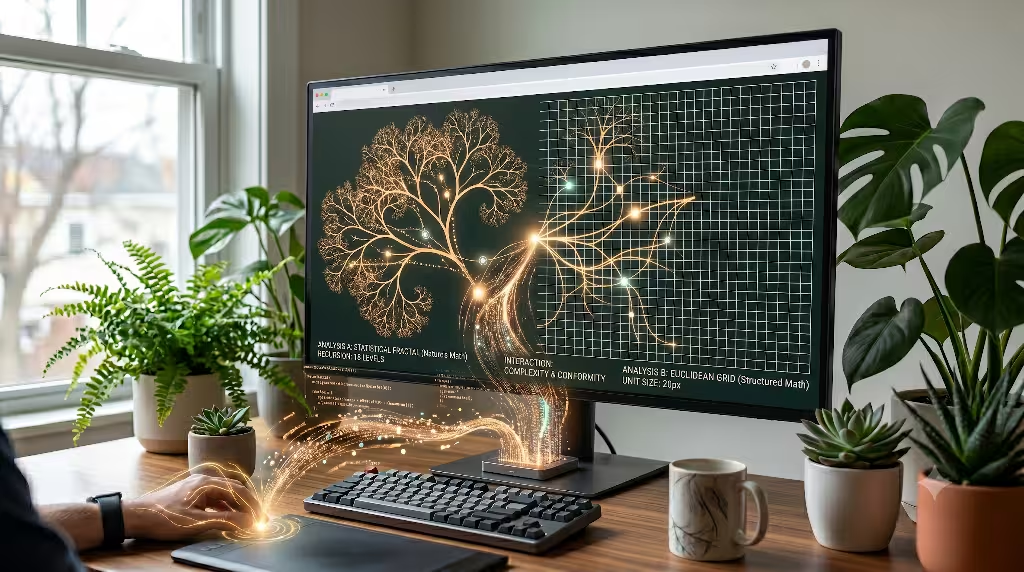
To understand why we use Gemini 3 Flash prompts for biophilic fractal patterns, we have to look at the math behind the natural world. In the world of design, experts often talk about Terrapin Bright Green and their research on how nature affects humans. Their eighth pattern of biophilic design focuses specifically on complex, organized shapes. Nature is full of these shapes, which are called fractals. A fractal is a geometric pattern that looks the same no matter how close you zoom in or how far you zoom out. Think of a fern leaf, where each small leaf looks like a miniature version of the whole branch. That is how biophilic fractal patterns work in the physical world.
The mathematical measurement used to describe these shapes is called the fractal dimension, which is written as a capital letter “D”. We can calculate this dimension using a specific formula:
D = log N\log(1/s)
In this equation, “N” represents the number of self-similar pieces created at each step, and “s” represents the scale factor. This formula helps us understand how dense and detailed a shape is. Scientists have conducted many studies on how the human body reacts to different fractal dimensions. The empirical data shows something amazing. When people look at shapes with a mid-range fractal dimension, specifically between 1.3 and 1.5, their stress levels drop by up to 60 percent. Our visual system can process these specific biophilic fractal patterns with ease, which brings a feeling of comfort to the viewer.
Traditional websites do not use these numbers. Instead, they rely on Euclidean grids, which are built on simple shapes like rectangles and straight lines. The Euclidean problem is that these sterile, rigid right angles do not exist in nature. When the human eye views a traditional web grid, the visual cortex has to work harder because it cannot find the natural rhythms it expects. This constant strain is a major reason why users get tired and leave websites quickly. By using Gemini 3 Flash prompts for biophilic fractal patterns, we can break free from the strict grid and introduce shapes that match our natural visual preferences.
When you write Gemini 3 Flash prompts for biophilic fractal patterns, you are telling the AI to use these mathematical rules instead of standard design grids. You are asking the model to calculate the scaling factors and lines that copy the geometry of a forest or a shoreline. This creates a bridge between computer code and human biology. The resulting layouts are not just decorative art pieces. They are highly calculated visual systems that make a webpage feel more relaxing, clear, and engaging for every person who visits it.
Prompt Engineering Framework for Gemini 3 Flash
To get the best results from the AI, you need a strong system for writing your instructions. This system is called prompt engineering. When you create Gemini 3 Flash prompts for biophilic fractal patterns, you must use context isolation. Context isolation means you tell the AI exactly what its job is and what it should ignore. If you do not isolate the context, the AI might spend too much time writing long paragraphs of text explaining what a fractal is. We do not want explanations; we want clean code. You must tell the model to skip the chat and output only the programming code needed to render the shapes.
Another major choice you have to make when using Gemini 3 Flash prompts for biophilic fractal patterns is picking the right output format. The two best options for web design are Scalable Vector Graphics, or SVGs, and HTML5 Canvas scripts. SVGs are excellent because they use mathematical points to draw shapes, meaning they stay perfectly sharp at any screen size. However, if a fractal has thousands of tiny pieces, an SVG can slow down the browser. For very complex biophilic fractal patterns, HTML5 Canvas combined with JavaScript is much better. The canvas element allows the browser to draw shapes directly onto the screen using the computer graphics card, which keeps the website running fast.
You also need to set strict mathematical boundaries in your Gemini 3 Flash prompts for biophilic fractal patterns. Computers can calculate math forever, but web browsers will freeze if they try to do too much work at once. This is why you must limit the recursion depth. Recursion is when a line of code calls itself to repeat a pattern. If a script tries to repeat a fractal pattern twelve times, the browser might crash. If you limit the recursion depth to five or six layers, you get a beautiful, detailed shape without causing any performance bottlenecks. Your prompts must balance visual beauty with computer processing speed.
Here is a blueprint you can use when writing your own Gemini 3 Flash prompts for biophilic fractal patterns:
Prompt Architecture Blueprint: Act as an expert front-end engineer and biophilic designer. Generate an optimized, responsive HTML5 Canvas script executing a recursive branching algorithm. Ensure self-similarity across 5 iterations. Target a statistical fractal dimension of D = 1.4. Output clean code exclusively.
By using this specific blueprint, you ensure that the AI gives you exactly what your website needs. It cuts out the fluff and delivers code that balances natural design principles with high performance.
Comparative Blueprint Matrix for Prompt Deployment
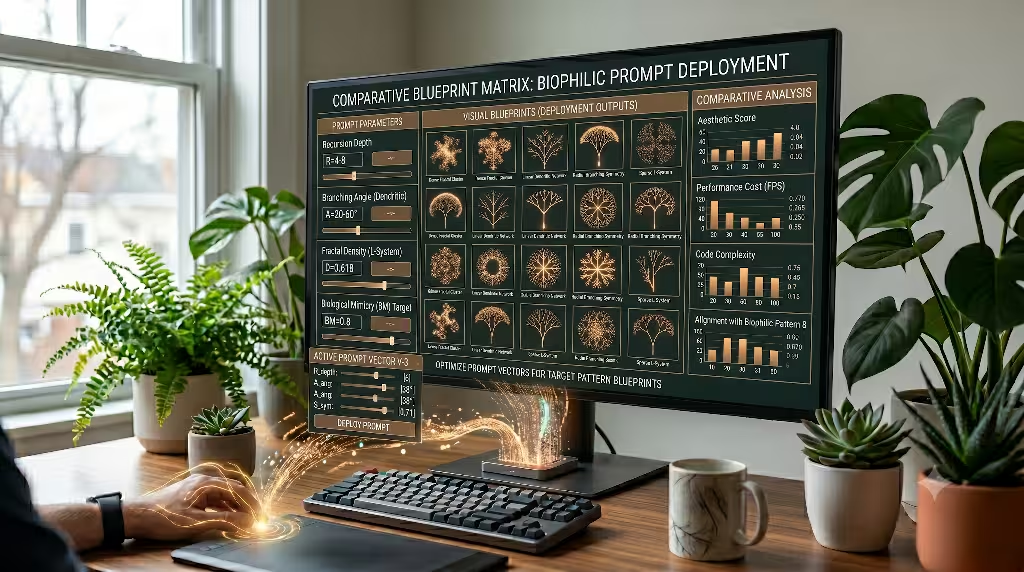
To make it easy to choose the right style for your website, we can look at a comparative matrix. Different types of natural shapes create different feelings and require different coding methods. When you write your Gemini 3 Flash prompts for biophilic fractal patterns, you should know exactly which style you want to target.
| Target Aesthetic | Core Algorithmic Directives | Optimal Output Format | Targeted Biophilic Response |
| Dendritic Branching | Recursive bifurcation, angle variance (20 to 35 degrees), structural thinning scale factors. | HTML5 Canvas / JS | Visual Connection with Natural Systems; cognitive restoration. |
| Fibonacci Spirals | Logarithmic growth vector plotting, Golden Ratio (1.618) scaling constraints. | Inline SVG | Biomorphic Forms & Patterns; innate geometric fluency. |
| Perlin Noise Waveforms | Non-periodic organic oscillations, multi-octave smoothing functions. | CSS Paint API / Canvas | Non-Rhythmic Sensory Stimuli; reduction in ambient heart rate. |
Let us explore the first row of this matrix in detail. Dendritic branching looks like the veins of a leaf, the lightning in a storm, or the branches of a tree. To create this with Gemini 3 Flash prompts for biophilic fractal patterns, you must tell the AI to use recursive bifurcation. This means one line splits into two lines, and those two lines split into four lines. You should tell the model to keep the angles between 20 and 35 degrees, and make the lines thinner as they split. This specific look targets the human visual connection with natural systems, which helps restore a tired mind.
The second style is the Fibonacci spiral, which you see in pinecones, seashells, and sunflowers. When you write Gemini 3 Flash prompts for biophilic fractal patterns to build a spiral, you instruct the AI to use the Golden Ratio, which is approximately 1.618. This number controls how fast the spiral grows. The optimal format for this shape is an inline SVG because the geometry is very smooth and clean. This layout uses biomorphic forms that our brains recognize instantly, satisfying our innate preference for geometric balance.
The third style uses Perlin noise waveforms, which copy the fluid movement of waves, clouds, or wind blowing through grass. Unlike sharp lines, these are non-periodic organic oscillations, meaning they bend and flow without repeating in a boring, predictable way. When writing Gemini 3 Flash prompts for biophilic fractal patterns for these waves, you use multi-octave smoothing functions to keep the motion looking soft. This provides non-rhythmic sensory stimuli on a webpage, which studies show can actually lower a user’s ambient heart rate while they browse.
Integrating Generated Geometries into Modern Web Frameworks
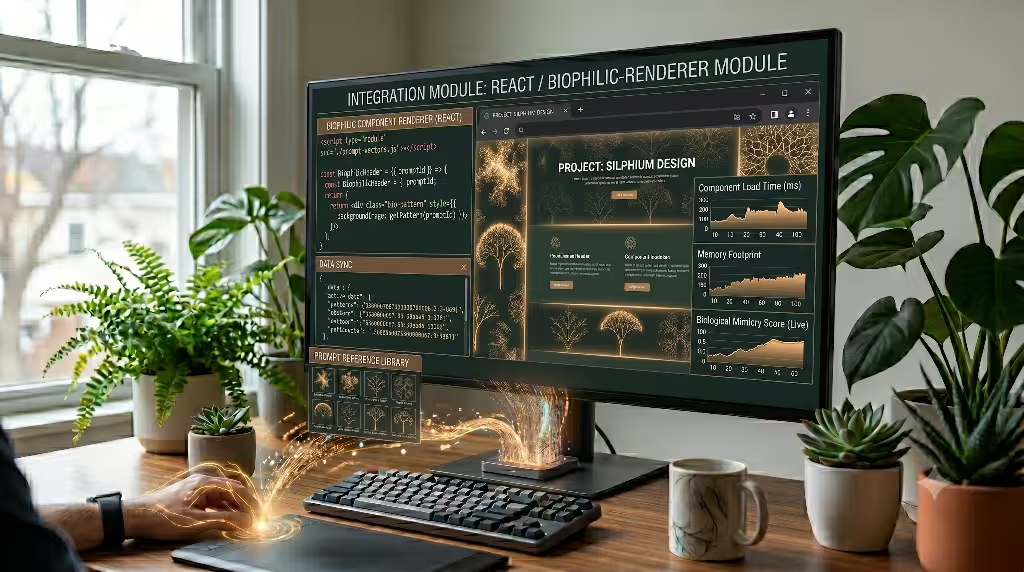
Once you use Gemini 3 Flash prompts for biophilic fractal patterns to generate your code, you need to put that code into your website. This step requires a strong understanding of web performance. If you add complex math scripts incorrectly, your website will stutter when users scroll down the page. To stop this from happening, developers should use CSS containment. CSS containment tells the browser that a specific area of the page is isolated, so if a fractal changes or moves inside that box, the rest of the website does not have to recalculate its layout.
Another critical trick when setting up biophilic fractal patterns is to use hardware acceleration. When a website moves or animates a shape, it can use the computer central processor, or CPU, or it can use the graphics processor, or GPU. The graphics processor is much faster at drawing complex math. By using the CSS code transform: translate3d, you force the browser to use the GPU. This keeps your website running at a silky-smooth sixty frames per second, even when rendering dense biophilic fractal patterns on mobile phones.
You also need to think about user experience hierarchy when placing these shapes. You should never place complex biophilic fractal patterns directly behind important body text, because it will make the words hard to read. Instead, use these geometries as subtle background textures with very low opacity, meaning they are almost see-through. They also work beautifully as asymmetric section dividers that break up the straight lines between different parts of a landing page. Another smart option is to use them as loading animations, giving the user something relaxing to look at while the website loads data.
The goal is to create a digital ecosystem where the code and the design work together perfectly. When you use Gemini 3 Flash prompts for biophilic fractal patterns, you are not just throwing random art onto a page. You are placing calculated, natural geometries into your design system to guide the user eye gently from one section to the next. This improves the overall flow of the website, keeping people engaged without overwhelming them with chaotic visuals.
Common Questions Answered about Biophilic Fractal Patterns
What are biophilic fractal patterns?
To design great websites, we must be clear about what these shapes are. They are repeating geometric designs found everywhere in the natural world. They show self-similarity, which means the smallest parts of the pattern look just like the largest parts. Common examples include the way a crystal grows, the branching paths of a river delta, or the spiraling shape of a snail shell. When we use these systems in modern design, we call them biophilic fractal patterns because they connect human technology with our biological love for nature.
Using these geometries helps solve a big problem in modern life. Most people spend nearly 90 percent of their days indoors, staring at flat screens that look nothing like the real world. By building websites that feature biophilic fractal patterns, we bring a piece of the outdoors into the digital environment. These shapes are highly organized but completely organic. They give our eyes a familiar, comforting structure to look at, which makes digital tools feel less like cold machines and more like helpful, natural extensions of our lives.
When you use Gemini 3 Flash prompts for biophilic fractal patterns, you are teaching a machine to think like a growing plant or a flowing river. The AI uses mathematical formulas to recreate these natural shapes perfectly on a digital screen. This makes the interface feel deeply familiar to our brains, even if we do not notice the math consciously. It turns an average webpage into a restorative environment that supports human wellness instead of causing screen fatigue.
How do you write an AI prompt for fractal art?
Writing an AI prompt for this type of design requires precise instructions. You cannot just ask the AI to draw something pretty. You must give the model clear mathematical rules, tell it what programming language to use, and specify how the final shape should behave. When creating Gemini 3 Flash prompts for biophilic fractal patterns, you should always break your instructions down into clear steps so the AI knows exactly what to do.
First, define the role of the AI, telling it to act as an expert coder and biophilic designer. Second, give it the exact mathematical rules, like asking for a specific fractal dimension or a limited number of repetitions. Third, tell it what colors to use. For the best results with biophilic fractal patterns, you should ask for analog earth tones, which are colors that sit next to each other on the color wheel, like soft greens, warm browns, and sandy beiges. Finally, tell the AI to output only the code, with no extra commentary or conversational filler.
By following this step-by-step method, your Gemini 3 Flash prompts for biophilic fractal patterns will always generate high-quality, usable results. You will avoid useless text descriptions and get straight, clean code that you can copy and paste directly into your web projects. This systematic approach saves time and ensures that the final design asset matches your exact technical goals.
Can Gemini 3 Flash generate functional UI layouts based on nature?
Yes, this artificial intelligence model is incredibly good at creating functional user interfaces that follow natural design rules. When you write Gemini 3 Flash prompts for biophilic fractal patterns, you can tell the model to look past basic backgrounds and actually arrange the layout of an entire page. Nature organizes space beautifully, balancing dense areas with open spaces. The AI can use these same ratios to place sidebars, main content blocks, and navigation menus.
For example, instead of using a standard box layout, you can ask the AI to space elements out using the Fibonacci sequence. This means the size of your text columns and white spaces will grow at the same rate as a natural spiral. When you use Gemini 3 Flash prompts for biophilic fractal patterns to organize page layouts, the resulting website feels incredibly balanced. The proportions feel right to the human eye because they mimic the structural ratios found in trees and shells.
This shifts our approach from building artificial grids to creating fluid digital ecosystems. A layout built this way responds naturally to different screen sizes, stretching and shifting just like a living organism adapts to its environment. Using Gemini 3 Flash prompts for biophilic fractal patterns ensures your website is highly functional, easy to read, and deeply connected to the natural geometry that humans enjoy most.
The Future of Computational Biophilia
Looking forward, the combination of artificial intelligence and natural design will completely change how we experience the internet. By using Gemini 3 Flash prompts for biophilic fractal patterns, we can move away from the boring, uniform websites that dominate the web today. We can start building digital spaces that are dynamic, responsive, and truly supportive of human health. This new field of computational biophilia proves that technology does not have to separate us from nature. Instead, we can use our most advanced code to bring the patterns of the physical world onto our screens.
One of the most exciting things about using Gemini 3 Flash prompts for biophilic fractal patterns is the ability to create dynamic layouts that change over time. For instance, you can link your fractal code to a user’s clock, allowing the patterns to shift slowly throughout the day. The shapes can look like a morning dewdrop at dawn, an open flower at noon, and a quiet night sky by evening. This kind of circadian design connects users to the real-world passage of time, making their digital experience feel much more grounding and natural.
Ultimately, using Gemini 3 Flash prompts for biophilic fractal patterns is a smart business decision as well as a beautiful design choice. When a website feels calming and easy to look at, people want to stay there longer. This increases what marketers call dwell time, meaning users spend more time reading your content and exploring your products. By using these natural shapes to lower stress and improve clarity, you build deeper trust with your audience. Computational biophilia is the future of web design, and mastering these prompts is the best way to build a healthier, more successful digital world.
To better understand how Google’s models process and render complex mathematical architectures in real-time, watching this Gemini Code Visualization of Fractal Sets provides excellent insight into programmatic recursion.