
At Silphium Design LLC, we study how the digital world impacts the biological body. Humans have spent thousands of years evolving in forests and fields, yet we spend most of our waking hours inside a glowing rectangle. This disconnect causes stress. My work at Silphium Design LLC involves bridging this gap.
The following article is an examination into how we can fix our social habitats.
Table of Contents
Reclaiming the Digital Habitat
Have you ever felt tired after scrolling through your phone for an hour? Most people call this “brain fry.” In the world of design, we call it a failure of the habitat. Right now, most social media apps are built like gray concrete boxes. They are full of sharp corners, bright white lights, and flashing red numbers. These things are designed to grab your attention, but they do not help your brain rest.
The problem is the “Sterile Grid.” When you look at a standard app, every post is in a perfect square. The colors are often neon or artificial. This setup creates digital fatigue. It leads to something called “zombie-scrolling.” This is when you keep moving your thumb but you aren’t actually enjoying what you see. Your brain is looking for a reward, but the environment is too harsh to give you one.
Biophilic social media design is the solution. The word “biophilia” means “love of living things.” It is a concept made famous by a scientist named Edward O. Wilson. He believed that humans have a biological need to connect with nature. Biophilic social media design is the practice of bringing the patterns of the natural world into our apps and websites.
We want to move from “User-Centered” design to “Life-Centered” design. Most apps only care about how many minutes you stay on the screen. Life-centered design cares about how you feel after you put the phone down. By using biophilic social media, we can lower your stress levels. We can turn a stressful app into a digital walk through the woods. The goal is to make the interface feel like an ecosystem rather than a machine.
The Main Pillars of Biophilic Social Media Design
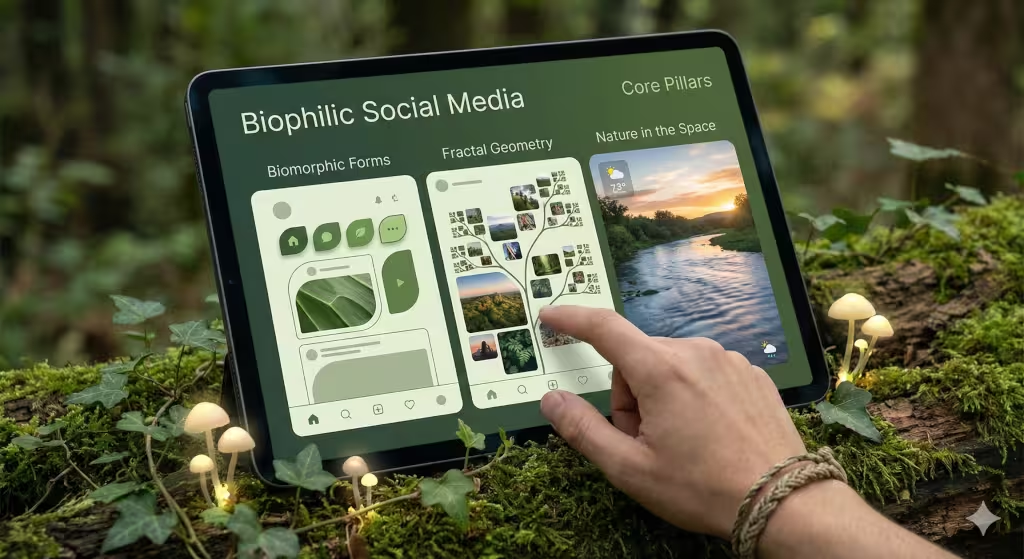
The core of my work at Silphium Design LLC involves translating the complex laws of biology into the language of the internet. When we discuss the pillars of biophilic social media, we are looking at the skeleton of the user experience. These pillars are the rules that keep a digital space from feeling like a cold, gray machine.
In nature, there is no such thing as a perfect vacuum or a perfectly empty space. Everything is connected. To build biophilic social media, we must look at how nature builds itself.
1. Biomorphic Forms and Patterns
The first pillar is all about shapes. If you look at a modern social media app, it is full of rectangles and sharp corners. In the natural world, these shapes are very rare. Nature prefers curves. Think about the shape of a river, a bird’s egg, or the petals of a flower. These are called biomorphic forms.
When we use biomorphic forms in biophilic social media, we change how the user feels. We replace square buttons with soft, pebble-shaped buttons. Instead of a grid that looks like a brick wall, we use a layout that flows like a vine. This reduces the visual stress on your brain. Your eyes do not have to “work” as hard to process organic shapes as they do for sharp, artificial ones.
2. Fractal Geometry and Complexity
Fractals are patterns that repeat at different scales. You can see this in a tree. The big trunk splits into branches, and those branches split into smaller twigs. The pattern is the same, just at different sizes. Humans find fractals very beautiful and calming.+1
In biophilic social media, we can use fractals in the layout of the feed. Most feeds are a straight line of boxes. A biophilic social media feed might have one large “parent” post followed by smaller “child” posts that mimic the branch of a tree. This creates a sense of “ordered complexity.” It gives your brain something interesting to look at without making it feel overwhelmed. It feels like a natural system rather than a computer list.
3. Nature in the Space: Direct Experience
This pillar is about bringing the actual elements of nature into the digital interface. We want the user to feel like the app is part of their real world. One way to do this in biophilic social media is through dynamic content.
Imagine an app that changes its lighting based on where you live. If it is morning in Boston, the app has a bright, golden glow. If it is evening in Vermont, the app turns deep purple and orange. This is called “Nature in the Space.” It helps your body stay in sync with the real world. It stops the app from feeling like a disconnected “black hole” of light.
Expert Note: Direct experience of nature in a digital space can lower blood pressure and improve mood in as little as forty seconds of viewing.
4. Biophilic Motion and Physics
Most apps move in a way that is very robotic. Screens snap into place or slide at a constant speed. This is not how things move in the forest. In the forest, things have weight and momentum. Leaves sway in the wind. Water ripples and then settles.
Biophilic social media uses natural motion. When you swipe a card on the screen, it should feel like you are moving a physical object. It should have a gentle “bounce” or a soft fade. This kind of motion is predictable to our lizard brains. It does not startle us. By making the movement of biophilic social media match the movement of the physical world, we make the digital experience feel safe and comfortable.
5. Prospect and Refuge
This is a very old human need. Humans feel best when they have a clear view of what is coming (prospect) and a safe place to sit (refuge). In ancient times, this meant sitting in a cave while looking out over a valley.
In biophilic social media, we create prospect by giving the user a clear navigation menu and a way to see what is happening in the whole community. We create refuge by giving the user private folders or “zen modes.” These are places where the user can go to read or write without being distracted by notifications or ads. It gives the user a sense of control over their digital habitat.
6. Non-Visual Connections
Biophilic social media is not just about what you see. It is also about what you hear and feel. Most phone vibrations are short and buzzy. This can make you feel anxious. A biophilic social media app might use a soft haptic pulse that feels like a heartbeat.
The sounds should also be natural. Instead of a high-pitched “ding” for a new message, the app could use the sound of a soft wooden block or a bird call. These sounds provide information without triggering a stress response. It makes the biophilic social media experience much more peaceful for the person using it.
Comparison of Design Styles
| Feature | Standard Social Media | Biophilic Social Media |
| Shapes | Sharp squares and rectangles | Soft curves and organic forms |
| Motion | Snappy and robotic | Fluid and weight-based |
| Colors | High-contrast neon or flat white | Earthy tones and circadian shifts |
| Sound | Machine beeps and buzzes | Natural textures and soft tones |
| Layout | Rigid and repetitive grids | Fractal and rhythmic patterns |
By focusing on these pillars, we can build biophilic social media that respects the human body. We stop treating the user like a data point and start treating them like a living creature. This is the goal of every project we take on at Silphium Design LLC. We want to make the digital world as healthy as the natural one.
Psychological and Physiological Impact: Why it Matters
Why should we care about biophilic social media? Because your body reacts to pixels the same way it reacts to physical spaces. There is a theory called Attention Restoration Theory. It says that we have two types of attention. One is “directed attention,” which we use for work and math. This gets tired quickly. The other is “soft fascination,” which happens when we look at clouds or trees.
Biophilic social media uses soft fascination to help your brain recover. When you see natural colors and patterns on your screen, your prefrontal cortex gets a break. This can actually help you focus better on your work later. It turns social media from a distraction into a tool for recovery.
We also have to talk about your internal clock. This is called your circadian rhythm. Most screens blast you with blue light, which tells your brain it is noon, even if it is midnight. Biophilic social media uses circadian lighting. This means the app automatically shifts to warm, amber tones as the sun goes down. It helps your body produce melatonin so you can sleep better.
Using earthy colors like moss green, sandy brown, and soft sky blue also helps. These colors are known to lower heart rates. When an app uses these instead of “alert red” or “electric blue,” your nervous system stays calm. You can stay informed about your friends without feeling like you are in a state of emergency.
Common Questions About Digital Nature in Biophilic Social Media
Many people ask how biophilic social media design affects how we talk to each other. When we are in a stressful environment, we tend to be more aggressive. This is why comment sections can be so mean. If the “room” we are in feels like a peaceful garden, we are more likely to be kind. This is called “Social Biophilia.” It’s about building digital communities that act like healthy ecosystems.
Another common question is about the 14 patterns of biophilic design. These were originally made for buildings by a group called Terrapin Bright Green. We are now taking those 14 rules and applying them to code. For example, “Non-Rhythmic Sensory Stimuli” in a forest might be a bird chirping. In an app, it might be a subtle, random change in a background texture that keeps the screen from looking “dead.”
People also wonder if digital nature is “real” enough to help. Research from places like Harvard and the University of Melbourne shows that even looking at a picture of nature helps. While it is always better to go outside, biophilic social media provides a “micro-break.” It is much better for your mental health than looking at a flat, white screen.
Implementation: How to Design a Biophilic Social Feed
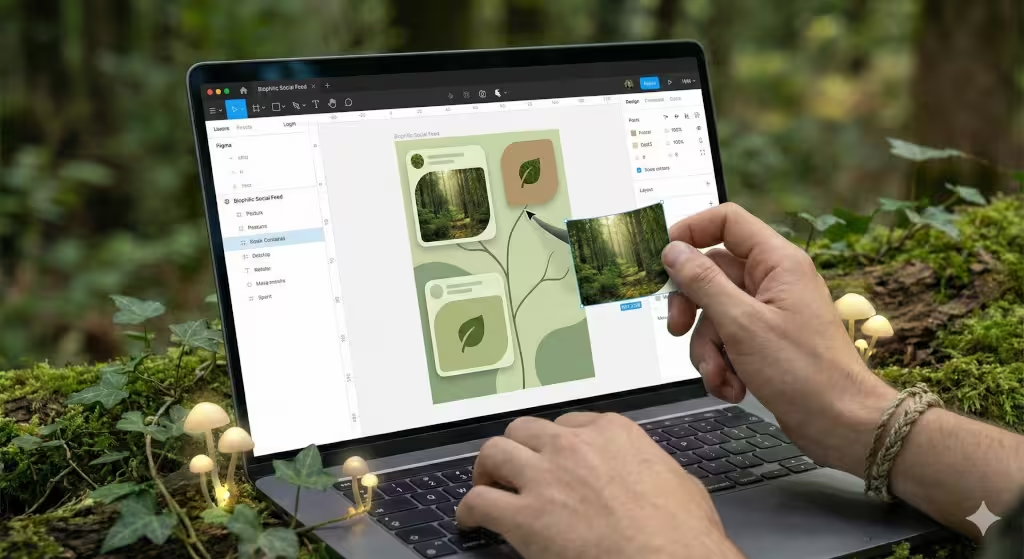
If you are building a biophilic social media platform, you start with the colors. You stay away from colors that don’t exist in the wild. You look at rocks, plants, and soil for your palette. This creates a grounded feeling.
Next, you look at the text. Most computer fonts are very stiff. For biophilic social media, we choose fonts that look like they were made by a human hand. These are called humanist fonts. They have slight variations in the lines that make them easier on the eyes.
Sound is the part everyone forgets. Most phone sounds are “beeps” and “dings.” These are machine sounds that trigger a “fight or flight” response. In a biophilic social media environment, a notification might sound like a single drop of water falling into a pool. It might sound like a soft wooden chime. These sounds give you the information you need without scaring your nervous system.
We also avoid “infinite scrolling” that never ends. In nature, everything has a season and a limit. A biophilic social media feed might have natural “breaks” where the user is encouraged to take a breath or look away from the screen for a moment. This makes the experience feel more like a conversation and less like a treadmill.
The ROI of Nature: Business and SEO Benefits
You might think that making an app calming would be bad for business. If people aren’t “addicted,” do they still use it? The answer is yes. This is the ROI (Return on Investment) of nature. When users feel good while using a platform, they develop a deeper loyalty to it. This is better than “addiction.” It is a healthy relationship.
In terms of biophilic social media and SEO, search engines are getting smarter. They now look at how long people stay on a page and how much they interact with it. If a website is beautiful and easy to look at, people stay longer. This tells Google that the site is high quality.
Also, using biophilic social media design helps with brand differentiation. Right now, every app looks like a copy of every other app. If your brand uses organic textures and natural patterns, you stand out immediately. People will remember how your site made them feel. In a world of loud, bright ads, the quiet, natural site wins the user’s trust.
Future Trends: AI and the Living Interface
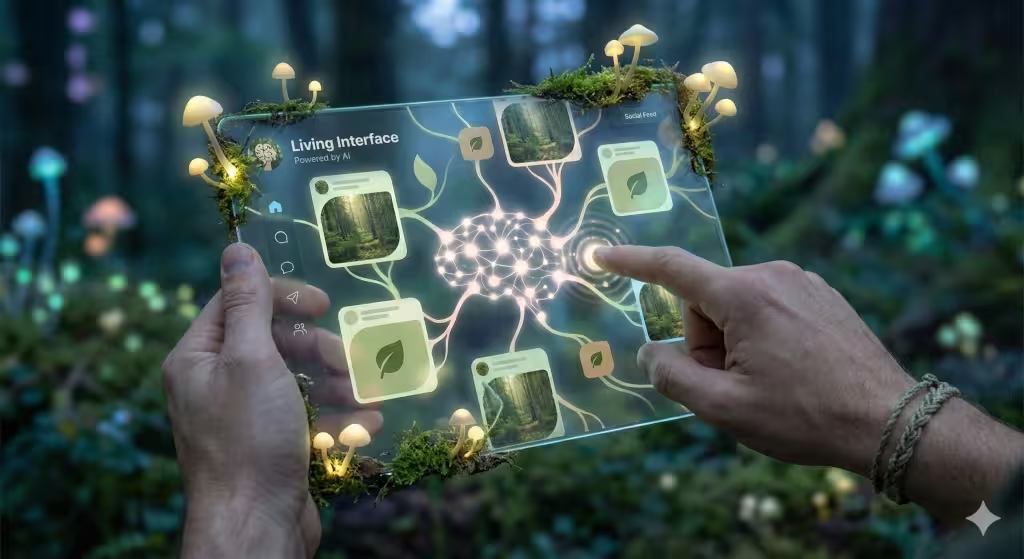
The future of biophilic social media is very exciting. We are starting to use AI (Artificial Intelligence) to create “living” interfaces. Instead of having a static background, an AI can generate a unique natural pattern for you every day. No two people will have the exact same screen. This mimics how no two trees in a forest are exactly alike.
We are also looking at “Generative Biophilia.” This means the app grows and changes the more you use it. If you post a lot of positive content, maybe your digital “garden” becomes more lush. This gives people a visual way to see the impact of their social interactions.
Finally, biophilic social media is tied to sustainable design. Apps that use darker, natural colors often use less battery power on OLED screens. By designing for the human spirit, we are often also designing for the planet. We are moving toward a world where our digital lives and our physical lives exist in harmony.
From Feed to Forest
Biophilic social media is not just a trend. It is a way to fix the broken relationship we have with our devices. We don’t have to choose between being connected to the world and being healthy. By using the rules of nature to build our digital spaces, we can create a web that heals rather than hurts.
At Silphium Design LLC, we believe the future of the internet should look more like a park and less like a factory. We are here to help you turn your digital presence into a living, breathing ecosystem.