
Imagine a forest. It is a complex system with billions of parts, yet it produces zero waste. Every leaf that falls feeds the soil. Every burst of sunlight is captured and turned into energy. Now, imagine the internet. It is also a complex system, but it is far from efficient. In fact, the digital world is a massive polluter. The internet emits about 1.6 billion tons of greenhouse gases every year. That is roughly the same amount as the entire airline industry. We have built a digital world that is hungry for power and creates a lot of waste. But there is a solution waiting for us, and it has been in development for 3.8 billion years.
This solution is called biomimicry. It is not just about making things look like nature, which is called biophilic design. Biomimicry is about copying how nature works. It is functional imitation. It asks, “How would nature build a website?” Nature does not waste energy. Nature adapts to change instantly. Nature is resilient. By exploring biomimicry for sustainable web design, we are not just trying to save the planet. We are trying to build websites that are faster, stronger, and smarter. We are looking at the “source code” of life itself to fix our broken digital systems.
In this article, we will closely examine how we can use nature’s genius of biomimicry to revolutionize the web. We will look at how a lotus leaf can teach us to write cleaner code. Then will look at how slime molds can help us route data better. Then we will explore how forests manage energy and how we can do the same for our servers. This is not just theory. It is a practical guide to the next stage of digital evolution.
Table of Contents
The Core Principles: Life’s Operating System
To understand how to apply biomimicry to the web, we first need to understand the rules that nature plays by. The group Biomimicry 3.8, led by Janine Benyus, has identified a set of “Life’s Principles.” These are the design lessons that every surviving species on Earth follows. If a species breaks these rules, it goes extinct. In the digital world, websites that break these rules become slow, buggy, and eventually obsolete.
Be Resource Efficient
Nature uses only what it needs. You will never see a tree grow leaves in a dark cave because that would be a waste of energy. In web design, being resource efficient means we must stop sending huge files to devices that do not need them. It means using “minified” code. This is where we remove all the extra spaces and comments from our CSS and JavaScript files. It makes the file smaller and faster to download. It is like packing a suitcase perfectly so you do not have to pay for extra luggage. Every byte we save is less energy used by the server and the user’s phone.
Evolve to Survive
The environment is always changing. Animals that cannot adapt die out. The internet changes just as fast. New phones come out, screen sizes change, and internet speeds vary. A website must “evolve to survive.” This is the definition of responsive design. A responsive website changes its layout based on the screen size, just like an octopus changes its color to match its background. We also need adaptive algorithms. These are pieces of code that can change how they work based on what the user is doing. If the user has a slow connection, the site should automatically serve lower-quality images to keep the experience smooth.
Integrate the Unexpected
Nature is full of surprises. Fires, floods, and diseases happen. A healthy forest recovers from a fire because it is resilient. It integrates the unexpected. Our websites are often fragile. If one thing goes wrong, the whole site crashes. We need to build “resilient” systems. This means using good error handling. If a database fails, the website should not show a blank white screen. It should show a friendly message and maybe some cached content. It should “fail gracefully,” just like a tree bending in the wind instead of breaking.
Structural Biomimicry: Form Follows Function in UI/UX
When we look at the shapes and structures in nature, we see that form always follows function. Nothing is beautiful just for the sake of it. It is beautiful because it works. We can apply this structural biomimicry to how we build the user interface (UI) and user experience (UX) of our websites.
The Lotus Effect (Self-Cleaning)
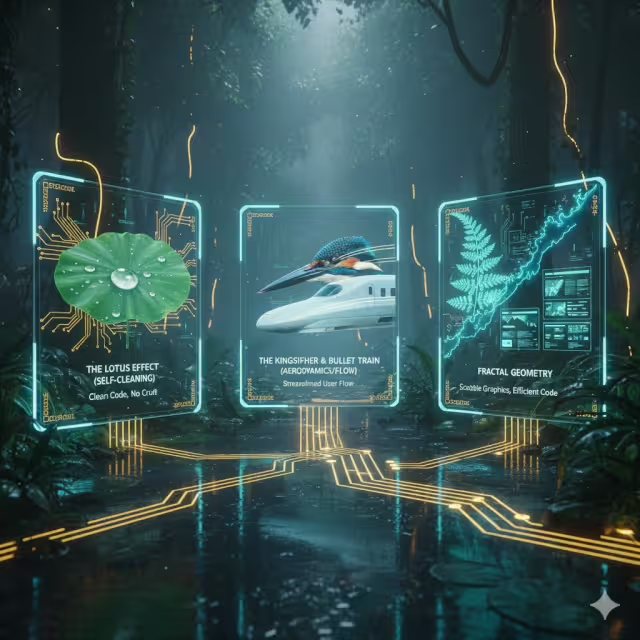
Have you ever seen a lotus leaf? It grows in muddy water, yet it is always spotless. This is because of the “Lotus Effect.” The surface of the leaf has tiny bumps that prevent dirt and water from sticking. Water just rolls off, taking the dirt with it.
We can apply this concept of biomimicry to our code. Over time, websites gather “cruft.” This is old code that is no longer used, like styles for a holiday sale that ended three years ago. This bloat slows everything down. We need code architectures that are “self-cleaning.” In programming languages like JavaScript, we have something called “garbage collection.” This is an automatic process that clears out memory that is no longer being used.
But we can go further. We should design our CSS (the code that controls how a site looks) to be modular. If we remove a button from the site, the code for that button should fall away easily, just like dirt off a lotus leaf. We should not let “mud” stick to our digital products.
The Kingfisher & The Bullet Train (Aerodynamics/Flow)
One of the most famous examples of biomimicry is the Shinkansen bullet train in Japan. The train was so fast that it created a loud boom when it exited tunnels. The engineer looked at the Kingfisher bird. The Kingfisher can dive into water without making a splash because of the shape of its beak. The engineer redesigned the train’s nose to look like the bird’s beak. It became quieter and 10% more energy efficient.
In web design, our “air” is user attention and bandwidth. We want users to move through our site without “friction” or “drag.” If a user has to click five times to buy a product, that is a lot of drag. It creates “splash” and noise. By streamlining the User Flow (UX), we make the experience aerodynamic. We remove unnecessary steps. Fewer clicks mean fewer requests to the server. This saves energy. A smooth, aerodynamic user flow is not just better for the user; it is better for the planet because it uses less processing power.
Fractal Geometry
Nature loves fractals. You see them in ferns, coastlines, and snowflakes. A fractal is a pattern that repeats itself at different scales. It is a way to create complex shapes with very little information.
We can use fractal geometry to solve the problem of heavy images. Images are the heaviest part of most websites. They take up the most bandwidth. Instead of using big grids of pixels (like a JPEG), we can use Scalable Vector Graphics (SVGs). SVGs use math to describe shapes. Because they are based on math, like fractals, they can be scaled up to the size of a billboard or down to the size of a watch face without losing quality. They are tiny files compared to photos. Using fractal-based compression and vector graphics is a perfect example of using biomimicry to reduce our digital footprint.
Algorithmic Biomimicry: The Heavy Lifting
Now we get into the deep technical side. Biomimicry is not just about shapes; it is about processes. Nature processes information in incredible ways. Animals and plants solve complex math problems every day just to survive. We can copy these algorithms to make our servers and networks run better.
Swarm Intelligence (Server Load Balancing)
Ants and bees are smart. But a single ant is not very smart. The intelligence comes from the colony working together. This is called “Swarm Intelligence.” When ants find food, they lay down a chemical trail called a pheromone. Other ants follow it. If the food is good, the trail gets stronger. If the food runs out, the trail fades.
We use this exact logic for “Server Load Balancing” using Ant Colony Optimization (ACO). Imagine a website like Amazon on Black Friday. Millions of people are trying to visit at once. If they all go to one server, it will crash. We need to distribute the traffic. We can use ACO algorithms to treat data packets like ants. The servers are the food sources. The algorithm sends “ant” packets to find the fastest server.
When a server responds quickly, it gets a stronger “digital pheromone.” The system then sends more traffic to that fast server. If a server gets bogged down, the “pheromone” fades, and traffic is routed somewhere else. This prevents crashes and ensures that no single server wastes energy while others sit idle and is a form of biomimicry.
The Slime Mold Network (Routing Efficiency)
Slime mold is a strange organism. It is just a yellow blob, but it is a genius at engineering. Japanese researchers once put slime mold in a maze. They placed food at the entrance and exit. The slime mold grew to connect the two points using the shortest possible path. In another experiment, they placed food on a map of Tokyo at the locations of major subway stations. The slime mold grew a network of tubes to connect the food. The network it created was almost identical to the actual Tokyo subway system, which took engineers years to design.
We can use this for Content Delivery Networks (CDNs). A CDN is a network of servers around the world that deliver web content to you. We want to find the fastest path (lowest latency) to get a video from a server in London to a user in New York. By applying “Slime Mold” algorithms, we can find the path of least resistance. The algorithm “grows” routes and strengthens the ones that are fast, while letting the slow routes die off. This type of biomimicry helps us build a internet that flows as naturally as a living organism.
Energy Efficiency: The “Hibernation” Protocols
Energy is the currency of nature. Nothing is wasted. When resources are low, nature shuts down. We need to teach our websites to do the same. Currently, most websites are “always on,” running at full power even when no one is looking at them.
Dormancy & Hibernation
Bears hibernate in the winter. Deciduous trees drop their leaves and go dormant to save energy when the sun is weak. This is a survival strategy. Our websites should have a “dormancy” mode, another form of biomimicry.
One way to do this is “Lazy Loading.” Imagine a long webpage with 100 photos. Usually, the browser loads all 100 photos as soon as you open the page. This wastes a ton of data if you only look at the top of the page. With Lazy Loading, the images further down the page are “dormant.” They do not load until you scroll down to them. They “wake up” only when needed.
Another strategy is “Dark Mode.” On modern OLED screens, a black pixel is actually turned off. It uses zero energy. A white pixel uses the most energy. By designing websites with a Dark Mode option, we are mimicking the energy-saving darkness of a cave or the deep ocean. It reduces the battery drain on the user’s device, which means they have to charge it less often.
Trophic Cascades
In nature, every animal is connected. If you remove a top predator, like a wolf, it changes the whole ecosystem. This is called a “Trophic Cascade.” Sometimes, removing one thing can make the whole system healthier.
In web design, the “predators” that eat up our performance are third-party scripts, thereby using biomimicry. These are the trackers, ads, and chat bots that we plug into our sites. They are heavy and slow. They eat up the user’s battery and data. By removing these heavy scripts, we improve the health of the entire website. The page loads faster, the Google ranking goes up, and the user is happier. We need to look at our websites as ecosystems and ask, “What invasive species are destroying this environment?” removing them restores the natural balance of speed and efficiency, showing another form of biomimicry.
Case Studies: Who is Doing it Right?
It is easy to talk about these ideas, but are people actually doing them? Yes. There is a growing movement of designers exploring biomimicry for sustainable web design.
Example 1: The Solar Protocol
There is a project called the Solar Protocol. It is a network of servers that are powered entirely by solar panels. The website is hosted on these servers. Here is the catch: the website changes based on the weather. If it is a sunny day at the server’s location, the website is high-resolution and fast. If it is cloudy or night time, the website goes into a “low energy” mode. It uses smaller images and simpler code. It mimics the circadian rhythm of nature. It accepts that energy is not infinite. This is a radical act of biomimicry.
Example 2: Generative Design
Designers are now using AI to “grow” website layouts. This is called Generative Design, a form of biomimicry. Instead of a human drawing a box, the human sets the goals: “I need a bridge that can hold 10 tons and uses the least amount of steel.” The computer then runs an “evolutionary algorithm.” It tests thousands of designs, mutating them slightly each time, just like evolution. The bad designs “die,” and the good designs “reproduce.”
The final result often looks like a bone or a tree branch. We are starting to use this for code. AI can write code, test it, and refine it until it finds the most efficient way to perform a task. We are using the process of evolution to write our software.
Your Questions Answered

How does biomimicry apply to web design?
Biomimicry applies to web design by looking at nature’s strategies for efficiency and resilience. It is not about making a site look like a forest (that is biophilia). It is about making the site function like a forest. This means using code that is resource-efficient, architectures that are modular (like cells), and systems that adapt to their environment (responsive design).
What is the difference between biomimicry and biophilia?
This is a common confusion. Biophilia is the “love of life.” Biophilic design is about adding plants, natural light, and nature sounds to a space to make humans feel good. It is about the connection to nature. Biomimicry is about emulation. It is technical. A building that looks like a flower is biophilic. A building that opens and closes its windows to regulate heat like a flower petal is biomimetic. In web design, a green background is biophilic; a self-repairing server algorithm is biomimetic.
Can web design really be sustainable?
Yes, absolutely. The internet uses electricity. If we reduce the amount of data we send, we reduce the amount of electricity needed to send it. This lowers the carbon footprint. A sustainable website is one that is lightweight, loads fast, and runs on servers powered by renewable energy.
What are examples of biomimetic algorithms?
There are many. Genetic Algorithms mimic the process of evolution (selection, mutation, crossover) to solve problems. Neural Networks mimic the structure of the human brain to learn patterns. Ant Colony Optimization mimics ants to solve routing problems. Immune System algorithms mimic how our bodies fight viruses to detect cyber attacks on websites.
The Next Evolutionary Step
We are at a turning point. For the last thirty years, we have built the web like a factory. We prioritized brute force and endless growth. We ignored the waste. But the “industrial” age of the internet is ending. We are moving into the “ecological” age.
Exploring biomimicry for sustainable web design is the key to this future. It offers us a library of solutions that have been tested for billions of years. Nature has already solved the problems of energy, communication, and scale. We just have to be humble enough to read the code. It is time to stop building websites that fight against the constraints of the real world and start building digital ecosystems that thrive within them.