The world of online networking is going through a massive structural shift. For many years, business owners relied on large, centralized platforms to reach their audience. Today, those platforms are changing, and organic reach is dropping to historic lows.
A healthy community needs a stable foundation, much like a living ecosystem needs healthy soil and open space to grow. When we look at Mastodon vs Facebook for small business community building, we are looking at a choice between two completely different digital structures. One is a closed, commercial greenhouse controlled by a single company. The other is an open, natural forest network that you can own and control. This article will analyze both spaces to help you make the right choice for your long-term growth.
Table of Contents
The Social Media Architecture Paradigm Shift
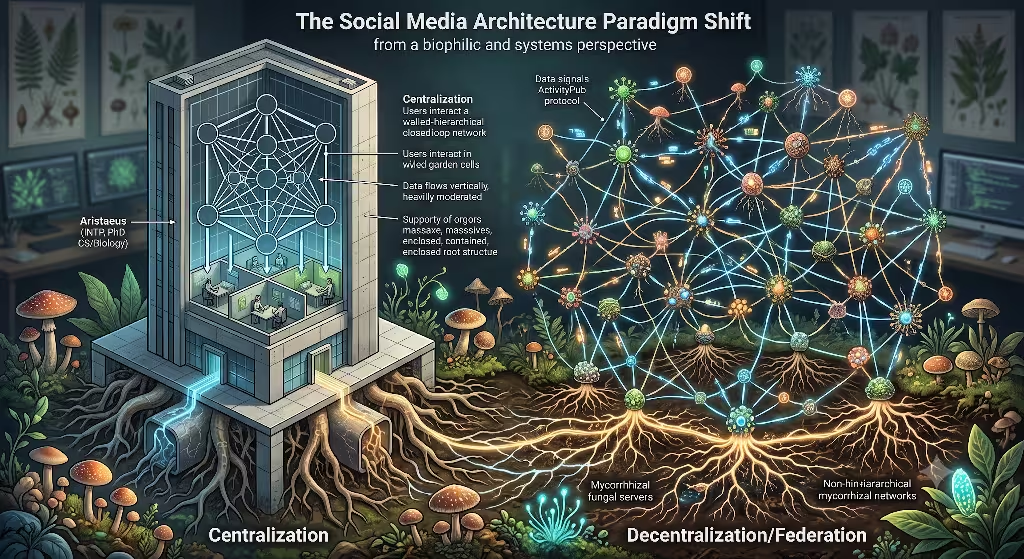
The way companies interact with audiences online has hit a major wall. In the early days of social media, digital marketing was simple. You created a page, people followed it, and those people saw your updates. Today, that simple path is gone. Large, centralized networks have changed their software rules to prioritize paid advertisements over organic posts. This shift has forced a complete rewrite of the rules for small business community building.
To understand why this happened, we must look at how these platforms are built. Centralized platforms are built as closed systems. They want to keep users inside their digital walls for as long as possible. The more time a user spends on the platform, the more ads the platform can show them. This creates a basic conflict of interest between the platform owners and your business goals. You want to build deep, direct relationships with your customers, but the platform wants to charge you a fee just to send a message to the people who already chose to follow your brand.
Because of this conflict, many owners are looking for alternative options. They are discovering federated networks like Mastodon. Mastodon operates on an open protocol called ActivityPub. This means it is not owned by a single corporation. Instead, it is a web of independent servers that can talk to each other. This architectural shift is changing the entire landscape of small business community building. It moves us away from a system where you rent your audience, and moves us toward a system where you actually own your digital relationships.
When you plan your marketing budget, you must consider the stability of your digital channels. If a platform can change its algorithm overnight and cut your visibility by half, that platform is a risk to your operations. True small business community building requires a steady foundation. By looking at how these spaces are built, we can see that the future of online engagement belongs to systems that mimic natural, open ecosystems rather than closed corporate structures.
Systemic Breakdown: Walled Gardens versus Open Ecosystems
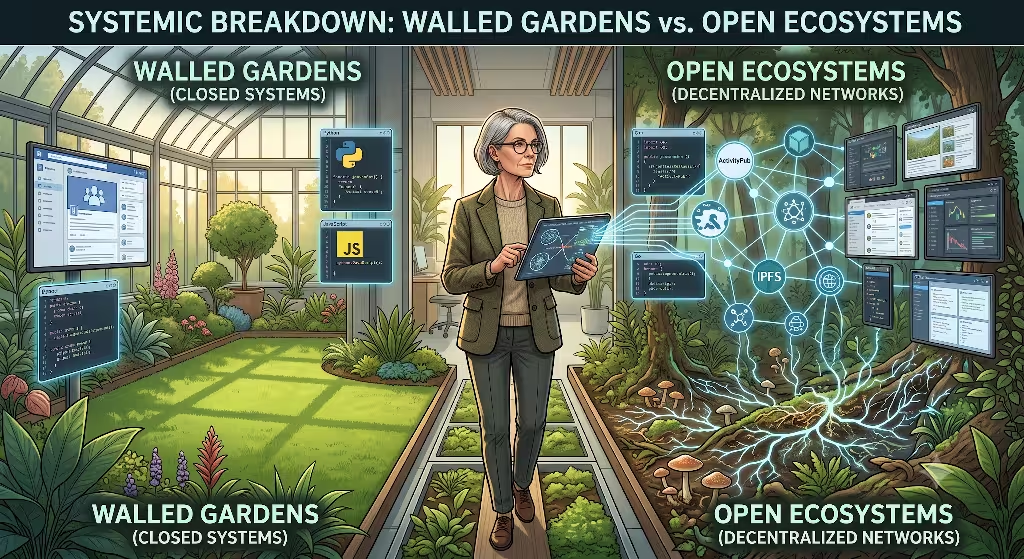
To build a healthy online presence, we have to look closely at the underlying technology of our options. Facebook is what is called a walled garden. It is a completely centralized network. Every piece of data, every user profile, and every interaction lives on servers owned by Meta. When you use a centralized system for small business community building, you must follow their specific code requirements and business rules.
The core business model of a walled garden revolves around data collection and ad placement. The platform tracks what users like, what they click on, and how long they look at a post. Then, it uses that data to sell targeted advertising space. For a small brand, this means your organic content is actively suppressed. The system wants you to buy ads to reach your members. This makes small business community building a very expensive process over time, as you have to keep paying to talk to the same group of people.
Mastodon uses a completely different setup called a federated network. Instead of one massive site, Mastodon is made of thousands of smaller, independent sites called instances. These instances connect to each other using the ActivityPub protocol. Think of it like email. You might use Gmail, and your customer might use Yahoo, but you can still send emails to each other because email uses an open, shared system. Mastodon works the same way. This open setup offers a fresh approach to small business community building because no single entity can change the rules for everyone.
As the diagram shows, a centralized network has a single point of failure and control, while a decentralized network distributes connection points across multiple nodes. In nature, we see decentralized networks everywhere. Take a look at how trees in a forest share nutrients through underground fungal networks. No single tree controls the forest. The forest survives because it is a shared, distributed system. Mastodon brings this biological design principle to the internet.
The biggest advantage of this federated layout for small business community building is data portability. On a centralized site, if your account is closed or the site goes down, you lose your entire customer list. You cannot export your followers from Facebook and move them somewhere else. On Mastodon, you have total ownership of your data. You can export your follower list as a simple file at any time. If you decide to move your community to a different server, or even start your own private server on your own business website domain, your followers can move right along with you. This data portability removes the risk of platform lock-in and gives your brand a permanent digital asset.
Direct Comparison Matrix
When choosing a platform, you need a clear look at how daily operations differ on each system. Small resource pools mean you cannot afford to waste time or money on channels that do not produce results. The table below outlines the core differences that impact small business community building.
| Operational Metric | Facebook Pages and Groups | Mastodon Instances and Nodes |
| Primary Discovery Mechanism | Algorithmic feed injection and paid advertisements | Hashtags, local timelines, and chronological feeds |
| Audience Ownership | None. Your audience is leased from a single corporation | High. Your audience is portable via open data files |
| Data Monetization | User tracking, profiling, and targeted advertising sales | None. Supported by donations, fees, or self-hosting |
| Content Moderation | Centralized, automated systems using Meta policies | Server-specific rules managed by local administrators |
| Technical Overhead | Low. Standard turnkey profile creation | Medium to High. Higher if you host your own node |
Every row in this matrix shows a fundamental trade-off. Facebook gives you low technical hurdles and immediate access to billions of users. However, it takes away your control and forces you to compete with paid ads. Mastodon requires you to learn new technical concepts, but it hands you full ownership of your customer relationships.
For effective small business community building, you must look at how these metrics affect user behavior. When users are on a platform that does not track their data or bombard them with ads, they act differently. They tend to have longer conversations and form deeper connections. This makes the operational style of Mastodon highly valuable for companies that want to build a loyal, dedicated customer base rather than just chasing quick, superficial views.
Small Business Community Building Mechanics and Engagement Dynamics

The way software displays content completely changes how people talk to each other. Facebook uses a complex mathematical system called an attention algorithm. This algorithm decides exactly what appears on a user’s screen. It does not just show posts in the order they were written. Instead, it prioritizes posts that generate a lot of emotional reactions, comments, and shares. For small business community building, this creates a difficult environment. It means your calm, helpful business updates are often hidden beneath loud, sensational posts that grab quick attention.
This attention economy encourages brands to create shallow, click-bait content just to stay visible. It hurts genuine small business community building because it rewards outrage and drama over real value. Furthermore, the organic reach of a standard business page on Facebook is now incredibly low. Most estimates show that less than five percent of your followers will see a non-paid post. This means your community building efforts are constantly throttled unless you dedicate a significant budget to boosting your posts with paid media.
Mastodon throws out the attention algorithm completely. It uses a strict chronological feed. This means your followers see your posts in the exact order you publish them. If you post an update at nine in the morning, it shows up at the top of your followers’ feeds at nine in the morning. This simple change has a huge positive impact on small business community building. It allows you to plan your content delivery reliably, knowing that you do not have to trick an algorithm just to be seen by your audience.
Without an algorithm sorting the feed, discovery on Mastodon relies heavily on the clean use of hashtags and active participation in local server timelines. Users actively search for topics they care about instead of waiting for a machine to feed them content. This intentional interaction means that the people who find your business are actually interested in what you do. It shifts the focus of small business community building from raw numbers to high quality connections.
The software updates in March 2026 brought a clean profile redesign to Mastodon. This redesign gives businesses better ways to display their brand identity, pin important announcements, and present a professional appearance to the network. By removing flashy, distracting ads from the user interface, the profile design keeps the user’s focus entirely on your content and your conversations. This lack of distraction is an important design principle that directly supports successful small business community building by keeping your audience engaged with your brand rather than competing side-ads.
Answers to Common Small Business Community Building Questions
When business operators look at new technology, they always have practical questions about how it works in the real world. Let us address the most common questions that come up when discussing small business community building across these platforms.
Can you run ads on Mastodon for business?
The short answer is no. Mastodon is built to be an ad-free space. There are no corporate tracking pixels, no sponsored posts to buy, and no dashboard where you can bid on user attention. The software is intentionally designed to block traditional tracking ads. For anyone used to standard social media marketing, this can feel like a major problem for small business community building.
However, this lack of ads is actually a massive opportunity. Instead of spending money on paid ad campaigns, you invest your resources into value-first content marketing. You build authority by sharing deep knowledge, answering questions, and being a helpful member of the network. You can also host your own server for your specific industry niche. By providing a clean, well-moderated space for your industry, your business becomes the trusted hub of that community. This creates far more brand loyalty than a standard pop-up ad ever could.
Is Mastodon good for small businesses?
Yes, Mastodon is excellent for small business community building, but it depends heavily on your specific business model and your target audience. If your company sells specialized products, offers professional B2B services, or values deep consumer trust, Mastodon is a great fit. It is a fantastic environment for establishing expertise and building a long-term, highly dedicated customer base.
If your business relies on high-volume, impulse purchases from a mass-market audience, you will find Mastodon more challenging. It requires a slower, more personal approach to customer acquisition. Successful small business community building on this platform demands that you show up as a real person to solve real problems, rather than just broadcasting generic sales pitches into the void.
What are the disadvantages of Mastodon for business?
The first major disadvantage is discovery fragmentation. Because there is no single, centralized directory of every user, finding people takes more effort. Users are spread out across thousands of separate servers. This means you cannot just run a single search to find every potential customer in your area. It requires you to learn how to navigate different instances and use tools like federated hashtags to find relevant conversations.
The second big disadvantage is the complete lack of built-in analytics tracking. Mastodon does not give you charts showing impressions, link click rates, or demographic data of your viewers. For data-driven small business community building, this can feel like driving in the dark. To measure your success, you have to look at clear, real-world metrics. You must track things like direct replies, manual profile boosts, and the traffic coming to your website using private, secure analytics tools. It requires more manual work and a deeper commitment to direct human interaction.
How does Mastodon compare to Facebook Groups for community retention?
Facebook Groups are a popular tool for small business community building because they offer a dedicated space for conversations. However, they suffer from constant external noise. When your customers are inside a Facebook Group, the platform is continuously showing them notifications from other groups, personal friends, and paid competitors. This constant distraction pulls attention away from your brand and reduces long-term member retention.
Mastodon nodes provide a clean, quiet environment with zero cross-advertising pollution. There are no flashing sidebars or recommended posts trying to steal your customers away. This lack of distraction leads to a much higher signal-to-noise ratio. When people log into a specific Mastodon instance, they are there to read the actual posts on their timeline. This focused environment creates superior long-term retention for small business community building because your messages do not have to fight a sea of unrelated corporate noise to be remembered.
Strategic Decision Framework: Where Should You Plant Your Roots?
Choosing where to focus your marketing energy is a critical business decision. You must look at your resources, your target market, and your long-term goals. Let us look at a simple framework to help you decide which platform best fits your current goals for small business community building.
                       [Analyze Business Goals]
                                  |
         ---------------------------------------------------
        |                                                   |
[Mass Scale & Local Ads Required]             [Niche Expertise & Data Ownership]
        |                                                   |
        v                                                   v
(Deploy on Facebook)                              (Deploy on Mastodon)
  - Hyper-local targeting                           - Direct audience ownership
  - Immediate ad injection                          - Unmediated chronological feed
  - Low technical setup                             - Long-term platform independence
As the framework outline suggests, your choice depends on what your business needs to survive and grow. Neither option is universally perfect. Instead, each serves a completely different marketing strategy.
Deploy on Facebook if your business relies on:
- Hyper-local geographic targeting: If you run a local physical shop, a neighborhood restaurant, or a local home repair service, Facebook’s massive local user base is highly useful. Their ad network lets you drop a pin on a map and show ads directly to people within a two-mile radius of your front door.
- Immediate, short-term scale: If you need to launch a product tomorrow and need thousands of eyes on it immediately, paid ads can buy that attention instantly. It bypasses the slow process of organic growth.
- Mass-market demographics: If your target buyers are everyday consumers who are not highly technical and prefer using familiar, mainstream applications, they are already on Facebook. Meeting them where they already spend their time reduces friction.
Deploy on Mastodon if your business relies on:
- Specialized B2B expertise or niche consultation: If you are an engineer, a specialized designer, a software developer, or a consultant, Mastodon’s highly educated and tech-literate user base is a goldmine. It allows you to engage in deep technical discussions that display your true competence.
- True asset protection and data ownership: If you want to make sure that no outside corporation can ever take away your access to your customer list, Mastodon is the only choice that gives you full data portability.
- Building high-trust, long-term customer circles: If your sales process requires building deep trust over months of conversation, the quiet, ad-free environment of the Fediverse supports that slow, relational selling process perfectly.
By checking your business model against these clear points, you can avoid wasting months of work on the wrong infrastructure. True small business community building means picking the environment where your specific type of business can naturally thrive.
Cultivating Sustainable Digital Ecosystems
When we look closely at the realities of social media today, we see that relying entirely on a single corporate platform is a dangerous strategy. A healthy digital footprint should look like a natural ecosystem. It needs a diverse mix of channels to stay strong and resilient against unexpected changes. For successful small business community building, you should avoid looking at this choice as a strict, all-or-nothing decision.
Instead, the most practical approach for small business community building is a smart hybrid model. You can use the powerful, paid tools of Facebook for quick customer acquisition and wide top-of-funnel reach. Their ad pixel can help you find new leads across your local area efficiently. However, you should not leave those leads inside Facebook’s walled garden where their visibility will be restricted by future algorithm changes.
Instead, look to systematically migrate your core brand champions, your repeat buyers, and your active community members over to an open web space like a dedicated Mastodon instance. By moving your core community to a federated network, you protect your most valuable business relationships from corporate control. You gain the massive benefit of full data portability and a reliable chronological feed.
This hybrid approach gives your company the best of both worlds. It combines the immediate, wide reach of centralized advertising with the deep security and trust of an open, decentralized network. By designing your online presence to mimic the open, connected patterns of natural ecosystems, you ensure that your small business community building efforts will remain stable, profitable, and safe for many years to come.