Table of Contents
The Transposition of Ecology into Information Architecture
The human brain did not evolve to stare at a flat glass screen for ten hours a day. For thousands of generations, our central nervous system grew and adapted inside wild environments. We watched the movement of leaves, followed the patterns of rivers, and shifted our focus with the rising and setting of the sun. This deep, biological connection to nature is called biophilia, which means our natural love for living systems.
Today, we spend most of our waking hours inside digital interfaces. This massive shift has created a silent state of mental fatigue and stress. As a digital designer, I look at our current internet and see a landscape that is mostly cold, artificial, and exhausting. To fix this, we must completely rethink how we build software by turning to biophilic UX architecture.
When we bring ecology into our digital systems, we are doing much more than changing the look of a webpage. We are changing how information is organized on a website, a practice known as information architecture. Instead of treating a website like a rigid plastic box, we can build it to act like a living habitat. True biophilic UX architecture treats the screen as an ecosystem. It uses natural rules to guide how data flows, how menus open, and how users interact with screens. When a website follows these natural rules, it feels immediately comfortable to the human mind. It reduces the effort your brain has to make to understand what it is seeing.
However, a serious problem has emerged as this style grows in popularity. Many design agencies are taking a cheap shortcut known as digital greenwashing. Greenwashing happens when a company makes its product look eco-friendly or natural on the outside without doing any real work on the inside. In the world of web design, this looks like slapping pictures of green leaves onto a slow, heavy webpage. This lazy approach does nothing to help the user’s brain, and it actually hurts the environment by wasting electricity. To build a healthier digital world, we must learn to separate shallow decoration from true biophilic UX architecture.
The main conflict comes down to a choice between surface style and deep structure. A greenwashed website uses nature as a marketing trick to get you to buy something or stay on a page longer. On the other hand, authentic biophilic UX architecture uses the science of nature to make a website work better for your eyes and mind. It changes how the code runs, how the servers process information, and how the visuals respond to your touch.
As digital spaces become our primary environments, understanding the gap between true biophilic UX architecture and greenwashing is no longer just a choice for designers. It is a necessary step for anyone who wants to build an honest, calm, and sustainable web.
We need to understand why our brains crave these patterns. When you walk through a forest, your eyes process thousands of tiny movements and shapes without getting tired. This happens because nature uses repeating structures that our visual systems can read with very little effort. When we apply these exact structures to software through biophilic UX architecture, we are working with human biology instead of against it. We can design interfaces that lower a user’s heart rate, clear up mental fog, and help people finish their online tasks without feeling drained.
To achieve this, we have to look past the superficial trends of the design industry. We cannot just paint the internet green and call it a day. We must look at the data, the code, and the underlying server metrics. If a platform claims to be inspired by nature but uses massive, unoptimized files that drain your phone battery, it is participating in greenwashing. True biophilic UX architecture relies on clean code, fast loading speeds, and structural shapes that mimic the living world. By exploring the deep mechanics of natural systems, we can create digital habitats that are genuinely healthy for both people and the planet.
Foundational Mechanics: What is Biophilic UX Architecture?

To understand how authentic biophilic UX architecture works, we have to look at systemic information architecture. This term describes how data is arranged, labeled, and connected across a web platform. In a typical website, information is often forced into stiff grids and confusing, deep menus that feel completely unnatural. A system built on biophilic UX architecture organizes information the same way a tree organizes its branches or a river systems branches into smaller streams. It uses a clear, organic hierarchy where big concepts naturally divide into smaller, logical sub-points. This layout allows the human mind to predict where information will be before they even click a button.
A major part of this structural framework relies on fractals. Fractals are complex mathematical shapes where each small part looks exactly like the whole shape, no matter how much you zoom in or zoom out. Think of a single fern leaf, where each tiny leaflet looks like a miniature version of the entire branch. Our eyes can scan these patterns with incredible ease. When we integrate fractals into biophilic UX architecture, we design layouts that use nested, self-similar structures.
For example, the main navigation menu matches the shape of the side menu, which matches the shape of the content cards on the page. Research shows that when human eyes view fractal patterns, our stress levels can drop by up to 60% because our brains do not have to struggle to interpret the shapes.
Another critical pillar of biophilic UX architecture is the use of circadian UI patterns. The word circadian refers to the natural 24-hour cycle of our bodies, often called the internal clock. A standard interface stays exactly the same whether you open it at 8:00 AM or 11:00 PM, blasting your eyes with harsh blue light late at night.
An interface built with biophilic UX architecture changes dynamically throughout the day. It reads the user’s local solar position and smoothly alters its layout. In the morning, it provides crisp contrast and cool light to match the sun. As night falls, it automatically shifts to warmer tones, drops the brightness, and reduces contrast. This respects your biological sleep cycles and protects your eyes from strain.
We also have to think about how objects move across our screens. Most modern software uses linear, robotic animations where elements pop into view or slide across the screen at a perfectly constant speed. This looks unnatural because nothing in the physical world moves that way. True biophilic UX architecture uses organic motion and fluid affordances, which are visual clues that tell you how an object works.
Animations in this system are guided by physics models that include gravity, inertia, and friction. When you swipe a menu out of the way, it slows down gently, like a swinging tree branch coming to rest. If you bounce a card against the edge of the screen, it reacts with a soft, liquid bounce rather than a hard, metallic stop.
By combining fractal layouts, circadian light shifts, and organic physics animations, biophilic UX architecture creates a unified digital ecosystem. It removes the jarring friction that makes modern apps feel so frustrating to use. Instead of fighting for your attention with bright, flashing boxes, it invites your eyes to glide across information naturally. This level of care requires deep collaboration between biological science and computer science. You cannot build true biophilic UX architecture by guessing or by following a visual trend. It requires a firm understanding of human perception and a commitment to writing clean, smart code that serves our ancient biological needs.
When these natural mechanics are missing, users experience cognitive fatigue, which is the mental exhaustion that comes from processing poorly organized data. When a website relies on biophilic UX architecture, it actively prevents this exhaustion. It creates an environment where users can focus deeper, remember information better, and feel a sense of calm. As digital tools continue to take over our lives, the demand for this style of design will grow. Web creators must move beyond basic layouts and start building complex, adaptive systems that mirror the balance, beauty, and efficiency of the physical earth.
The Superficial Veneer: How Do You Spot Greenwashing in Digital Design?
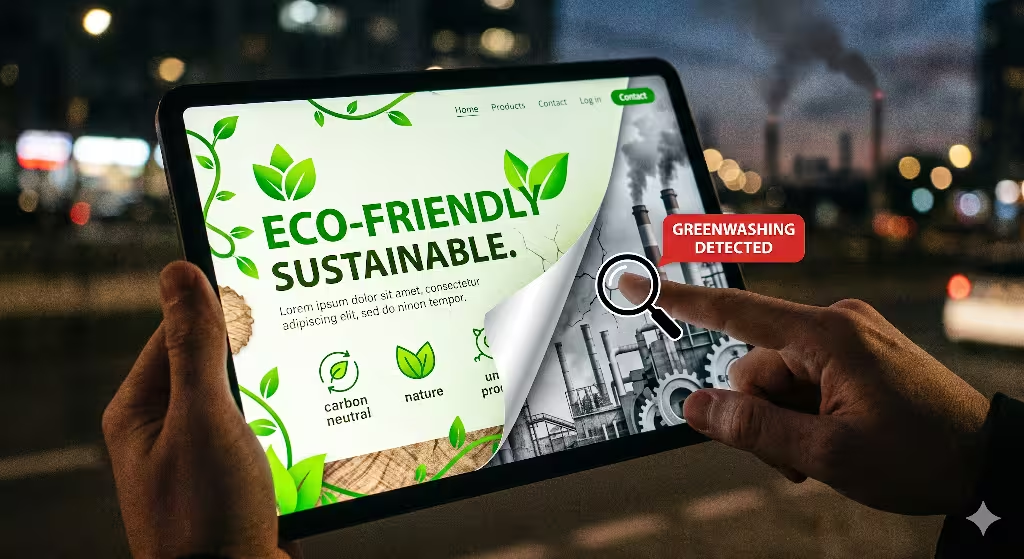
Digital greenwashing is the practice of using superficial nature themes to hide messy, wasteful, and energy-consuming technology. It is a form of design trickery that aims to make a user feel calm and eco-conscious while completely ignoring the real impact of the software. Many companies use these tricks because it is much easier to buy a stock photo of a rainforest than it is to optimize their software code. When a website relies on greenwashing instead of true biophilic UX architecture, it treats nature as a costume. It tries to trick your brain into thinking a platform is healthy and gentle, even if the underlying system is slow, distracting, and badly built.
You can spot a greenwashed interface by looking at the relationship between its visual assets and its overall weight. A classic sign of digital greenwashing is a homepage covered in heavy, unoptimized, high-resolution videos of wind turbines or green fields. These massive files take an immense amount of energy to send across the internet from the server to your device. While the company claims to love the planet, their bloated website is actively burning through extra electricity and running up carbon emissions. Authentic biophilic UX architecture does not need to show you a literal picture of a tree to feel natural. Instead, it builds the structure of the tree directly into the system code.
Another common trick is what I call the green hex illusion. This happens when a design team updates a product by swapping out its brand colors for earthy tones like sage green, forest green, or warm clay brown. They keep their stressful pop-up ads, their tracking cookies, and their confusing navigation menus exactly the same, but they wrap them in a soothing color palette. This is a clear example of greenwashing masking as biophilic UX architecture. Changing a color code in a CSS stylesheet takes five seconds, but it does absolutely nothing to fix the cognitive load or the mechanical friction that drains a user’s mental energy.
/* An example of the Green Hex Illusion: Natural colors hiding messy, unoptimized code */
.greenwashed-button {
  background-color: #2E7D32; /* Soothing forest green */
  font-family: 'Organic-Sans', sans-serif;
  transition: none; /* Jarring, instant movement */
  padding: 50px; /* Excessive, unoptimized spacing */
}
We also have to look closely at the modern AI and compute paradox. Today, many apps feature wellness tracking or environmental calculators that claim to help you live a mindful, eco-friendly life. They use soft animations and gentle language to appear aligned with biophilic UX architecture. However, behind the scenes, these features often run heavy predictive algorithms or generative AI models that consume 30 to 40 times more server energy than simple, traditional code. This is the ultimate form of greenwashing. The app tells you to take a deep breath and connect with nature, while its distant servers are consuming massive amounts of water and electricity to keep those heavy algorithms running.
To uncover digital greenwashing, you must look past the visual skin of the application. You must ask questions about how the app behaves and how it was built. Does the website load instantly, or does it make your device get hot in your hand? Do the menus move with the soft grace of a physical object, or do they snap into place like a broken machine? If a platform looks like a garden but acts like a chaotic factory, it is not an example of biophilic UX architecture. It is simply greenwashing designed to make you lower your guard while the system extracts your time, your attention, and your device’s battery life.
As users become more aware of these tactics, greenwashed sites will start to lose their appeal. People can instinctively feel when an interface is dishonest. When a site uses fake natural themes to cover up bad functionality, it leaves the user feeling frustrated and manipulated. True biophilic UX architecture requires absolute honesty between the front-end design and the back-end infrastructure. It rejects the idea that nature is just a visual theme. By focusing on deep efficiency and true biological harmony, real biophilic design helps us build a digital space that looks honest, feels honest, and respects the user’s intelligence.
Comparative Analysis: Sustainable UX vs. Greenwashing
When we compare authentic biophilic UX architecture against digital greenwashing, the biggest difference lies in structural efficiency over aesthetic posturing. Aesthetic posturing means making something look beautiful or responsible on the surface without changing how it works underneath. A sustainable user experience looks at every line of code, every database call, and every image asset as a part of a larger, physical system that consumes real-world resources. Greenwashing looks at design as a marketing tool to improve a brand’s reputation. True biophilic UX architecture connects deep sustainability with human biology, proving that clean technology and natural comfort are the exact same thing.
To make this clear, we can look at how these two approaches handle digital assets like graphics and fonts. A greenwashed website will often load giant bitmap images or heavy video files to create a natural atmosphere. These files can easily push a webpage’s weight up to 5MB or 10MB, requiring massive amounts of data transfer. In contrast, a platform rooted in biophilic UX architecture uses lightweight vector scripts, CSS canvas animations, and clever SVG graphics. Instead of downloading a massive photo of a leaf, the browser uses a tiny snippet of code to draw an organic shape directly on your screen. This keeps the page light, fast, and highly efficient.
| Design Element | Digital Greenwashing | Authentic Biophilic UX Architecture |
| Visual Assets | Heavy, unoptimized photos and videos of nature | Lightweight vector lines, code-based canvas shapes, and SVGs |
| Server Choice | Standard cloud hosting powered by fossil fuels | Localized edge networks powered by renewable microgrids |
| Interface Action | Flashing notifications and pop-ups that steal attention | Quiet layouts that help you finish your task quickly |
| Color Strategy | Randomly using green hex codes as a visual mask | Dynamic circadian color shifts that respond to the sun |
| Code Efficiency | Messy, redundant frameworks that waste server power | Clean, minimized code written to lower CPU processing time |
The contrast becomes even clearer when we look at data infrastructure. Greenwashed websites are usually hosted on cheap, standard data centers that run around the clock on electricity from fossil fuels like coal or gas. They do not care where their servers are located or how much energy they waste. On the other hand, true biophilic UX architecture is paired with green hosting and edge computing networks. Edge computing means the website’s files are stored on small, local servers close to the user, rather than on one massive server halfway across the world. When these local servers are powered directly by renewable microgrids like solar or wind power, the website’s carbon footprint drops to nearly zero.
We must also compare how these two systems handle human interaction. Greenwashed designs frequently use engagement loops, which are deceptive features meant to hook your attention and keep you scrolling forever. They might use a friendly green theme while using psychological tricks to force you to stay on the page, draining your time and your phone’s battery. Authentic biophilic UX architecture practices respectful design. It creates a lean, quiet task flow that helps you find what you need as quickly as possible. The goal is to reduce your time-on-screen so you can close your device, step outside, and interact with the real world.
/* Clean, natural layout logic using CSS Grid instead of bloated layout frameworks */
.biophilic-grid {
  display: grid;
  grid-template-columns: repeat(auto-fit, minmax(250px, 1fr));
  gap: 2.5rem; /* Balanced, comfortable spacing based on the golden ratio */
  align-items: start;
}
When you look at these two paths side by side, you can see that greenwashing is a lazy, surface-level habit. It takes the visual symbols of the Earth and uses them to create more digital noise, waste, and distraction. True biophilic UX architecture is an engineering practice that respects both human biology and physical resources. It shows that true beauty comes from structural health, clean execution, and minimalist design. By choosing deep efficiency over empty decoration, we can build a web that feels as refreshing and clean as a walk through a healthy ecosystem.
Critical Reality Check: Is Biophilic Design Intrinsically Eco-Friendly?

We need to face an uncomfortable truth about design. Just because an interface feels natural and comforting does not mean it is automatically good for the planet. There is a famous quote from an eco-city planner named Paul Downton that explains this perfectly. He wrote: “The eco-city is, by definition, a biophilic city, but biophilic design is not intrinsically eco-friendly.” This means that while a green city must love nature, simply putting plants or natural shapes onto a building or a website does not stop it from being wasteful. We must apply this exact lesson to digital systems if we want to build true biophilic UX architecture instead of advanced greenwashing.
This brings us to the multi-sensory trade-off in modern web design. To create an immersive, natural experience, a designer might want to add ambient soundscapes, like the soft sound of rain or birds chirping in the background. They might want to use advanced WebGL layers, which are complex code scripts that create moving, 3D liquid textures that ripple when a user moves their mouse. While these features can make a website feel incredibly organic and lower a user’s mental stress, they come with a major technical cost. They require your computer’s graphics card and central processor to work much harder, which immediately drives up the device’s electricity usage.
If a website uses high-bandwidth audio files and heavy 3D rendering scripts, it is harming the environment in order to look natural. This is a very subtle and dangerous form of digital greenwashing. The user feels a sense of peace because of the soft sounds and pretty ripples, but their phone battery is draining twice as fast as normal. True biophilic UX architecture must solve this friction. It requires us to find a balance between sensory-rich features and strict data budgets. We cannot sacrifice the physical health of our planet just to make a screen look more beautiful or relaxing.
The solution to this problem lies in smart, procedural generation. Instead of serving heavy, pre-recorded media files across the internet, a skilled developer can use lightweight code to create these effects locally on the user’s device. For example, instead of a 5MB audio recording of a river, you can use a tiny 10KB Web Audio API script that generates soft, random ambient noise using mathematical waves. Instead of a heavy 3D video texture, you can use a few lines of clean CSS to create a soft, gradient color shift that mimics natural morning light. This is how biophilic UX architecture achieves true environmental sustainability without losing its human benefits.
We must always remember that software does not exist in a vacuum. Every pixel on your screen, every animated transition, and every sound effect requires physical electricity generated by a real-world power plant. If we build rich, heavy natural interfaces without optimizing the underlying code, we are just participating in a prettier version of greenwashing. Authentic biophilic UX architecture demands that we measure our success using hard numbers, like page weight, server response times, and CPU cycles. We must make sure that our love for natural patterns does not end up creating more pollution in the physical world.
By taking this critical reality check seriously, we elevate our design work from a simple artistic style to a serious engineering discipline. We stop treating nature as an endless resource for visual ideas and start treating it as a model of perfect efficiency. Nature never wastes energy; every leaf, root, and branch is optimized to do the maximum amount of work with the fewest possible resources. True biophilic UX architecture adopts this exact law of conservation. When we build software that is both biologically comforting and structurally lightweight, we create a digital world that is genuinely sustainable.
The Implementation Framework: Metrics, WSG, and Certifications
To bring authentic biophilic UX architecture into the real world, we need a clear framework built on clear, measurable metrics. We cannot rely on opinions or artistic feelings to tell us if a website is well-built. In the physical world, architects use strict guidelines like the WELL Building Standard or the Living Building Challenge to prove that a building is healthy for people and safe for the environment. In the digital world, we can translate these physical rules into software development metrics. This allows us to ground our biophilic UX architecture in verifiable facts, leaving absolutely no room for digital greenwashing.
The foundational checklist for this approach starts with the W3C Web Sustainability Guidelines, often called the WSG. These guidelines are an international set of rules designed to help developers lower the environmental impact of digital products. When we apply the WSG to biophilic UX architecture, we commit to keeping our initial page weight under 1MB. Page weight is the total size of all the files required to load a single webpage. If a site goes over this limit because it is loaded with heavy images or messy code libraries, it fails our sustainability test and crosses the line into greenwashing.
Summary of Core Biophilic UX Metrics:
1. Target Initial Page Weight: Less than 1.0 MB
2. Maximum Server Response Time (TTFB): Less than 200 milliseconds
3. Renewable Energy Hosting Score: 100% Verified Green Power
4. Code Efficiency Standard: Zero unused CSS or JavaScript execution
We must also perform regular clean-code audits to keep our platforms running efficiently. Over time, websites tend to accumulate a lot of digital waste, such as old tracking pixels, redundant CSS styles, and unnecessary JavaScript frameworks. This waste forces server processors to work harder and run longer, which wastes electricity. A true biophilic UX architecture workflow requires developers to constantly prune this digital overgrowth, much like a gardener trims dead branches from a bush. By removing unused code, we decrease server compute times and ensure that the platform loads instantly on even the oldest, slowest mobile devices.
Beyond code cleanup, true biophilic UX architecture introduces transparency directly into the user interface. Instead of hiding the website’s environmental impact, we can build clear controls that give users real agency over their data usage. For example, we can include a prominent “low-carbon mode” toggle switch right in the main menu. When a user flips this switch, the website automatically turns off non-essential animations, stops loading ambient graphics, and switches to a high-efficiency text layout. This gives the user direct power over their device’s energy consumption, which is a complete rejection of performative greenwashing.
/* CSS implementation for a user-controlled Low-Carbon Mode */
body.low-carbon-mode * {
  animation: none !important; /* Disables all CPU-heavy motion graphics */
  background-image: none !important; /* Drops heavy background assets */
  color: #111111; /* Forces high-contrast, easy-to-read text */
}
By enforcing strict page weights, following the W3C Web Sustainability Guidelines, and providing clear user controls, we create a trustworthy framework for digital design. We move away from vague promises about eco-friendliness and move toward verifiable technical standards. This disciplined approach ensures that every aspect of our biophilic UX architecture is serving a real purpose. It protects the user from mental fatigue, protects the planet from unnecessary carbon emissions, and sets a high standard for what honest, modern software engineering should look like.
Engineering the Future Digital Landscape
Building the future of the internet requires a complete rejection of shallow design tricks. As we have explored, the differences between authentic biophilic UX architecture and digital greenwashing are deep and structural. Greenwashing tries to soothe your mind with superficial natural decorations while running messy, wasteful systems that damage our physical environment. Authentic biophilic UX architecture is a holistic engineering method. It unites clean code, organic information design, and strict data-efficiency metrics to build digital habitats that respect both human biology and physical resources.
Moving forward, web creators must stop thinking of nature as a simple visual theme or a marketing asset. We must look at the natural world as the ultimate guide for system efficiency and structural balance. When we build websites that use fractal hierarchies, circadian color scales, and physics-based movement, we are creating spaces where human minds can focus and rest. When we pair these human features with lightweight files, edge servers, and renewable energy, we are ensuring that our digital tools do not come at the expense of our living planet. This intersection of biology and computer science is where true innovation happens.
True Biophilic Design Lifecycle:
Clean Code Architecture -> Organic Visual Patterns -> Renewable Server Infrastructure -> Human Mental Relief
We do not need to fear greenwashing accusations if we base our design choices on hard data and open transparency. By measuring our digital products against international sustainability standards and keeping our page weights low, we can prove that our work is genuinely responsible. We can build an internet that is quiet, fast, and remarkably beautiful. True biophilic UX architecture allows us to move past performative statements and start building software that actively supports human health and respects our planetary limits.
The digital landscape does not have to remain a sterile, exhausting source of stress and waste. By adopting a rigorous, scientifically grounded approach to biophilic UX architecture, we can transform our screens into healthy, living ecosystems. As designers, developers, and users, we have the collective power to demand honesty, clarity, and efficiency from our technology. Let us commit to throwing away the superficial veneer of greenwashing and start engineering a digital future that feels as clean, natural, and restorative as the world outside our windows.
Frequently Asked Questions about Biophilic UX Architecture
What is the difference between green design and biophilic design in software?
Green design focuses on reducing the physical resources a website uses, such as lowering page weights, optimizing code, and using servers powered by renewable energy. Biophilic design focuses on the human experience, using natural shapes, fractal patterns, and circadian lighting to reduce mental stress and eye strain. True biophilic UX architecture combines both approaches, creating an interface that is comforting to human biology and highly efficient for the planet.
Can a website be biophilic if it does not use the color green or pictures of plants?
Yes. Authentic biophilic design is about structure, movement, and system logic, not surface decoration. A website can achieve a beautiful natural balance by using nested fractal layouts, soft animations that follow real-world physics, and colors that shift naturally with the local sun position. Slapping pictures of leaves on a website without changing how it works is a classic sign of digital greenwashing.
How does reducing web page weight help the physical environment?
Every kilobyte of data sent across the internet requires physical electricity to travel from a data server, through network cables, to your device. Heavy websites with unoptimized images and messy code force servers and phones to work harder, which consumes more power and increases carbon emissions. Keeping web pages lightweight reduces this energy drain and directly lowers the internet’s carbon footprint.